Yes He Did

Chait delivers a reality check:

On January 20, 2009, when Obama delivered his inaugural address as president, he outlined his coming domestic agenda in two sentences summarizing the challenges he identified: “Homes have been lost, jobs shed, businesses shuttered. Our health care is too costly, our schools fail too many, and each day brings further evidence that the ways we use energy strengthen our adversaries and threaten our planet.” Those were the four major areas of domestic reform: economic recovery measures, health-care reform, a response to climate change, and education reform. (To the justifiable dismay of immigration advocates, Obama did not call for immigration reform at the time, and immigration reform is now the only possible remaining area for significant domestic reform.) With the announcement of the largest piece of his environmental program last Monday, Obama has now accomplished major policy responses on all these things. There is enormous room left to debate whether Obama’s agenda in all these areas qualifies as good or bad, but “ineffectual” seems as though it should be ruled out at this point.

“An Epic Of The Human Body”

But first, a very NSFW reading of one of James Joyce’s love letters to his wife:

This embed is invalid


In his about-to-be released The Most Dangerous Book: The Battle for James Joyce’s Ulysses, Kevin Birmingham offers new evidence that the author was going blind from syphilis:

The Harvard scholar decided to “turn over every stone” to find out what might have caused Joyce’s deteriorating vision, compiling references to every symptom and treatment the author had. One item in particular sparked his curiosity: Joyce’s reference in two separate 1928 letters to the injections of arsenic and phosphorous he was receiving.

“It wasn’t too long before I found a medication that fit: galyl, a compound of arsenic and phosphorus that doctors injected multiple times. Galyl was only used to treat syphilis,” said Birmingham.

The drug is obscure, and Birmingham believes Joyce opted for this treatment, rather than the more effective drug salvarsan, because one of salvarsan’s side effects was that it could further damage his eyesight – and Joyce hated the idea of having to dictate his work.

As John Lingan’s review of The Most Dangerous Book makes clear, sex also figured into the obscenity trial that Ulysses sparked:

Fancying his book “an epic of the human body,” he filled it with every conceivable excretion and referenced a panoply of sex acts, from the mundane to the surreal. Moreover, its opening lines, a mock invocation of the Catholic mass over a shaving bowl, announced Joyce’s intention to revel in heresy.

Obscenity was the lifeblood of Ulysses, the proof that it truly comprehended all human experience. “To artists like Joyce,” Birmingham writes, “who considered free expression sacrosanct, censorship epitomized the tyranny of state power. … To publish a gratuitously obscene text—to deny ‘obscenity’ as a legitimate category altogether—was a way to expose and reject the arbitrary base of all state power. It was a form of literary anarchy.”

The novel was eventually published in 1922 by Shakespeare and Company, another literary institution (this one in Paris) run by a strong-willed American woman. Sylvia Beach had opened her store in 1919, and it quickly became the Lost Generation’s literary locus, functioning as a library and mailing address for itinerant artists. Her version of Ulysses, with its iconic blue cover and monolithic title font, was priced up to 10 times higher than the normal rate for a new book, but was nevertheless so popular that she had to remove a copy from her store window to prevent mob scenes.

In a detail that will resonate with anyone who’s tried to make it all the way through Ulysses, James Longenbach notices one of the defenses of the book during the obscenity trial – that no one actually would read it:

John Quinn, a powerful New York lawyer who was a friend of Pound’s and a patron of many modernist writers and painters, represented the editors at the Jefferson Market Courthouse. No passage from Ulysses was read into evidence; the New York Society for the Suppression of Vice argued that it would violate the law to do so, since the book was “so obscene, lewd, lascivious, filthy, indecent and disgusting that a minute description of the same would be offensive to the Court and improper to be placed upon the records thereof.”

Cannily, Quinn based his defense on the Hicklin Rule (formulated by a British judge in 1868 and still current at the time), which maintained that the “test of obscenity” was whether or not the language in question would tend to “deprave and corrupt those whose minds are open to such immoral influences.” Language could not deprave and corrupt, Quinn argued, if nobody read it: “You could not take a piece of literature up in an aeroplane fifteen thousand feet into the blue sky, where there would be no spectator, and let the pilot of the machine read it out and have it denounced as ‘filthy,’ within the meaning of the law.” Quinn was himself an avid reader of Joyce’s prose, but in court he argued that Ulysses was like the entry on “and” in theOED: Who would get through it?

Don’t Drive Stoned And Drunk

Balko proclaims that “Colorado’s poster boy for ‘stoned driving’ was drunk off his gourd.” Kleiman chimes in:

The involvement of alcohol is hardly surprising. Drunk driving is much more dangerous than stoned driving, and the combination is worse than either drug alone.

In a followup, Kleiman asks, “what are the actual risks of stoned driving?”:

The answer, from what seems to be a well-done case-control study, is that driving stoned is hazardous, but much less hazardous than driving drunk. (A relative risk of 1.83 – meaning that driving a mile stoned is about as risky as driving two miles sober – strongly suggests that cannabis-impaired driving is a problem, but also that it isn’t much of a problem; the relative-risk number for alcohol is over 13.) On the other hand, the same study shows that adding cannabis or other drugs to alcohol substantially worsens the odds: alcohol-and-something-else has a relative risk of 23.

Given those numbers, and the technical difficulty of identifying cannabis-impaired driving (because impairment doesn’t track cannabinoid levels in blood nearly as well as it tracks alcohol levels) I’d propose the following rule: anyone who tests positive for cannabis on a mouth swab (which detects use within the past few hours) should be considered guilty of impaired driving if that person’s BAC is detectably different from zero. All that means is that, if you’ve been toking and drinking, you need to wait as many hours as you’ve had drinks before getting behind the wheel.

Is They Right?

Transgender activist and author Janet Mock tries to convince Colbert to substitute “they” for “he” or “she”:

This embed is invalid


Meanwhile, linguist Gretchen McCulloch gets technical about why the singular “they” became nonstandard in the first place, arguing that it’s time to rescue the all-purpose pronoun from Middle English obscurity:

[I]n the late 18th century, grammarians started recommending that people use he as a gender nonspecific pronoun because they was ostensibly plural…. Many excellent writers proceeded to ignore them and kept using singular they, just as English-speakers had been doing for some four hundred years by that point, although … a whole bunch of style manuals did end up adopting generic he. That is, until they started facing pushback in the 1970s from people like the incredibly badass Kate Swift and Casey Miller, who you should go read about right now.

Recognizing that it’s useful to have a gender-neutral (aka epicene) pronoun but that many people are uneasy with both generic he and singular they, various creative people in both language reformer and nonbinary activist camps from the 1850s to the modern day have developed and advocated for an assortment of options.

While some invented epicene pronouns never made it past 1850s obscurity (heesh) and others are deliberately more fanciful (bun, bunself), a few made it to relative popularity particularly in certain communities, including ey, eir, em (the Spivak pronouns) and xexirxem, both with a variety of spellings. It’s pretty hard to change the most common words in a language though, so at the moment the only one that has really wide use is our old friend singular they.

Despite this occasional lingering sense of unease around it, these days reputable usage guides endorse singular they for a whole host of reasons and institutions from Facebook to the Canadian Government are increasingly accepting of it, so maybe in another couple hundred years we’ll have finally forgotten about this foolish vendetta.

Not Any Udder Milk

David Despain observes the breast milk energy drink phenomenon:

Far away from government oversight or official scrutiny, hundreds of gallons of breast milk flow through online classifieds, according to one of the leading online facilitators, OnlytheBreast.com. The site officially caters to mothers who want to sell their “liquid gold” (their language, not ours) to other women, but about a third of the requests for milk on the site are posted by men. The demand has set off an arms race among the 10 percent of women willing to sell their milk to the other sex. One St. Louis provider catering to athletes boasts that her milk is best because she adheres to a “Paleo-style diet with added grass-fed butter,” only organic foods, and a daily regimen of supplements including charcoal and probiotics.

The “breast is best” believers drink this stuff up. They say they the milk is more nutritious than anything you can get from a cow, best for body building, the secret to fighting off disease, and a sure-fire way to boost energy levels. It’s the energy drink of the future, New York Magazine reports.

It’s too bad it’s soggy logic—on all counts, says Bo Lonnerdal, a professor of nutrition and internal medicine at University of California at Davis. “I don’t see much sense in it all,” she says. “It doesn’t provide more energy than other drinks with the same energy content.”

Marcotte is among the dubious:

Of course, the fact that this appears to be a male-only endeavor that involves boobs suggests that maybe, just maybe, all this talk about health and fitness is just a cover story. One of the men [Chavie] Lieber spoke with was refreshingly honest on this front: “All I’ll say is it’s a fetish for me.” And the discussion on Bodybuilder.com took a turn toward the pornographic, with men posting pictures of women pumping milk and making jokes about getting aroused thinking about it. I suspect these guys are never going to be convinced that eating a steak is as, uh, energizing as drinking breast milk.

But if you’re really set on unusual alternatives, there’s always “ass milk“:

Two things that may surprise you. One, you can milk a donkey (and yes, it’s also sometimes called ass milk). Two, people love the milk.

Over the past couple of months, Jean-Michel Evequoz, a chef and teacher at Les Roches International School of Hotel Management in Switzerland, has been experimenting with donkey’s milk, with a view to figuring out just how well it lends itself to traditional European cuisine. Thus far, he’s made a simple panna cotta, a “mousse au chocolat blanc” and he’s working on an emulsion of donkey’s milk and wild flowers to complement a poached lobster. “The milk works very well in a number of recipes,” says Evequoz, “and when you add in sugar and chocolate in particular, the taste is amazing.”

Evequoz is one of a small yet growing number of donkey milk aficionados in Europe, all of whom are instrumental for what’s become a sort of renaissance of both the milk as well as the animal that produces it.

Previous Dish on breast milk here, here, and here.

A Super-Sized Startup

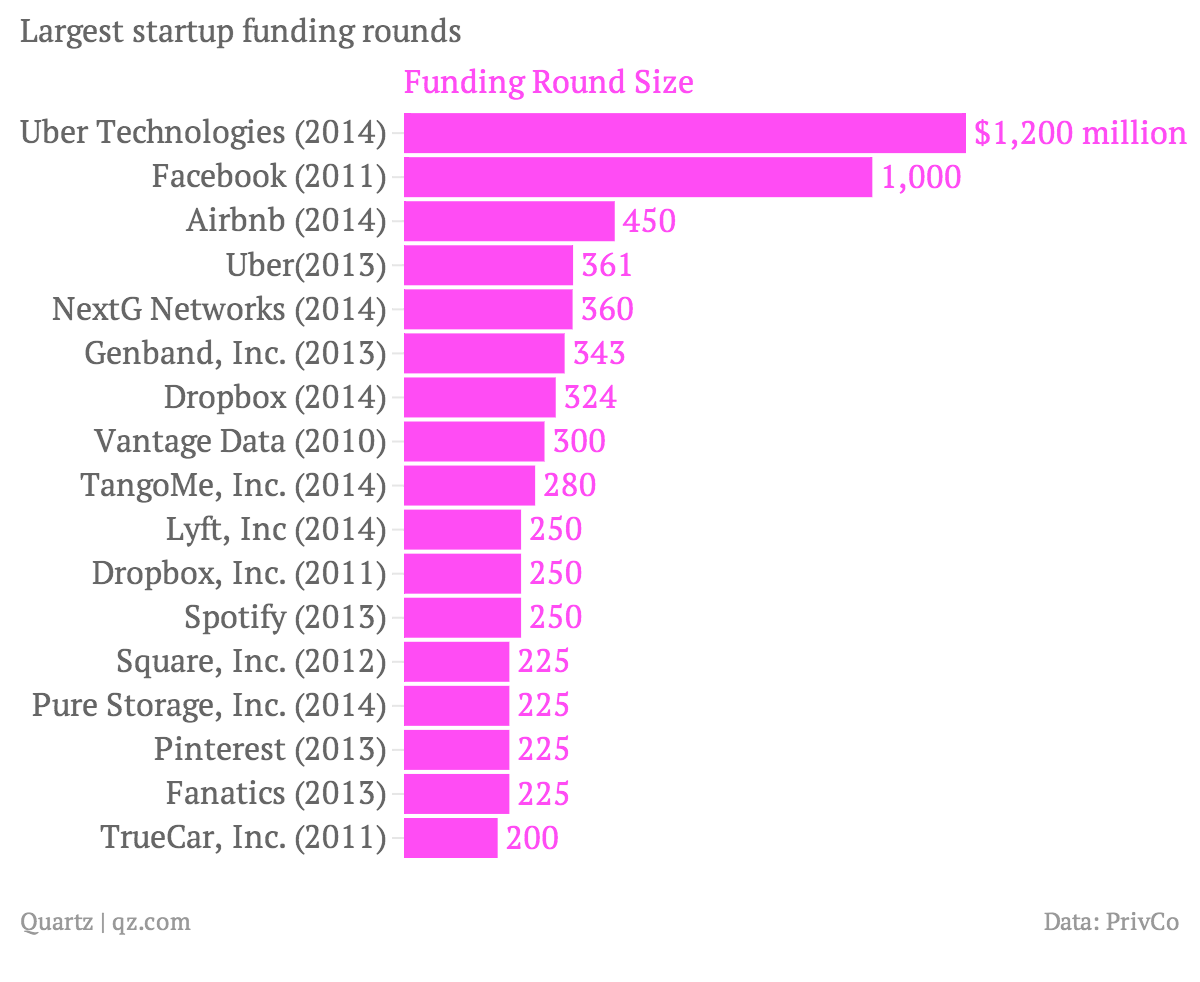
Uber’s latest funding round broke Facebook’s record:

Start Up Finding

Will Oremus comments:

[N]o one has the foggiest idea how much Uber will be worth once it matures. Anyone who tells you that he does is not to be trusted. Investors are looking at a company whose possible outcomes range from “the Amazon of the transportation industry” to “the Webvan of the 2010s.” (Amazon, in case you were wondering, has a market cap of about $150 billion.) They’re taking semieducated guesses that attempt to capture both the sky-high upside and the steep downside of its prospects. Less than a year ago, the guess was around $3.5 billion. Today it’s $17 billion. Welcome to Silicon Valley circa 2014.

Mark DeCambre’s take:

Bloomberg notes that, at $17 billion, Uber rivals the valuation of well-established, publicly traded companies such as car rental firm Hertz Global and retailer Best Buy. Critics aren’t necessarily buying Uber’s valuation. “Uber’s uber-valuation is a stretch given Uber’s numerous legal and regulatory challenges not fully discounted in Uber’s $17 billion valuation,” said PrivCo president Sam Hamadeh via email. Maybe Hamadeh has a point: Uber is said to be battling more than a dozen lawsuitsstemming state and local agencies aiming to limit the company’s car-sharing business. However, that hasn’t driven investors away.

Yglesias ponders Uber’s worth:

Right now, Uber is in a fight with Florida regulators and taxi incumbents. If Uber wins, it will poach market share from existing Miami-area cab companies. But it will do more than that. It will significantly increase the number of taxi rides that people in the Miami area take.

And that is the fundamental Uber value proposition. That by making it much easier to drive a cab to make money on the side (you just need a decent car and time on your hands) and much more convenient to hail a cab, you can greatly increase the size of the paid rides market.

Mark Rogowsky makes similar points:

So long as you look at Uber as a taxi replacement, you’ll see it as something less than it’s already becoming in its early markets: A transportation app. In San Francisco, for years the taxi commission didn’t want to issue more medallions for additional cabs because there was ostensibly no real demand for them (As of last year, the city had 1,600 taxi medallions). Yet just 4 years after Uber’s launch, there are often well over 1,000 rideshare vehicles on the road during peak times.

Wait, what? Surely all those additional cars aren’t making any money, right? Actually, they are. In fact, demand is so strong Uber is guaranteeing drivers $40 an hour in gross fares throughout the summer during prime time (the company takes a 20% commission and $1 per ride for insurance, so drivers make less than the nominal amount — but typically far more than they would driving a taxi).

Will Global Warming Defeat Us?

Last week, Ezra listed reasons he expects America to lose the battle against climate change. In a follow-up, he adds another cause for pessimism:

States like Kentucky and Montana and West Virginia care much more about pulling fossil fuels out of the ground than other states care about keeping them in the ground. And the American political system, which makes action hard under any circumstances, cares much more about the strong objections of individual states than the weak preferences of the country.

As I wrote in the original piece, “if you were going to weaponize an issue to take advantage of the weak points in the American political system – to highlight all the blind spots, dysfunctions, and irrationalities – you would create climate change. And then you would stand back and watch the world burn.”

In response, Plumer insists climate change is still worth fighting:

Different models have different estimates for how costly global warming will be. But everyone agrees on the general point — risks and damages keep piling up as the world gets hotter. So if the world can’t prevent 2°C of warming, it’s still a good idea to try and avoid 3°C of warming. If we can’t avoid 3°C of warming, it’s still a good idea to avoid 4°C. And so on. …

Setting hard boundaries — and framing things in terms of success and failure — is a much more intuitive way to think about the issue. (I’ve been guilty of this sort of talk myself.) But it doesn’t really make sense to declare “game over” at any point.

Ronald Bailey wonders about international cooperation:

International climate negotiations are somewhat similar to the prisoner’s dilemma. Assuming man-made global warming is costly to all countries, the optimum solution is for all countries to cut their greenhouse gas emissions. But for an individual country, the better option is to keep burning low-cost fossil fuels while other nations reduce their emissions. Since all countries recognize that other countries are likely to cheat and continue to use fossil fuels, they all fail to cut their emissions.

Is there a way out of that dynamic? Two political scientists, Scott Barrett of Columbia and Astrid Dannenberg of Princeton, tried to find one in a 2013 study using game theory experiments. They concluded that if game players know for sure where the threshold for huge losses is located, they will cooperate to avoid it. The catastrophe threshold acts a form of punishment that encourages cooperation.

However, the experiments showed that “when the threshold for catastrophe was even slightly indeterminate, the players crossed essentially every time”:

The current uncertainties about the effects and intensity of future climate change suggest that countries are unlikely to follow the Obama administration’s lead. Based on their experimental results, Barrett and Dannenberg hold out the hope that climate research that reduces threshold uncertainty might help spur countries into mutual cuts of their greenhouse gas emissions.

Passing The Turing Test

Dante D’Orazio takes note of this weekend’s big news out of London:

Eugene Goostman seems like a typical 13-year-old Ukrainian boy – at least, that’s what a third of judges at a Turing Test competition this Saturday thought. Goostman says that he likes hamburgers and candy and that his father is a gynecologist, but it’s all a lie. This boy is a program created by computer engineers led by Russian Vladimir Veselov and Ukrainian Eugene Demchenko.

That a third of judges were convinced that Goostman was a human is significant – at least 30 percent of judges must be swayed for a computer to pass the famous Turing Test. The test, created by legendary computer scientist Alan Turing in 1950, was designed to answer the question “Can machines think?” and is a well-known staple of artificial intelligence studies. Goostman passed the test at the Turing Test 2014 competition in London on Saturday, and the event’s organizers at the University of Reading say it’s the first computer to succeed.

Kabir Chibber looks back to Turing’s exact prediction:

He said in 1950:

I believe that in about 50 years’ time it will be possible to program computers… to make them play the imitation game so well that an average interrogator will not have more than 70 percent chance of making the right identification after five minutes of questioning.

While this didn’t happen by the year 2000, it seems Turing was off by only 14 years.

Nathan Mattise has more on this weekend’s breakthrough:

Eugene was one of five supercomputers tackling the challenge at this weekend’s event, held precisely 60 years after Turing’s death on June 7, 1954. It was designed by a team in Saint Petersburg, Russia, led by creator Vladimir Veselov (who was born in Russia and now lives in the US). An earlier version of Eugene is hosted online for anyone to interact with, according to The Independent (though with interest understandably high right now, we’ve been unable to access it).

“Eugene was ‘born’ in 2001. Our main idea was that he can claim that he knows anything, but his age also makes it perfectly reasonable that he doesn’t know everything,” Veselov said according to the event press release. “We spent a lot of time developing a character with a believable personality. This year we improved the ‘dialog controller’ which makes the conversation far more human-like when compared to programs that just answer questions. Going forward we plan to make Eugene smarter and continue working on improving what we refer to as ‘conversation logic.'”

Polly Mosendz suggests Goostman wouldn’t have passed the test if he weren’t a teenbot:

Developer Veselov explained that, “Our main idea was that he can claim that he knows anything, but his age also makes it perfectly reasonable that he doesn’t know everything.” So if the judges asked him something he was not programmed to know, judges might write that off as a factor of his age instead of his lack of humanity.

Pranav Dixit comments that “a chatbot successfully pretending to be a 13-year-old boy for whom English is a second language ain’t exactly Hal 9000,” but calls the event “an obviously exciting breakthrough.” Robert T. Gonzalez and George Dvorsky elaborate:

The chatbot is not thinking in the cognitive sense; it’s a sophisticated simulator of human conversation run by scripts. In other words, this is far from the milestone it’s been made out to be. That said, it is important, because it supports the idea that we have entered an era in which it will become increasingly difficult to discern chatbots from real humans.

“Having a computer that can trick a human into thinking that someone, or even something, is a person we trust is a wake-up call to cybercrime [and the] Turing Test is a vital tool for combatting that threat,” said competition organizer Kevin Warwick on the subject of the test’s implications for modern society. “It is important to understand more fully how online, real-time communication of this type can influence an individual human in such a way that they are fooled into believing something is true…when in fact it is not.”

Update from a reader:

This chatbot absolutely did NOT pass the Turing test – not even close. Nor is it a breakthrough in any technical or conceptual sense. “Passing the Turing test” does not mean fooling more than 30% of judges within 5 minutes – that’s just what Turing thought might be possible by 2000. Passing the Turing test means fooling a capable judge after an extended, thorough interrogation.

As hilariously demonstrated by MIT computer scientist Scott Aaronson, this chatbot cannot even tell you whether a shoebox is bigger than Mt Everest, or how many legs a camel has.

Another passes along this article, which “pretty much blows all the claims out of the water – and makes clear the whole thing was a PR stunt by a “scientist” who specializes in PR stunts.”