An Accounting Of American Racism, Ctd

Last week, in response to Ta-Nehisi’s cover-story, Frum laid out why he sees reparations as unworkable:

Affirmative action’s quirks and injustices are notorious. But they will be nothing compared to the strange consequences of a reparations program. Not all black people are poor. Not all non-black people are rich. Does Oprah have a housecleaner? Who changes the diapers of Beyonce’s baby? Who files Herman J. Russell’s taxes? Will their wages be taxed and the proceeds redirected to their employers?

Within the target population, will all receive the same? Same per person, or same per family? Or will there be adjustment for need? How will need be measured? Will convicted criminals be eligible? If not, the program will exclude perhaps one million African Americans. If yes, the program would potentially tax victims of rape and families of the murdered for the benefit of their assailants.

TNC pushes back:

The problem of reparations has never been practicality.

It has always been the awesome ghosts of history. A fear of ghosts has sometimes occupied the pages of the magazine for which David and I now write. In other times banishment has been our priority. The mature citizen, the hard student, is now called to choose between finding a reason to confront the past, or finding more reasons to hide from it. David thinks HR-40 commits us to a solution. He is correct. The solution is to study. I submit his own article as proof of why such study is so deeply needed.

Frum goes another round:

Ta-Nehisi does not wish to deal with fine details of who pays, who receives, how much, and on what basis. First we are to agree to his proposal. Only then will he tell us what the proposal is. But it seems to me the time to discuss an idea is before it becomes law, not after.

Especially since, in this case, the reparations idea actually distracts from understanding—and overcoming—the continuing disadvantages of black America. By Ta-Nehisi’s own telling, for example, his protagonist Clyde Ross was a victim not only of housing discrimination, but also of Ross’s lack of financial sophistication.

Taking the conversation in another direction, Matt Fletcher spotlights the difference between African Americans and Native Americans when it comes to the idea of reparations:

Tribal fights for hunting and fishing rights, education, sacred sites, and natural resources are all rooted in self-determination. When tribes settle claims against federal and state governments, the funds invariably go toward governance. Even Indian gaming, which many people think of as a form of reparations, grows out of tribal government activity, and Congress has mandated that gaming profits be spent on governance.

America’s moral debts to African-Americans and American Indians are shockingly deep and wide. African Americans point to slavery, Black Codes, Jim Crow, and redlining. And American Indians point to land and resources theft, boarding schools, and cultural and religious persecution. But while African-Americans eye individual payments, Indian tribes seek control over lands and natural resources taken from them by the United States and state governments. The advantage in the tribal strategy is to make Uncle Sam the bad guy. African-American strategists should take note.

Previous Dish on the reparations discussion hereherehere, and here.

Compassion For Pedophiles, Ctd

A reader emails using “not my real name, of course”:

I was thankful to see you mention the recent “This American Life” episode on non-offending pedophiles. I’m a long-time Dish reader. I’m also a pedophile. And like many others who are attracted to children, I have never acted on my attractions, and am committed to never doing so.

I’d also like to make you aware of an online resource for pedophiles who are committed to abstaining from sexual contact with minors: Virtuous Pedophiles. We provide information and a list of resources, and an online support group for those who believe that sexual contact with children is always wrong. Thanks for raising awareness of the issue.

The intro message from Virtuous Pedophiles sums up the predicament:

We do not choose to be attracted to children, and we cannot make that attraction go away.

But we can resist the temptation to abuse children sexually, and many of us present no danger to children whatsoever. Yet we are despised for having a sexual attraction that we did not choose, cannot change, and successfully resist. This hatred has its consequences; many of us suffer from depression and sometimes even commit suicide. Paradoxically, the hatred actually increases the risk of child sexual abuse by making us afraid to admit our condition to others, thus discouraging us from seeking treatment. More of us could lead productive, happy, law-abiding lives if we could open up to people who would treat us not as monsters but as human beings with an unfortunate burden to bear.

Another reader adds:

I have provided psychiatric care for similar men. Supporting pedophiles in not acting on their attraction helps these men and helps prevent victimization of children. In Sweden, there is a helpline called PrevenTell, which provides phone counseling and referrals for help for pedophiles to not act on their attraction.  It is a program of the Karolinska University Hospital in Stockholm, under the leadership of sexologist Katarina Görts Öberg. But even in Sweden, funding for such programs is a challenge.

Perhaps if we had more funding and support for non-practicing pedophiles at a young age, when they are most treatable, not as many of them would enter, say, the priesthood and become non-non-practicing.

Marriage And the Pursuit of Happiness

One of the epiphanies I had a long time ago when thinking about the question of marriage equality was upon reading a passage from Hannah Arendt in Dissent in 1958. I’ve cited it a few times over the years on the Dish, but its core point is worth revisiting:

Even political rights, like the right to vote, and nearly all other rights enumerated in the Constitution, are secondary to the inalienable human rights to ‘life, liberty and the pursuit of happiness’ proclaimed in the Declaration of Independence; and to this category the right to home and marriage unquestionably belongs.

In my old 1990s stump speech that I gave at countless colleges and bookstores and fundraisers, I used to end on that quote. The question was not really why gay people should seek the right to marry; the question was why a tiny minority of Americans had been excluded from one of the most basic rights of any American: the pursuit of happiness. I’d ask of the straight people in the crowd if they’d ever doubted that their right to the pursuit of happiness included the right to marry the person they loved. And the answer was: of course not. It was inconceivable that the pursuit of happiness could mean anything unless it included the institution most relevant to love and family and thereby happiness.

And so it’s particularly gratifying to see the ruling striking down Wisconsin’s ban on marriage equality rest on this core idea (with a few citations of yours truly). The question becomes one in which core notions of equality – rather than esoteric questions about social policy – are front and center. And this, remember, was precisely what many on the right were opposed to. But their insistence that the right to marry was not a civil right ultimately rested on the notion that gay people were somehow not citizens or were somehow incapable of the responsibilities of the institution. And that’s when their case began to fall apart – because Americans increasingly looked at their gay neighbors, family and friends and did not see them as somehow non-citizens or unable to love and be loved in a committed life-long marriage.

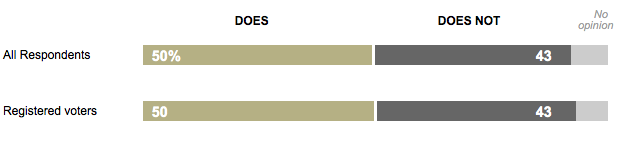
And so it’s not a surprise to me that a new poll from the WaPo has the following result for the question: “Regardless of your own preference on the issue, do you think that the part of the U.S. Constitution providing Americans with equal protection under the law does or does not give gays and lesbians the legal right to marry?”

Screen Shot 2014-06-09 at 1.39.10 PM

This is where we’re headed. Back in the 1990s, I kept that argument in speeches to rouse the base, as it were. I knew that putting it like that in print would be a reach. But in due course, the power of the point keeps growing. Either gay people are citizens or not. It’s really that simple. For any citizen in the US has the right to marry the person they love. The great mystery and tragedy is why it took us – gay and straight – so long to realize and internalize it.

Quote For The Day

“I think that we have found something horrible. At least one of the detainees was alive hours later than reported. He was left to die. First in the detainee clinic, where he lay unattended on a gurney with ropes tied around his neck. He was later found in an ambulance with faint vital signs because the ropes were still around his neck. When they cut the ropes off, his vital signs improved. But when he arrived at the hospital, he lay there while Camp Delta kept calling, asking if he were dead yet. And finally he died. This is more horrible than I could possibly have imagined,” – a student at Seton Hall University, on a FOIAed document from an internal military review of the conduct of guards one night in Gitmo, where three prisoners are said to have committed suicide simultaneously on June 9, 2006.

Dish readers may recall Scott Horton’s dissection of the military’s and DOJ’s assurances that somehow, three prisoners managed to elude 6a00d83451c45669e2014e8817f075970d-550wiguards and cameras and hang themselves in tandem in their cells on that night. (The story won the National Magazine Award for reporting in 2009.) The Alpha Block where their bodies were allegedly discovered was closely monitored, with guard checks of every cell required every 10 minutes. There were five guards for 28 prisoners. And yet the NCIS report found that the bodies were not discovered for two hours. How one of those prisoners was still alive thereafter – as shown in the new document in an eye-witness account from one of the medics – is yet another head-scratcher. So too is the absence of any disciplining of the negligent guards.

The story is not uncontroversial. Many investigative reporters looked into the story and didn’t find anything to contradict the Pentagon’s story and the conclusion of subsequent investigations. For skeptical takes, see Shafer and Koppelman. For a back-and-forth on the issue, see here.

But that an internal military investigation found testimony that clearly contradicts that version of events – a prisoner still breathing two hours after hanging himself and with the rope around his neck not fully cut – is clearly something worth examining. That this document was also filled out of order, and not included in the formal NCIS report is also suspect.

For me, the thing I cannot quite get my head around is why the prisoners were all found with a rag stuffed in their throats. The official line is that this was contrived by the prisoners who wrapped cloth around their faces to muffle any involuntary cries in the hanging. Somehow, they sucked those rags into their mouths during their deaths, further asphyxiating them. Seems more than a little strange to me. What else could explain it? Some have posited an experimental torture technique known as “dry-boarding”, in which rags are stuffed down throats until near-asphyxiation and then removed. If that torture technique went wrong, you can see how a hastily contrived “suicide” cover-story would have been an option. I really don’t know.

This is a complicated story – but when a key piece of evidence contradicting the Pentagon line gets mis-filed, and is discovered only in a mass review of FOIAed documents, I’m not inclined to take the Pentagon’s word for it. And on Gitmo and torture in general, I’ve come to see that the Pentagon just isn’t to be trusted. And neither, alas, is the Obama administration.

A Good Guy With Pepper Spray

A shooting last Thursday at Seattle Pacific University, a small evangelical Christian school, ended with only one death thanks to the courage of a student volunteer security guard:

The 26-year-old shooter, identified by Seattle’s KIRO-7 as Aaron Ybarra, was armed with a shotgun, a knife, and several rounds of ammunition. When Ybarra paused to reload, a student security guard pepper-sprayed him and pulled him onto the ground. Several other people held him down until the police arrived. As Seattle’s assistant police chief Paul McDonagh told reporters, “But for the terrific response of the people at Seattle Pacific University, this incident might have been much more tragic.”

The Internet thanked the hero, engineering student John Meis, by buying every item listed on his and his fiancée’s wedding registries and raising, as of this writing, over $48,000 for their honeymoon. But would Meis have stopped Ybarra sooner if he had been carrying a gun? Making a case for the virtues of gun restrictions on college campuses, Evan DeFilippis argues that the “good guy with a gun” theory isn’t backed by evidence:

Even if a student or professor were to confront a shooter, their chances of stopping a bad guy with a gun would be slim. This should be self-evident given that New York City Police, for instance, only hit their target in 18 percent of cases. The average student or professor would likely have a substantially lower hit rate, thereby increasing the threat to innocent bystanders.

20/20 segment, “If I Only Had a Gun,” showed just how hopeless the average person is in reacting effectively to high-stress situations. In the segment, students with varying levels of firearm experience were given hands-on police training exceeding the level required by half the states in order to obtain a concealed carry permit. Each of these students was subsequently exposed to a manufactured but realistic scenario in which, unbeknownst to them, a man entered their classroom and begin firing fake bullets at the lecturer and students. In each one of the cases, the reaction by the good guy with a gun was abysmal.

Sarah Posner interviews the Rev. Rob Schenck, an evangelical leader who has soured on the religious right’s “unholy alliance” with the NRA. This incident, he says, should wake up the evangelical community to America’s gun violence problem:

Evangelicals, Schenck said, “have been quiet and have not entered robustly into the discussion on the moral and ethical dimensions of firearms ownership and use. We need to have that.” He said he has met with pastors and other church leaders, offering advice on how to address these issues from the pulpit, and said he hopes pastors, Sunday schools, and other Christian education programs begin to teach on the “theological and moral implications” of gun ownership and use. He said he plans to give a formal address on the topic at the annual convention of the Evangelical Church Alliance, which he chairs, in Branson, Missouri in July. Through speaking engagements, private meetings with clergy and religious leaders, and press conferences in Washington and around the country, he hopes to “catalyze a national conversation with church leaders.”

Update from a reader:

Unfortunately, the “good guy with a gun” theory was just tested in Las Vegas. After killing two police officers:

The suspects then fled on foot to a nearby Wal-Mart, where Jerad Miller fired a single shot upon entering, police said. A patron at the store who carried a firearm confronted Jerad Miller, not realizing that he was accompanied by Amanda Miller, who shot and killed the man, police said. He was identified as 31-year-old Joseph Wilcox of Las Vegas.

“Joseph died trying to protect others,” Sheriff Doug Gillespie said.

Engaging The T, Ctd

It’s a very dangerous endeavor, as my old friend Dan Savage just found out. In talking about the evolution of his sex advice column in an off-the-record seminar at the University of Chicago, Dan referred to many terms he has used in the past, including the word “tranny” which he stopped using in 2011:

I talked about why the word was problematic, why some object to its use, where I see double standards, and the LGBT community’s long history of reclaiming hate words.

This was a hate crime, apparently:

During this part of the talk a student interrupted and asked me to stop using “the t-slur.” (I guess it’s not the t-word anymore. I missed the memo.) My use of it—even while talking about why I don’t use the word anymore, even while speaking of the queer 186162987-SDcommunity’s history of reclaiming hate words, even as I used other hate words—was potentially traumatizing.

I stated that I didn’t see a difference between saying “tranny” in this context and saying “t-slur.” Were I to say “t-slur” instead of “tranny,” everyone in the room would auto-translate “t-slur” to “tranny” in their own heads. Was there really much difference between me saying it and me forcing everyone in the room to say it quietly to themselves?  … I asked the student who objected if it was okay for me to use the words “dyke” and “sissy.” After a moment’s thought the student said I could use those words—permission granted—and that struck me a funny because I am not a lesbian nor am I particularly effeminate.

This student became so incensed by our refusal to say “How high?” when this student said “Jump!” that this student stormed out of the seminar. In tears. As one does when one doesn’t get one’s way. In college.

Yes, this occurred at the University of Chicago! Now, I’m not interested in defending Dan, because he can defend himself. And John Aravosis is right that there’s a potent and destructive strain in the LGBT world that aims more hate at someone like Dan Savage than at Rick Santorum (tell me about it). What I am interested in is condemning this pathetic excuse for a student. This plea in a university to be free of hearing things that might hurt, offend, traumatize or upset you is an attack on the very idea of education itself. And don’t get me started about “trigger warnings.” So many things worth thinking about, grappling with, and chewing over can be offensive at first or second blush. That’s what a real education is about: offending your pre-existing feelings and prejudices with reason and argument and sometimes provocation. Education is not and never should be about making you more comfortable and more safe within your current worldview. It should not be about accusing someone with whom you might disagree of a hate crime.

And the idea that trans people or gay people are those signing up for this mindless crap is particularly distressing.

Policing language is something no gay person should ever countenance – if only because our language and our speech, as tiny minorities, could be the first to be policed in that brave new world. And what does it say about someone’s self-esteem that they run crying out of a seminar because they cannot handle a simple fricking word (and that they do that, while preferring to be referred to as “it”!). I know life as a member of a sexual minority is not exactly an easy one. But what happened to self-empowerment? Whatever happened to the proud, fearless trans people fighting back against the cops at Stonewall? Whatever happened to the great tradition of flouting all sorts of public norms and parading down main street in full Pride regalia? Or the tradition of bawdy outrage perfected by generations of drag queens, gay satirists, cultural provocateurs, and performance artists whose goals often include the salutary impact of – precisely – offense?

All of this is to be buried in a ghastly, quivering, defensive crouch of affirming claptrap, with trans people whining to teacher that someone said a naughty word, and incapable of taking in even a completely benign discussion without collapsing into trauma and tears. There is only one word for this and it is pathetic. I’m all in favor of avoiding words that some people find distressing if at all possible. It can get in the way of an argument, or simple manners. But I am more in favor of free, bold and fearless speech and argument, in which every t and l and g and b can give as good as they get, and in which this sad and pathetic recourse to fathomless victimology is called out for the disgrace it is. It is entirely self-defeating. No one else can give you the self-respect you may want. No one else’s words have any more power over you than you decide to give to them.

When you think of the courage so many trans people have demonstrated over the decades and centuries, when you think of all the brilliant, funny and sharp ways in which trans people have described their world and ours over the years, this craven emotional blackmail and language monitoring is particularly tough to take. It is not some kind of high-point for gay maturity and tolerance. It’s a sad and tawdry failure to live up to the heroes and heroines – and standards – of the past.

Book Club: How Do You Look At Your World Differently Now?

Maria Popova, the host of our second Book Club, starts the discussion by posing a challenge to readers:

“Reality,” Philip K. Dick wrote, “is that which, when you stop believing in it, doesn’t go horowitz-onlookingaway.” There are two reasons I chose Alexandra Horowitz’s On Looking: Eleven Walks with Expert Eyes for the Dish book club. Besides being a masterwork of storytelling bridging science and everyday life, it also reminds us – subtly, elegantly, yet unequivocally – that what we call “reality” is a highly edited picture of the world, projected through the lens of our beliefs, our biases, our baggage, and our experientially conditioned selective attention. It’s a point especially poignant today as we go through our lives worshiping at the altar of productivity, often at the expense of presence. After all, as Annie Dillard put it, “how we spend our days is, of course, how we spend our lives.” And under the modern condition, we spend the overwhelming bulk of them in the trance of our routines, showing up for our daily lives but being, in a rather significant way, absent from them – the very tendency against which Alan Watts admonished half a century ago when he began popularizing Eastern philosophy in the West.

What Horowitz does is peel back precisely those cognitive curtains that obscure from view the richness of our everyday reality. When I first wrote about On Looking last fall, I knew it was the kind of book that stays with you for a lifetime, but this awareness was rooted mostly in intellectual appreciation. I didn’t anticipate just how profoundly those eleven perspectives bookclub-beagle-trwould change the way I experience and inhabit my day-to-day life, from the parallel-universe ecosystem of wildlife in my tiny backyard to the remarkable invisible choreography of swiftly navigating a crowded New York City sidewalk while a hundred strangers do just the same.

Perhaps the greatest gift of a book club is that we get to share our private realities around a common point of interest – the book – and in the process enrich the collective experience. With that in mind, what is one facet of your day or aspect of your usual daily routine – your apartment, your commute, your dog walk route – that On Looking helped you see with new eyes?

Email your personal observations – and photos when relevant – to bookclub@andrewsullivan.com and we’ll pick the most interesting ones to post. And we’ll be discussing On Looking for up to the whole month of June, so you still have plenty of time to buy the book and join the conversation. Also, if you haven’t already, check out Maria’s inimitable blog, Brain Pickings, and subscribe to it here if you like what you read.

“Traditional Masculinity Has To Die” Ctd

A reader quotes me:

And that’s why I have a core objection to the attempt to abolish what makes men different. In many ways, it’s an attack on our nature, a position of extreme prejudice against the essence of maleness.

But here’s the problem. Earlier you graciously acknowledged that both men and women can have high levels of testosterone. I will take it as read that you also acknowledge that not all men have equally high levels. Some of us don’t find it a particularly noticeable or bothersome thing at all. And yet, just a few paragraphs later, it’s now the essence of maleness. Leaving the women with high testosterone and the men with low levels … where, exactly?

Still miles apart. Testosterone in women varies from 15 – 70 ng/dL; for men, 270 – 1,070 ng/dL.  So the most testosteroned woman still has a fifth of the lowest-testosterone male. It matters. Another reader:

As a transman who has been on hormones for years now, I’m unconvinced by your claims that male aggression is natural.

Testosterone does not make you aggressive. As a person who is on a very stable, natural-male-level of testosterone, and as someone who has read extensively about people in similar circumstances, I can say testosterone itself does not make a person aggressive. Testosterone can give someone a great deal of energy, which they are conditioned to express as aggression. To me, this is the heart of the issue. Men are taught that the way to express their energy and need for (often physical) release is through aggression, but there are other ways to express this drive without engaging other people in a violent or harmful way.

To me, there is a difference between drive, competition and aggression. The first two come from an internal sense of seeking validation for self-expectations, such as “I want to be able to climb that mountain or build that pipe system” or “I want to feel proud of my hard work by winning”. Aggression itself is lashing out in a violent way, either verbally or physically, toward another person. Transitioning has led me to believe there are a few fundamental ways of processing emotions, as well as other biological responses, but testosterone doesn’t make people aggressive. We just don’t give testosterone-based-lifeforms many other ways to deal with a unique core self that says, “Go do something!”

Well, yes, men do have the capacity to channel testosterone away from violence and aggression. It can be much more benign. But there’s a reason that men vastly outnumber women in rates of assault, murder and general violence and the answer is testosterone, not sexist discrimination by law enforcement. And a new study on our evolutionary origins also adds a fascinating nugget:

A new theory suggests that our male ancestors evolved beefy facial features as a defence against fist fights. The bones most commonly broken in human punch-ups also gained the most strength in early “hominin” evolution. They are also the bones that show most divergence between males and females. The paper, in the journal Biological Reviews, argues that the reinforcements evolved amid fighting over females and resources, suggesting that violence drove key evolutionary changes … “In humans and in great apes in general… it’s males that are most likely to get into fights, and it’s also males that are most likely to get injured,” he told BBC News.

Interestingly, the evolutionary descendents of the australopiths – including humans – have displayed less and less facial buttressing. This is consistent, according to Prof Carrier, with a decreasing need for protection: “Our arms and upper body are not nearly as strong as they were in the australopiths,” he explained. “There’s a temporal correlation.” The facial buttressing idea builds on a previous observation by Prof Carrier and Dr Morgan that the early hominins were the first primates to evolve a hand shape compatible with making a fist – and thus, throwing a punch.

To see what is in front of one’s nose …

(Video of the marsupial mouse called antechinus further explained here.)

Congratulations, We’re Finally Back To Square One

Jobs-Recovery.jpg

Matt O’Brien sums up the good and bad news from Friday’s jobs report:

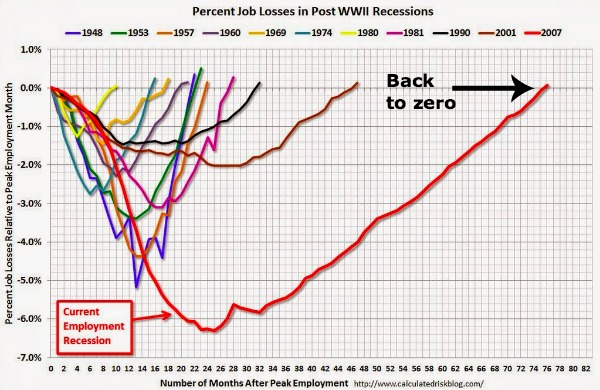
The economy added 217,000 jobs in May, and the previous two months’ reports were only revised down by 6,000. That was enough to keep the unemployment rate flat at 6.3 percent, which, as Phil Izzo points out, is better news than it sounds like since economists expected it to go back up after a fluky drop last month. … Even though we’ve gotten out of the hole from the recession, we still haven’t gotten out of the hole from our too-weak recovery. That is, there’s still a big jobs gap, and it’s going to take a long time to fill.

John Cassidy’s take:

These figures can be interpreted in a number of ways.

To me, they show that the expansionary monetary and fiscal policies enacted during the recession did what they were intended to do, and got the economy back on track. On the White House blog, Jason Furman, the chairman of the Council of Economic Advisers, pointed out that “the private sector has added 9.4 million jobs over 51 months of straight job growth.” On a monthly basis, that translates into an increase of about a hundred and eighty-five thousand jobs, which is a decent number, especially since it has been sustained for more than four years.

That’s the good news. The bad news is that for the American economy, whose leitmotif is expansion, to go for six and a half years without any net job growth is something we haven’t seen in eighty years. The only comparable period on record is the Great Depression.

Neil Irwin asks when we can hope to return to full employment. Turns out it’s not a simple question:

Economists think the nation is at full employment when the unemployment rate is something like 5.5 percent (it can’t fall too much lower because some people are always between jobs, and if it falls too low inflation will result). That would imply 1.24 million of the people who are currently unemployed finding themselves with a job. But that number is too simplistic — it implies a static system with the labor force consisting only of the people who were in it in May.

In reality, the labor force remains a good bit smaller than you would expect it to be given demographic trends. Presumably, if unemployment keeps falling, employers keep hiring, and worker pay starts to rise, at some point some of those people will decide they want a job after all. But it is hard to know just how big this shadow work force is. How many of the 61-year-olds who gave up looking for a job in the last few years are going to return to the labor force when they smell opportunity, and how many have retired for good?

Adam Ozimek presents a counter-chart to the one above and argues that, for a recession spurred by a financial crisis, this one actually wasn’t that bad:

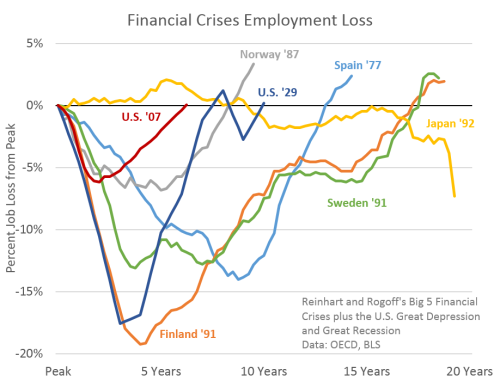
other-financial-crisis-e1402162937800[Past American recessions] is not the only relevant comparison. We can also compare the current recovery to other major financial crises. The graph [to the right], from Josh Lehner, shows that in this light the U.S. recover actually doesn’t look so bad.

So which comparison is correct? Given that this recession included a serious financial panic, I’m not sure we learn much from comparing it to, say, the Volcker recession of 1980 that resulted from the attempt to reign in inflation. The comparison to other financial crises is more relevant to understand just how bad things could have been. However, simply showing that it could have been worse does not prove that policymakers could not have done better. Indeed, it would be tough for any simple comparison of recessions to show this. For that you need to take a much closer and more careful examination. But as far as these simple comparisons go, I believe it is more accurate to compare to other financial crises than to compare to other U.S. recessions.

Ben Casselman spots a bit of good news about the quality of the jobs being created:

One of the persistent concerns about the recovery has been not just that job growth has been weak, but that many of the jobs that are being created are low-wage and part-time. But as the job market strengthens, that trend may at last be reversing. Average hourly earnings rose by 5 cents in May and are up nearly 50 cents over the past year, representing a 2.1 percent growth rate. That’s far from spectacular, but it’s faster than the rate of inflation and it’s an improvement from earlier in the recovery. Meanwhile, full-time employment is up by more than 2.4 million in the past year, while part-time employment is down by 500,000. The picture isn’t entirely rosy, however. There are still more than 7 million people working part time because they can’t find full-time jobs. And 14,000 of the jobs created in May were temporary jobs, continuing a long-running shift toward temporary employment during the recovery.

One thing holding back overall job growth, David Leonhardt remarks, is that public sector employment remains severely depressed:

In fact, public-sector employment has barely begun to recover. It reached a recent low of 21.83 million jobs in December and now has 21.87 jobs. Many state and local governments cut jobs sharply to deal with budget deficits during the recession. The federal government also employs somewhat fewer people than it did in December 2007. … If the government hadn’t done so much cutting over the last several years, the job market would almost certainly be healthier today.

“This has never happened before in recent history,” Drum observes:

[Government] employment rose during the Reagan recovery. It rose during the Clinton recovery. It rose during the Bush recovery. And that’s one of the reasons those recoveries were fairly strong. Only during the Obama recovery did austerity fever force government employment to fall. It’s not the only reason this recovery has been so weak, but it’s certainly one of the leading causes.