The Clinton-Obama Alliance

Scheiber’s onto something about Hillary’s new book:

[E]ven as Clinton’s book lays out a variety of dissents she will no doubt invoke when taking flak from Jeb Bush, for the moment she’s still far more interested in bucking up Obama than in distancing herself. Look no further than her emphatic comments on the release of Afghanistan POW Bowe Bergdahl. (“It doesn’t matter” how he was captured, she told ABC’s Diane Sawyer, “we bring our people home.”) The stand seemed to signal her posture of choice during the forthcoming book tour, and it was certainly welcome in the White House.

As for the president, as annoying as it must be to have the most popular Democrat in the country distance herself from his foreign-policy B-sides, the broader arrangement still beats any plausible alternative. Consider: If not for the way Hillary’s proto-campaign has frozen the Democratic presidential field, there would already be half-a-dozen Democratic governors and senators trooping through Iowa, complaining to anyone who will listen that Obama still hasn’t closed Guantanamo, arrested any Wall Street bankers, or brought the NSA to heel. “Put aside that she may or may not share all his positions,” says the Obama campaign adviser. “The fact that no one is doing that is a great thing for him.”

Since this is Hillary week, here are a couple of suggestions I’d make for getting queasy Obamaites like me off the fence. The first, especially in the next year or so, is an indication that while Clinton will obviously be different than Obama, in a few key respects, she will be vital to his legacy. In other words, a Clinton campaign in 2016 would not be zero-sum, as Obama’s was in 2008. It would be both an expression of support for Clinton but also for Obama.

I see her potential victory as confirming two big Obama-era shifts: universal healthcare and a less reactionary Supreme Court. In those two areas, Clinton would entrench Obama’s achievements, the way George H.W. Bush did Reagan’s. Of course, Obama is highly unlikely to end his two terms with Reagan’s ratings, so this will not be easy. On the other hand, it makes Clinton’s task as president less of an onerous one. She will not have to grapple, as Bush did, with matching his superstar predecessor, and also being vulnerable with the base. She has a superstar mantle herself – the first woman president – and an extraordinarily wide base of support in the grass roots. She’s right, in other words, not to run against Obama. If she’s canny, she’ll use him as well as he used her in 2008.

The other word of advice to Clinton would be to emphasize the Thatcher-like aspects of being a woman leader.

That means embracing her age and maturity, not running from it. It means plenty of photo-ops with the military – there’s nothing like a woman leading a bunch of soldiers to tap deep wells of emotion in the human psyche. The general theme would be “tough old broad”. And I mean that entirely as a compliment. America is not yet fully comfortable with female leadership, especially in a commander-in-chief. The way to square that is not to minimize her feminine charms but to add a drop-shadow of steeliness and toughness. She has both already. She just needs a few, carefully chosen moments of snarl.

I guess I’m saying that I’d be best charmed by a version of Obama’s and Thatcher’s heir. First, Obama’s heir with the base. Second, Thatcher’s heir with the country at large. Yeah, I know. I’m a parish of one. But I bet you I wouldn’t be the only one susceptible to one or both of these themes in the middle of the country. And Clinton could do worse than launch her campaign in those Southern Appalachian states where she made her last stand in the primaries of 2008 and began to find a clearer and more authentic voice. We need a rough, tough Hillary. And not too polished a pol.

The Long And Winding Road To Closing Gitmo

Max Fisher tackles the notion that Obama can or should use the executive powers he flexed in the Bergdahl deal as an end-run around Congress to shutter Gitmo. The debate, which the Dish has covered here and here, hinges on how we categorize the facility’s 149 remaining detainees:

If the US categorizes them strictly as combatants in a war, then while that gives the US authority to hold them for the duration of war, the United States’ war in Afghanistan is legally ending in 2014, which means Obama would legally have to release most or all detainees at that time. It would also mean that he’d need to try them in a military tribunal to have detained them in the first place, which in many cases he did not do for lack of admissible evidence. But if the US categorizes the detainees as terrorists, while that gives the US legal license to hold them far beyond 2014, the US would need to convict them in a civilian courtroom first.

So why can’t the president exploit that ambiguity to release the rest of the detainees, like he did with the five we traded for Bergdahl? One reason is the question of where they would go:

The US cannot legally take these detainees, most of whom are not Afghan nationals, and simply drop them off by the side of a random road in Kabul, like a family pet that bit the baby. So the Obama administration has to try to find a third country that will accept them. This is why, for example, it wrangled Bermuda into accepting a handful of Chinese detainees whom China had refused to take back.

Were Obama to declare all of the Gitmo detainees to be legal enemy combatants, he would make these problems harder to solve, not easier.

It’s one thing for the US State Department to call up the Bermudan foreign ministry and ask them to accept some Chinese detainees whom the US insists are harmless; it’s quite another to ask Bermuda to accept people whom we legally designate as active fighters in an ongoing war. Even if Obama decided it were worth the risk to jump dump the entire population of Guantanamo into the Taliban’s hands, it’s not at all clear that even the Taliban would accept the detainees, not all of whom fought with the group.

Drum’s takeaway from Fisher’s analysis is that “Obama is not going to close Guantanamo,” ever:

The legal loophole he used in the Bergdahl prisoner exchange—no matter what you think of it—flatly wouldn’t apply to shutting down the entire prison. Plus there’s the fact that Congress would go ballistic if he tried—including plenty of Democrats. Impeachment would go from a fever dream of the tea-party right to a very realistic bipartisan possibility.

Finally, there’s frankly never been much evidence that Obama cares all that much. He’d obviously like to shut down Guantanamo, but he just doesn’t feel that strongly about it.

So give it up. Guantanamo will be here through the end of Obama’s presidency, and quite possibly until its last prisoner dies. It’s fanciful to think anything else.

But Matt Welch insists that Obama can and should do his darnedest to shut it down:

When it comes to terrorism, apples-to-apples rates of recidivism may not be possible—all it takes is one murderous nutbag to kill scores of people, the “worst of the worst” are probably going to be worse than the first ones released, and it’s important to be clear-eyed about the risk here. But one risk that rarely gets mentioned by War on Terror hawks is the (to my mind) equal certainty that other people around the world will be inspired by the existence of America’s Kafkaesque prison to commit murder against Americans. Put another way, we will be able to “see” acts of terrorism committed by those who are sprung from Gitmo, but the “unseen” acts of terror that are partly motivated by the U.S. conducting itself as a superpower above the law are no less real.

It’s a messed-up paradox, and one of Republicans‘ making. Maybe next time we’ll think a bit more through the problem of snatching and torturing people and then realizing that such treatment makes them damnably hard to stand even military tribunals.

Frank Goldsmith – a lawyer who has represented five detainees, including one of the Taliban members traded for Bergdahl – stresses how few of these “terrorists” have ever been successfully charged with crimes:

In the cases of the Guantánamo detainees, we lawyers cannot discuss the specific facts publicly, because we were required to trade our free speech for access to the classified evidence necessary to represent our clients. But it is telling that after over a dozen years of detention, the government has managed to charge, try, and convict only a handful – fewer than ten – of the 779 men it brought to the base.

Five were convicted of minor charges (some that were not even crimes at the time of their detention) and have been released. One of the convictions was overturned on appeal; other appeals remain pending. This is not a record of ringing prosecutorial success. Of the five men I represented, including the Taliban political official just sent to Qatar, none was ever charged with even the most minor crime; they were simply held for years without charges until it pleased the government to send them back. Where is the evidence that they are terrorists?

About half of the 149 men still left at Guantánamo have long been determined not to be a threat and have been approved for transfer; the only impediments to their release are political.

Here’s my fear: that 2009 represented the high watermark for closing this obscenity down. A newly-elected president had a clear mandate to do it and yet the Congress simply vetoed it, with strong public support. Blaming Obama for that seems absurd to me. The sad truth is that Americans are perfectly fine with detaining innocent people indefinitely, if they have beards and funny names, and have no interest in sustaining democratic norms if it means one life lost to terrorism. The whole edifice of Western justice went out the window with one terror attack and because one major political party, the GOP, is only too willing to use this fear for political dividends, it will not be put back together again. We will, in fact, be lucky if a future Republican president doesn’t restore torture as a legal form of statecraft.

Does this lead me to despair? Well, not far off. We have learned a lot about this country these past few years. Gitmo – a torture and detention camp outside any norms of Western justice – is now a symbol of America across the world. It is our 21st Century city on a hill. It is, in many ways, an emblem of the death of America as an ideal. And one political party made that happen.

It’s, Like, Thoughtful

A study indicates that speech tics like “uh,” “um,” and “like” are, rather than blights on the English language, markers of increased conscientiousness:

Charlyn Laserna and her colleagues used recordings of everyday speech collected from hundreds of participants in earlier studies performed between 2003 and 2013. They specifically looked at utterances of uhum (known as “filled pauses”) and I meanyou know, and like (known as “discourse markers”). … Discourse markers were also used more frequently by people with a more conscientious personality. Uhs and ums became less common with age, but their use was not related to gender or personality. This last point is somewhat surprising since such hesitations are often assumed to be a sign of anxiety.

Why should use of phrases such as “like” and “you know” be related to conscientiousness? One possibility is that this is a false positive result – the researchers performed multiple comparisons looking for links between personality and word use, and this is known to increase the risk of spurious findings. However, assuming the finding is reliable, the researchers believe the explanation is that “conscientious people are generally more thoughtful and aware of themselves and their surroundings,” and their use of discourse markers shows they have a “desire to share or rephrase opinions to recipients.” Stated slightly differently, discourse fillers are a sign of more considered speech, and so it makes sense that conscientious people use them more often.

The Camera Reinvents You

05-misleading-first-impressions-2.w1120.h1120

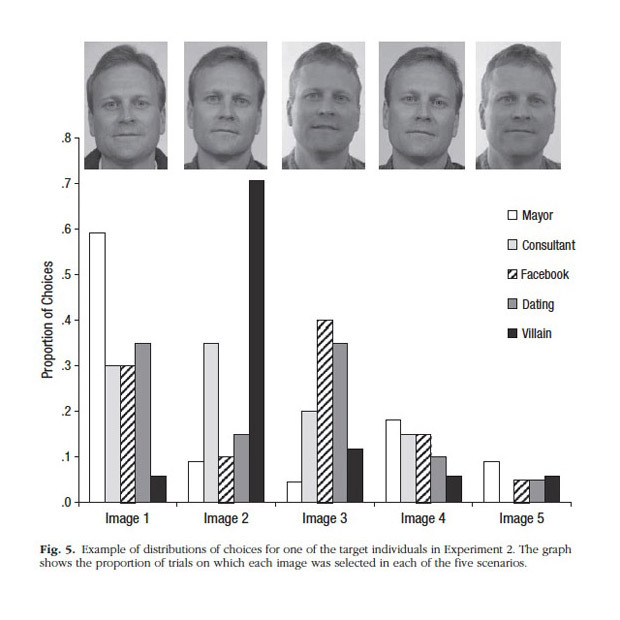
Jesse Singal flags a study that shows how the slightest differences between two photos of the same person can dramatically influence how people perceive them:

In … one of the study’s experiments, subjects were told they were choosing a photo to be used on a résumé for a high-salary position, a dating website, Facebook, a mayoral campaign poster, or a headshot for the role of a villain in a film. They were then given five photos of the same individual and asked which one would be best for the task at hand. … Look at Image 2 and Image 4. They’re almost identical, and yet just about everyone saw the former and said, “Yep, villain,” while hardly anyone said that of the latter.

So maybe we’re right to obsess over our profile pictures after all:

So what should you keep in mind when you’re choosing which photos to use for your various social-media personalities? The researchers didn’t really get into it in this study, but on the dating-site front, at least, there’s some surprisingly substantive (and entertaining) data-mining research on the subject over at OKCupid.

The Dish covered those OKC findings here.

Disabled But Not Despairing

Tom Shakespeare offers suggestions for better understanding the “disability paradox,” the raft of survey findings revealing that people with disabilities “consistently report a quality of life as good as, or sometimes even better than, that of non-disabled people”:

To start with, we can offer more nuanced accounts of the psychological processes that go on in the mind of a person with disability. Adaptation means finding another way to do something. For example, the paralysed person might wheel, rather than walk, to, places. Coping is when people gradually re-define their expectations about functioning. They decide that a stroll of half a mile is fine, whereas previously they would only have been content with a 10-mile ramble. Accommodation is when someone learns to value other things – they decide that rather than going for walks in the country with friends, it’s far more important to be able to go to great restaurants with them. This teaches us an important lesson – human beings are capable of adapting to almost any situation, finding satisfaction in the smaller things they can achieve, and deriving happiness from their relationships with family and friends, even in the absence of other triumphs.

Our appraisal of life with impairment may have less to do with reality than with fear and ignorance and prejudice. We wrongly assume that difficulties for people result in misery for people.

The Known Unknowns About Bowe Bergdahl, Ctd

Was he actually a bit of a gung-ho warrior? As I noted last night, further reporting keeps complicating the Palinite meme:

To many of those soldiers, Sergeant Bergdahl was viewed as standoffish or eccentric, smoking a pipe instead of spitting tobacco, as so many soldiers do, and reading voraciously when others napped or watched videos. But he was not isolated from his platoon Screen Shot 2014-06-09 at 10.18.38 AMmates, some said. And while he was, like other soldiers in the platoon, often disappointed or confused by their mission in Paktika, some of his peers also said that Sergeant Bergdahl seemed enthusiastic about fighting, particularly after the platoon was ambushed several weeks before his disappearance.

“He’d complain about not being able to go on the offensive, and being attacked and not being able to return fire,” said Gerald Sutton, who knew Sergeant Bergdahl from spending time together on their tiny outpost, Observation Post Mest Malak, near the village of Yahya Khel, about 50 miles west of the Pakistani border. Mr. Sutton said he had struggled to square the popular portrayal of Sergeant Bergdahl as brooding and disenchanted with the soldier he knew. “He wanted to take the fight to the enemy and do the mission of the infantry,” he said, adding, “He was a good soldier, and whenever he was told to do something, he would do it.”

But Carpenter expects the right to stick to its story without regard for the evidence:

The Times adds that “Just how and why Sergeant Bergdahl disappeared remains a mystery to his fellow soldiers.” But it’s no mystery to the right. They have their story and they’ll stick to it–no matter how thumpingly it unravels–because not only does it mesh with their history of Obamian horrors, it must mesh.

Meanwhile, Tomasky knocks down the meaningless notion that “we don’t negotiate with terrorists”:

Every president since has said we don’t negotiate with terrorists. And every president has. And I would say prudently and reasonably so. When terrorists can give you information, for a certain price or because you have a shared enemy, take it. George W. Bush paid a ransom of $300,000  to a radical Islamist group in the Philippines that was holding two American missionaries, a married couple, captive. To get them to safety? I say, fine. Alas, however, the man was killed, even after we paid the money. So an American president ended up financing terrorist operations and overseeing a failed military mission. Imagine what Lindsey Graham would be saying today if Barack Obama had done that over the weekend.

It’s a mindless, right-wing electoral politics that make our politicians say “I won’t negotiate with terrorists.” It’s just like “I won’t let the Willie Hortons out of prison,” or, from an earlier time, “We won’t let the ChiComs take over Korea.”

David Rohde, who was kidnapped by the Taliban around the same time as Bergdahl and subsequently escaped, weighs in on our misguided approach to the issue:

Both sides in the furor over the Bergdahl case offer simplistic answers to the growing problem of abductions. Those who say the release of the five prisoners sets no precedent are downplaying the scope of this propaganda coup for the Taliban. Other militants around the globe will likely emulate them. At the same time, the argument that refusing to pay ransom or release prisoners will end all kidnappings is wishful thinking. Given the delusions of my captors, jihadists will remain convinced for years, if not decades, that secret ransoms are being paid.

The real solution would require a massive and difficult long-term effort to reduce the world’s pockets of ungoverned spaces. The Taliban who held Bergdahl and me felt no pressure to reduce their demands because they had a safe haven in the mountains of Pakistan.

And Dexter Filkins wonders about the extent of Pakistan’s involvement in the Bergdahl case:

So far, Pakistani officials have been silent about any role they played in either Bergdahl’s captivity or his release. But there are many questions that need to be answered. The Haqqani network, the group that was holding Bergdahl, maintains especially close ties to Pakistan’s Inter-Service Intelligence, or I.S.I. (The Taliban official who told me about Bergdahl was a leader of the Haqqani group.) That a Taliban-aligned guerrilla unit would be so closely tied to the government of our ostensible ally—to which we give more than a billion dollars each year—has long raised troubling questions about American policy in the region. …

Given the close connections that the I.S.I. maintains with the network, it seems inconceivable that the organization wasn’t well aware of Bergdahl’s condition, status, and whereabouts. Did the I.S.I. try, over the years, to free him? We don’t know. Could Pakistani intelligence officials have done more to help him? Did they do nothing? Likewise, we don’t know. Were they involved, and perhaps even instrumental in, gaining his final release? We don’t know. But, given the amount of American money that flows into Pakistan, we’re entitled to ask.

Recent Dish on the evolving Bergdahl story here. My take on the right’s hysterical reaction here, here, here, and here.

(Photo: a reaction to the military’s difficulties in interviewing someone immediately after five years of sometimes brutal captivity and stress.)

Curbing Memorial Sprawl

Screen Shot 2014-06-05 at 10.33.07 AM

Catesby Leigh raises an eyebrow over proliferating monuments:

In prehistoric times, when people wanted to commemorate something or someone, they erected a monument—even if it was nothing more than an upright slab or heap of stones. Elaborating on those origins, traditional architecture would come to embrace an array of monumental forms readily recognizable for their symbolic import. As a result, the Washington Monument is an obelisk, the nearby Lincoln and Jefferson Memorials are temples, Eero Saarinen’s Gateway Arch in St. Louis is a modernist rendition of a triumphal arch and Felix de Weldon’s Marine Corps War Memorial in Arlington, Va., a realist sculptural composition. All mine the monumental vein in one way or another.

But more recently we have seen a remarkable shift from the vertical to the horizontal, with a significant number of major memorials designed as places rather than objects. They are symptomatic of a civic-art disease: memorial sprawl. Memorials are now sprawling both physically and conceptually—and becoming unnecessarily expensive in the bargain.

Previous Dish on memorials here.

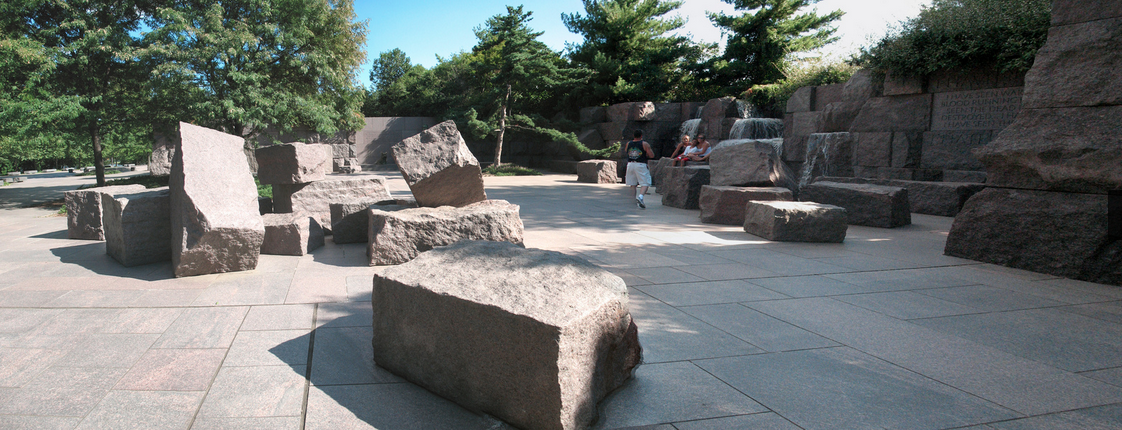
(Photo of the FDR Memorial in Washington, DC, via Mike Boucher)

How Unhealthy Is Your Sweet Tooth?

honey-booboo

James Hamblin takes a close look at the literature on sugar, high-fructose corn syrup, and agave:

Barry Popkin, who was investigating fructose long before [Dr. Robert] Lustig, recommends caution. Popkin, a distinguished professor of nutrition at the University of North Carolina, co-authored a widely-read academic article in 2004 titled “Consumption of High-Fructose Corn Syrup in Beverages May Play a Role in the Epidemic of Obesity.” That paper was followed by many popular articles that cited it, and a lot of research down this road. But he didn’t mean for it to lead to all-out fructose terror.

All that Popkin really wrote in the original article was that metabolism of fructose, unlike glucose, favors production of fat in our livers. That leads to a fatty liver, a condition that affected at least 70 million Americans at the time, and affects many more now. Fatty liver is linked to insulin resistance and cardiovascular disease.

But the science is far from settled:

The amount of sugar Americans consumed before the late twentieth century was trivial compared to what we eat today, Popkin noted. “We’re in a whole new world of sugar consumption. It’s not just beverages; it’s in all the foods. And we don’t really know what that means to our health. We know that we face an epidemic of things like fatty liver disease. Not just obesity, not just diabetes, but many other problems that could potentially be related to all the sugar. We think from some studies that fructose could be responsible, but we don’t have slam-dunk evidence on any of it.”

Relatedly, German Lopez flags a report on the effectiveness of a soda tax:

A new study published in the American Journal of Agricultural Economics found that adding a tax of 0.04 cents per calorie of sugar on drinks — the equivalent of nearly 6 cents for a 12 ounce can soda — would drive Americans to drink 5,800 calories less in sweet drinks each year. That reduction is roughly two days worth of the recommended number of calories.

A Bot That Blushes

Katerine Kravtsova reports from Moscow’s “Robot Ball”:

Of all those at the ball, one of the most human-like is RoboThespian, a life-size humanoid robot created by British engineers to perform on stage and to provide guided tours in museums. Unlike robots like Cubic, designed for domestic servitude, RoboThespian is intended to entertain and educate. It can be controlled via an online interface from anywhere in the world, interact with humans independently by scouring the internet for answers to questions, recognise faces, sing and dance. The gracefully moving machine can be bashful, friendly or bored depending on the situation. It can even blush when an attractive woman walks past. “Android robots such as Thespian demonstrate well the full range of technologies available,” says [exhibition organizer Igor] Nikitin.

Although the technology is developing at a rapid pace, it’s still a long way off before robots will be able to develop and display emotions in the same way as humans. Last year, British scientists developed the Experimental Functional Android Assistant, or efAA, a socially intelligent humanoid that has been designed not only to recognise and respond to human emotion but also to develop empathy. “It’s quite possible to have robots that exhibit strong emotions,” says Ray Taylor, one of the exhibition’s organisers. “And it will be possible to teach robots to be able to identify human emotions in the future.”

Please Keep Your Seatbelt Fastened

But don’t freak out over turbulence:

For all intents and purposes, a plane cannot be flipped upside-down, thrown into a tailspin, or otherwise flung from the sky by even the mightiest gust or air pocket. Conditions might be annoying and uncomfortable, but the plane is not going to crash. Turbulence is an aggravating nuisance for everybody, including the crew, but it’s also, for lack of a better term, normal. From a pilot’s perspective it is ordinarily seen as a convenience issue, not a safety issue. When a flight changes altitude in search of smoother conditions, this is by and large in the interest of comfort. The pilots aren’t worried about the wings falling off; they’re trying to keep their customers relaxed and everybody’s coffee where it belongs. Planes themselves are engineered to take a remarkable amount of punishment, and they have to meet stress limits for both positive and negative G-loads. The level of turbulence required to dislodge an engine or bend a wing spar is something even the most frequent flyer—or pilot for that matter—won’t experience in a lifetime of traveling.

Update from a reader:

Check out China Airlines Flight 006. Air Crash Investigation (best. show. ever.) did a whole show on this a while ago. Just watch the first minute of that. Blows my mind that that’s survivable. I used to be really afraid of flying. Somehow this show has made me way less stressed about it.