Sex With Benefits?

Jesse Singal breaks down the breaking news that casual sex may be beneficial “… if you like casual sex”:

[R]esearchers had a bunch of undergraduates take a survey that revealed whether they had so-called restricted or unrestricted “sociosexual orientations” — that is, whether or not they viewed casual sex in a positive light and had a tendency to seek it out. (How someone’s sociosexual orientation develops is complicated — it’s “determined by a combination of heritable factors, sociocultural learning, and past experiences,” the researchers write.) Then they tracked the participants’ sexual activity via self-reporting over the course of an academic year.

Undergrads who viewed casual sex in a positive light “typically reported higher well-being after having casual sex compared to not having casual sex” — “well-being” meaning higher self-esteem and lower depression and anxiety. Those with negative attutides toward casual sex reported a hit to their well-being, but this wasn’t statistically significant. (The researchers didn’t have a lot of data to work with because, unsurprisingly, people who don’t like casual sex don’t tend to have a lot of casual sex.) There were no identifiable gender differences.

Picking up on Isha Aran’s takeaway of “whatever floats your boat,” Amanda Hess challenges the study:

But whose boats are being floated here, exactly? [Researcher Zhana] Vrangalova told Pacific Standard that people who rate high on the sociosexual scale are generally “extroverted” and “impulsive” men who are more likely to be attractive, “physically strong,” and “more sexist, manipulative, coercive and narcissistic” than their peers. The people on college campuses who are the most likely to engage in casual sex—and to reap its benefits—are also dudes who are high in social status and low in character. For college students like them, ‘‘not all casual sex is bad.’’ But is that actually good news for anyone else?

It may be that attractive, manipulative, narcissistic, and sexist men are simply naturally inclined to enjoy no-strings-attached sex. Or it might be that only these men have acquired the status necessary to not suffer any social consequences for doing so.

Update from a reader:

As a younger man, I had many, many partners and tons of casual sex (but please, let’s not conflate “casual sex” with a one-night-stand with someone I just met – though that happened, too). I’m not extroverted nor impulsive (OK, maybe a tad impulsive), and definitely not sexist, manipulative, coercive nor narcissistic.  I can say, however, and without hesitation, that before I entered into a monogamous marriage, some of the very most joyful moments in my life were associated with casual sex experiences.

I struggled with that realization for a long while because I had inevitably absorbed some of the societal bullshit that makes us think that casual sex is automatically wrong.  After pondering on it for years, I came to the conclusion that experiencing joy through casual sex is A-OK. Again, I never manipulated, coerced, nor deceived, and I tried my very best to be considerate of everyone’s feelings.   At various times, these encounters were loving, healing, confusing, awkward, bittersweet, angry, sad – the whole human range of emotions. Further, those moments of joy often weren’t necessarily about the sex itself, but rather the situation around the encounter, the run-up to sex.  Had I not met and married my spouse, I would be happily living a life that involved lots of joyful casual sex and I wouldn’t feel a nit of guilt about it.

Softcore Soviets

Joy Neumeyer recently investigated the long-secret Soviet-era erotica of the Russian State Library:

It was the kinkiest secret in the Soviet Union: Across from the Kremlin, the country’s main library held a pornographic treasure trove. Founded by the Bolsheviks as a repository for aristocrats’ erotica, the collection eventually grew to house 12,000 items from around the world, ranging from 18th-century Japanese engravings to Nixon-era romance novels. Off limits to the general public, the collection was always open to top party brass, some of whom are said to have enjoyed visiting. …
One of the most stunning items seized from an unknown owner is “The Seven Deadly Sins,” an oversized book of engravings self-published in 1918 by Vasily Masyutin, who also illustrated classics by Pushkin and Chekhov. Among its depictions of gluttony is a large woman masturbating with a ghoulish smile.

Nick Davies elaborates on who frequented the collection:

The biggest boost to the [old special storage collection] spetskhran’s naughtier items came from librarian Nikolai Skorodumov, who was allowed to maintain an extensive erotica collection under the guise of “the discourse of communist ideology,” though the truth might be that he was protected by Joseph Stalin’s secret police chief Genrikh Yagoda, “a pornography aficionado whose apartment reportedly held a dildo collection.” …

While it’s no longer secret, the collection still isn’t readily available to the public, though [collection overseer Marina] Chestnykh points out that this hasn’t prevented a few stray items from going missing over the years, at the hands of “unscrupulous librarians, or even heads of state.”

View the Moscow Times‘ disappointingly unsmutty gallery of the library here.

(Image of illustration from The Seven Deadly Sins by Vasily Masyutin via ARTINRUSSIA)

Maybe Spitzer Was Onto Something

Melissa Dahl pulls some fun facts from a new book about sex myths by Aaron Carroll and Rachel Vreeman:

It’s totally cool to leave your socks on during sex. Okay, nothing sounds less sexy than that, but hear Carroll and Vreeman out. They cite a study by Dutch scientists that found both men and women were more likely to have orgasms … when they were given socks. Eighty percent of the participants with socks on were able to have orgasms, but for the unfortunate sockless participants their ability to come was reduced to a coin-flip.

In this particular study, the researchers did brain scans on men and women while their partners attempted to get them to orgasm by stimulating their genitals. So, yes, okay, we’re talking about a laboratory setting, not an actual bedroom. But the real point here is that comfort and relaxation is key, and that may be especially true for women.

Book Club: A Conversation With Alexandra And Maria, Ctd

In our next clip, Maria and Alexandra discuss the idea that a writer is a “professional observer”:


Meanwhile, on her blog Brain Pickings, Maria quotes Alexandra, a professor at Barnard who specializes in dog cognition:

I am, professionally, an observer of animals — by which I mean nonhuman animals. I actually have been less interested in looking at people… But of course, as it turns out, the human animal is also infinitely more complex than I give us credit for. And I appreciated — a lot — the fact that, at the end of this book, I could take a walk with anybody — it didn’t have to be an expert… — and I became more appreciative of anyone’s perspective. If you can bookclub-beagle-trjust get somebody to talk about what they see when they’re walking down the street, they will almost inevitably be seeing something different than you. Because they are a different person, and there’s a whole background there. And, actually, I think that is a kind of writerly trick — it’s sitting in the restaurant and making up stories about the people who sit around you… being interested in [them] and being able to imagine, backwards, their stories.

Follow the whole book club discussion here, and email your thoughts and observations to bookclub@andrewsullivan.com. You can listen to the entire conversation from Alexandra and Maria below:

A Black Market For Black Lungs

Keith Humphreys checks in on shady trading practices for cigarettes:

The global black market in tobacco is estimated to supply 11.6% of the world’s consumption, a startling 650 billion cigarettes a year. And there are two components to this market that have drawn the particular scrutiny of law enforcement: fake cigarettes and tax avoidance. The reason why fake cigarettes are big business will be obvious to anyone who tunes in to Mad Men. Cigarettes have arguably been marketed internationally more effectively than any other American product.  The resulting worldwide recognition of the Marlboro Man, Joe Camel et al. means that hundreds of millions of smokers are willing to pay a premium for famous Western brands. This has created a lucrative opportunity for criminals – overwhelmingly based in China — to repackage over 100 billion cheap cigarettes a year as marquee Western brands. While not enthusiastic about the amount of revenue being generated by fake cigarettes, U.S. policymakers have been even more concerned about smugglers avoiding taxes for selling genuine cigarettes.

A Short Story For Saturday

This weekend’s short story is Joyce Carol Oates’ “Where Are You Going, Where Have You Been?“, first published in 1966. Its opening paragraphs:

Her name was Connie. She was fifteen and she had a quick, nervous giggling habit of craning her neck to glance into mirrors or checking other people’s faces to make sure her own was all right. Her mother, who noticed everything and knew everything and who hadn’t much reason any longer to look at her own face, always scolded Connie about it. “Stop gawking at yourself. Who are you? You think you’re so pretty?” she would say. Connie would raise her eyebrows at these familiar old complaints and look right through her mother, into a shadowy vision of herself as she was right at that moment: she knew she was pretty and that was everything. Her mother had been pretty once too, if you could believe those old snapshots in the album, but now her looks were gone and that was why she was always after Connie.

“Why don’t you keep your room clean like your sister? How’ve you got your hair fixed—what the hell stinks? Hair spray? You don’t see your sister using that junk.”

Her sister June was twenty-four and still lived at home. She was a secretary in the high school Connie attended, and if that wasn’t bad enough—with her in the same building—she was so plain and chunky and steady that Connie had to hear her praised all the time by her mother and her mother’s sisters. June did this, June did that, she saved money and helped clean the house and cookedand Connie couldn’t do a thing, her mind was all filled with trashy daydreams. Their father was away at work most of the time and when he came home he wanted supper and he read the newspaper at supper and after supper he went to bed. He didn’t bother talking much to them, but around his bent head Connie’s mother kept picking at her until Connie wished her mother was dead and she herself was dead and it was all over. “She makes me want to throw up sometimes,” she complained to her friends. She had a high, breathless, amused voice that made everything she said sound a little forced, whether it was sincere or not.

Read the rest here. For more of Joyce Carol Oates’ short fiction, check out her High Lonesome: New and Selected Stories 1966-2006. Previous SSFSs here.

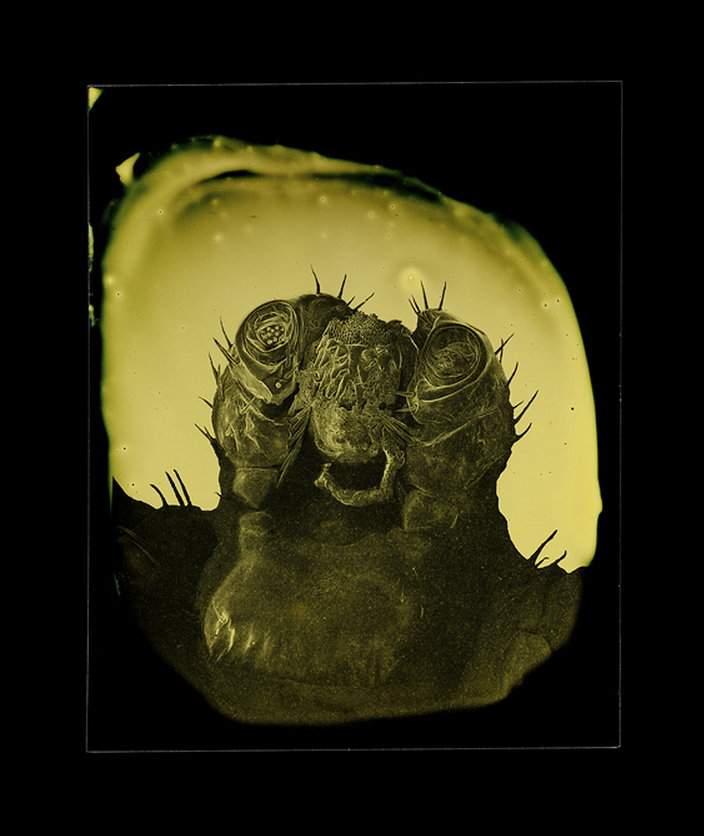
Face Of The Day

Screen Shot 2014-05-29 at 11.17.04 AM

Photographer Marcus DeSieno captures microscopic parasites:

It is fair to assume that while most of us know that our world, our living spaces, and even our bodies are covered with microscopic organisms, we do like to not be reminded of it. Photography student Marcus DeSieno’s recent photoseries begs to differ, offering a beautiful yet disturbingly close look at our microscopic natural surroundings. Parasites is an ongoing project “investigating a history of scientific exploration through images of parasitic animals.” Taken with a Scanning Electron Microscope and then exposed onto dry plate gelatin ferrotype plates, a process which combines classical and cutting-edge photographic techniques. The final images are archival pigment prints from the scanned ferrotype plates and printed larger for these abject animals to confront the viewer at a one-on-one scale.

See more of DeSieno’s work here.

Márquez The Reporter

Jessica Sequeria considers Gabriel Garcia Márquez’s considerable influence on Colombian journalism:

Apart from the linguistic pleasures it provides, García Márquez’s nonfiction plays a vital role in the cultural history of Colombia. Not just in its style – these works have an ironic sense of humor, conversational tone, and attractive snark often lacking in his novels – but also in its influence, both on the way journalism has been written and on the formation of a national cinema. For a long time, Colombian journalism operated under G.G.M.’s shadow. As Gilard put it, writing in 1993, “Until the end of the ’70s, all Colombian reportage followed García Márquez’s pattern, imitated just as much in journalism as in literature. His at times suffocating omnipresence didn’t show itself only in narrative; it was as real, and perhaps stronger, in news writing.”

Previous Dish on GGM here and here. We recently featured one of his short stories here.

A Lonely Elegy

In an interview earlier this year, Lonely Christopher described his debut poetry collection Death & Disaster Series (see above trailer):

It’s a collection of poetry that I wrote while my mother was battling late stage cancer and after she died. It was a very necessary thing for me to write—the only way I knew how to react to what was happening, which seemed so much larger than anything I had heretofore directly experienced. It’s an angry book screaming out for redemption.

Felix Bernstein appreciates how Christopher “depicts a prickly, dangerous, upsetting world that somehow reveals the unthinkably awful without making it palatable”:

Series is a prolonged elegy to Christopher’s mother, who died in August 2011, and was written from the time of his mother’s decline (“Poems in June” chronicling June 2011) to only about a year after her death. This “Death and Disaster Series” does the opposite of the “death and disaster” artworks provided us by Warhol and [Kenneth] Goldsmith: this is not a work that appropriates the banal in order to render it sublime. Rather, this is a work that draws from personal experience in order to make precarious beauties that lack any sort of monumentality in the face of darkness. In that way, his work can be seen to follow the neglected tracks of [John] Wieners, who called what he wrote obsessional, not confessional, poetry.

If Wieners obsessively tried to write the most embarrassing thing he could think of, Christopher betters him with even more guttural honesty:

“My boyfriend fucked me tonight without a condom / or lubricant; my anal wall started bleeding and / he cut open his dick before he came / and I shit blood.” But even within the goriest of passages, there is often a delicate treasuring of the poet’s personal glimpses of beauty.

In another recent rave review, Joyelle McSweeney also picked up on the contradictions in Christopher’s verse:

The lushness of Lonely Christopher is a contradictory flora, both decorated and plain, but always intensely voiced, dramatic, forceful, and red-hued. This is a poet who can write “I love a boy’s cock/it make me think of AIDS/it gets me off.” and who can end a volume by writing, simply, of his dead mother, “I love you, Susan”, while in the same volume producing ruffles and flourishes and lacings (and lashings) of language, of decadent aesthetic pleasure. My favorite poems in the volume are the ones which do both, deploying an admirable directness and a delectable oddness….