Going Back To Where Christianity Was Defined

During his recent trip to the Holy Land, Pope Francis prayed with Ecumenical Patriarch Bartholomew I, the primary leader of Eastern Orthodox Christians, at the Church of Holy Sepulchre in Jerusalem. Afterward, Bartholomew announced that he and Francis were planning an ecumenical gathering in Nicaea in 2025, marking the 1700th anniversary of the Church council that gave Christians the Nicene Creed. Emma Green tries to decipher the news:

That’s a pretty big deal; in 1054, theological disagreements led to a schism in Christianity, which is how Roman Catholics and Eastern Orthodox Christians became separate faith traditions. This is a call back to a time before the schism, before the fundamental disagreements that kept popes and patriarchs from talking to each other for more than 900 years.

But the specifics are still pretty fuzzy. Will it be a formal ecumenical council, with leaders from the two faiths earnestly trying to reconcile their theological differences? Or will it be just what Bartholomew said—a celebration, full of meaningful dialogue but little actual change? Hard to tell, says Rocco Palmo, the author of the blog Whispers in the Loggia. 

“It’s 12 years away,” he pointed out. Trying to predict what will happen in 2025 is like an extreme version of confidently declaring who will be president of the United States in 2016—there’s just no way to know. Plus, Francis and Bartholomew are both in their 70s. Bartholomew said the pair wanted to leave this council “as a legacy to ourselves and our successors,” which seems like an acknowledgment that they could both be dead—or retired—11 years from now.

Michael Peppard adds:

The ongoing Catholic-Orthodox dialogue will be intensified in preparation for the event. What began in Jerusalem in 1964 and was celebrated last week at the Holy Sepulchre will continue in the holy city this fall, when, in Bartholomew’s words, “a meeting of the Catholic-Orthodox Joint Commission  will be held hosted by the Greek Orthodox patriarch Theophilos III. It is a long journey in which we all must be committed without hypocrisy.”

In all the attention to the Pope’s gestures toward political peace in the Holy Land last week, the joint event with the Orthodox got a bit lost in the mix. But Francis and Bartholomew didn’t lose focus. And they’ve got a date on the calendar to prove it.

Bart Gingerich, however, downplays what might happen at Nicaea 2025:

[B]efore my fellow Christians of a more traditionalist persuasion get too fired up, they must remember that this is not an ecumenical council itself. There is no heresy at stake. There is no summons from an emperor. Indeed, unless there is a very distinct order of business, Nicaea 2025 could possibly become a tremendous photo-shoot, with little effective action aside from some high-profile handshakes.

We must keep in mind that there is still much theological plaque that church leaders need to deal with in order to achieve a some kind of organic unity. First of all, the East and West have different views of sin and the Trinity. This fundamental disagreement comes in part to the influence of the Cappadocian Fathers on the East and St. Augustine of Hippo on the West.  Moreover, both communions have the “OTC syndrome.” The Roman Catholic Church and the Eastern Orthodox churches claim to be the exclusive “One True Church (TM)”; both are going to have to admit “We have been wrong for centuries” in order to have actual union. This takes no small amount of humility and may even open the door to the legitimacy of other communions and denominations. However, the more difficult issues may arise at the grassroots and in the local pulpits of the two communions. While Rome has developed and fallen in love with the concept of papal infallibility, outspoken critiques of “western rationalism” have become a homiletical staple in Orthodox circles.

A reminder of the theological issues separating east and west:

The two theological sticking points are the same now as they were in 1054. One is the pope. Orthodox Christians are happy with him as a figurehead, like the Queen, but are alarmed at the idea that he might intervene in their affairs or boss around their patriarchs. Catholic teaching, meanwhile, holds that the pope has “full, supreme and universal power”. The way around this is to define clearly the limited situations in which he might exercise jurisdiction over the east.

The other problem is the filioque. This refers to the words “and the Son” added unilaterally by the western church to the Nicene Creed (the summary of the Christian faith agreed on in the fourth century). This inflamed east-west relations so much that in 867 AD, Patriarch Photius of Constantinople called the pope who approved it a “heretic who ravages the vineyard of the Lord”. The change itself is a subtle one. It annoyed the Orthodox church though, because it believed that any amendment to such a central part of the faith should be agreed by consensus at a council. Most theologians now think the filioque issue is minor – that it is an acceptable variant between east and west. Yet that relaxed approach won’t go down well with many Orthodox Christians, for whom it is still a serious heresy.

Seedy Cinemas

Screen Shot 2014-06-05 at 10.40.40 AM

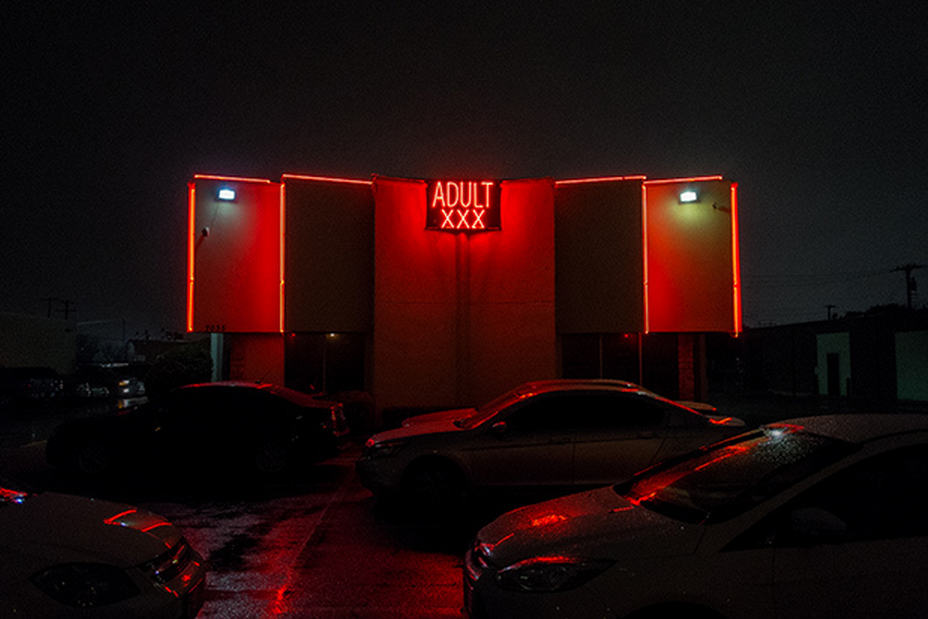
Photographer Michael Max McLeod captures remaining public porn cinemas:

I’m surprised they still exist. The internet has been mainstream since, what, 1993 maybe? That’s over 20 years. Porn and anonymous hookups are a click away now – anywhere, any time. Most of the locations I go to are completely empty or have only 1 or 2 patrons. Thats great, because it gives me a lot of freedom to photograph. But I imagine they can’t stay in business much longer.

As for the locations that actually get traffic, I’m surprised to discover how they each have a specific culture. Truck stop locations are busy and have a very fast turnover. A location off the highway is going to be busiest at 3pm on a Friday. The neighborhood porn shop might serve as a friendly, social hangout for retired men. Certain locations might attract black and latino men and their admirers. Other locations attract prostitutes, straight couples or a lunchtime businessman crowd. I could go on. Each location has its own unique rituals.

See more of his work here.

Too Soon?

A reader replies to this thread on faking orgasms:

Your reader wrote: “You really want to get people talking? Start a thread about people who come too fast instead of not at all.”

I’m one of those guys, sometimes. My wife likes to sneak off to the bathroom at work and send me naughty snaps when she’s wanting to have some naked fun time that night. She keeps me primed all day to the point that, when we finally get down to it, I’m so hot I pop in sometimes less than a minute.

This was a big problem for me for a long time, assuming that my wife wasn’t getting satisfaction from our sex life. I always went down on her before the actual sex, so I comforted myself knowing she was at least having an orgasm. Finally, I asked her about it just to clear the air, and I was the only one with an issue. She loved that I came so fast, when it happened. Knowing that SHE got me that hot, that it was HER that I was so excited about, it made it even better for her even when it was short. She did confess that, occasionally, she would be disappointed with the brevity, but not often enough for it to be an issue. Still, now that we’ve talked about it, if it happens, we just wait awhile for the batteries to recharge (with lots of cuddling and continuing foreplay) and go at it again. “Problem” solved.

Another can relate:

I am apparently a rare creature  – a woman who often comes “too early.”

I’m also one-and-done on orgasms, which my husband knows. So if it happens too soon, I fake that I’m not having an orgasm; I hide it. Definitely being a woman is an advantage here. I have sometimes then faked a later orgasm, but usually I just show enthusiasm up until my husband finishes, at which point he often asks if I came, and I assure him yes, because I did. Not a lie! He does not ask for details on timing. I justify this act on the basis that I do not want him to feel rushed. I’ve tried to adjust him to my speed, and I’ve tried to get him on board with moves that slow me down, but neither of those worked, so the act continues.

Another female reader ventures into new territory:

I am so happy to see other women writing in to say they are not able to have orgasms during normal sexual intercourse. I’m not happy for them but I’m happy to hear it is not just me. I spent most of my 20’s believing something was seriously wrong with me. I can get myself there, but no one else was able to. I don’t think it’s psychological for me. I don’t get all up in my head when I’m having sex. I can usually let go and enjoy it pretty well. I just never orgasm unless I take matters into my own hands, so to speak.

In my late 20’s I met a man who is now my husband. After many months of being intimate I agreed to let him try anal sex with me. I had tried it before, but it was painful and not anything I wanted to try again. We started slow but eventually got there. I orgasm every time. Every single time. But only during anal sex. I can’t get my vagina to operate normally (at least that is how it feels in my head), but at least my butt is on board. It’s something. I often wonder if there are other women out there that can’t hit the big “O” vaginally but can with anal penetration.

In Brief

With an exhibition on the history of lingerie opening in New York this week, Raquel Laneri considers how unmentionables became a turn-on:

10313038954_2076a43534_zThe idea that underthings can serve any other purpose besides a purely functional one, of course, is relatively new. For centuries, men and women wore plain T-shaped linen tunics under their clothes, most likely for warmth and, as FIT Museum Director Valerie Steele writes in the catalog’s forward, to protect more decorative outer garments from “the dirt and sweat associated with the (seldom washed) body.” (Eww.) Undergarments did enjoy a brief moment of exposure in the 18th century, with the ruling class indulging in decorative corsets. (Think Marie Antoinette and her semi-public dressing rituals.) Yet by the early 19th century, the rise of the middle class – and a certain “bourgeois modesty” – sent these undergarments back into hiding, with women relegated to simple, white stays and petticoats that served to enhance their virtue rather than their allure.
That all changed in the late 19th century. The Impressionists had shaken up Paris with frank portraits of their mistresses and friends wearing blue silk unmentionables. Department stores opened to cater to an increasingly powerful middle class that no longer felt shy about displaying its wealth. And, most importantly, women began to see themselves not just as housewives and mothers but also as sexual beings. Silhouettes – the hourglass, the “S” (achieved by wearing a corset and a rear-enhancing bustle) – became more extreme, and underwear more luxurious.

(Image: Ad for Stardust Miracle-Lift Bra, published in the March 1953 issue of Woman’s Day, via Flickr user Classic Film)

Writing The Book On Sex

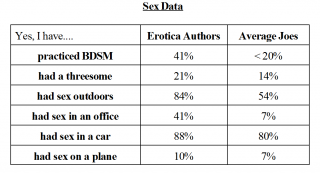
According to a survey by The Fussy Librarian, authors of erotica unsurprisingly have more adventurous sex:

The survey … gave authors an opportunity to share the most unusual place they’d had sex. The answers included “on stage at a concert,” “The Louvre,” “a slide at a playground dish_booksex at night,” “the bed of our truck in our driveway,” “doctor’s office,” “a horse” and “on the Haunted Mansion ride at Disney World.” To the last, the writer added, “Please let them have destroyed the security tape!”

Whether inspired by “Fifty Shades of Grey” or their own fantasies, 41% of the erotica authors in the survey said they have practiced BDSM — an overlapping abbreviation of bondage and discipline, dominance and submission, and sadism and masochism — while the average is less than 20%, according to the website. On the whole, they didn’t think much of the mega-bestselling novel by E.L. James: A third said they’d rate it one out of five stars.

Martin Rouse adds:

So, who are these enlightened sexual beings? It might be disappointing to find that 94% of respondents were female, and 89% were straight. This comes as no surprise to anyone who frequents the romance section of a bookstore, where a diversity of sexual scenarios does not reflect a diversity in the authors who write them. Such is life. It’s nowhere near as disappointing as curling up with an erotic novel and some wine, ready to relax, and realizing that the book’s author is probably curling up with a real man somewhere, doing all the things you’ll be reading about when the sequel finally arrives.

Chris And Don’s Love Story

When he first started reading The Animals, the recently published love letters of Christopher Isherwood and Don Bachardy, Matthew Gallaway rolled his eyes at the couple’s pet names for each other – Isherwood was a variation on “horse” and Bachardy “kitten.” But he eventually saw something deeper was at work:

Isherwood and Bachardy were living openly in a society that was hostile to their relationship on several fronts — besides being gay, Isherwood was also more than 30 years older than Bachardy, who was only 18 when they met — and so they needed to create an imaginary world, one that (in [editor Katherine] Bucknell’s words) was “safe” and “entertaining” to the two men, when so many others in their situation succumbed to bitterness and self-loathing.

The animal device also allowed them to address issues of infidelity or — since they weren’t really cheating — “sexual freedom” that might otherwise have pulled them apart.

With Isherwood’s blessing, Bachardy spent many months away from their home in Santa Monica — in London, in New York, in continental Europe — in order to develop his artistic career and to see the world; Isherwood understood that to constrain the much-younger Bachardy would almost certainly have resulted in a breakup. That said, Isherwood was also not shy about inviting others he found attractive into his bed. Both men enjoyed many different lovers during the course of their relationship, but the letters are never graphic. The language they used helped them to navigate waters that are always dangerous, even — or especially — where both parties are being honest, and we see how it can perhaps soften the blow to Isherwood when Bachardy refers to other men as “bowls of cream” he may or may not reject during the course of his travels. To witness a couple, under this twee façade, balancing such obligations of commitment and desire feels very contemporary and somehow important, given how the conformity of marriage so often means that such things — even in the gay world — are still discussed in disapproving whispers, if at all.

In an earlier review of the book, Olivia Laing noticed the letters also contain all the gossip you’d expect from a prominent Hollywood couple who knew just about everyone worth knowing:

Although work is a regular topic of conversation (particularly Bachardy’s sometimes anguished attempts to find his métier), the keynote here is gossip. On Auden at 59, Isherwood notes, “Wystan can never possibly look older,” while Bachardy memorably describes Vanessa Redgrave as a “pod-born replacement for real humans”. Observations on the love lives of the beau monde are traded back and forth like cigarette cards (a pearl for the susceptible: Vivien Leigh’s private number in the 1960s was Sloane 1955).

Gossip is a leveller but one of the oddities of this capacious book is how similar the two voices sound, considering the vast gulf in age and experience, background and nationality. The struggle to bridge these gaps forms the great underlying drama of the letters.

And it turns out Bachardy holds his own as a man of letters when compared to his novelist partner:

One of the best surprises of the collection is what an excellent writer Bachardy is — wry, sharp and funny. In one letter, he describes the aftermath of an attempted suicide of a friend’s father, who left blood splattered on the carpet. Isherwood replies, “Your letter, with the truly horrendous diary excerpt, just arrived. I enjoyed it so much I quite forgot to feel sorry for anybody. Honestly, this is literature! The things you put in! Like Marguerite saying, ‘She’ll never get it out of the carpet!'”

Watch a video of Bachardy reading some of the letters here.

(Video: Trailer for the 2007 documentary Chris & Don)

A Good Movie To Hate

Lara Zarum reviews Adam Nayman’s It Doesn’t Suck, which disputes the conventional wisdom that Showgirls is a bad film:

Showgirls is not a piece of shit or a masterpiece—it’s a “Masterpiece of Shit,” Nayman writes, and the book’s embrace of both of Showgirls’ “two minds” is its greatest strength. It Doesn’t Suck frees viewers from the constraints of the guilty pleasure—because if you feel guilty watching Showgirls, you’re doing it wrong. As Kael wrote, “Movies—a tawdry corrupt art for a tawdry corrupt world—fit the way we feel.”

Showgirls may have initially been dismissed, but when I rewatched it for this review—twice, of course, in keeping with its doubling motif—I was surprised at how it made me feel: not angry or amused or dismissive, but sick to my stomach. Not because it’s a terrible movie, but because it’s such an effective one. Nomi’s full-circle journey from nameless drifter to star and back again really is horrific, filled with backstabbing rivals, conniving love interests, and brutal rapists. In its 128 minutes, it seems to encompass all the sleaze in Las Vegas and then some. And more importantly, you can’t take your eyes off it.

It Doesn’t Suck isn’t just a book about Showgirls, but about the way we perceive such films and how that perception changes over time. As an extended conversation on one of the most ridiculed films of the past two decades, Nayman’s book is a valuable gift. After all, the only thing more fun than watching a deliciously tacky movie is picking it apart with your friends when the lights go up.

Poems Are Not Selfies

Daniel Johnson traveled to Oxford to profile Geoffrey Hill, the university’s Professor of Poetry, describing him as a man born out of time:

By the time Hill came on the scene … the landscape had been transformed: the line between poetry and prose had been blurred, the laws of prosody had been suspended and poets were marginalised by or subsumed into other art forms, such as popular music. Poems too became primarily vehicles of self-expression. Like everybody else, poets had to compete for attention and celebrity. As schools no longer taught their pupils poetry by heart, the handful of verses that retained public affection acquired the status of secular icons. New poetry seldom achieves such recognition, for the very good reason that is rarely memorised or indeed memorable. Poets instead strove to reinvent their functions: as performance art for highbrows, icing on the secular wedding cake, or therapy for the deserted, the desolated and the dumped.

Against this, Hill champions a poetry of ideas:

“It is public knowledge that the newest generation of poets is encouraged to think of poems as Facebook or Twitter texts — or now, I suppose, much more recently, as selfies.” The mention of such an improbable neologism from such a source elicited an embarrassed titter from the audience, as if Hill had caught his academic peers indulging a secret vice.

“The poem as selfie is the aesthetic criterion of contemporary verse,” he continued. “And, as you know, in my malign way I want to put myself in opposition to this view. That is to say, the poem should not be a spasmodic issue from the adolescent or even the octogenarian psyche, requiring no further form or validation.” Hill came back to the theme in his vindication of [Gerard Manley] Hopkins, whose sonnets did not, he expostulated, deserve the condescension of posterity: “I do not think that they are Hopkins’s selfies.”

The underlying reason for Hill’s rejection of poetry as pure self-expression is that he sees such narcissism as beneath the dignity of his calling. He preaches, rather, what he has practised ever since his youth: a poetry of ideas. It is this determination to place ideas at the heart of his work that sets him apart from even his most celebrated contemporaries.

In a Paris Review interview over a decade ago, Hill defended “difficult” art in similar terms:

We are difficult. Human beings are difficult. We’re difficult to ourselves, we’re difficult to each other. And we are mysteries to ourselves, we are mysteries to each other. One encounters in any ordinary day far more real difficulty than one confronts in the most “intellectual” piece of work. Why is it believed that poetry, prose, painting, music should be less than we are? Why does music, why does poetry have to address us in simplified terms, when if such simplification were applied to a description of our own inner selves we would find it demeaning? I think art has a right—not an obligation—to be difficult if it wishes. And, since people generally go on from this to talk about elitism versus democracy, I would add that genuinely difficult art is truly democratic. And that tyranny requires simplification.

A Poem For Saturday

3306277484_48bd1c5946_b

Dish poetry editor Alice Quinn writes:

We post poems by gay poets all year long, naturally, and this weekend and next, we’ll feature three each by the Italian poet Patrizia Cavalli, who lives in Rome, and Kevin Simmonds, an American who lives in San Francisco.

Cavalli has been a favorite of many friends of mine for decades—poets, writers, and others notably devoted to the arts. Among her admirers are Eliza Griswold, several of whose translations,  I Am the Beggar of the World: Landays from Contemporary Afghanistan, we featured in March, Maxine Groffsky, an exceptional literary agent, the memoirist and novelist Edmund White (“Look at her closely: it’s as if you were seeing Sappho in the flesh.”), and Marilyn Goldin, a brilliant screenwriter who wrote with and for such luminaries as Bernardo Bertolucci and Agnes Varda and who died some years ago in her home in upstate New York near a monastery where she served the Swami as a scholar and writer. (I delight in every chance to celebrate this extraordinary woman.)

The Pulitzer Prize-winning novelist and story writer Jhumpa Lahiri expresses best why we have chosen the poems we have to represent this Italian poet’s limpid, mischievous, and perhaps above all, abundantly (and winsomely) genuine work, “She articulates with disarming precision, the instability, the absurdity, the exquisite anguish, of love. Perhaps her poems can’t change the world, but they have changed my life.”

Our first selection from Patrizia Cavalli translated, from the Italian, by Moira Egan and Damiano Abeni:

Love not mine not yours,
but the fenced-in field that we entered
from which you soon moved out
and where I’d lazily made my home.
I watch you from the inside, you out there,
strolling distracted on the outskirts
and coming closer now and then to check
whether I’m still there, stopped and stunned.

(From My Poems Won’t Change the World: Selected Poems of Patrizia Cavalli, edited by Gina Alhadeff. Translation © 2013 by Moira Egan and Damiano Abeni. Reprinted by permission of Farrar, Straus & Giroux, LLC. All rights reserved. Photo by Henry Burrows)