Jennifer Weiner argues that some of it is “straight-up packaging”:
If you’re writing for FSG or Knopf it’s like it cannot, by definition, possibly be something as degraded as chick lit, because they don’t publish that stuff! If your book has a cover that’s just typography and color, it’s literature, but if there’s a female body part, it’s chick lit. If you’re smiling in your (color) author photo, it’s chick lit. If you’re smirking, or giving a stern, thin-lipped stare in your black-and-white picture, and if you go out of your way in every interview to talk about how “unserious books do not deserve serious attention,” then it’s literature. (Or, more likely, it was literature all along but you just want to make quadruply sure that absolutely no one is mistaken about your serious intentions and gets you confused with one of this icky pink girls who have cooties.)
Eliza Berman pushes back against Weiner’s observation about authors’ book-jacket photos:
I compared the photos for the top 20 best-selling female authors in [Amazon’s] “Women’s Fiction” [category] with the same group in “Literary Fiction.” If they didn’t have a photo, I skipped them and moved on to the next one. If they appeared twice within the top 20, I only counted them once.
On the first count, smiling versus unsmiling, Weiner was right. Sort of. Seventy-five percent of “Women’s Lit” authors were smiling, compared to 55 percent of “Literary Fiction” authors. But if you look at not just whether someone’s smiling, but with how much gusto, of the shiny, happy writers, 60 percent of chick lit authors bared their pearly whites, while more than 70 percent of the literary writers did. The chick lit writers smiled more often, but when the literary writers smiled, they did it with abandon.
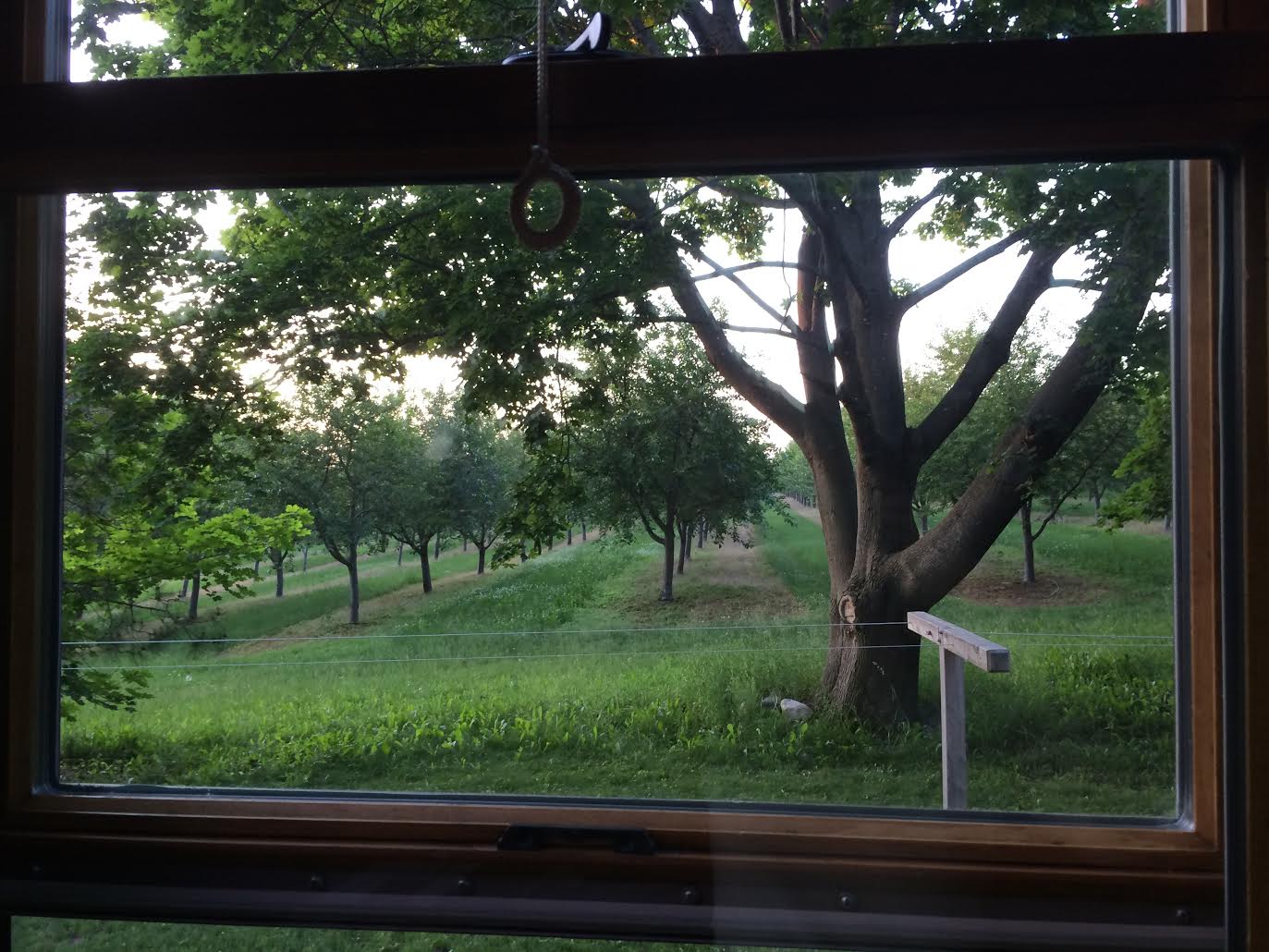
You have until noon on Tuesday to guess it. City and/or state first, then country. Please put the location in the subject heading, along with any description within the email. If no one guesses the exact location, proximity counts. Be sure to email entries to contest@andrewsullivan.com. Winner gets a free The View From Your Window book or two free gift subscriptions to the Dish. Have at it.
[D]ebates over whether print beats screen are hopelessly simplistic, not least because reading on a computer, with endless distractions a click away, is very different from reading on a dedicated e-reader. Much depends on what you’re reading and why. In a Taiwanese study led by Szu-Yuan Sun, the results suggested that reading linear texts in the manner of traditional paper books was “better for middle-aged readers’ literal text comprehension” but reading on computers with hyperlinks “is beneficial to their inferential text comprehension”. In other words, the joined-up environment of the web encourages people to make connections and work things out, while straightforward reading encourages them to take in what’s on the page in front of them. Hence the prevalence of hyperlinks and multiple windows on computers could be seen as creating either unwelcome distraction or more opportunities for active learning.
Where research has suggested that comprehension is diminished by screen reading, it is hard to know if this is an artefact of the particular piece of technology and people’s familiarity with it. “Having a device that requires a lot of attention to simply operate could essentially steal working memory resources,” says [researcher Sara] Margolin. That did not appear to be the case in her own research, which she suggests was probably because “the device we used was fairly easy to manipulate and my participants were familiar with technology”.
This is a nice example of how hard it is to know whether the preferences we have for one type of reading device over another are rooted in the essentials of cognition or are simply cultural. As another researcher, Simone Benedetto, points out: “The fact that the large majority of the population is still trained to the use of paper since early childhood has a major influence on the preference for paper.”
Last week we posted a beautiful poem by John Clare, born in 1793 in Helpston, England, which he described as “a gloomy village in Northamptonshire, on the brink of the Lincolnshire fens.” Clare was schooled locally in his village but often forced to abandon school when times were hard to work as a child thresher, a ploughboy, or a potboy at a local inn. In 1820, he fell in love with James Thomson’s poem The Seasons and set about writing poetry himself. His Poems, Descriptive of Rural Life and Scenery, published when he was 26, brought him fame, patronage, and the acquaintance of London literary figures such as Charles Lamb and William Hazlitt. In the 20th century, poets as various as Robert Graves, John Ashbery, and Seamus Heaney wrote sweetly of their love for his poems.
Clare married and fathered six children, five of whom died before him. He suffered his first episode of major depression from 1823-25 and another from 1830-32. Five years after that, his condition complicated by hallucinations and aberrant behavior, he was certified insane and confined until his death in 1864 in various institutions although free to roam about during the day in the woods he found so entrancing. (From “Memories of Childhood”: “Ah what a paradise begins with life & what a wilderness the knowledge of the world discloses. . .”)
Today and in the days ahead, we’ll post poems written while Clare was an inmate at the places that sheltered him. At the last, the Northampton General Lunatic Asylum, one of the stewards, William Knight, transcribed and preserved many of the more than three and a half thousand poems of his. Jonathan Bate’s biography, John Clare, is superb. He is also the editor of the most recent edition of Clare’s Selected Poetry.
“How Can I Forget” by John Clare (1793-1864) :
That farewell voice of love is never heard again,
Yet I remember it and think on it with pain:
I see the place she spoke when passing by,
The flowers were blooming as her form drew nigh,
That voice is gone, with every pleasing tone—
Loved but one moment and the next alone.
“Farewell” the winds repeated as she went
Walking in silence through the grassy bent;
The wild flowers—they ne’er looked so sweet before—
Bowed in farewells to her they’ll see no more.
In this same spot the wild flowers bloom the same
In scent and hue and shape, ay, even name.
’Twas here she said farewell and no one yet
Has so sweet spoken—How can I forget?
Gillian Tett marvels at the success of Starbucks’ “secret menu” – which includes the Cotton Candy Frap(puccino), Grasshopper Frap, and Rolo Frap – among teens and tweens:
As a piece of marketing strategy, this is pure genius. It is also a striking symbol of our age. Until the early years of the 20th century, the concept of a teen – let alone a tween – was unknown; in western society people were classified either as adults or children. The concept of the teenager sprang to life as consumer companies discovered a new market for their goods. They realised that the key to selling things in this demographic was to make teen brands different from parental brands, and a little subversive too.
Until recently, Starbucks did not seem keen – or able – to tap into the teen demographic. Coffee bars are generally branded as grown-up places where young professionals hang out; coffee drinkers are, on average, relatively old. But Howard Schultz, Starbucks’ CEO, knows that if he wants to keep expanding, he has to get creative. Since the 1970s coffee consumption has been flat or falling; today Americans “only” consume 23 gallons of coffee a year, half the level of 50 years ago. But Starbucks is convinced that it can use the 13,000 outlets that dot the US today to sell something else. Hence the secret menu campaign, which is now cropping up in other places too: Chipotle, Jamba Juice and even McDonald’s are playing with the concept.
(Photo of Cotton Candy Frap(pucino) by Elizabeth Faith via Pinterest)
Some brave souls from MIT and the University of La Laguna (“samples were collected by hand,” the researchers said) analyzed the makeup of the samples and found that Neanderthals ate a diet dominated by meat, but definitely ate some plants, as well.
That’s because lead researcher Ainara Sistiaga and his team were able to identify, for the first time, the presence of metabolites such as 5B-stigmastanol and 5B-epistigmastanol, which are created when the body digests plant matter. The existence of those metabolites “unambiguously record the ingestion of plants,” Sistiaga writes…
Sistiaga said it was possible, though unlikely, that the fecal biomarkers she and her colleagues found were solely the result of Neanderthals eating the stomach contents of their prey. “In any case, this would represent another way to eat plants,” she said.
A few updates from readers:
This may be pedantic but please don’t refer to Neanderthals as our ancestors. We did not descend from Neanderthals. We share a common ancestor with them, and there is evidence for breeding between Homo Sapiens and Neanderthals, but that is different from calling Neanderthals our ancestors. With that line of thought, though, the diet of Neanderthals, a physically distinct and not-ancestral hominid, would not really have any pertinence towards what I ought to eat.
Another:
I need to correct that earlier comment from one of your other readers. Neanderthals are in your ancestral tree if you happen to have European or Asian ancestry. There was some interbreeding of Neanderthals with the populations of H. sapiens who left Africa. Between 1 and 4 percent of European and Asian genomes is Neanderthal. So, yes, they were our ancestors, unless you happen to of African origin with no European or Asian in your family tree …
Another attests:
According to my 23&me genetic profile, I’m 3.2% Neanderthal.
On the heels of Amanda Hess’ defense of ogling World Cup athletes, Esther Breger contends that the BBC America sci-fi show Orphan Black “embodies that female gaze better than anything else on television right now”:
In sex scenes, the camera glances past [Tatiana] Maslany’s body to linger on beefcake abs. Sarah’s two love interests, Paul and Cal, take on the role of Bond girls – objectified eye candy who spend their time helping our heroine or betraying her. Paul is a Ken Doll, and Cal is Your L.L. Bean Boyfriend come to life. Even when she uses sex as a distraction – jumping Paul when he begins to suspect her identity last season– Sarah isn’t a femme fatale or vixen. The focus is her desire, not his. When Paul has sex with Rachel this season, he’s like a stallion at a livestock auction. She commands him to undress, inspects his body, appraises his teeth, pours him a glass of wine and won’t let him drink it.
So I’m an ardent World Cup fan, I love the game, and “explosion at the mancandy factory” is now my new favorite line! I have been struck by how HOTHOTHOT almost all of the goalkeepers have been this year. (¡OCHOA! Be still my heart! Being a soccer nerd, the fine playing just adds to the hotness exponentially) But can we talk about the man hugging??? It’s one of the most beautiful things in a sport that is full of beautiful things! Now, where are my smelling salts?
Another changes the mood:
As a straight guy who was told at a young age that I was “not cute enough to date”, I take extreme umbrage at the assumption that men do not have their self-esteem thrown for a loop based on the objectification of the male body.
The problem is that a guy who is not considered physically attractive is basically expected to “suck it up” and deal with it. We’re told to go to the gym, as if all the blame rests on the individual. No one would dare suggest such a thing about feminine beauty.
There is nothing that can be done about the inherent objectification that goes in with sexual human beings. It’s like male masturbation; anyone who says “no” on the survey is lying. However, the idea that men do not somehow suffer as a result is crazy. This should at least be acknowledged by women, or else it’s simply exercising privilege – the privilege to look at men like meat while forcefully fighting against looking at women like meat.
Another is on the same page:
Thank you for highlighting the very recent and prolific objectification of World Cup athletes. I don’t necessarily have a problem with it per se, but I do have a problem when it’s by Jezebel or other feminists outlets who self-righteously and consistently claim that women should not be judged by their bodies – but say it’s perfectly okay to do it to dudes. The obvious double standard is infuriating; how can objectifying one population be sexist and disgusting, but objectifying a different population the exact same way is perfectly kosher? That’s crap. Pick one or the other, judge or don’t judge and stick to it. I don’t care which as long as you are consistent about it.
This strongly echoes your discussion thread a while ago where women shared their stories about not being attracted to short men. Many posts were defensive about their sexual preference (i.e., that’s just who I am), but when they were challenged by a guy who said (along the lines of) if this were a bunch of guys talking about women’s weight or bust size they would be called misogynists. The very next poster said “as they should be.” I think it’s this point that you say “and the beat goes on!”
Saj Mathew explains why the Argentine short story writer and essayist Jorge Luis Borges disdained soccer:
His problem was with soccer fan culture, which he linked to the kind of blind popular support that propped up the leaders of the twentieth century’s most horrifying political movements. In his lifetime, he saw elements of fascism, Peronism, and even anti-Semitism emerge in the Argentinean political sphere, so his intense suspicion of popular political movements and mass culture—the apogee of which, in Argentina, is soccer—makes a lot of sense. (“There is an idea of supremacy, of power, [in soccer] that seems horrible to me,” he once wrote.) Borges opposed dogmatism in any shape or form, so he was naturally suspicious of his countrymen’s unqualified devotion to any doctrine or religion even to their dear albiceleste.
Soccer is inextricably tied to nationalism, another one of Borges’ objections to the sport. “Nationalism only allows for affirmations, and every doctrine that discards doubt, negation, is a form of fanaticism and stupidity,” he said. National teams generate nationalistic fervor, creating the possibility for an unscrupulous government to use a star player as a mouthpiece to legitimize itself. In fact, that’s precisely what happened with one of the greatest players ever: Pelé. … Governments, such as the Brazilian military dictatorship that Pelé played under, can take advantage of the bond that fans share with their national teams to drum up popular support, and this is what Borges feared—and resented—about the sport.
Sarah Albers, on the other hand, offers a more positive take on the sport’s cultural impact – at least for Americans:
At the Wall Street Journal, Jeremy Gordon called the World Cup a “global ritual.” And it would seem so. But, more importantly, it is a national ritual: it is a means for people from all around the country to connect, an opportunity so rarely afforded us anymore. William Leitch of Sports on Earthsays that we “can talk all we want about a globalized society, … but that has always seemed more true in theory than in practice. In real life, we search out our own.”
And I think that this cuts to the heart of the issue: it is through sports that Americans, so wary of religion, race, and politics, can finally have confidence that we are among “our own.”
Maria Popova, the host of our second Book Club, recently sat down with Alexandra Horowitz for a wide-ranging discussion of her latest book, On Looking:
Maria introduces it:
For the inaugural Dish Book Club podcast, I had the pleasure of sitting down with Alexandra to discuss her wonderful tapestry of perspectives on everyday life, On Looking: Eleven Walks with Expert Eyes. Our conversation, itself a winding walk through psychology, literature, and the perplexities of modern life, ranges from Alice in Wonderland to dog cognition. At the heart of the discussion lies an exploration of how to end the tyranny of productivity (“I don’t mean to be testifying against productivity per se,” says Horowitz, “but I do see that it’s certainly mindless, the way that we approach there being only one route to living one’s life.”) and learn to live with presence (“I value the moments in my life that are productive, certainly, but only the ones that are productive and also present.”) Please enjoy.
If you don’t have time to listen to the whole 40-minute recording, we will be sampling the best parts throughout the weekend. In this clip, Maria and Alexandra discuss how the book might help counteract the perils of a mind too focused on productivity:
If you enjoyed any part of the conversation, send us your thoughts at bookclub@andrewsullivan.com. Follow the whole Book Club discussion here. And don’t forget to check out Brain Pickings, Maria’s fantastic blog, and subscribe to it here if you like what you read. We sure do.



 The Dish