The Myth Of Social Mobility

Stephanie Mencimer presents the results of a 30-year study showing that most poor kids end up as poor adults:

Of the nearly 800 school kids [Johns Hopkins sociologist Karl Alexander has] been following for 30 years, those who got a better start—because their parents were working or married—tended to stay better off, while the more disadvantaged stayed poor.

Out of the original 800 public school children he started with, 33 moved from low-income birth family to a high-income bracket by the time they neared 30. Alexander found that education, rather than giving kids a fighting chance at a better life, simply preserved privilege across generations. Only 4 percent of the low-income kids he met in 1982 had college degrees when he interviewed them at age 28, whereas 45 percent of the kids from higher-income backgrounds did.

Perhaps more striking in his findings was the role of race in upward mobility. Alexander found that among men who drop out of high school, the employment differences between white and black men was truly staggering. At age 22, 89 percent of the white subjects who’d dropped of high school were working, compared with 40 percent of the black dropouts.

This study isn’t particularly new or surprising. In a post last month taking rich conservatives to task for professing sympathy for poor children but not poor adults, Matt Bruenig reminded them that the entrenchment of class status across generations is well established in social research:

Not all poor kids wind up as poor adults obviously, but you can’t seriously look at these aggregate figures and not see pretty straightforward life-cycle class continuities. If poor children are sympathetic for some reason owing to unluck, then it’s hard to understand why poor adults seem to elicit so much disdain and disparagement when it’s clear that the unluck of being born poor doesn’t disappear at age 18.

Perusing another new study of wages, Neil Irwin discusses how the link between economic growth and poverty reduction fell apart sometime in the mid-1970s:

[I]f you adjust for the higher number of hours worked, over the 1979 to 2007 period (selected to avoid the effects of the steep recession that began in 2008), hourly pay for the bottom 20 percent of households rose only 3.2 percent. Total, not per year. In other words, in nearly three decades, these lower-income workers saw no meaningful gain in what they were paid for an hour of labor. Their overall inflation-adjusted income rose a bit, but mainly because they put in more hours of work.

Recent Dish on the stagnation of socio-economic mobility here.

Face Of The Day

Hong Kong Marks 25th Anniversary Of Tiananmen Square Protests With Candlelight Vigil

People take part in a candlelight vigil on the 25th anniversary of the Tiananmen Square protests during heavy rain in Hong Kong on June 4, 2014. Held to mark the crackdown on the pro-democracy movement in Beijing’s Tiananmen Square on June 4, 1989, it is the only commemoration on Chinese soil. By Lam Yik Fei/Getty Images.

Making Peace With Growing Old

Linda Fried suggests it’s the key to a long and happy life:

There is a growing body of impressive research showing that our attitudes toward aging affect our health, our resilience in the face of adversity, and our very survival. Becca Levy at Yale, a pioneer and leading researcher in this area, conducted a study that followed several hundred adults (50 years and older) for more than 20 years. She and her colleagues found that older adults who held more positive age stereotypes lived 7.5 years longer than their peers who held negative age-related stereotypes. …

Unfortunately, negative stereotypes are much more common than positive images; indeed, according to some researchers, ageism is more pervasive in our society than negative stereotypes based on gender, race, or sexual orientation. Our negative attitudes towards aging blind us to the fact that millions of people in their ’60s, ’70s, ’80s, and beyond are robust, active, functional, experienced, capable, and talented – and that they want to remain engaged and contributing. However, we have not yet created the social structures, roles, and institutions to capitalize on our success in adding years to life by also adding life to years.

Who Needs A “Guardian Angel”?

First there was anti-rape underwear. Now this:

One push of a secret button on this necklace gives women an instant escape from awkward situations: The jewelry automatically triggers a call to a woman’s cell phone, so she has a convenient excuse to walk away from unwanted attention at the bar or a bus stop. If things change from annoying to dangerous, holding down the button sends an emergency message to a friend with the victim’s exact GPS coordinates.

The Guardian Angel technology was designed by ad agency JWT Singapore, who were originally asked to create an educational campaign about date rape, but decided to go further than the usual series of ads and try to solve the problem more directly.

Adi Robertson believes the pendant “symbolizes some of our worst ideas about women and sexual assault”:

I understand the reasoning. If you want people to use something, you should make it look like it will seamlessly integrate into, then improve, the rest of their life. I want a smartwatch to feel like a more useful version of what’s on my wrist now. I want checking a fitness tracker to feel like a natural part of my routine. But this reasoning is fundamentally, grossly, offensively unsuited to rape prevention. You are asking civilian women to wear body armor or an emergency alert system in order to go to a bar, restaurant, or party. If this is the place we are at – and we are, it seems, still at that place — then that is not something to be streamlined and minimized. It is something to be deeply concerned about.

And that’s what’s wrong with the Guardian Angel’s gauzy, stereotypical femininity: it ends up normalizing rape as an unremarkable, if unfortunate, part of the female experience. The soothing language – making women “feel less vulnerable” so they can “live their lives to the fullest” – smacks of the vagaries in tampon commercials. It’s something everyone knows about but nobody wants to hear about, and certainly nothing that we want to acknowledge is a shamefully common plague in our schools, our prisons, our armed forces, and almost every other social institution.

Update from a reader:

Guardian Angel seems like a failure on all fronts. It’s not actually pretty or subtle. It’s casually offensive. It doesn’t call 911 or some other protective service. How dense do the creators have to have been to think that rapes are happening because women don’t have a polite excuse to leave? Stranger rapists will likely be undeterred by a phone call. Maybe it’s a closer call with date rape, but it seems unlikely to be useful in a situation where any party is drunk beyond reason or where physical force is being used.

At best, it seems like Guardian Angel usefully transmits your GPS location to use as evidence when your abduction is reported to the police. Which raises the question: Is this something advertisers actually don’t expect women to buy for themselves but want parents to buy for their teenage daughters? Presumably the device can be set up to call any phone and not just your own cell phone. The message is certainly much more consistent with a parent’s fear than women’s empowerment. Because really, what woman is looking is to buy ugly -jewelry-Life Alert but without the emergency services?

Another has a different view:

I think Adi Robertson is a) over reacting and b) not aware of other products on the market that perform a similar function.  This thing is mostly going to be used exactly as it says in the blurb: to ring your phone giving you a convenient way to get out of an uncomfortable situation.  Haven’t most of us pretended to be on a call just to avoid talking to someone we didn’t care for?  Haven’t we even pretended our phones vibrated, signalling an incoming call?

This simply creates an actual ring the other person can hear.  It makes a commonly used (by men and women) dodge a bit more believable.  As to being able to use it to call for help, well, that’s one reason we carry phones in the first place, isn’t it?  To be able to notify someone in case of an emergency.  Why is moving that from your phone to around your neck a huge step in ” normalizing rape”.

Finally, there is at least one product on the market right now, the 5Star Responder, which offers a similar level of protection.  While large numbers of their customers are elderly, they promote their product as “peace of mind” for everyone from children coming home to an empty house to women walking to their cars in an empty parking lot.  I can’t find it now, but in the original marketing material they specifically suggested women call and talk to a representative while walking to their cars after dark.

How women or anyone taking actions to make themselves feel safer can be viewed as a negative is beyond me.

Quote For The Day

“When I entered the Prime Minister’s Office for my second term, I was summoned to Washington. ‘Not one brick,’ they told me (referring to settlement construction in Judea, Samaria and East Jerusalem). I was threatened specifically: ‘Not one brick.’ The pressure from the international community and the Americans was enormous. I don’t think anyone in Israel was under such pressure. And still, after five years Israeli PM Netanyahu weekly cabinet meetingon the job, we built a little more than “one brick.” But the important thing is to do it in a smart way, in a quiet way, without inflammatory statements.

Do you think it’s a problem for me to say, “I am a hero, I am strong, I don’t care about anything, what do I care what the world says?’” I don’t have any problem saying that, but it would be a lie. Whoever tells you that doesn’t deserve to be prime minister; he is a populist. This is not a future leader. A leader knows to stand up to international pressure by maneuvering.

Imagine yourself standing on a hill overlooking the whole valley. You get to see all the obstacles below from above – some from the right and some from the left – and then when you walk down, you know exactly where to go in order to avoid the obstacles. What matters is that we continue to head straight toward our goal, even if one time we walk right and another time walk left,” – Bibi Netanyahu, in a private speech to young Likud supporters, on his goal of permanent occupation and ethnic social engineering of the West Bank.

Translation: suckers!

(Photo: Abir Sultan – Pool/Getty Images)

Seattle Maxes Out The Minimum Wage, Ctd

Earlier this week, Seattle’s city council approved a measure to raise the city’s minimum wage to $15 over the next seven years. Jordan Weissmann revisits the debate over whether this is a good idea:

The economics literature suggests that moderate increases in the minimum help workers more than they hurt them, because the raises outweigh the cost of lob losses. At $15, the effects might well be different. Some businesses may cut jobs. Others simply might not choose to open or expand in Seattle. Others could try to find ways to automate jobs. But, as Reihan Salam has written, the effects may also be more subtly damaging. As wages rise, businesses could simply seek to hire better educated and skilled employees, some of whom may well live outside the city limits but suddenly find themselves happy to commute for a fatter paycheck. … The upshot: the $15 minimum doesn’t have to turn Seattle’s labor market into a flaming wreck for it to cause harm.

Kevin Roose calls the minimum wage hike “a Kennedy School study in shifting the Overton window on contentious issues”:

Supporters of the bill are hoping it will spread. Already, labor activists in cities like Milwaukee, Providence, Chicago, L.A., San Francisco, and New York City are calling for similar wage hikes.

And crazier things have happened — even though economists warn that raising the minimum wage by such large amounts could wreak havoc in the labor markets, it’s still a political slam-dunk for progressive politicians hoping to play up their populist bona fides.

But taking the $15 minimum wage nationwide won’t be easy. Seattle’s experiment had a lot of factors in its favor: a progressive voter base; an already-high minimum wage above $9 an hour, which made $15 seem like a lesser jump; the timing of a mayoral race in which both candidates found it politically advantageous to back the wage hike. Not every city can replicate that. And on a federal level, the minimum wage seems stuck in the single digits — Congress and big business have so far successfully fought President Obama’s attempt to phase in a $10.10 minimum wage.

In the short term, it appears that the minimum-wage battle will be fought on a city-by-city basis. Which makes it much more interesting to watch.

Paul K. Sonn is hoping for that trend:

Looking abroad, Australia has a minimum wage of more than $15 per hour yet enjoys low unemployment and strong growth. Closer to home, Washington, D.C., instituted a substantially higher minimum wage and benefits standard for security guards in 2008, successfully transitioning an $8 occupation to one where guards now earn $16.50 in wages and benefits without evidence of ill effects on the commercial real estate industry, which pays the guards’ wages.

Similarly, Los Angeles, San Jose and St. Louis have all phased in minimum wages and benefits of more than $15 for airport workers without adverse effect. And San Francisco already requires all employers to provide minimum wages and benefits that together total $13.18 per hour for large employers, yet the restaurant industry has seen stronger growth in the city than in surrounding counties. Equally significant, it is not just workers but also growing numbers of business voices that are backing the need for transitioning our economy to a $15 minimum wage.

But Scott Shackford doesn’t approve:

There’s … already some information about how a $15 minimum wage may affect the area. Voters set a minimum wage for jobs at hotels and parking garages serving the Seattle-Tacoma International Airport to $15 last fall. The change went into effect with the new year. The Seattle Times looked at some of the impact in February. While acknowledging that it’s still too soon to truly evaluate the consequences, the paper noted some price increases and “casualties” …  Several business leaders in Seattle’s Asian community submitted a commentary to the weekly warning about the terrible impact of the wage increase on immigrants and minority-owned small businesses. Read it here.

Scott Sumner, who prefers a low minimum wage supplemented with wage subsidies, explores some counterintuitive outcomes that may arise from the wage hike:

Liberals tend to argue that low wages are a huge problem for the poor.  Thus a $15 dollar wage would offer significant improvements in living standards (BTW, I agree with this, although I’d prefer the government paid the bill.)  Let’s say liberals are correct, and that the Seattle policy is a huge boon to the poor.  In that case low wage workers from other cities should flood into Seattle looking for one of those precious jobs.  Yes, the cost of living is high, but no higher than some other bigger affluent cities with minimum wage rates that are far lower.  The low-skilled workers will park themselves in the informal economy, or live off welfare, until they find one of those jobs.  Thus we have the odd situation where the law will be a boom to low wage workers if and only if it leads to a large rise in Seattle’s unemployment rate.

“But in the longer run,” John Aziz writes, “I highly doubt that a higher minimum wage is the right policy to ensure a decent standard of living for the poor”:

The key factor is the emerging economic phenomenon of robotics. Robots have already taken over many roles in the manufacturing industry, and are now moving into roles including food servers, bank tellers, telephone operators, receptionists, mail carriers, travel agents, typists, telemarketers, and stock market traders. The higher the minimum wage goes, the lower the threshold will go for robots to replace humans in many minimum wage roles.

While there are sure to remain many jobs that still require a human touch — think personal assistants, janitors, home health aides, and security personnel — and while lots of new human professions will likely emerge, the automation revolution is already putting lots of people out of work. To me, this suggests a better approach is universal basic income, a version of which was first advocated in America by Thomas Paine.

Previous Dish on Seattle’s minimum wage hike here and here.

When Your Parents Divorce Late In Life, Ctd

A few more readers chime in:

I love your blog, but your comment on this subject, sadly, missed the point. I agree that it’s never too late to seek happiness in life. I divorced after a 10-year marriage (no kids) and have discovered happiness and a life now that is more complete than I ever imagined.

I’m also an adult child of divorce. My parents split when I was in my late 20s (and while I was still married). It has had a profound impact on me. When you’re an adult child, the roles are reversed. You aren’t the “kid” who mom or dad or other family members reach out to make sure you’re ok and handling the grief of seeing your family being torn apart. You are the “adult” who becomes the shoulder for your mom and/or your dad to deal with their grief and their emotions.

They open up to you about the other in ways that make you look back and question memories of your childhood. The father I thought I knew becomes an ex-husband who “wasn’t this and wasn’t that”. The mother I thought I knew, becomes a ex-wife who “wasn’t this and wasn’t that”. People think since you’re an adult and already grown up, it’s easier for you to rationalize that relationships fail and deal with the loss.

Even though we’re adults, we’re still kids at heart. Experiencing the break-up of your family and loss of decades of established family traditions is hard too. Yet few recognize the impact this has on us kids even when we’re grown-up. We’re expected to understand. And, as a result, the loss and grief we go through are often ignored.

Another makes an interesting point:

Several readers wrote in objecting to the use of “stepmother” to refer to someone you first met as an adult. English is a flexible language.  It is up to us to determine what words mean.

Reading the letters of how people think of a person who becomes attached to them as a result of the legal act of marriage, I realized that these people are discussing their “stepmothers” exactly the way I think of my two mothers-in-law (I’m widowed). Neither one was someone I had a choice in. Both were attached by marriage.  One is someone I’m cordial to, but not all that close. The other is a great friend.

I just realized that these people are describing mothers who arrived by marriage.  If she arrives when you’re already and adult, your dad’s new wife is really a “mother-in-law”, not a “stepmother”.

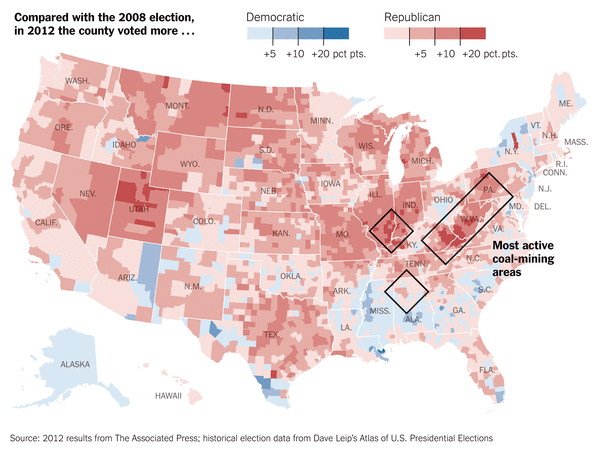
How Risky Is Going After Big Coal?

Coal Territory

For Democrats, not very:

The war on coal hasn’t hurt the Democrats very much in presidential elections. Since 2000, when coal country and Appalachia helped cost Mr. Gore the presidency, Democrats have built an alternative path to victory with large margins in diverse, well-educated metropolitan areas, like Northern Virginia, Denver and Columbus, Ohio. Additional losses in coal country haven’t changed this because the areas don’t have enough voters to make a difference in battleground states.

And coal country has clear boundaries that limit harm to Democrats. In 2012, Mr. Obama suffered significant losses in the coal country of southwestern Virginia, losing as much as a net 30 points in traditionally Democratic Dickenson and Buchanan counties. Yet just a few miles to the east, in counties where there are no coal mines, Mr. Obama retained nearly all of his support. The same was true in southeastern Ohio.

Alec MacGillis adds:

Take Kentucky, the focus of much of the punditry, given the close race between Republican Senate leader Mitch McConnell and Democratic challenger Alison Lundergan Grimes. Coal-mining employment in the Bluegrass State has plunged by more than half in the past three decades, from 38,000 in 1983 to under 17,000 in 2012, according to the U.S. Department of Labor. (Nationally, there are 78,000 people employed in coal miningwell less than half as many as are employed in oil and gas extraction, and not much more than the number of people employed in logging.) To put that in perspective: the auto manufacturing industry in Kentucky employs three times as many people as the coal industry does today. When is the last time you heard pundits making grand predictions about how new auto-industry regulations would affect Kentucky “Car Country”?

China Gets Serious About Climate Change?

Maybe:

China said on Tuesday it will set an absolute cap on its CO2 emissions from 2016 just a day after the United States announced new targets for its power sector, signaling a potential breakthrough in tough U.N. climate talks.

Plumer unpacks the news:

If China ever did put a cap on its absolute carbon emissions, that would definitely mark a big policy shift. For now, China has only aimed to restrict its “carbon intensity” — the amount of carbon-dioxide it produces per unit of economic output. That means China’s overall emissions keep growing as the nation’s economy expands. A cap on emissions, by contrast, would require overall emissions to peak.

Also:

It’s not yet guaranteed that China will actually announce a cap. The man who made the announcement — He Jiankun, chairman of China’s Advisory Committee on Climate Change — is an adviser to the government, but he’s not a government official. So we’ll still have to see if this is the official Chinese government’s position. … More importantly, we don’t yet know the details of this supposed cap. What emissions will get capped? All of them? Some? How stringent will the cap be? Will it be enforceable?

Keating hopes the Chinese follow-through:

The Chinese government and official media often present the U.S. position on emissions as deeply hypocritical. China, after all, still has much lower emissions per capita than the United States, and the U.S. and Europe were able to pollute their way to prosperity in an era before concerns about global warming. Why, the argument goes, should China and other developing countries shoulder the burden for a problem largely created by the West?

This argument, paired with the American aversion to any new emissions rules that won’t also apply to China, creates a perfect feedback loop of inaction, with both countries arguing that the issue is the other side’s problem. While still very preliminary, this week’s news could be an indication that the two countries are starting to break out of the cycle and take some action on their own.

What Andrew Revkin is hearing:

I consulted with The Times’s Beijng bureau. Christopher Buckley, a reporter [based in Hong Kong] who in 2011 had covered China’s emissions plans [and similar pushes from advisers to adopt a cap] while with Reuters, spoke with He Jiankun, who told him repeatedly that he did not in any way speak for the government, or the full expert climate committee. Here’s Buckley’s translation:

It’s not the case that the Chinese government has made any decision. This is a suggestion from experts, because now they are exploring how emissions can be controlled in the 13th Five Year Plan…. This is a view of experts; that’s not saying it’s the government’s. I’m not a government official and I don’t represent the government.

Keith Johnson adds more context:

Beijing’s formal environmental goals are designed to make the economy relatively cleaner but allow overall greenhouse gas emissions to keep rising as the economy keeps growing. The latest official targets, for instance, are meant to cut carbon emissions per unit of GDP by 2015, rather than cutting carbon emissions outright. China is struggling to meet even those lower targets. Meeting these potentially more ambitious ones will be even harder.