Creepy Ad Watch, Ctd

mexico-city-breastfeeding-hed-2014

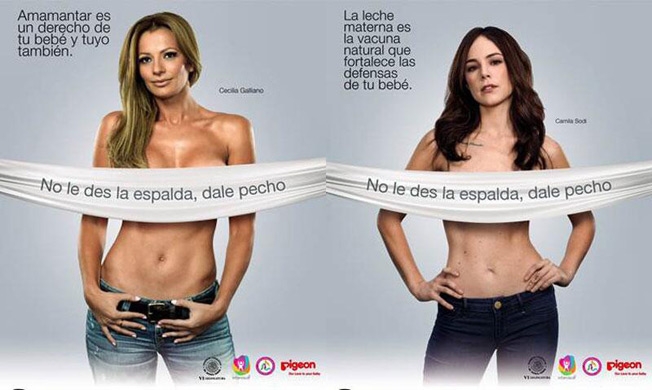
Adding to this reader’s comments, a Colombian reader further contextualizes the debate surrounding the racy breastfeeding campaign in Mexico City:

Many of the protesters of the campaign were against it because it stigmatized those women who choose not to breastfeed for valid reasons. In Spanish, the expression used has multiple meanings that were intentional: Rebecca Cullers’ literal translation fails to capture the contrast meant. Giving your back is equal to be selfish or lazy, and giving your breast also means to be brave (dar el pecho = to face a problem).

Meanwhile, Mya Frazier suggests that bra manufacturers could hold the key to normalizing public breastfeeding:

Fantasy and lust, as embodied in its annual televised Fashion Show, define the Victoria’s Secret brand, but it is also an innovator in bra design, with new product launches a key part of its marketing efforts. Yet while Victoria’s Secret works on a bra with “improved nipple concealment,” other companies appear to be dominating innovation in the nursing bra category. There’s a patent application for a nursing bra that would hold a thin circular heating/cooling device to provide “relief from engorgement, plugged ducts, mastitis and other general nursing pain.” There’s even a patent for a device to connect a breast bump to nursing bra for “hands-free” pumping.

In her book, Breastwork: Rethinking Breastfeeding, Alison Bartlett argues for the acceptance of breastfeeding as a potentially erotic experience, asking: “If it’s generally acceptable or even desirable in Western culture to have sexy breasts available for public viewing, what would be the effect on that set of values and meanings if we regarded lactating breasts as sexy?” Could a brand like Victoria’s Secret use its multi-million dollar advertising budget to disrupt the carefully constructed borders between the sexualized breast and the maternal breast? Millions of babies and their mothers might be better off for it.

To widen the thread further, here’s an excerpt from Chavie Lieber’s piece on “men who drink breast milk”:

Some men who drink breast milk, like Anthony, cite reasons of health or nutrition. Jason Nash, a 55-year-old father of four, started drinking breast milk after the birth of his first child. “It occurred to me that breast milk could be just as healthy and tasteful for adults as infants,” Nash said. “I believe it has kept me from getting sick all these years.” His wife isn’t thrilled, but doesn’t mind as long as the milk comes from a safe source.

For other men (not least those in adult-nursing relationships), breast milk is a kink. “All I’ll say is it’s a fetish for me,” wrote another man, whose post on Only the Breast identified him as a “nice, harmless man in New Jersey seeking breast milk from healthy, non-smoking mom.”


Poseur Alert

“I have no axe to grind about the ban on smoking in public places, nor do I resist the shift in social mores that nowadays makes it, oftentimes, a solecism to light up in a private home. Nonetheless I miss smoke; it draped a decent veil across interior vulgarities, while softening our loved ones’ hateful features. Moreover, it was something to look at: its chiffon convolutions and tulle thunderheads made perfectly dull places seem excitingly mysterious. I don’t think the NHS’s smoking cessation schemes make enough of this: what we smokers need to help us kick this obnoxious addiction is a portable son et lumière, not a packet of nicotine gum. Nicotine gum is in fact the spatial inversion of smoking: the gum-chewer, instead of looking out, as the smoker does, on a roiling boiling atmosphere, has his attention driven entirely inward to a dark and claustrophobic space where giant teeth clash and clash again,” – Will Self.

Boozy Beasts

Do wild animals enjoy recreational drugs as much as humans? The vervet monkey might:

Sometimes called green monkeys, they are native to Africa, but a handful of isolated groups dish_vervetwound up scattered across islands in the Caribbean. In the 18th and 19th Centuries, slavers often took the monkeys as pets, and when their ships landed in the new world, the monkeys easily escaped or were intentionally released. There, free of most of their predators, the small primates adapted quite well to tropical island life. For 300 years, the animals lived in an environment dominated by sugar cane plantations. And when the sugar cane was burned, or occasionally fermented before harvest, it became a treat for the monkeys. As they became accustomed to the ethanol in the fermented cane juice, the monkeys may have developed both a taste and tolerance for alcohol. …

Descendants of those introduced monkeys have since been studied so that we can understand more about their boozy behavior. One study found that nearly one in five monkeys preferred a cocktail of alcohol mixed with sugar water over a sip of sugar water alone. Intriguingly, younger individuals were more likely to drink than older individuals, and most of the drinking was done by teenagers of both sexes. The researchers, led by Jorge Juarez of Universidad Nacional Autonoma de Mexico, suspect that older monkeys shun alcohol because of the stresses of monkey politics. “It is [possible] that adults drink less because they have to be more alert and perceptive of the social dynamics of the group.” In other words, at some point the monkeys leave their days of heavy drinking and hangovers behind and start acting like adults.

(Image of a vervet monkey with sugar cane via Robert Neff)

An Accounting Of American Racism, Ctd

A reader protests:

Did your readers, who I look to as a refreshingly open-minded community, even read Coates’ article? To quote him:

Broach the topic of reparations today and a barrage of questions inevitably follows: Who will be paid? How much will they be paid? Who will pay? But if the practicalities, not the justice, of reparations are the true sticking point, there has for some time been the beginnings of a solution.

And we devolve into half-serious talk about half-black children and then curl up in the fetal position and say, “It makes my head hurt”?

Coates himself realizes, I think, that we may never have a day when white folks are writing checks to black folks. And that’d probably do more harm than good anyway.  But what we can do is help the people who have been harmed decade after decade with jobs and healthcare and whatever else we can think of to bridge the gap. But importantly – acknowledge aloud that we are acting out of a sense of obligation to right a wrong we have the capacity to try and fix.

Another passes along “three handy tips to help you suss out folks who haven’t actually read” TNC’s essay. Number one: “They talk a lot about slavery.” Another concurs:

I admire what Ta-Nahesi Coates is doing by revisiting the argument for reparations. And I am also deeply disappointed reading comments on The Dish and around the internet that can’t get past the year 1865. This is not just about slavery. If I understand him correctly, this is a thought exercise to update the reparations claim through the 20th century (and 21st) that moves past slavery to implicate North and South, as well as immigrants who arrived after the Civil War. Sharecroppers working white land after a landless emancipation, black maids and sharecroppers denied Social Security, decades of African Americans paying taxes for FHA loans they couldn’t have and for freeways to those white Levittowns that tore through black neighborhoods and forced African Americans into projects.

I believe Coates wants his reader to look at every stop on this reparations tour and make his or her case for where they would get off, to argue where they would draw the line. But once they see the route he is taking, all I read is, “Oh, slavery, that’s my stop. Would’ve been nice for money back then, but what can you do?”

Another is on the same page:

In synthesizing for his readers the tremendous work done over the past two decades by historians about how suburbia was created as a white’s-only domain, Coates is making two different arguments about the logic for reparations that we normally hear when slavery’s at its center. He’s arguing first that the material effects of racial inequality, effects underwritten by federal policy, are far more recent than the usual “slavery was a long time ago” argument. There are no antebellum slaveowners alive, but there are millions of people who were suburban homeowners between 1938 and 1968.

Second, he’s showing, again mainly in the Lawndale sections, how suburban segregation created the conditions whereby blacks could be defrauded by contract sellers who dramatically increased home prices and held the deed so they could evict people on any pretenses in order to resell their homes, multiplying their profit many times over. Beryl Satter, whose work Coates is drawing from, estimates that contract selling stripped one million dollars a day out of Lawndale alone.

People asking Coates how reparations would work have a duty to actually consider the argument he’s making. Are so many unwilling to do so, and so willing to fall back on “75 percent of southern whites didn’t own slaves,” because it’s too uncomfortable to look at their parents’ or grandparents’ houses as spaces of Jim Crow?

Previous Dish on the reparations discussion herehere, and here.

The Best Of The Dish Today

Two big news events of the day – the prisoner exchange with the Taliban and the new EPA rules. My take on the GOP on climate here. My conflicted feelings over Bergdahl here. Plus: the world’s first elphie – i.e. an elephant selfie. Terrible real estate photographs. And the far too defensive nature of the transgender movement.

Sargent has something to add about the GOP’s know-nothingism on the climate. He thinks the Dems have concluded that they can handle the blowback from coal states now if they can secure bigger majorities among the young in 2016. Money quote:

Look back at this Pew poll from last fall. It shows that the very voter groups who could continue giving Dems a demographic edge in national elections — the same groups that Republicans must broaden their appeal among — overwhelmingly believe there is solid evidence of global warming:

73% of those aged 18-29 believe it’s happening.

76 percent of nonwhites believe it’s happening.

67 percent of college educated whites believe it’s happening.

Meanwhile, far more Republicans remain skeptical of global warming, but this is largely driven by Tea Party Republicans. While 61 percent of non-Tea Party Republicans believe there is solid evidence of global warming, only 25 percent of Tea Party Republicans believe this.

It’s a wedge issue!

The most popular posts of the day were The Scandal of the GOP and Climate Change; followed by A Problematic POW.

Many of today’s posts were updated with your emails – read them all here. You can always leave your unfiltered comments at our Facebook page and @sullydish.

20 31 more readers became subscribers today. One writes:

Your Quote for the Day finally got me over the hump and I’m a first-time annual subscriber (and longtime reader).  Not that it told me anything I didn’t already know, but as I find myself increasingly irritated by the click-baitey approach to online publishing, it helped me finally admit that if I’m not part of the solution, I’m part of the problem.  Keep fighting the good fight.

You can join him here. Unless you prefer to have a fucking video ad pop up from fucking nowhere and ruin your day.

See you in the morning.

Behind The Classical Music

George B. Stauffer runs down a few of the more dramatic episodes in John Suchet’s Beethoven: The Man Revealed, a biography that eschews the development of the composer’s music to focus on his “erratic behavior and fiery temperament”:

Beethoven thrived as a strong-willed but socially adept virtuoso pianist and composer for hisBeethoven first 25 years or so. As he developed hearing problems in his late 20s, however, and moved toward the realization that the malady was irreversible, he began to turn inward. As he descended into deafness in his 30s and 40s, he grew increasingly mercurial, irritable, and paranoid. At times, he appeared to be fully irrational. He wrote emotional confessionals and fought with members of his family. He flirted with numerous women but was unable to sustain a lasting relationship. He moved restlessly from dwelling to dwelling, changing residences in Vienna more than 30 times in 35 years. A smart dresser in his youth, he appeared increasingly unkempt and disheveled. In his final decade, he became so dissipated that he was once mistaken for a vagabond and thrown into jail. By any measure, Beethoven’s personal life was bizarre. …

The Beethovenian paradox of “crisis and creativity”—to use the phrase coined by [Maynard] Solomon—has been well described in the past. But no one before Suchet has focused quite so intensely, and so eagerly, on the crisis part—and the composer’s melodramatic highs and lows: stopping the orchestra during an already overly long performance and insisting that the players start again from the beginning; refusing to bow before passing royalty when walking in the park with Goethe; receiving a distinguished visitor with an unemptied chamber pot under the piano. Such stories, well known to historians, are too good to make up.

(Image: Joseph Karl Stieler’s portrait of Beethoven, 1820, via Wikimedia Commons)

The New Marxishism

Reviewing Benjamin Kunkel’s new book, Utopia or Bust: A Guide to the Present Crisis, Kyle Chayka describes the new flavor of leftist political thinking that Kunkel labels “Marxish”:

The “Marxish” coinage is a good way of referring to this next-generation critical political thought being put into practice by the left, a kind of functional Marxism. Marxish dumps Marx’s difficult teleology in which socialism inevitably triumphs over capitalism, or “capitalist production begets, with the inexorability of a law of Nature, its own negation.” Instead, thinkers like Kunkel and his subjects are using Marxism as a tool to deconstruct and mitigate the destructive effects of capitalism as we see them occurring in the world today.

The Marxish milieu has come to the fore lately in a collection of journals and magazines widely regarded as the forefront of contemporary intellectual writing in the United States. The thrice-yearly journal n+1, of which Kunkel is a co-founder, provided space for Marxish criticism, produced a broadsheet during the heyday of Occupy, and has served as an incubator for books about the financial crisis, office environments, and hipsters. The magazine also produces posters emblazoned with the suitably tongue-in-cheek-or-is-it slogan “Utopia in our time.”

Debunking Of The Day

The phrase “rule of thumb” doesn’t have the origins you think it has:

Update from a reader:

As a professional researcher in the legal field, I enjoyed that video greatly. However, I am terrified of sharing it with my friends for fear of being pilloried as a misogynist. When I tried to suggest, while in no way condoning his vicious rants, that Elliot Rodger’s actions were more those of a mentally ill person than a “natural result” of widespread hatred of women, my suggestion was so quickly and roundly dismissed in light of his “obvious” motives that I decided to politely bow out of further discussion. It seems that much of twenty-first century feminism has taken on many elements of religious fundamentalism, in this case using patriarchy and misogyny as its original sin. And like Islamic and Christian fundamentalists, the most faithful interpret the world through their central ideology and will not engage in any discussion that might hold it as less than absolute truth.

Where Self-Driving Cars Will Take Us

Thinking about how driverless cars will influence how we think about driving, Eric Jaffe wonders if it would be possible to program one for road rage:

I posed that question to Chris Urmson, head of Google’s self-driving car program, when I rode in the car on city streets in late April. In a strict technical sense, sure, the car could be programmed for aggression. But in line with the safety points mentioned above, Urmson said it’s “probably not the right thing to emulate all the human behavior” in programming driverless cars. … Urmson believes self-driving cars might have a therapeutic effect on aggressive driving styles. Slowly you’ll stop noticing the things that once made you irate on the road, and eventually you’ll forget they even existed. That’s a huge change in how we travel. Riding in cars, in this case, would become more like riding on trains or subways: the occasional unexpected stop will be annoying, but largely outweighed by the chances for diversion.

John Michael McGrath expects self-driving buses to be a more promising innovation than self-driving personal cars:

I strongly suspect sitting in traffic isn’t actually going to be more amusing just because your car is a robot. (Or at least, not after the first few times.) We will still need to find ways to move people more efficiently than any single-passenger vehicle can. That’s why people are mistaken when they say autonomous vehicles are going to mean the end of traditional mass transit.

Rather, the same kind of technology that allows self-driving cars should also allow transit operators to introduce self-driving buses, if voters (and transit unions) will accept it. Buses will continue to make more efficient use of the road due to physics and geometry than even the slimmest self-driving cars. Voters can be leery of driverless transit, but it can offer much higher frequency in off-peak times than systems relying on higher labour costs.

T.C. Sottek posits that driverless cars could be a boon for privacy as well, by eliminating one of our most common encounters with the police:

Privacy is about more than just data collection. It’s also about feeling secure against someone searching through your belongings. While the Bill of Rights protects citizens against unreasonable searches, it’s no guarantee that your rights won’t be violated — just ask David Eckart. Eckart’s example is extreme, but the kind of traffic stops that led to his ordeal are very common. Forty-two percent of involuntary encounters with police in the United States happen in cars, and many of these encounters lead to searches. …

In total, violations based on driver behavior accounted for 68.1 percent of traffic stops by police. In other words, human beings were pulled over in most cases because they’re human: they break the rules of the road and sometimes make mistakes. In some cases, like obeying speed limits, there’s even a cultural expectation that most people will routinely break the law. As the ACLU’s senior policy analyst Jay Stanley tells The Verge, this means that roads are quasi-authoritarian spaces that give police huge discretion in choosing who to punish. But in a world with self-driving cars, things would look much different. “The latitude of the police to pull people over would be much reduced,” Stanley says. “People wouldn’t be subject to so much arbitrary enforcement.”

And Camille Francois hopes they will get people to pay more attention to surveillance:

It’s quite clear: for most people, the link between government surveillance and freedom is more plainly understood by cars, rather than personal computers. As more and more objects become connected to the Internet these questions will grow in importance. And cars in particular might become, as Ryan Calo puts it in a 2011 article on drones, “a privacy catalyst”; an object giving us an opportunity to drag our privacy laws into the 21st century; an object that restores our mental model of what a privacy violation is.

When my grandmother starts to consider technologically-enabled constraints on how she can drive; or people knowing exactly where she can go—abstract issues of “autonomy” and “privacy” become much more real. … And that is important because in order for our society to shape the rules that will make the future of self-driving cars one in which we want to live, we need all members of society to contribute to the conversation. We need to ask: what happens when cars become increasingly like computers? With self-driving cars, are we getting the best of the computer industry and the car industry, or the worst of both worlds?

Previous Dish on self-driving cars here and here.

He Likes To Be, Under The Sea …

Fabien Cousteau (grandson of Jacques) and five other ocean scientists are spending 31 days living in an underwater habitat off the coast of the Florida Keys. Svati Kirsten Narula interviewed Cousteau about the project before he went under:

Ocean scientists have made enormous strides in underwater research, but the 20th century’s love affair with outer space means we know far more about the moon than we do about the sea floor. Cousteau sees Earth as a “little brown veneer,” compared with the vastness of the sea—and he gets frustrated when people marvel at the Earth’s oceans by saying that 70 percent of the planet is covered by water. “[That’s] talking about the world in a two-dimensional way, and the planet is three-dimensional,” he said. “So if you’re talking about a three-dimensional system, the oceans represent 99 percent of our world’s living space. And yet we’ve explored less than 5 percent of it.”

This is something of a sore subject for ocean scientists, who point out that public funding for space exploration dwarfs the money that undersea researchers get. …

Mission 31 is concerned with how the oceans are changing—namely, what we humans are doing to them. We’ve been using them as a carbon sink, a garbage dump, and simultaneously, a garden from which to harvest. Three broad subjects of study for the Mission 31 scientists are ocean acidification (as it relates to climate change), ocean pollution (with an emphasis on the effects of plastics), and declining biodiversity (attributed to overfishing). This is a bona fide research expedition, but it’s also a publicity stunt. Cousteau wants to drum up enthusiasm for the sea, which helps explain why he’s letting celebrities like rapper will.i.am and billionaire entrepreneur Richard Branson dive down to Aquarius for short 45-minute visits, and auctioning off similar experiences to the highest bidders. The idea, Cousteau says, is to spark the interest of a population of people who haven’t previously gotten excited about the ocean—and to change the way they think about the planet.

“It’s really about engaging audiences young and old to dream, to aspire—the way we used to with the Apollo mission.”