David Biello profiles Victor Smetacek, a marine biologist who devised a scheme to use plankton to help cool the earth:
Much of the oxygen we breathe comes from just one species of cyanobacteria, Prochlorococcus. This species was not even discovered until the 1980s: it is so tiny that millions can fit into a single drop of water and no one had produced a sieve small enough to catch it. The oxygen made by these tiny marine plants dwarfs that produced by the Amazon rainforest and the rest of the world’s woodlands combined. By taking in CO2 and exhaling oxygen, these tiny creatures serve as the planet’s lungs, whose steady breathing is limited only by nutrition.
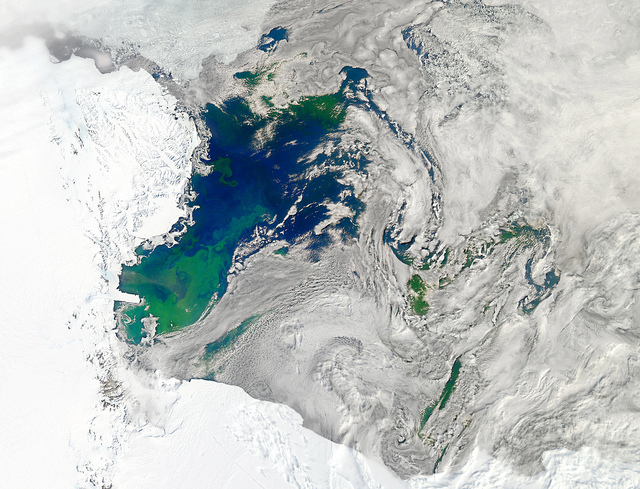
Just as land plants need nitrogen, phosphorus and other elements to thrive, missing nutrients restrain planktons’ growth. Add enough of those missing elements – via dust blown off a continent or fertiliser run-off from farm fields – and the oceans will produce blooms that can be seen from space. Many of these plankton pastures are held back by iron shortages, especially in places that are largely cut off from continental dust and dirt. With access to more iron, the plankton would proliferate and siphon more and more planet-heating CO2 from the atmosphere.
In an experiment in 2004, Smetacek’s ideas worked. He and his crew “fertilized” part of the Southern Ocean, which surrounds Antarctica, and the plankton bloomed with remarkable results:
For two weeks, he was able to induce carbon to fall to the sea floor at the highest rate ever observed – some 34 times faster than normal. Just as marine and terrestrial plants sucked up CO2 from Carboniferous or Jurassic skies only to be buried and cooked with geologic heat and pressure into coal, gas and oil, these modern microbes helped pull back some of the CO2 released when we burned their ancestors to make electricity, or to propel hulks of metal over tarred roads. This marine tinkering could help buffer the ever-increasing concentrations of CO2 in the atmosphere, concentrations that have touched 400 parts-per-million, levels never before experienced in the hundreds of thousands of years that our clever species, Homo sapiens, has existed. Smetacek has given us the blueprints for a man-made portal for our pollution, a column of plankton running between the atmosphere and the deep ocean.
Further experiments, however, were halted due to protests from environmentalists. Update from a reader:
O for crying out loud! The articles describing Smetacek’s experiments came out in 2012. Environmentalists called for more study in 2008, and that’s what they got. You think we should just launch a huge plan to dump tons of iron sulfide over the Southern Ocean without studying it seriously first? And one of the papers resulting from the experiment is titled: “Iron fertilization enhanced net community production but not downward particle flux during the Southern Ocean iron fertilization experiment LOHAFEX“. From the abstract:
Our data thus indicate intense flux attenuation between 100 and 200 m, and probably between the mixed layer and 100 m. We attribute the lack of fertilization-induced export to silicon limitation of diatoms and reprocessing of sinking particles by detritus feeders. Our data are consistent with the view that nitrate-rich but silicate-deficient waters are not poised for enhanced particle export upon iron addition.
From the conclusion:
Our results add further evidence to support the idea that Fe fertilization does not necessarily stimulate POC export and sequestration under Si limitation in the Southern Ocean. Zooplankton community composition and activity under the mixed layer may strongly regulate the export by reprocessing sinking particles and altering the particle size distribution.
Things are not as simple as Martin hoped, back in 1988.
(Image via the NASA Goddard Space Flight Center. This true-color image captures a phytoplankton bloom in the Ross Sea on January 22, 2011, as viewed by the Moderate Resolution Imaging Spectroradiometer (MODIS) on NASA’s Aqua satellite. Bright greens of plant-life have replaced the deep blues of open ocean water)
 The Dish