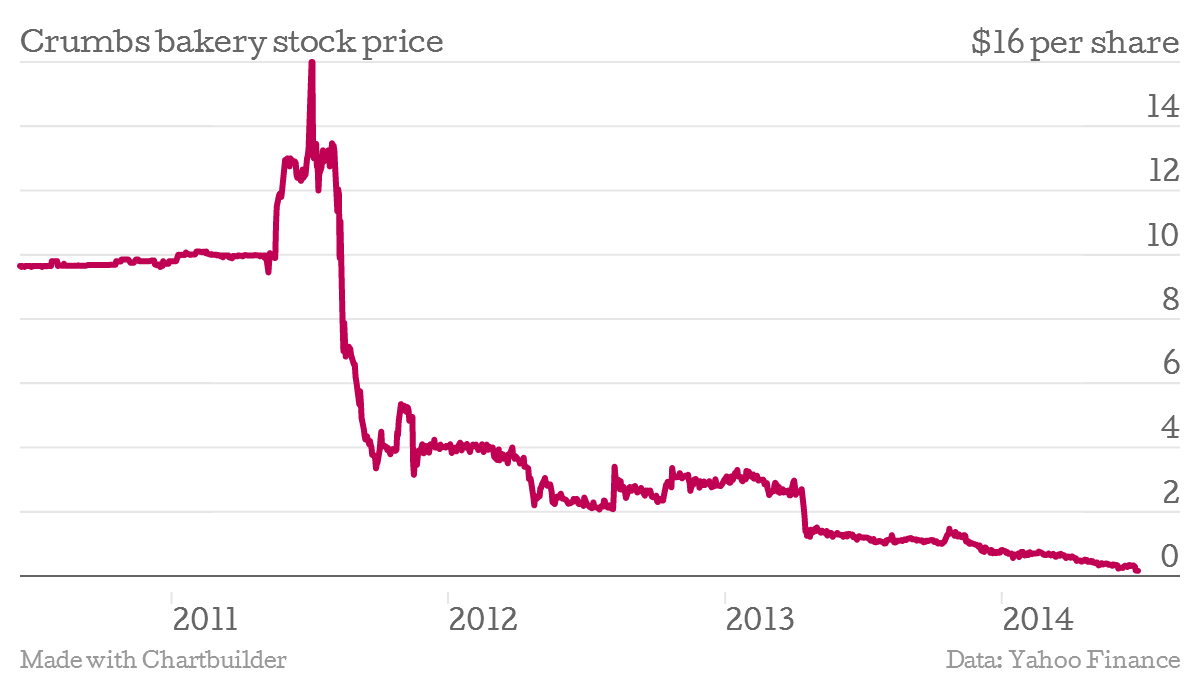
Roberto A. Ferdman is unsurprised that cupcake company Crumbs is closing up shop:
Cupcakes are a fad, not a food staple. The cupcake bubble, after all, was exactly that: a bubble. And bubbles—even cupcake bubbles (paywall)—burst. The market called this one back in 2011.
has seen this all before:
Crumbs joins the long list of once hot food franchises that couldn’t resist the smell of growth and ultimately had difficulty managing it: David’s Cookies, Krispy Kreme, Einstein Bagels, World Coffee, just to name a few. They can survive, but generally after massive restructuring. Crumbs ran out of time and money. The pattern is similar: a good product or idea becomes increasingly popular, and investors get moon-eyed about the prospects. At the same time, other operators and investors will swear to you that there’s plenty of room for more than one brand—or that if there isn’t much room, their concept is superior.
Daniel Gross predicted this years ago:
Trends often inspire counter-trends. And the latest hot trend in dessert has proven to be something of a backlash to cupcakes. The cupcake bubble has been replaced, as I documented last year, by a fro-yo bubble. Tart instead of sweet, light instead of heavy, low-cal instead of fattening, fro-yo is in many ways the ying to the cupcake’s yang.
But John Aziz believes there “was never a cupcake bubble”:
[C]upcake sales have declined a little — falling 6 percent in 2012, flat in 2013, and falling 1 percent so far this year, according to NPD — but that is nothing like a bursting bubble. That’s a gentle, gradual decline that’s reflective of consumer tastes that have gradually changed, a marketplace that has become crowded, and snacks like the cronut and wonut that have begun to eclipse the cupcake. … Companies like Crumbs who botch their expansion plans, leaving themselves stuck with high levels of debt, tend to fail in whatever industry they are in. That’s not a bubble bursting — that’s business.
Jessica Grose finds all the cupcake hated a “little sexist”:
What’s going on seems to be about more than just the confection, which, like any other, some people enjoy eating and others do not. My theory: It’s about a dismissal and dislike of a certain kind of woman. (Hooooooold on, hear me out.) The kind of woman who watches Sex and the City (an important driver of the cupcake trend) and takes the bus tour to Magnolia Bakery. The kind of woman who gets excited about J. Crew catalogs and Instagrams her “glittery cupcake nail art.”
Mary Elizabeth Williams defends the humble cupcake:
Crumbs didn’t fail because people have stopped loving cupcakes. Put out a tray of cupcakes – Hostess, homemade, you name it – at a partytoday and see how long it lasts. Crumbs failed because the novelty has worn off — and because the product itself simply couldn’t sustain consumer loyalty after it had. But as long as there are mouths, people are going to love cupcakes. It’s cake you can carry around; figure it out. Victory will always belong to cake, even when all that’s left of Crumbs is, well, you know.
David Sax is of the same mind:
After nearly two decades as the reigning dessert trend in America, and increasingly the world, the cupcake will not go away. It will be there at birthdays, graduations and office parties. It will still elicit palpitations of excitement on sight, even from those who cursed its constant attention, because fundamentally the cupcake’s enduring strength is its very essence: a cake you can hold in your hand and eat without a fork. A cake you can eat in the car. America’s perfect cake.
 The Dish