A reader writes:
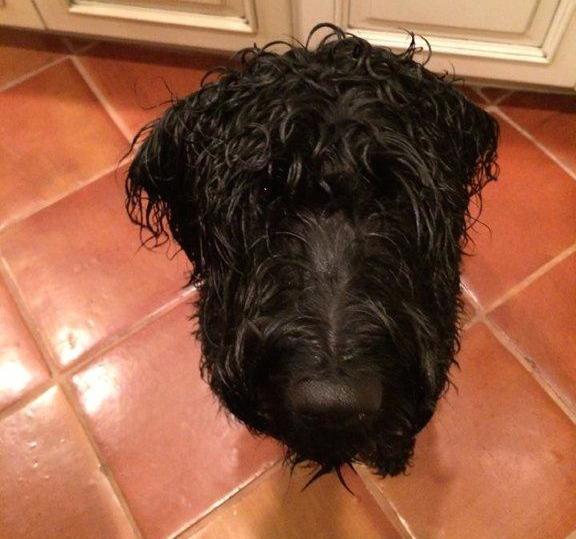
It really is true that it is more work to appreciate the features of a black dog. For instance, in this photo of my dog, you can barely see his eyes:
Or his body. Or his feet.
Another can relate:
I volunteered at a shelter and noticed this problem too. I adopted a black-haired, medium-sized, young adult, mixed-breed dog who turned out to be essentially perfect. I find that with a decent camera and some experience, experimentation, and digital editing, one can make great photos of black-haired dogs. Here’s one I took of my dog, which I think proves the point:

Another reader:
We recently adopted a rather large black dog. Sonny is beautiful, but there are problems.
First, Sonny is impossible to see at night. That means he sometimes gets stuck at the back door, begging to be allowed back in the house. And sometimes, in the middle of the night, I get tripped up on my way to the bathroom.
Second, having a black dog muddies my standing as a yellow dog Democrat. In years past, when asked about my politics, I just pointed to my pooch. Can’t do that now.
Another has a suggestion for photo-taking:
As you can see, black dogs can be photographed wonderfully, and tools like Instagram help:

Another has more tips:
First, there’s the Black Dog Project if you want to see some great photographs of black dogs. The photographer, Fred Levy, photographs them against dark backgrounds to highlight the difficulties they face in being adopted.
Secondly, there’s a few things that you can do when taking photographs of black dogs to make them turn out better. This is really good for shelter workers, but also just for regular dog owners who want better photos of their pooches. Black dogs can seem scary and ominous, but if you play with the dog for a few minutes and get it into a light pant, they start to look like they are smiling, and their eyes come alive. The dog goes from scary to friendly in an instant. Washing them and giving their coat a good brush will help them shine and create really nice highlights that also make them turn out less like a dark blob in a photo.
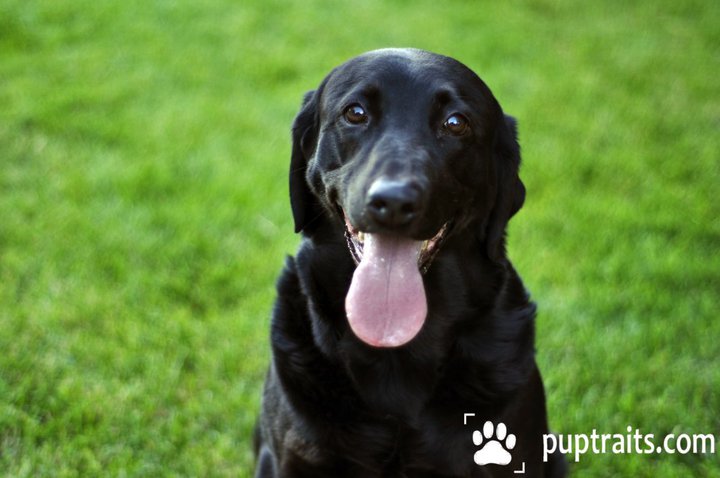
Finally, I’d be remiss to not include a photo of my own black pup:
Another has a different recommendation:
The best barbecue joint I have ever been to in my life is in Urbana, Illinois, home of the University of Illinois, called Black Dog Smoke and Ale House. It proudly displays several signs about this exact issue of adoption, donates to the Humane Society of Champaign (a no-kill shelter), and the owners have their own adopted black dogs. And their food is out of this world. If you ever find yourself lost in the cornfields of Illinois, worth the time.
More readers share their pup pics:
I knew about the bias against black cats in shelters, but I didn’t realize it extended to dogs. He is hard to spot in the laundry basket, though:

Another:
It breaks my heart to think that people might be biased against dogs based simply on the color of their coats. Makes about as much sense as being biased against people based on the color of their skin. Not saying that the effect isn’t real, just that it’s stupid.
My evidence? Take a look at these two adorable mutts that rule over our house: Chloe on the left and Chip on the right:
Never a better pair of “pound puppies” to be found!

Another:
I couldn’t help but write you after reading your post today on the bias against black dogs; it’s an issue I think about daily. I have two dogs, both rescues; one is a beagle/border collie mix (mainly white with charcoal markings), and the other is a black lab/doberman/german shepherd mix. Every evening, weather permitting, I take them on a long walk throughout the neighborhood, and whenever anyone stops to talk, or pet the dogs, the white beagle mix is “the little one,” and Moxie is “the black one.” I find it fascinating. The only exception to this is small children; teens, adults, and the elderly all toe the invisible “little/black” line.
Both of my dogs are extremely friendly, well-
behaved on walks, and love to meet new people. I absolutely understand why strangers would be apprehensive of my larger dog, as she is about 125 pounds, but no one, not ever, in four years of walks, has called her “the big one.” My neighborhood is fairly diverse, but regardless of the ethnicity of the person we meet, she is always the Black Dog. It makes me a little sad, not just because it happens, but because it is apparently such a widespread bias.
Interestingly, the colors/sizes split along gender lines, too. Both of my dogs are female, but strangers always assume the mostly white dog is a girl, and the black dog is a boy (even though she sports a hot pink collar and matching leash).
Like all proud dog owners, I can’t resist talking about my dog without forcing you to look at sending at least one picture along. Look at that face!
I can’t close without telling you how much I enjoy The Dish, and how meaningful it is to me in my daily life. I’m a founding member, and I can say without a doubt that my membership is one of the most rewarding purchases I’ve made, and I plan on renewing into perpetuity. Thanks again!
One more:
Our black dog is Chaucer, born in Oxfordshire, who has traveled with us through 10 countries on our (USAF) military career. We are now in S. Korea for another year on assignment. He has flown over the Atlantic and Pacific and is a love. Koreans are afraid of large dogs and people have been known to run screaming when they see us on our walks. The younger folks stop and ask if they can have their picture taken with him. As you can see, he is very photogenic; please, please, PLEASE add my gorgeous boy to your black dog thread. You will make him very happy!

 The Dish