That’s the good news as the journalism industry morphs into a branch of public relations. A new study has followed up on Tony Haile’s evidence that no one reads the damn stuff anyway. Its findings?
Two-thirds of readers have felt deceived upon realizing that an article or video was sponsored by a brand.
54 percent of readers don’t trust sponsored content.
59 percent of readers believe a news site loses credibility if it runs articles sponsored by a brand.
As education level increases, so does mistrust of sponsored content.
So I’m not alone among the consumers of journalism; I’m just almost alone in being a journalist who is publicly prepared to call this ethical swamp what it is. When asked if they would prefer old-fashioned, honest banner ads rather than this morphing of advertising, journalism and PR, the answer is overwhelming: by almost 2 -1 readers preferred traditional advertising.
But the core legal and political question is whether there is active deception going on, in violation of FCC rules. On that level, today’s media machers have some ‘splaining to do:
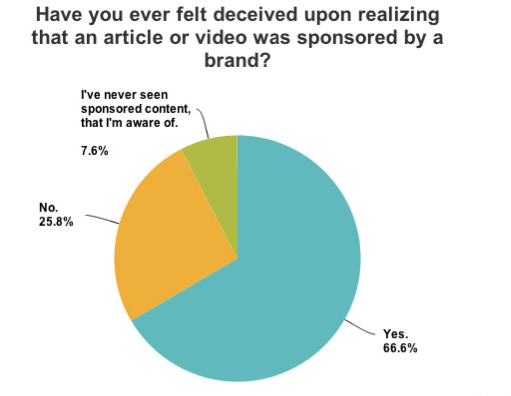
When an industry is engaged in the wholesale deception of its consumers, the public interest is involved. At the very least, it seems to me, we should have Congressional hearings on whether this level of deception can be defended under the law.
Update from a reader:
“But the core legal and political question is whether there is active deception going on, in violation of FCC rules. On that level, today’s media machers have some ‘splaining to do”
Not so fast! The FCC, which regulates radio, TV, and common carriers, does not involve itself with online advertising. Those of us in the Radio/TV industry are familiar with the “sponsorship identification rule,” which requires that advertisers and their related content be identified in those media. There were some serious fines levied recently for this ($44,000 to a Chicago radio station for 11 instances of playing a “news” show that didn’t identify that the content was sponsored, and not actual news). Historically, the practice of payola led to these regulations, to prevent disc jockeys from accepting money to play records and thereby popularize them – a deceptive form of advertising.
 The Dish