Ned Resnikoff defends his coverage of yoga instructors’ labor concerns:
Nobody asks why a story about, say, school teachers or truck drivers counts as news. But for whatever reason, yoga instructors don’t count.
That seems a little odd to me. It’s a skilled service profession, typically requiring some form of accreditation. People do get paid, albeit not very much, for rendering the services in question. So what makes it not-work? To flip the question around, why are stories about yoga instructors not considered to be labor stories?
I can think of a couple possible reasons. One is the widely held perception that yoga instructors are pursuing a hobby, despite the money involved. Another related reason is the casual, precarious nature of the work, which differentiates it from a full-time, salaried position. And a third, less charitable explanation, has to do with the gender breakdown of yoga instructors. Most of them are women, and feminized labor is often dismissed as not being “real” work.
Another reason yoga instructors may not register as suffering workers is that yoga is seen as something largely by and for rich white people. As Rosalie Murphy demonstrates, the stereotype isn’t entirely unfounded. On the racial component:
A 2009 study in the Journal of Religion and Health found that 63 percent of African Americans and 50 percent of Hispanic Americans pray to improve their health. Only 17 and 12 percent, respectively, reported relying on an alternative spiritual practice like meditation or yoga to stay healthy, and almost everyone in that group also prays. In contrast, twice as many white Americans identify with alternative spiritual practices and don’t pray at all.
“It’s easier for someone who’s not committed to anything to do yoga,” [researcher Amy] Champ said. “Ethnicity is connected to spiritual practice. Culturally, African-Americans and other ethnic Americans have their own [spiritual culture]. To get buy-in from those communities is pretty heavy lifting.”
And on the cost:
[O]ften, yoga is a privilege of the upper class. An average one-hour yoga class in Los Angeles costs $17. Most require students to bring their own equipment. A mat costs around $20; lululemon yoga pants, $82.
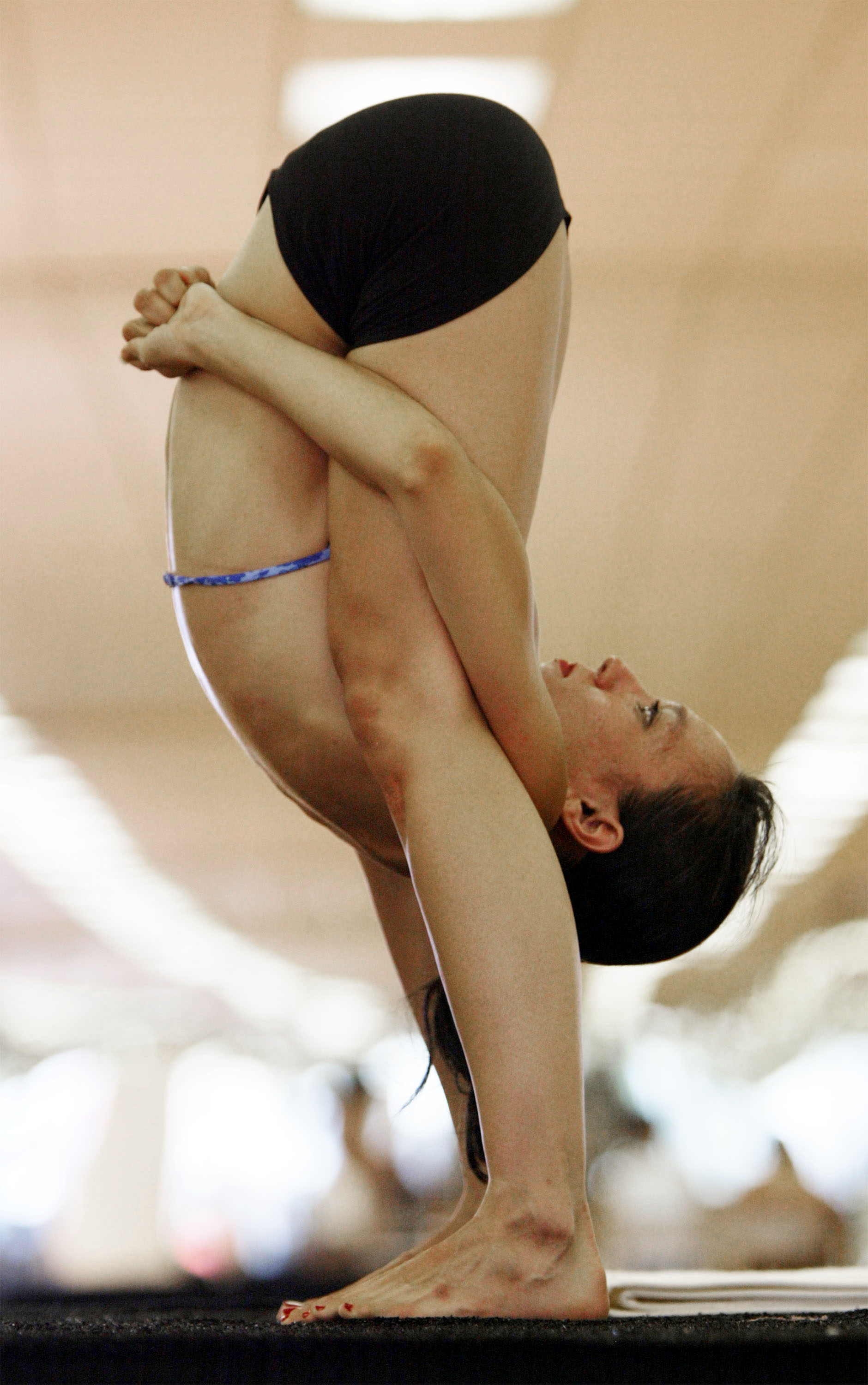
(Photo: Noriko Moser, of Pasadena, California, competes in the semifinal round of the 2003 International Yoga Championship-Ghosh Cup July 12, 2003 in Los Angeles, California. By David McNew/Getty Images.)
 The Dish