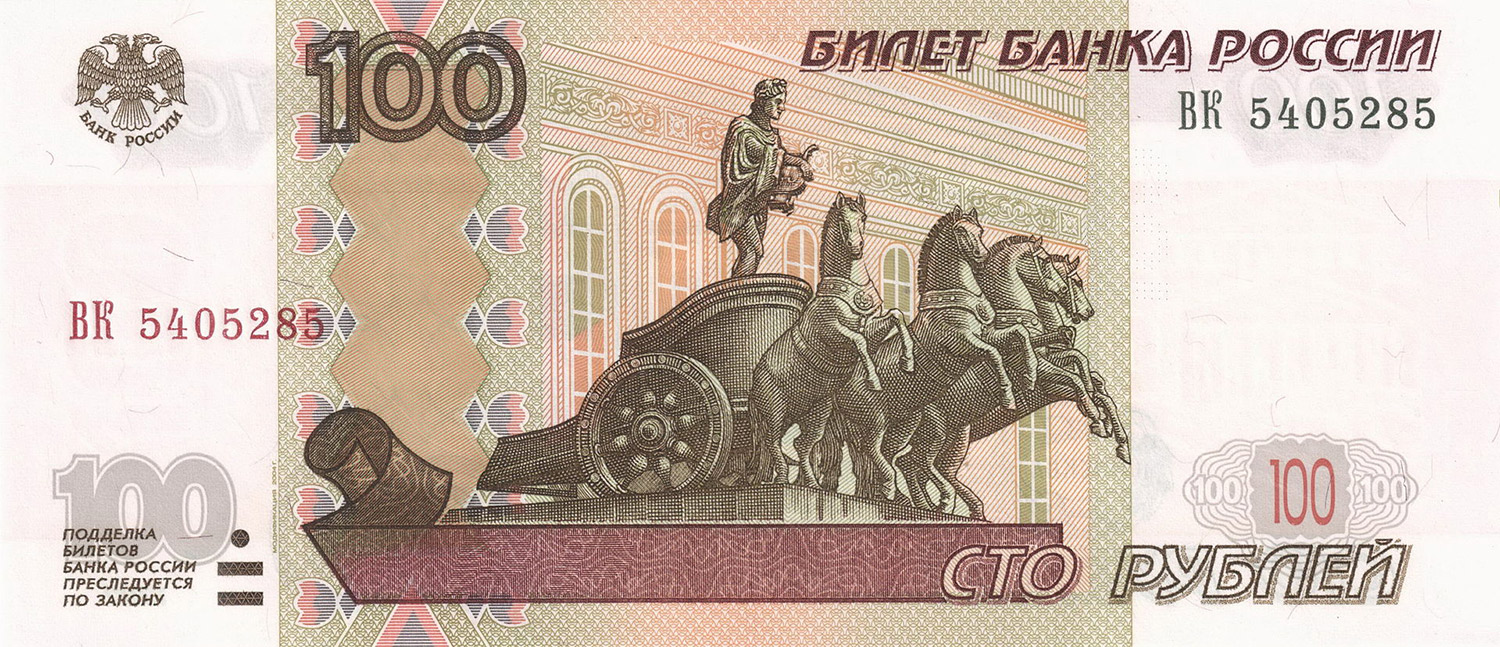
But not in the way you might imagine:
Roman Khudyakov, a member of the Russian Duma, is gravely concerned about a moral threat to the country’s children: he recently discovered that youngsters are being exposed, on a daily basis, to a graphic image of male genitals. The object of Khudyakov’s outrage is the hundred-ruble note (worth a bit less than three dollars), which shows the façade of the Bolshoi Theatre, adorned with a world-famous sculpture of a chariot driven by the Greek god Apollo. It is Apollo’s intimate parts that, in Khudyakov’s opinion, pose a dire problem.
In a televised interview on Euronews, he said he had evidence that the hundred-ruble note provoked unhealthy curiosity:
he had personally seen a little boy and a little girl closely examining the bill and pointing to the region of the body in question. (If true, the two kids must have been highly inquisitive: it is extremely difficult to even discern the actual “parts” without magnifying the image.) Khudyakov’s proposed solution was to mark the bill with an eighteen-plus rating. Better still, as he suggested in a letter to the Russian Central Bank, remove the morally improper bills from circulation and replace them with ones bearing an image of Crimea, annexed by Russia in March.
Khudyakov’s initiative may sound like a joke—and, indeed, the Russian media and social networks promptly made fun of it, suggesting that children should now be barred from human-anatomy classes and museums—especially in St. Petersburg and Italy, where a minor might be exposed to the works of Michelangelo and other Renaissance sculptors—and certainly kept away from the statue of the Manneken Pis, in Brussels. The lawmaker’s attack on the banknote was hardly a joke, though. It was, rather, of a piece with the anti-liberal trend that has dominated the Russian scene since Vladimir Putin’s return to the Kremlin.
(Image: the hundred-ruble note in question)
 The Dish