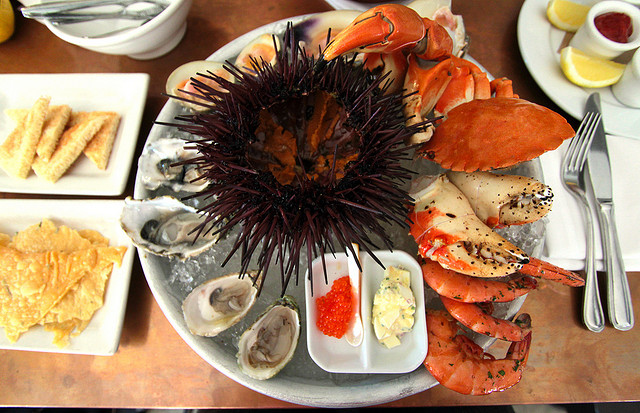
Food trendsetters, Franz Lidz observes, are looking past sea urchins’ spiny exterior:
In the brave new world of fine dining, the roe of the humble urchin—a shellfish once cursed as a pest to lobstermen, mocked as “whore’s eggs” and routinely smashed with hammers or tossed overboard as unsalable “bycatch”—is a prized and slurpily lascivious delicacy. Unlike caviar, which is the eggs of fish, the roe of the urchin is its wobbly gonads. Every year more than 100,000 tons of them slide down discerning throats, mainly in France and Japan, where the chunks of salty, grainy custard are known as uni and believed to be an uplifting tonic, if not an aphrodisiac. The Japanese exchange urchins as gifts during New Year celebrations.
Lidz profiles Roderick Sloan, who harvests the creatures off the coast of Norway. According to one chef, Sloan’s plunder tastes “like you’re making out with the sea.” Updates from several readers:
My wife eats sea urchins every year when we go to Greece. Her uncle collects them from the ocean in front of her father’s house there. Just a little lemon and olive oil goes into the sea urchin and then you scoop it out with fresh bread.
But my sea urchin story has nothing to do with eating them. My wife used to have warts on the bottom of her foot.
She didn’t deal with them quickly and picked at them (which you are not supposed to do) and when she finally did nothing worked to get rid of them. She tried the acid pads, she
went to the doctor and got them frozen she even tried something where they infected her foot with yeast. I wanted her to deal with it because I got them a couple of time on my foot from her. (I dealt with them quickly using the acid pads from the drug store and got rid of them). Her doctor told her that surgery would be the only way to get rid of them and that she would be on crutches for months they were in so deep.
Well, one day in Greece she stepped on a sea urchin. Like I said, they live in the ocean right below the house in Greece where we swim in the afternoons. It was painful and many a spike had to be tweezed out of her foot. Still, we couldn’t get all of them out (they break off when you try to pull them out with the tweezers). A month later she noticed that the warts were gone. She told her doctor who was equally amazed. I don’t know how or why but stepping on a sea urchin killed off the warts on her foot!
The attached photo is of the cove were we swim in the afternoons where my wife stepped on the sea urchin. Look for the house that is closest to where I took the photo – a white blob with a red door facing the camera – then look to the left and slightly up the hill: that’s my father-in-law’s house. It’s our P-town.

A less happy story:
Years ago I spent six months in Cairo, Egypt, having been hired by an Egyptian family to help with the rehabilitation of their brain-injured son. We spent the hot month of August at a villa on the Mediterranean coast just west of Alexandria. They knew my fondness for seafood (I’m from North Carolina), so one morning they brought me a tray of freshly caught sea urchins with some cut lemons. After they showed me which part of the strange interior to eat, I consumed the entire tray.
Almost exactly one month later, I came down with a raging case of hepatitis A and spent the next month in bed. My employer (my Egyptian patient’s father) told me that I must have eaten some bad street food in Cairo. I quickly thought back and remembered the sea urchins. I later learned that raw sewage was being released into the sea at Alexandria. I never told the family that in their effort to give me a treat, they had unwittingly fed me the contaminated urchins and nearly destroyed my liver!
Meanwhile, another recommends for stepping on urchins:
Have someone urinate on the wound. No really. It softens the spines and allows you to pull them out. I guess you can use vinegar if you’re not into golden showers, but on a beach far from civilization, it might be the only option.
(Top photo of sea urchin served at the Hungry Cat, a restaurant in Santa Barbara, via Roger Braunstein)
 The Dish