An older reader snarks:
I’m sure my son appreciates your approval of the Millennial generation. Now, shall I have his things shipped directly to you, or would you like to stop by the house to pick them up?
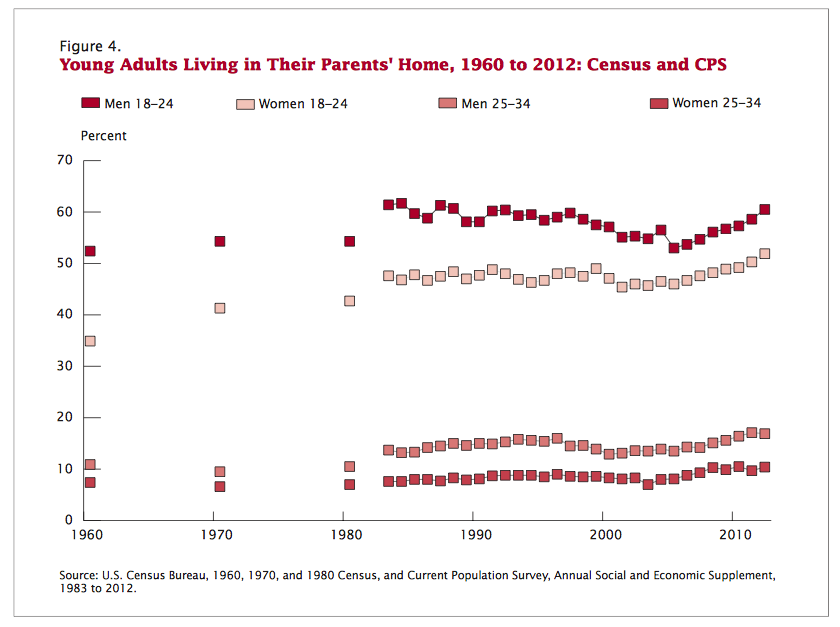
On that note, Derek Thompson recently argued that statistics about millennials living with their parents are “criminally misleading”:
Almost half of young people “living with their parents” are in college, where all campus housing counts as “living with their parents.” Scary Millennials Trends are fun and popular—young people read them to feel outraged; parents read them to gauge their own Millennial’s progress; others read them for schadenfreude. If we’re going to freak out about young people, let’s do so for the right reasons. Unemployment is too high, entry-level jobs are depressingly salaried, and many have taken on student loans that will negatively shape their immediate future.
But David Dayen rebuts:
First of all, Thompson plays a bit with his age ranges. The statistics he pulls on the increase in college enrollment are for millennials aged 18-24. However, the trend of more young adults living at home, based on Current Population Survey statistics, extends from 18-34. You can see the upward trend for men and women aged 25-34 specifically. It’s hard to figure that this all comes from dorm living. Especially considering that college enrollment has actually fallen the past two years, yet young adults living at home continued to rise.
Put this all together, and you get the result that economist Jed Kolko of housing analysis site Trulia finds: even after you adjust for increased college enrollment, “millennials were more likely to live with parents in 2012 and 2013 than at any other time for which a consistent data series is available.” Even eliminating all full-time college students aged 18-24 from the data shows the trend.
Yglesias comes to the same conclusion. Back to the reader discussion:
While I agree that the Millennials have taken huge strides beyond our generation, it is well to remember one thing: they have the enormous advantage of being the second generation to grow up with massive change.
For example, why do they have fewer problems with gays and gay marriage? Well, consider that in my lifetime, anti-miscegenation laws were still the norm in the US. California, for example, only got rid of its laws in the middle of the last century (which means that, at the time I was born, my marriage would have been illegal). If you wonder why voters in our parents’ generation have so much trouble adapting to gay marriage, consider that they were raised in a culture where things didn’t change much – technology changed in some regards, but society much much less so.
Not to minimize how well the Millennials are doing at building a better society. But, as with all social constructions, the foundations were laid by those who went before. It’s all too easy to forget that.
Meanwhile, a pessimistic reader across the Pond writes:
I was born in 1995 and have become politically aware only during the
last couple of years, and here in England, what I see does not fill me with great confidence.I see an electorate dominated by older generations who are terrified at the changes going on throughout the country. I would say that the political awakening that Millennials feel in this country is revulsion and cynicism. We don’t want anything to do with the obviously stitched-up system. Our only route is to get a good education and then get the hell out of this place before the older generations shut the doors to the continent and to the world through their palpable fears of everything. And our apathy and their fears have created a vicious circle, since if my generation wants nothing to do with the system and then abdicates the levers of the system to the older generations, then things will only get worse. I worry about my country.
I don’t know what can be done. I think Millennials will become more apathetic as our democracy becomes more corrupt, which will only worsen the corruption. It has become so bad that I now actually hope that Scotland will vote to leave the union in September. Maybe that can bring enough shock to the system that something can be rescued. I don’t know. I don’t hope much.
Another reader weaves in another thread:
Your reader is right that liberalising theology won’t get millennials rushing back to the pews. Partly this is because it will take time for churches to stop being associated with gay bashing, covering up child abuse and so on, it doesn’t get forgotten that instantly. And partly because it’s not enough for organised religious groups to remove some barriers to relevance; they also have to BE relevant. What does an organised church actually offer even to a millennial with faith in God that they can’t get from praying on their own or with friends or family, let alone to anyone wavering?
If nothing else, the millennial generation refuses to accept institutions and rules just because they are there or because they are venerable, and they’re getting old enough it can’t be written off as adolescent rebellion anymore. To me it is one of their most attractive features, but I imagine it aggravates people and institutions used to unquestioning obedience.
 The Dish