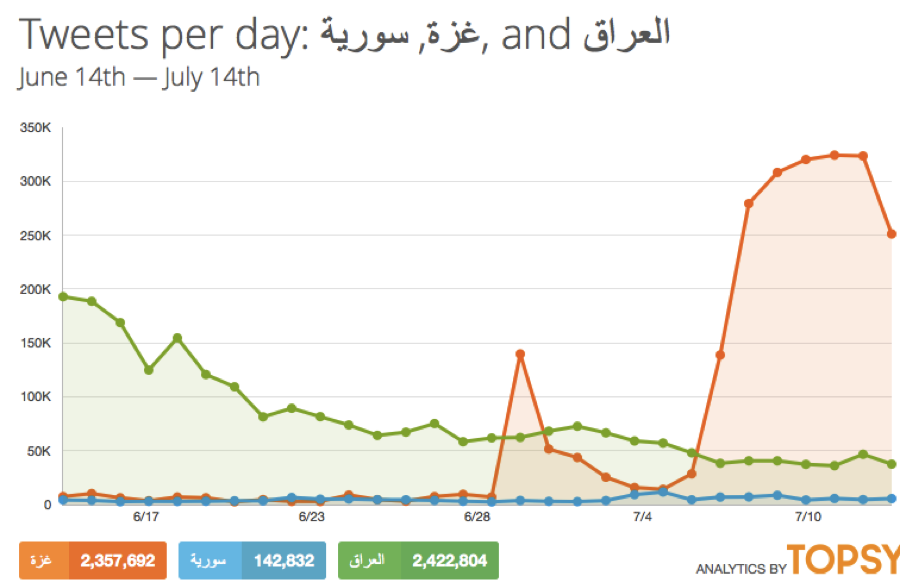
“Has the Palestinian issue really lost its centrality to Arab identity or did it retain the latent power to galvanize Arab attention?” Marc Lynch asks. To try and answer that question, he took a look at Twitter trends:
Syria (in blue), which in 2012 and early 2013 consistently generated millions of tweets per month in Arabic, shows a relatively low level flat line. The shocking developments in Iraq (in green) galvanized attention in mid-June, and Iraq continues to attract more attention now than does Syria. But Gaza, after being virtually ignored for a long time, surges to dominate everything else once the conflict begins. Score one for the “latent relevance” hypothesis.
That doesn’t mean that nothing has changed, of course. Arab publics remain intensely divided and frustrated, while Arab regimes remain intensely repressive and more fearful than ever of popular mobilization. Sectarianism remains rampantly virulent, and the regional campaign against the Muslim Brotherhood can’t help but affect public sentiment toward Hamas (especially in Egypt). The Gulf states and their media seem to be replaying 2006, when they tried to buy Israel time to finish off Hezbollah.
But one of the lessons of 2006 was the limitations of such efforts: Hezbollah garnered widespread, intense Arab support for its struggle against Israel despite the Arab media’s coverage and the sectarianism generated by Iraq’s civil war. The solidarity generated by the killing of innocent fellow Arabs by Israel tends to overwhelm political divisions, even among those who blamed Hezbollah then or blame Hamas today for the war.
 The Dish