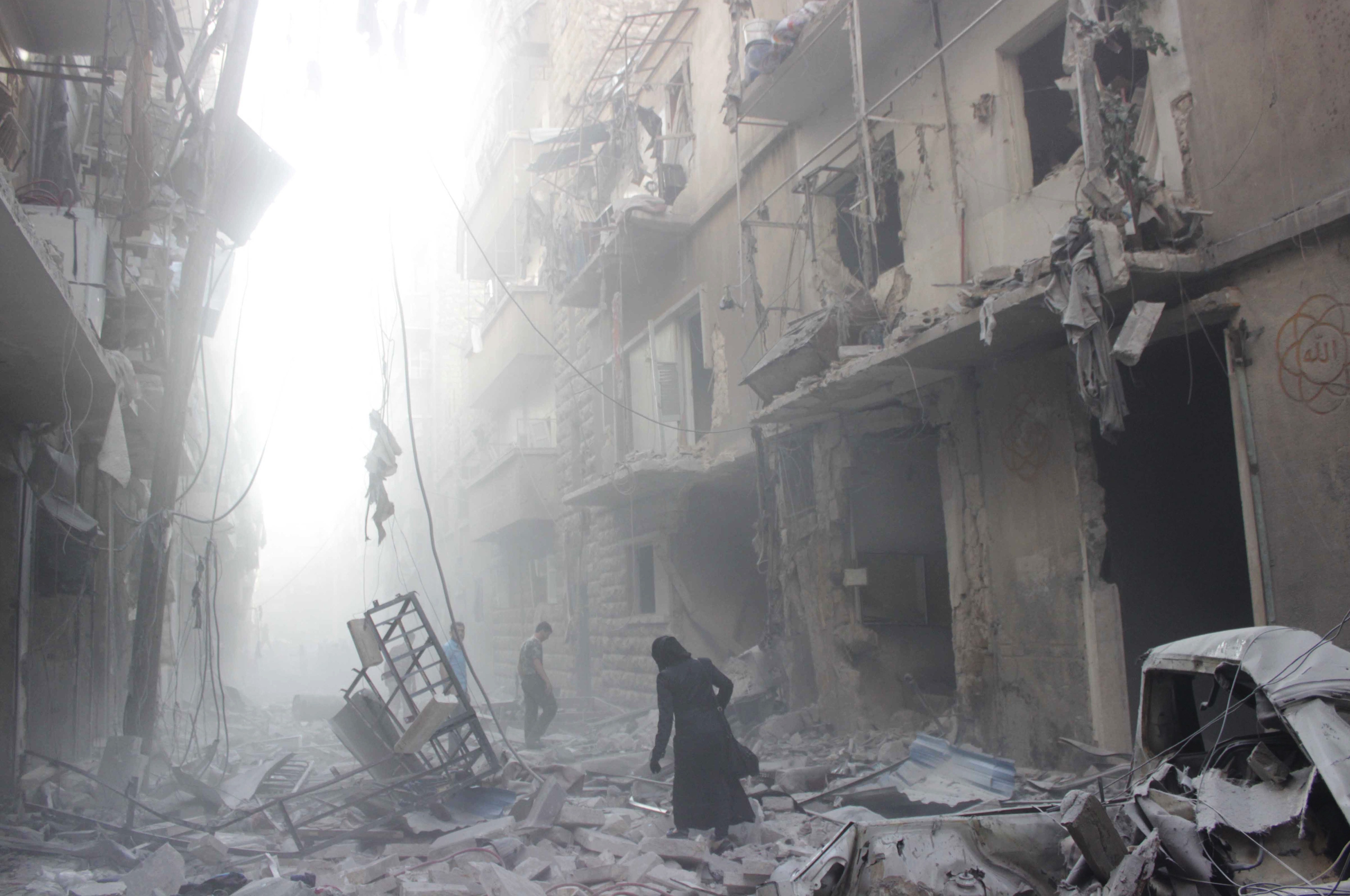
A resident provides a glimpse into her day-to-day life in the war-ravaged city:
I make my coffee while reading Facebook to see what damage last night’s bombings caused. I am lucky to have the money to pay for a satellite internet connection. This is the only way to get online here in the rebel-held areas of Syria because for almost two years all means of communication have been cut—landlines, the mobile network and the internet—as collective punishment for areas that rebelled against the regime. Fighters and activists use walkie-talkies but as a woman I am not allowed to use one. This area of the city has long been very conservative and women don’t participate in public life; now it is also a frontline in a warzone, even more of a male-only domain.
The electricity is on for around four hours a day, so many people have paid to get an alternative source of power. Local traders invest in huge generators and they distribute electricity to others for a monthly fee. Sometimes the electricity is completely cut off for a week and the generator breaks, like today.
I have breakfast and wash the dishes with a trickle of water to save what is left. The water comes on for an hour per week. That is enough to fill the tank on my roof and with careful use I won’t run out this week. If I do, I will have to buy water from a well. New wells are being dug randomly, without engineers or studies—I recently saw one being dug in the middle of a crowded neighbourhood.
It is 11 am and I put on a hijab (not something I wore before the war) and a loose knee-length sweater and leave to go to a field hospital where a friend I am filming is living. She is the only female citizen journalist working in the northern rebel-held areas and I am doing a profile of her. As well as being dressed conservatively, I have to make sure I have a male “guardian” with me. This area of Aleppo has always been conservative, but before the war visitors could wear what they wanted. That is no longer the case now the social tradition is armed.
(Photo: A Syrian woman makes her way through debris following an air strike by government forces in the northern city of Aleppo on July 15, 2014. More than 170,000 people have been killed in the three-year war, one third of them civilians, according to the Syrian Observatory for Human Rights. By Karam Al-Masri/AFP/Getty Images)
 The Dish