Reviewing the exhibition “Pontormo and Rosso Fiorentino: Diverging Paths of Mannerism” at the Palazzo Strozzi in Florence, Barry Schwabsky applauds the works of Rosso Fiorentino for displaying “truly bad taste.” He argues that “whatever is cringe-inducing in Rosso’s pictures is more or less inextricable from what sometimes makes them so breathtaking”:
Rosso [aka “Florentine Red”] offended established taste almost from the get-go. Vasari tells us that the young artist wouldn’t stay with any master, “having a certain opinion of his own that conflicted with their manners.” Commissioned in 1518 to paint an altarpiece, he invited the patron, Leonardo di Giovanni Buonafede, to view the work in progress; alas, “the Saints appeared to him like devils,” according to Vasari, and so “the patron fled from his house and would not have the picture, saying that the painter had cheated him.”
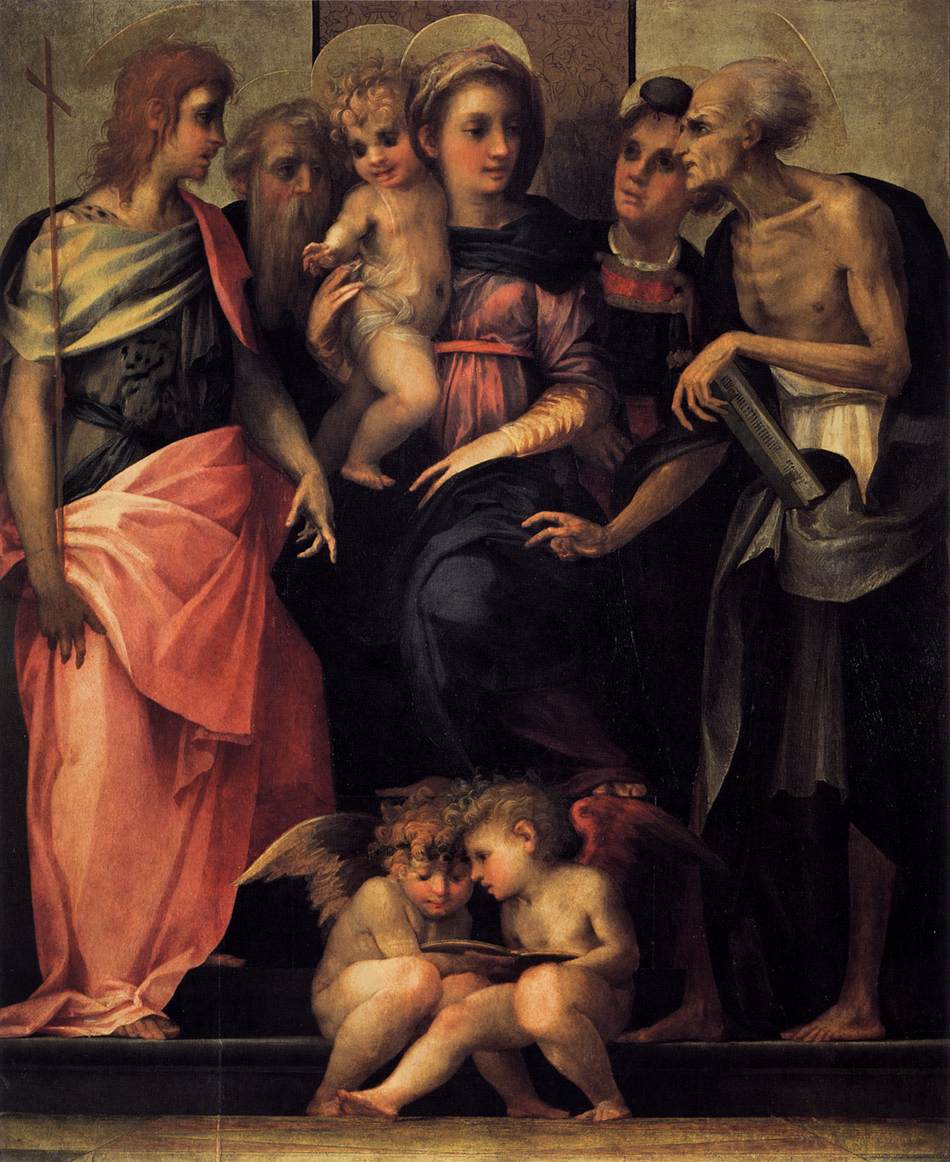
The work, Madonna and Child With Four Saints, also known as the Spedalingo Altarpiece, was exiled to a small provincial church, where it slumbered until the nineteenth century; in 1900, it was admitted to the collection of the Uffizi and has now moved across town for the Palazzo Strozzi exhibition. As David Franklin writes in the catalog, the learned Carthusian who was so horrified by Rosso’s painting thus far “was a prolifically experienced if conservative patron of altarpieces” whose “reaction, although vehement, was well-informed.”
Schwabsky goes on to describe what makes the painting so unnerving:
Most demoniac in appearance is the harsh and wasted figure of St. Jerome on the right. Franklin suggests that the red-haired St. John on the left—the artist’s namesake, and the only one of the painting’s figures (aside from the infant Christ and the sweetly earnest cherubs at Mary’s feet) who doesn’t appear to be an emanation of the blue shadows swirling around the Madonna’s legs—is Rosso’s way of announcing that the painting was intended as his “impassioned personal contribution to the hothouse atmosphere of Florence in the first two decades of the 16th century.” I shouldn’t wonder. In any case, despite Vasari’s claim that it was all a misunderstanding and that Rosso intended to “sweeten the expressions” of the saints in the process of finishing the painting, they retain to this day the “savage and desperate air” that drove the poor churchman running from Rosso’s door.
(Image of Madonna Enthroned with Four Saints by Rosso, 1518, via Wikimedia Commons)
 The Dish
