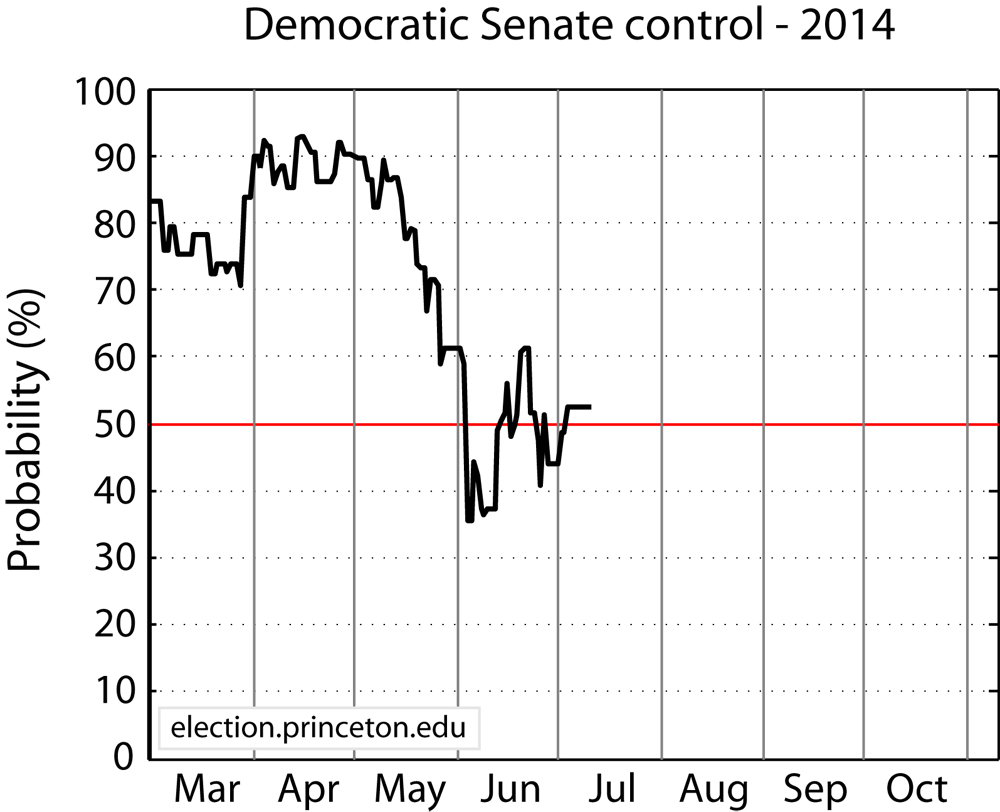
Sam Wang presents his “Senate polling snapshot for this year so far”:
The graph shows a history, over time, of the probability of Democrats/Independents getting 50 or more votes in an election based on today’s opinion polls. On Election Eve, opinion polls closely track final outcomes. Therefore, consider this a snapshot of Campaign 2014.
John Sides’ new forecast, which takes fundamentals into account, calculates an 86 percent chance of Republicans taking the Senate. Why this is higher than other models:
Our forecast in states like Arkansas, Georgia, Kentucky, and Louisiana gives the GOP a much better chance than many observers do. These races are toss-ups according to the Cook Political Report, for example. The reason is that our model is very confident of a GOP win in all three campaigns, and the polls do not give us enough reason to question this for now. At the same time, the Democrats have strong candidates in these races, so it is possible that the prediction could shift in their favor. However, absent a clear trend toward the Democrats in the polls, our forecast will continue to favor the GOP in these races.
By contrast, the Upshot’s Senate model currently only gives the GOP a 51% chance of overtaking the chamber. But Harry Enten warns that a lot of seats are within the GOP’s grasp:
[I]f Republicans sweep those nine close races (plus South Dakota), the GOP would pick up 10 seats, controlling 55 in the new Senate. If Republicans lost all of them (including Georgia, Kentucky and Arkansas), they’d pick up only two seats — holding 47. In other words, the final outcome for the Senate could be anything from a minor Republican gain to a GOP romp. At the moment, the state of play seems manageable from a Democratic perspective, but the party’s position is perilous. A tiny shift could tip the canoe and spill a lot of Democrats overboard.
Cillizza examines the limits of these calculations:
Models are, by their nature, data driven. (That’s why models tend to get better the closer the election gets. There’s just more raw material — poll numbers, fundraising numbers etc. — to mine.) Because of that reality, models tend to favor elements of races that can be easily quantified (presidential approval, GDP growth, fundraising) and diminish less easily quantifiable factors like candidate quality and the sort of campaigns being run on the ground.
Sides and his team use three data points aimed at ensuring the Election Lab model takes those candidate/campaign factors into account: 1) polling in the race 2) fundraising by the candidates 3) experience in elected office. Historically, all three have functioned as solid predictors of success or failure.
And yet, those three data points alone can miss other realities that do help to decide elections.
 The Dish