Reviewing Jonathan Rose’s The Literary Churchill: Author, Reader, Actor, Michael F. Bishop appreciates the insights offered by approaching Sir Winston through the writing he both produced and loved:
Like Abraham Lincoln, the greatest statesman of the 19th century, Winston Churchill, the
greatest of the 20th, had a genius for language. But unlike Lincoln, Churchill made a lucrative living as an author, inflating both his bank balance and his reputation with prodigious (and shrewdly self-promoting) feats of literary craftsmanship. In this sometimes speculative but immensely enjoyable biography, Jonathan Rose shows that Churchill’s authorial and political careers were entwined and inseparable. And he convincingly argues that while “tracking down literary influences is often dismissed as a purely academic exercise . . . sometimes the lives of millions depend on what their rulers read.”
According to Rose, Churchill was principally driven in life by “the desire to frame a thrilling story” for himself, and “once we understand that as his life goal, then Churchill’s impulsive courtship of danger becomes predictable, explicable, and eminently reasonable.” To Rose, his performance on the world stage was influenced in part by the theater, especially the Victorian melodrama of his youth. This sense of life as a drama, with him in the starring role, prompted both rash judgments and acts of dazzling courage. While a more prosaic outlook might have helped him avoid misadventures, it would have deprived Britain of its “finest hour” in 1940.
In an earlier take on the book, Sam Leith had more on how Churchill’s flair for the dramatic helped him understand Hitler’s rise:
Rose paints Churchill as a man in love with the bold stroke — the coup de théâtre — and mired in a view of the world as Victorian melodrama. While the fractured categories and stalled certainties of modernism were making the literary weather, Churchill looked backwards. His was a world of clear identities, dramatic reversals and good triumphing pluckily over evil. His ideas of everything from Irish Home Rule to the government of native populations in India are credited with having been formed by the view from the cheap seats. He spoke claptrap — which, as Rose tells us more than once, is a term from melodrama: the inspiring speech the hero makes with his back to the wall, trapping the audience into applause.
This is the stopped-clock version of how Churchill got the fascists right: Hitler was one type of melodramatic villain (dark, shouty, moustachioed); Mussolini (treacherous, semi-comic) another. It just happened that silly old Winston, who sonorously predicted the final crisis of western civilisation once a week or so, happened to coincide with the real thing. Rose’s dimmish view of Churchill seeps up like ground-water. He presents him as an egotistical lunatic obsessed with being remembered as one of the great men of history, heedless of who died to make that dream come true, and with a script for achieving it based, more or less, on a bunch of babyish Victorian pantos.
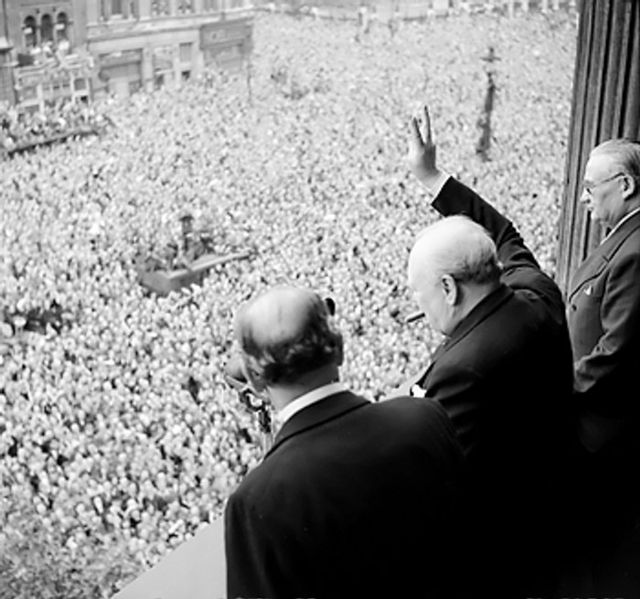
(Image: Churchill waves to crowds in Whitehall on the day he broadcast to the nation that the war with Germany had been won, 8 May 1945, via Wikimedia Commons)
 The Dish
