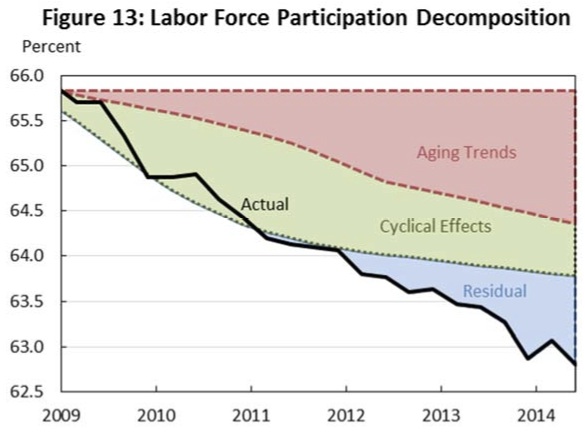
One of the mysteries of the recovery that feels like a recession is that since 2012, more Americans have been dropping out of the workforce than demographic and cyclical trends can account for. Zachary Goldfarb peruses a new report from the White House Council of Economic Advisers that seeks to explain why:
The first theory is that higher levels of long-term unemployment as a result of the Great Recession are causing more workers to exit and remain outside the labor force. A well-chronicled feature of the economic recovery has been the very large numbers of Americans unemployed for more than six months — 3.1 million in June. The report highlights other economic research that has shown that jobless Americans have lower odds of finding a job the longer they’re unemployed. And a big part of the reason is that employers discriminate against those with long spells of joblessness. …
The report’s second theory essentially boils down to the idea that the participation rate is lower because when the recession started, the labor market was already much weaker than was widely recognized.
Nearly every demographic group saw labor force participation declines ahead of the recession. It was especially problematic for men, who have been beaten down by declines in manufacturing, advances in workplace automation and expanding trade. The report does not specify how exactly the Great Recession would have led to an intensification in those trends. But it’s not hard to imagine that the severe economic contraction would have kicked out many workers, particularly men, who were just hanging on to the labor force before the economic decline even began. It’s startling to think about, but as a percentage of the population there are far fewer men working today than at any point in the past 50 years.
As the above chart illustrates, the CEA estimates that the “residual” accounts for about one-third of the decline. But as Ben Casselman remarks, this estimate itself carries a political charge:
Economists more or less agree on what the factors are behind the decline in the labor force. What they don’t agree on is how much of the decline to assign to each factor. The debate has huge policy implications. If the drop in participation is mostly about the weak economy, that means the labor market is much worse than the 6.1 percent unemployment rate would normally indicate; there are millions of Americans who don’t count as unemployed but would be working if there were more jobs available. That means the government should be doing more to help boost the economy, whether through monetary policy, tax cuts, government stimulus or other programs.
On the other hand, if the drop is mostly about aging and other long-term factors, then the recent decline in the unemployment rate accurately reflects a rapidly improving economy. Rather than trying to stimulate the economy, policymakers should be focused on making sure it doesn’t overheat and lead to faster inflation.
 The Dish