Though Søren Kierkegaard wrote his theological works attached to his own name, he “published each of his philosophical texts under a different identity, each with a unique perspective, background, and set of beliefs — which may or (more likely) may not be those of Kierkegaard himself.” Eric Thurm explains:
Heteronymity, or the publication of works under an assumed identity constituting an entirely different character, distinguishes itself from pseudonymous works that
express the author’s opinions under a different name. In a sense, heteronymity requires two acts of creation: the invention of an author and the text produced by that author, placing further distance between the original author and the final words in a text. There’s some history for the practice distinct from its pseudonymous cousin, most notably in the works of Portuguese writer Fernando Pessoa, who coined the word “heteronym” to refer to the many voices he used to write poetry and letters, each with their own biography, influences, and style.
Kierkegaard’s work is particularly well suited to heteronymity’s abstraction from straightforward authorial intent. His intricate web of identities allowed him to tackle his central question — how to be a good Christian in contemporary Christendom — from a variety of perspectives, many of which openly disagreed, in the public sphere. (Were Kierkegaard alive today, he might well have been an avid user of multiple anonymous Twitter accounts.) Most of the heteronyms are in turn mocked, even while their arguments are serious — Johannes Climacus, who does not consider himself a Christian, recounts how he became an author through a winking “self-communion” and smoking multiple cigars, in which he decides to try to mimic those with worldly success “out of love for mankind.”
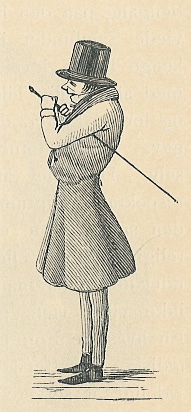
(Image of caricature of Kierkegaard, 1846, via Wikimedia Commons)
 The Dish
