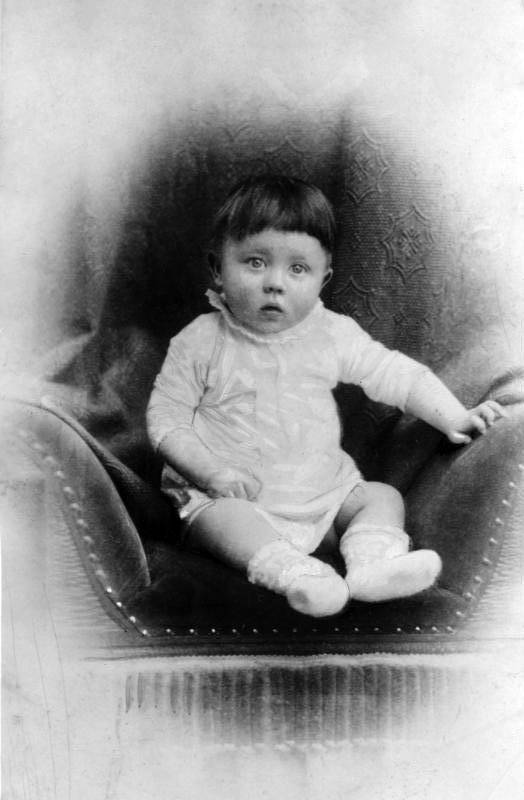
In an afterword for the new edition of his Explaining Hitler, Ron Rosenbaum reflects on one of the central puzzles driving examinations of Hitler’s life – “why that innocent infant evolved into a genocidal monster”:
[S]omething or some things made Hitler want to do what he did. It wasn’t a concatenation of
impersonal, external forces, a kind of collective determinism. It required his impassioned personal desire for extermination, even at the potential cost of defeat for Germany. It required him to choose evil. It required free will.
It required Hitler to make a continuous series of choices, the ultimate source of which may always be shrouded in mystery. We will likely never know, for instance — barring some discovery in a “lost safe-deposit box” — what went on between Hitler and the alleged hypnotist, Dr. Forster, said to have treated him at the time of the World War I German surrender and instilled in him a will to avenge the (baseless) “stab-in-the-back” myth of German defeat. We have only Ernst Weiss’s fascinating novelistic speculation (The Eyewitness) to go on, and it can’t be counted as proof, although it may be the unsolved Hitler mystery I’d most like an answer to. In fact, we lack proof, and the most salient clues might be lost in the mists of history. We just may never know with certainty what made Hitler Hitler. And worse, we may never know why we don’t know: whether it’s because of a missing piece of biographical evidence, or an inability to evaluate the evidence we have. It’s beyond frustrating not knowing whether we might.
Update from a reader:
Long-time reader and subscriber. Your post on “why that innocent infant evolved into a genocidal monster” I would highly recommend reading Robert G. L. Waite’s The Psychopathic God, which does a pretty good job of showing how documented accounts of his childhood history correlate to his compulsions later in life.
I read this at university as a student of central European history in the 19th and 20th century. Our professor warned us that psycho-history was scorned in academic historian circles but offered it as a perspective.
Interestingly, I later connected his work with that of the Swiss-German psychologist Alice Miller who wrote extensively about parental child abuse. In her work For Your Own Good she covers very similar ground as Waite, but as a trained psychoanalyst.
My belief is that sociopaths and psychopaths are largely made by their environment, but imagine there’s a bell curve with some individuals at one tail coming through trauma to lead relatively normal lives and others, at the other tail becoming “exceptional” monsters. Hitler arrived on the world stage in a time, place and context that would celebrate and willingly participate in his monstrosity.
So, I don’t find Hitler as monster so puzzling. Parents create them every day, but only rarely do they get to act out there pathologies in such a world-historical way.
(Image of Adolf Hitler as an infant, 1889–1890, via Wikimedia Commons)
 The Dish
