Jesse Rosenfeld reports from Shejaiya, the Gaza City neighborhood that bore the brunt of yesterday’s shelling. Residents tried to evacuate but didn’t have many options:
Magdin Ayad, 26, standing with her seven children in front of a shuttered store on the edge of Al Shejaiya, doesn’t know where she can go. “We will just sit and wait,” she said amid the routine boom of exploding tank shells. With all her family also fleeing from the district, her only option is to join the hundreds seeking safety at Gaza City’s Al Shifa hospital.
Although strained and running out of supplies, the hospitals are the sole sign of any functioning civil institutions. There is a constant flow of ambulances bringing in wounded while doctors scurry to save them. Hamas spokesmen stand by the hospital gates and denounce the attack on Al Shejaiya as a massacre and vow to fight on. It’s the only place to get official government comment in Gaza and a handful of guards are the only security forces to be seen.
But there’s no seeking shelter at the Wafa hospital, which has been repeatedly bombed:
Since the beginning of the war, Israel had been calling the al-Wafa rehabilitation hospital in eastern Gaza telling them to evacuate ahead of a scheduled bombing, according to the hospital’s executive director Basman al-Ashi. The Israeli military says it was attacking military targets nearby. Many of the patients at al-Wafa are severely disabled or paralyzed, unable to move. The staff refuses to leave.
The fourth floor of the hospital was first shelled on Tuesday, and several times after that. Doctors moved the patients to the first floor to withstand the assault. Around 8:30 p.m. on Thursday, they received another call from an Israeli officer telling them to evacuate. Again, they refused. Minutes later, the attack began with artillery shells crashing into the fourth, third, and second floors.
“The electricity went out, all the windows shattered, the hospital was full of dust, we couldn’t see anything,” says Aya Abdan, a 16-year-old patient at the hospital who is paraplegic and has cancer in her spinal cord. She is one of the few who can speak. Many of the other patients are comatose.
Telling a hospital to evacuate or be bombed is what Israel has descended to. That the Israelis need to harden themselves in the face of such slaughter from the skies does not remove the stain. In some ways, it intensifies it. The rhetoric of Israel and its reliable supporters reflect this fact. They have to assign responsibility to Hamas for every child they kill. The alternative – the truth – is too painful for them to absorb. And so the dehumanization intensifies.
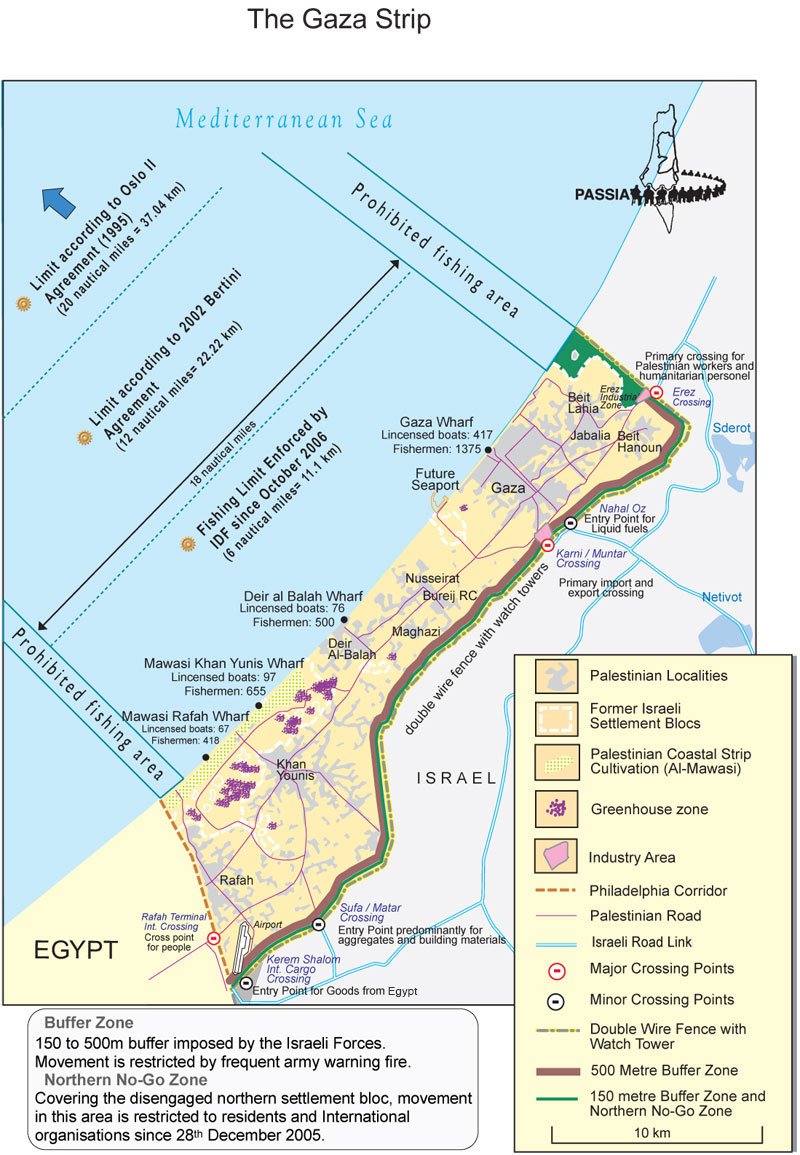
Zack Beauchamp captions the map above, which illustrates how trapped the Gazans are:
There’s a serious Israeli blockade of Gaza. You’ll notice Israeli fences, boundaries, and supervised crossings all around Gaza. Israel heavily controls the flow of goods through these channels, including food, medicine, construction materials, and the like. The [stated] reason it does that is to limit Hamas’ ability to resupply itself militarily; for instance, Hamas and other militant groups often home-build rockets that get fired into Israeli towns and cities. These restrictions also severely affect civilians. To deal with the military and civilian effects of the blockade, Hamas built well over a thousand tunnels out of Gaza — mostly into Egypt. Israel’s stated reason for the ground incursion into Gaza is shutting down tunnels into Israel built for attacks, but it also may want to shut down Hamas supply tunnels into Egypt.
 The Dish