The government shared some of it yesterday. Shane Harris summarizes:
The officials offered little new information about the MH17 investigation, except to say that U.S. intelligence analysts are now persuaded that the jet was downed by accident, likely by forces who believed they were taking aim at a Ukrainian military aircraft. The officials circulated widely available information, including photographs of the suspected missile launcher posted to social media in recent days, and pointed to voice recordings posted to YouTube of separatists acknowledging that they shot down a jet, which they later discovered was a civilian plane. One official stressed that analysts weren’t relying solely on social media information, such as tweets and online videos. But nothing in the agencies’ classified files has brought them any closer to definitively blaming Russia.
Max Fisher’s two cents:
What’s perhaps more interesting is what the US intelligence officials would not say: that the attack was deliberate or that Russia pulled the trigger. The officials said they suspected the rebels fired on a commercial airliner mistakenly; this too had become conventional wisdom, as the rebels had only previously fired on Ukrainian military aircraft, but the hint of possible confirmation is something.
But the rebels compromised the wreckage, which makes our investigation much more difficult:
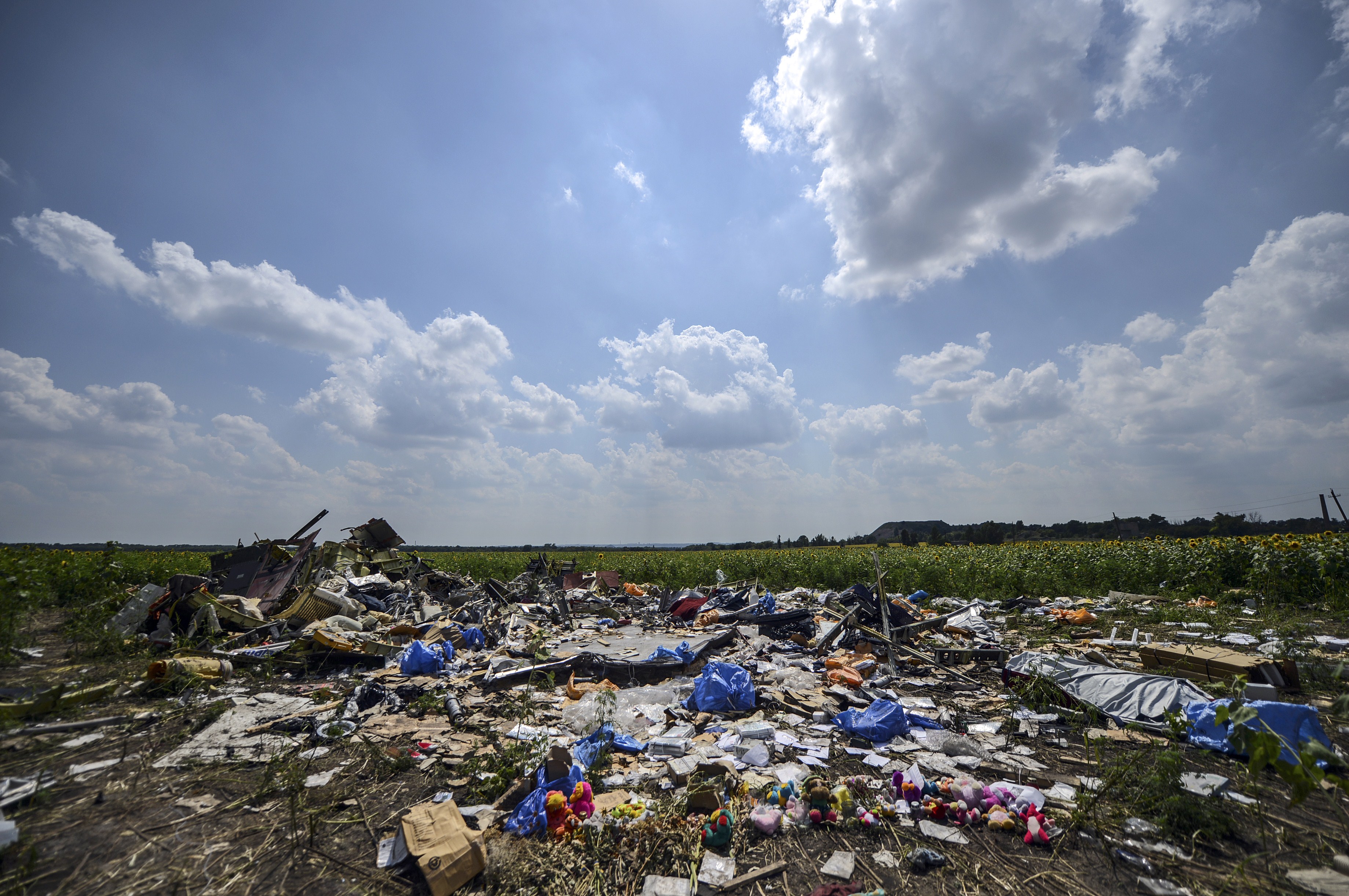
While Malaysia was finally able to recover the black boxes from the rebels at the crash site, investigators at the site have determined other evidence has been “significantly altered.” Michael Bociurkiw, a spokesperson for the Organization for Security and Cooperation in Europe, has said large pieces of the front of the plane have been cut away. Investigators have seen power tools on the site, used to cut into the fuselage. Rebels said their reasoning was to move the large plane pieces in order to retrieve bodies. However, OSCE said the cuts made were “very invasive.”
Clive Irving doesn’t think this obstacle is insurmountable:
There has been a lot of concern about contamination of the evidence at the site. In reality, it’s hard to deliberately mess up a debris field as large as this one. First of all, you would need to know which bits are likely to be the most damning, a knowledge unlikely to be present in this case. Secondly, large pieces of wreckage can’t be moved without someone seeing that happening. And, thirdly, even if you are moving pieces of wreckage, there are eyes in the sky watching it all from satellites.
Patrick Tucker explains what investigators will be looking for:
If the Obama administration is correct, what will the ground evidence show? The distribution of debris, once fully catalogued, would confirm a violent sudden explosion, as opposed to a long trail of parts indicating a slow breaking apart and would include missile shrapnel. It would also show that the radar-guided missile likely exploded within about 65 feet from the target. Infrared imaging might show explosive residue somewhat evenly distributed on the bottom of the plane. Conversely, an excessive amount of explosive residue on the engines could indicate that the missile was heat seeking and not shot from an SA-11 and that the U.S. was wrong.
Mark Galeotti worries about Putin taking advantage of a lengthy investigation:
You don’t need to be a fan of the vintage British political sitcom Yes Minister to know that inquiries can as easily be used as tools of obfuscation and delay. As the suavely cynical Sir Humphrey Appleby puts it in one episode, “The job of a professionally conducted internal inquiry is to unearth a great mass of no evidence.”
(Photo: A photo taken on July 23, 2014 shows the crash site of the downed Malaysia Airlines flight MH17, in a field near the village of Grabove, in the Donetsk region. The first bodies from flight MH17 arrived in the Netherlands on July 23 almost a week after it was shot down over Ukraine, with grieving relatives and the king and queen solemnly receiving the as yet unidentified victims. By Bulent Kilic/AFP/Getty Images)
 The Dish