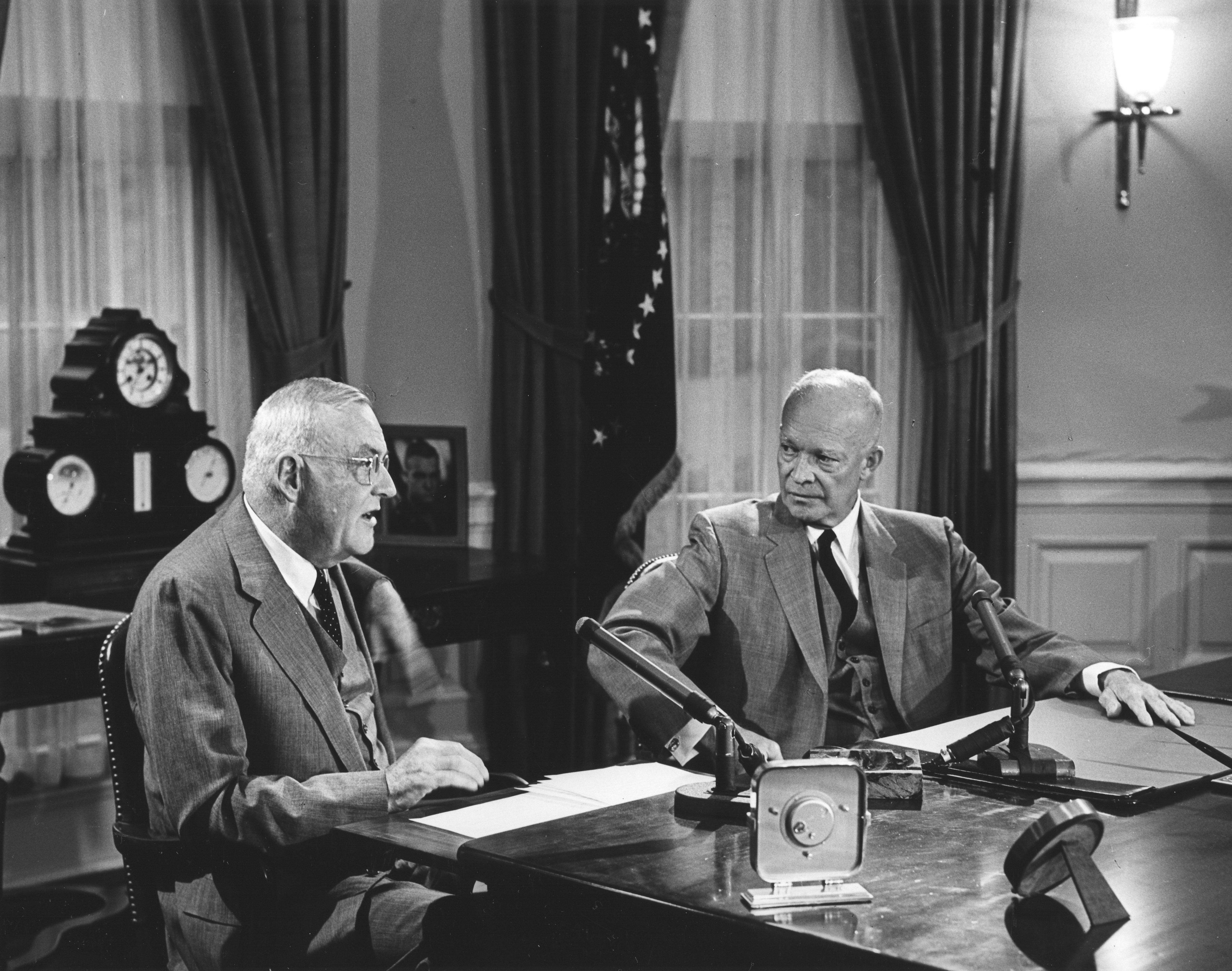
Scott McConnell has an interesting trip down memory lane at The American Conservative. He remembers a time when the first thing Republicans would consider with respect to Israel was the national interest of the United States. Remember Suez? Money quote:
During the Cold War 1950s, Israel was not especially favored by the right. It was perceived as vulnerable and somewhat socialist, and even conservative publishing houses like Regnery produced books sympathetic to the Palestinians. But the 1967 war transformed Israel’s image for conservatives—as it did for other groups, American Jews especially. By 1970, the Nixon administration and many on the right had begun think of Israel as a useful Cold War asset. The Jewish state had demonstrated it could fight well against Soviet allies. The idea of Israel as a strategic asset was always somewhat problematic—it would be called into question when America suffered the Arab oil embargo of the 1970s, and there were sharp disagreements over Israel’s invasion of Lebanon in the 1980s. But one could safely generalize that most conservatives considered Israel an asset—a proposition that the neoconservatives, valued newcomers to the conservative movement, pushed enthusiastically.
When the Cold War ended, this became more complicated.
Israel proved useless when Iraq invaded Kuwait: American diplomacy had to devote much time and energy to ensuring that Israel did not enter the conflict, as Israeli involvement would have blown up the anti-Saddam coalition President George H.W. Bush had painstakingly constructed. What good was a regional ally that must be kept under wraps when a regional crisis erupts? More generally, once Americans began to see their Mideast problems as originating from within the region, rather than from Soviet meddling, issues such as Israel’s treatment of the Palestinians became salient. For a brief time, the place of Israel in the conservative mind was in flux.
McConnell makes the argument that it was at this point that the neoconservatives made their move – by ending the careers of Joe Sobran and Pat Buchanan at National Review, both of whose criticism of US-Israel relations sailed very close to the wind of anti-Semitism. It’s been a while since those controversies, and it’s impossible to defend Sobran, especially given the hate-filled rants he would go on to pen. Buchanan is a trickier case because, whatever else you can say about him, he has a first class mind and a real, if often noxious, worldview. But the threat of having your career ended by saying the wrong thing about Israel lingered in the atmosphere, as it was always intended to do:
Buckley’s depiction of the power of the Israel lobby to break people’s reputations is perceptive and unequivocal. Describing his first private dinner with Joe Sobran where they discussed the Decter/Podhoretz charges, Buckley relates that he told the story of William Scranton, a governor of Pennsylvania who was considered presidential timber in the 1960s. Nixon sent him on a fact-finding mission to the Mideast and he came back with a recommendation that the United States be a little more evenhanded, and… no one ever heard from him again. Buckley writes: “We both laughed. One does laugh when acknowledging inordinate power, even as one deplores it.”
Would Buckley now be considered an anti-Semite because if his description of AIPAC as having “inordinate power”? Maybe five years ago. But one senses a little more nuance and a little more circumspection about the consequences of always backing Greater Israel for ever. Even, perhaps, on the right, however much money Adelson and his buddies pour into the process.
(Photo: During a radio and television broadcast, US Secretary of State White House John Foster Dulles (1888 – 1959) (left) speaks with US President Dwight Eisenhower (1890 – 1965) in the Oval Office at the White House, Washington DC, August 3, 1956. The men were discussing the recent nationalization of the Suez Canal by the Egyptian government. By Abbie Rowe/PhotoQuest/Getty Images)
 The Dish