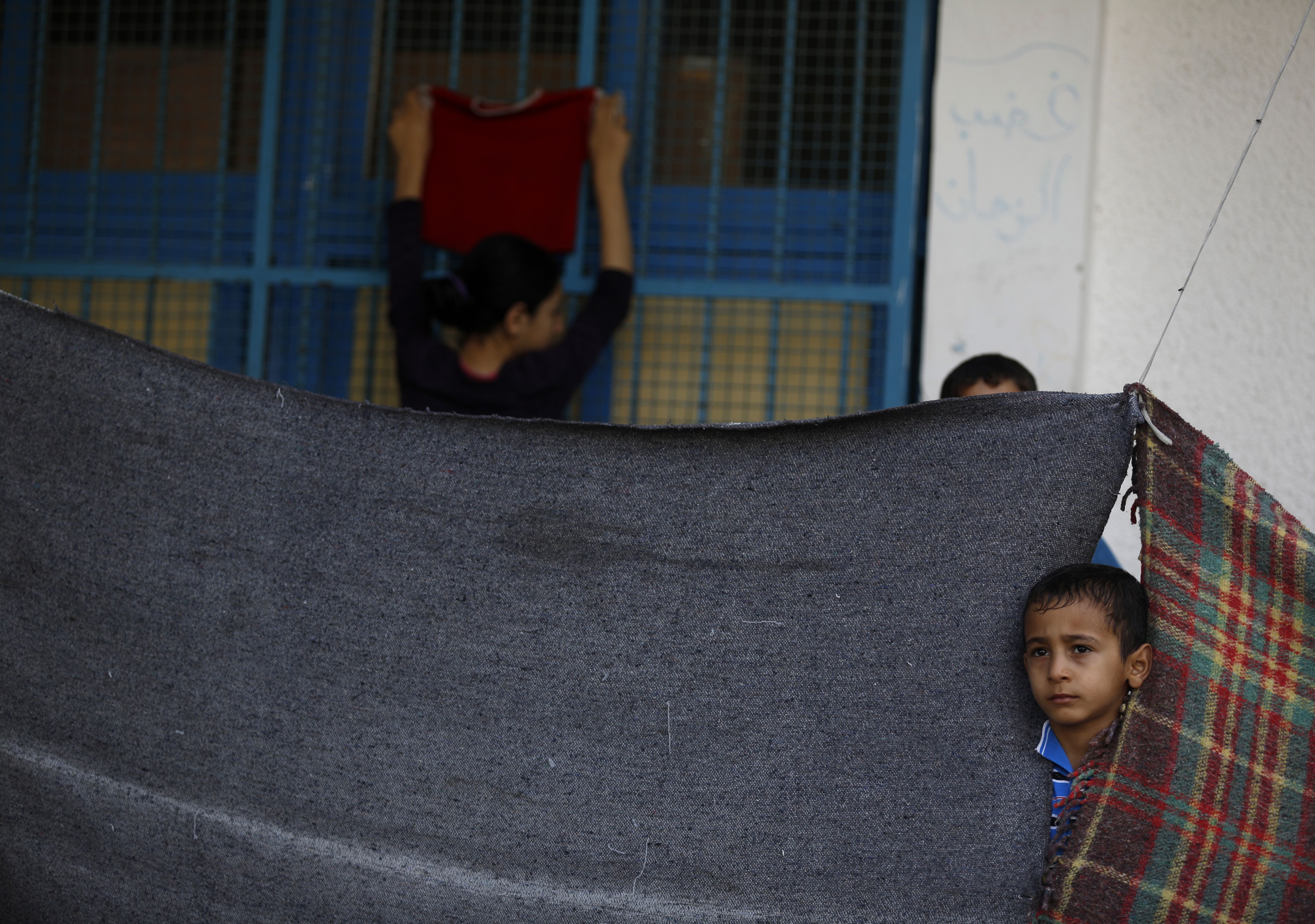
“While there have been many news reports on the number of people who have been killed (over 500) and wounded (over 3,000) in the Israeli offensive,” Elizabeth Ferris observes, “far larger numbers of people are being forced from their homes”:
In fact, displacement may turn out to be the defining characteristic of this terrible conflict. As the United Nations Relief and Works Agency for Palestine Refugees (UNRWA) spokesperson Chris Gunness said today, “This is a watershed moment for UNRWA, now that the number of people seeking refuge with us is more than double the figure we saw in the 2009 Gaza conflict. We are seeing a huge wave of accelerated displacement because of the Israeli ground offensive.” …
People are warned to evacuate by the Israeli forces, but there are not many places to go as Gaza’s borders are all but closed. Some have taken shelter with family or friends, some have even sought protection in a Greek Orthodox Church, but many have turned to U.N. facilities for protection. Yet UNRWA’s facilities are close to capacity and, as numbers increase, conditions are likely to worsen. According to Doctors Without Borders, unhygienic conditions and overcrowding at UNRWA facilities “are extremely worrying.” UNRWA also may not be able to provide the protection which internally displaced persons (IDPs) are seeking. In fact, the agency reports that 64 of its buildings have been damaged in the offensive.
The war will also leave indelible psychological scars, particularly on Gazan children:
Three months after the last period of bombing ended, in January 2009, Abdelaziz Thabet, a child psychiatrist at Al-Quds University in the Gaza Strip, studied the effects of the bombing on Palestinian children. The Gaza war lasted three weeks and saw 1100 Palestinians killed and 13 Israelis. Of the 358 teenagers Thabet studied, 30 per cent were left with full-blown post-traumatic stress disorder. Most other children presented some PTSD symptoms, and only 12 per cent had no symptoms. The study was published in the May issue of the Arab Journal of Psychiatry, just a month before the current campaign. The rates of full-blown PTSD may be worse this time due to the intensity of the shelling, warns co-author Panos Vostanis at the Greenwood Institute of Child Health at the University of Leicester, UK. “I’d expect them to be at least 60 to 70 per cent in the three to six months afterwards,” he says.
Jesse Singal also warns of an epidemic of childhood PTSD:
Gazans do appear to suffer from PTSD to a greater degree than either Israelis or West Bank Palestinians, at least according to a 2009 joint Israeli-Palestinian study also focused on the fallout of the second intifada, which found that 6.8 percent of Israelis and 37.2 percent of West Bank Palestinians met the clinical criteria for the disorder …
There are mental-health resources in Gaza, but they’re overstretched and constantly disrupted. The infrastructure is provided by a mix of the Ministry of Health, NGOs, and UNRWA, Seita explained, with UNRWA providing “psychosocial counselors” at schools, health centers, and women’s centers that can refer patients to more serious treatment from the Ministry. There are many obstacles to treatment. Israel’s blockade (and Egypt’s to the south) has made it difficult for medical supplies to cross the borders into Gaza, and the same goes for people trying to temporarily get out: Gazans who require specialized care must travel to better-equipped medical centers in Israel or Egypt, and they often aren’t allowed to.
Previous Dish on Gaza’s children here. Atef Abu Saif offers a harrowing glimpse at day-to-day life in the Strip:
The first question I ask when I open my eyes is, “When is the truce?” Everybody is asking the same question. After 16 days of attacks, you wish, even harder than at the start, that it is all just a nightmare. Many times I have closed my eyes and thought, “What if I were just sleeping, and everything I saw was a dream?” I shake my head and look around. Everything looks real: The tree in the school yard moves in the wind, the sun shines, the lady next door is sitting in front of her house with other old ladies of the neighborhood, everything looks normal. No sign that this is a dream, a nightmare.
On Monday, more than 100 people were killed in Beit Hanoun and Shijaia. While sitting with my friends Faraj, Abu Aseel, and Wafi in Faraj’s place, smoking nargila as we do every night, Faraj keeps turning the dial on the radio, searching the news, trying to find an announcement that might calm him down. The voice on the radio announces that the total number of people killed during the last two weeks is 567. He starts to break this number down according to where they lived, according to their ages, their genders, the method of attack, and so on. A few hours ago a shell decapitated three kids. They were carried to the hospital headless. The radio reporter continues his presentation of the situation. The number of people injured has reached more than 3,300. Some 670 houses were destroyed, and more than 2,000 were partially damaged.
And here’s more on those families seeking sanctuary in Gaza City’s only Greek Orthodox church, hoping that Israel won’t bomb it:
The panicked search for someplace in Gaza that isn’t under fire has led about 1,000 people to claim refuge in Saint Porphyrios Church. “It’s for Christians so it won’t be targeted,” says Etadil al Saerky, 42, who is staying there with 12 members of her family. But, really, nowhere is safe. The church cemetery was hit with a rocket on Monday night. All that people are sure of is that a church may be a little safer than a mosque, since some 50 of those have been bombed because the Israelis believe weapons are stored in them.
Greek Orthodox Archbishop Alexios of Gaza, who has been organizing the food and shelter for those claiming refuge, refuses—despite all the suffering and fear around him—to focus only on the carnage and destruction in this latest, bloodiest Gaza war. He is determined to fulfill his mission of Christian charity, it appears, and he remains resolutely upbeat. He says a woman went into labor in the sanctuary on Monday during the shelling, and a healthy baby was delivered. “You see,” said the archbishop, “in Gaza there is also life, not only death.”
(Photo: A displaced Palestinian boy stands behind blankets serving as a separation curtain for his family on July 23, 2014 at a UN school in the northern Gaza Strip refugee camp of Jabalia where displaced families have taken refuge after fleeing heavy fighting in the besieged Palestinian territory. By Mohommed Abed/AFP/Getty Images)
 The Dish