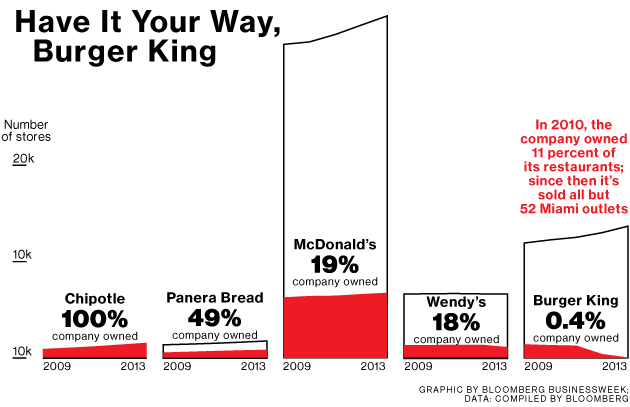
In 2010, the Brazilian private equity firm 3G Capital acquired Burger King for $4 billion. Regime change has since led to a “ferocious approach to cost reduction”:
McDonald’s owned 19 percent of its 35,429 restaurants worldwide in 2013. Wendy’s owned 18 percent of its 6,557 outlets. Historically, Burger King operated much the same way: When 3G bought the chain in 2010 it owned 11 percent of its 12,174 restaurants around the world. Since then, Burger King has sold all but 52; it keeps the last few for training executives and testing products.
That’s such a departure from the way its competitors operate that some people are questioning the company’s strategy. …
After unloading more than 1,200 restaurants, the company’s corporate head count has fallen from 38,884 to 2,425 in 2013. Now its income flows almost entirely from royalty fees from franchisees, on average 4 percent of franchisees’ monthly revenue. That’s less money than before overall, but Burger King has become a cash machine. And 3G hasn’t been shy about helping itself to some of that money. …
Wall Street has responded enthusiastically. Burger King went public again in June 2012 in an offering that put a $4.6 billion value on the company. As of early July, its market cap had risen to more than $9 billion. The doubters are in the minority now, and many in the investment community would like McDonald’s and Wendy’s to mimic the kids at Burger King. “These things are seemingly working at Burger King and causing questions to be asked about the strategy of others in fast food,” says David Palmer, an analyst who covers the restaurant industry for RBC Capital Markets (RY). “Like, why aren’t you doing what they’re doing?”
 The Dish