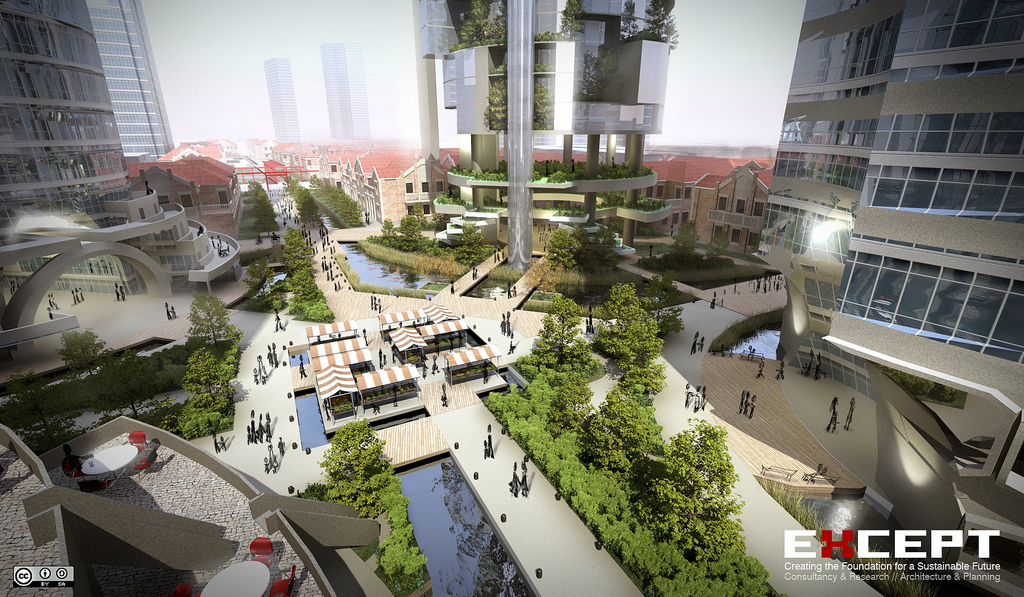
Tim Heath and Yiming Shao see it in vertical farming:
It has been suggested that a 30-story, 27,800,000-square-meter vertical farm could be achieved within one New York City block. That farm could feed 50,000 people, providing 2,000 calories for every person each day. With results like that as a prospect, it’s easy to see why enthusiasts see vertical farms as the future. … Vertical farms do indeed have many advantages. They would enable us to produce crops all year round using 70 percent less water. We wouldn’t need to use agro-chemicals and could avoid the adverse environmental factors that affect yield and quality in more traditional farming. And if food were grown in urban areas in the first place, we could eliminate the financial and environmental costs of importing food into towns and cities.
And in fact, we have the technology to do it:
We can already cultivate plants without soil and recycle the water used to deliver clean indoor farming, for example. Hydroponics, where plant roots are grown in nutrients dissolved in water, is one option. This plant-growing technique can be combined with traditional aquaculture to raise fish or prawns – a farming technique known as aquaponics. Another way to grow plants is aeroponics, which involves growing suspended plants by spraying the roots with a nutrient-rich water solution.
But even though it has been more than than 20 years since the concept was first proposed and the pressure of climate change continues to mount, vertical farming is still not a reality. The two biggest problems have been financial and technological viability, particularly when it comes to actually building these high-rise spaces.
Previous Dish on vertical farming here.
(Image of 4 vertical farms surrounding a couryard in a Shanghai Sustainable Masterplan model via Except Integrated Sustainability)
 The Dish