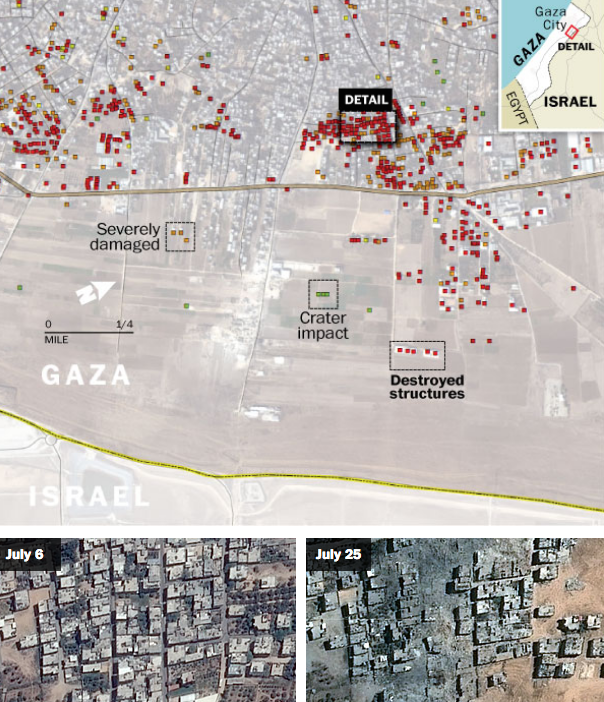
The Israeli army is employing what Jesse Rosenfeld calls scorched earth tactics in Gaza, practically leveling entire neighborhoods, as the UN satellite photo above illustrates:
The Israeli military, relentlessly and methodically, is driving people out of the three-kilometer (1.8 mile) buffer zone it says it needs to protect against Hamas rockets and tunnels. According to the United Nations Office for the Coordination of Humanitarian Affairs, the buffer zone eats up about 44 percent of Gaza’s territory. What that means on the ground is scenes of extraordinary devastation in places like the Al Shajaya district approaching Gaza’s eastern frontier, and Beit Hanoun in the north. These were crowded neighborhoods less than three weeks ago. Now they have been literally depopulated, the residents joining more than 160,000 internally displaced people in refuges and makeshift shelters. …
According to Hebrew University political scientist and longtime analyst of the Israeli-Palestinian conflict, Yaron Ezrahi, with or without the phrase [“scorched earth”], the idea does have a certain logic.
Ezrahi says there is a military and political calculation behind this devastation. Some in the Israeli government believe it will create enough Palestinian suffering so that Gazans will rise up against Hamas or force the leaders to come to terms with Israel when they come out of hiding. But that is an assumption that greatly underestimates the resolve of Gazans to see an end to their seven years of Israeli blockade and rid themselves of the Israeli presence that controls the strip like guards positioned around a prison yard.
Sari Bashi argues for lifting the travel restrictions on Gazans:
[I]t would be a mistake to consider the negotiations over the travel restrictions as a zero-sum game—as if lifting them were a concession to militants that must be balanced by concessions to Israel. Ending the restrictions on civilian movement into and out of Gaza would have the primary effect of benefiting Palestinian students, workers, farmers and factory owners, and many Israeli officials say doing so would improve Israeli security.
Closing off Gaza hasn’t made Israel safer. Yet that’s exactly what Israel has gradually done for the past two decades, especially since the 2007 takeover of Gaza by the Hamas movement. While Israel formally recognizes Gaza and the West Bank as a single territorial unit in international agreements, in practice it implements what it calls the “separation policy,” designed to sever Gaza from the West Bank and keep movement of people and goods to a “humanitarian minimum.” Travel to Israel and the West Bank is limited to exceptional humanitarian cases, mostly medical patients and merchants buying essential goods, and the number of Palestinians passing through the Israeli-controlled Erez Crossing is less than 1 percent of what it was in September 2000, on the eve of the Second Intifada.
Previous Dish on the humanitarian disaster in Gaza here.
(Image source: WaPo)
 The Dish