Flipping The Burger Biz

dish_burgerking

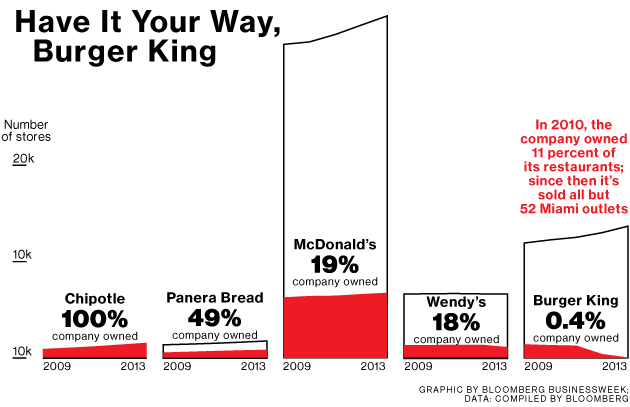
In 2010, the Brazilian private equity firm 3G Capital acquired Burger King for $4 billion. Regime change has since led to a “ferocious approach to cost reduction”:

McDonald’s owned 19 percent of its 35,429 restaurants worldwide in 2013. Wendy’s owned 18 percent of its 6,557 outlets. Historically, Burger King operated much the same way: When 3G bought the chain in 2010 it owned 11 percent of its 12,174 restaurants around the world. Since then, Burger King has sold all but 52; it keeps the last few for training executives and testing products.

That’s such a departure from the way its competitors operate that some people are questioning the company’s strategy. …

After unloading more than 1,200 restaurants, the company’s corporate head count has fallen from 38,884 to 2,425 in 2013. Now its income flows almost entirely from royalty fees from franchisees, on average 4 percent of franchisees’ monthly revenue. That’s less money than before overall, but Burger King has become a cash machine. And 3G hasn’t been shy about helping itself to some of that money. …

Wall Street has responded enthusiastically. Burger King went public again in June 2012 in an offering that put a $4.6 billion value on the company. As of early July, its market cap had risen to more than $9 billion. The doubters are in the minority now, and many in the investment community would like McDonald’s and Wendy’s to mimic the kids at Burger King. “These things are seemingly working at Burger King and causing questions to be asked about the strategy of others in fast food,” says David Palmer, an analyst who covers the restaurant industry for RBC Capital Markets (RY). “Like, why aren’t you doing what they’re doing?”

The Hard Work Of Working From Home

In a review of Nikil Saval’s Cubed: A Secret History of the Workplace, Jenny Diski comments on the rise of work-from-home freelancers:

These workers are a serious new class, known as the precariat: insecure, unorganised, taking on too much work for fear of famine, or frighteningly underemployed. The old rules of employment have been turned upside down. These new non-employees, apparently, need to develop a new ‘self-employed mindset’, in which they treat their employers as ‘customers’ of their services, and do their best to satisfy them, in order to retain their ‘business’.

She continues:

The US Bureau of Labor Statistics projects that ‘by 2020 freelancers, temps, day labourers and independent contractors will constitute 40 per cent of the workforce.’ Some think up to 50 per cent. Any freelancer will tell you about the time and effort required to drum up business and keep it coming (networking, if you like) which cuts down on how much work you can actually do if you get it. When they do get the work, they no longer get the annual salaries that old-time clerks were so proud to receive.

Getting paid is itself time-consuming and difficult. It’s estimated that more than 77 per cent of freelancers have had trouble collecting payment, because contractors try to retain fees for as long as possible. Flexibility sounds seductive, as if it allows individuals to live their lives sanely, fitting work and leisure together in whatever way suits them and their families best. But returning the focus to the individual worker rather than the great corporate edifice simply adds the burdens of management to the working person’s day while creating permanent anxiety and ensuring employee compliance. As to what freelancers actually do in their home offices, in steamy cafés, in co-working spaces, I still have no idea, but I suspect that the sumptuous stationery cupboard is getting to be as rare as a monthly salary cheque.

On a related note, Karen Alpert finds that being a work-from-home parent, in particular, is the worst of two worlds:

Every day, I hear it: You’re so lucky you get to work from home. But guess what? Being a stay-at-home mom is hard, and being a working mom is hard, but being a work-at-home mom is the suckiest choice of all. It may not be worse than the single mom who has to hold down two or three jobs and never gets to be at home with her children, but it’s worse than going to an office 9 to 5 and it’s worse than staying home with the kids all day long. I’ve done all three, and that is my conclusion. ….

[B]eing a working mom and being a stay-at-home mom are both crazy hard. But being a work-at-home mom is hard in a whole different kind of way. It’s not about seeing your kids too much or too little. It’s about ignoring your kid–a lot–and feeling like you’re constantly failing them throughout the day. … Day in, day out, I have to tell my kids to leave me the hell alone, and I constantly feel bad about it. Do they think my work is more important than they are? It’s not. But sometimes it has to be.

Mapping The Scenic Route

8666792058_4176792501_z

Researchers are developing an app for it:

For a paper released earlier this month, adorably entitled “The Shortest Path to Happiness,” [researchers from the University of Turin and Yahoo] asked over 3,000 online users of their site Urbangems.org to decide which of two street scenes from Google Earth was the most beautiful. The researchers then used this data to put together four different routes between London’s Tate Modern and Euston station, and asked 30 people to test and rate them. Each route was chosen by the researchers to display a different quality: one was “beautiful,” another “happy,” a third “quiet” and the last was “short.”  …

In each of these experiments, the team found that the shortest route was often ranked the lowest by users: the quickest path between their two destinations in London, for example, took walkers down busy, car-clogged roads, and crossed Blackfriars Bridge. Much better, many felt, to take a quieter and more scenic path across the pedestrianized Millennium Bridge. If a route is attractive, walkers often don’t even notice that it’s longer.

The endgame:

The plan is to turn all these findings into an app for cities in the US and Europe. It wouldn’t be the first app to take users off the beaten path – Dérive gets you “lost in the city,” while Serendipitor uses the philosophy of, among others, Yoko Ono to “introduce small slippages and minor displacements within an otherwise optimized and efficient route” (oooohkay). But this would be the first app to generate routes based on “quiet, happiness and beauty.”

(Photo of a Berlin street by Steffi Reichert)

Do Autodidacts Know Best?

Annie Murphy Paul argues that advocates of self-directed learning don’t have a lot of evidence in their corner:

In a paper published in Educational Psychologist last year, Paul A. Kirschner of the Open University of the Netherlands and Jeroen J.G. van Merriënboer of Maastricht University challenge the popular assumption “that it is the learner who knows best and that she or he should be the controlling force in her or his learning.” There are three problems with this premise, van Merriënboer and Kirschner write. The first is that novices, by definition, don’t yet know much about the subject they’re learning, and so are ill-equipped to make effective choices about what and how to learn next. The second problem is that learners “often choose what they prefer, but what they prefer is not always what is best for them”—that is, they practice tasks that they enjoy or are already proficient at, instead of tackling the more difficult tasks that would actually enhance their expertise. And third, although learners like having some options, unlimited choices quickly become frustrating—as well as mentally taxing, constraining the very learning such freedom was supposed to liberate.


The Best Of The Dish This Weekend

1771470937_4e9ef63c81_b

Another grueling weekend in the Middle East, but some relief here at the Dish. Six posts worth revisiting: the perils of auto-correct; the dirty mouths of babes; Edmund White’s brilliant appreciation of friendship; visualizing Debussy; a religious history of the Great War; and an adorable nine-day-old white lion.

The most popular post of the weekend – by a mile – was The Worrying Vacuity Of Hillary Clinton; followed by Why Am I Moving Left?

19 more readers became subscribers this weekend. You can join them here – and get access to all the read-ons and Deep Dish – for a little as $1.99 month. Gift subscriptions are available here. One subscriber writes:

Celebrity is confusing. While your public persona seems so confessional, it’s easy to forget that I don’t actually know you. That what I think about you includes an enormous amount of projection. And that you certainly don’t know me. It’s the asymmetry, I think, that is so strange. Your persona speaks to me most days, through your writing, while you have received perhaps 10 emails from me, among god knows how many emails from 30,000 others.

Is it strange for you? It must be. How do you handle it? I hope that people respect your privacy and personal space, but you must have your share of unwanted encounters. Or are you one of the lucky few who is energized by such encounters?

The issue came up last weekend, when my girlfriend introduced me to Provincetown. She knows that I am a Dishhead, and that you are a Provincetownhead. On the ferry from Boston, she teased me about you. Asked me what I would say if we bumped into you. I said that of course we wouldn’t bump into you.

We got off the boat, and you were EVERYWHERE! Turns out it was bear week. Ten million beards, many resembling yours. Made me unreasonably happy to see your gathered tribe. And I see why you love the place itself. We spent all weekend walking, unmolested by celebrity, passing among the dunes from one unexpected oasis to the next, our souls sipping the serenity in each.

Beardless, both of us, yet happy.

May your private oases be safe and bright. May you and your husband take moments to be happy, despite all the troubles of the world.

See you in the morning.

(Photo by Mikael Colville-Anderson.  See the poems it illustrated here.)

The Lie Behind The War

Christian woman killed in Israeli airstrike on Gaza

Katie Zavadski, fresh from a Dishternship, nails down a critical fact in the latest Israel-Hamas death-match. As the Dish has noted before, the Israeli government knew from the get-go that the murderers of three Israeli teens – the incident that set off this bloody chain of events – were not doing official Hamas’ bidding even in the West Bank, let alone Gaza:

This was confirmed by Mickey Rosenfeld, the police spokesman:

So the entire swoop on the West Bank against Hamas, which soon escalated into all-out war, was based on a a false premise, uttered by Bibi Netanyahu thus: “Hamas is responsible, and Hamas will pay.” It’s worth recalling in that context that Hamas had recently been very quiet on the rockets front:

Fewer rockets were fired from Gaza in 2013 than in any year since 2001, and nearly all those that were fired between the November 2012 ceasefire and the current crisis were launched by groups other than Hamas; the Israeli security establishment testified to the aggressive anti-rocket efforts made by the new police force Hamas established specifically for that purpose.

Netanyahu saw an opportunity to hammer Hamas and punish the PA for cooperating with them. He took it. It disempowers both and makes an even more radical successor more likely. But if you assume that Netanyahu has no intention of ever coming to a peace agreement, a more radical Palestinian population helps justify that. Meanwhile, the core project of a permanent Greater Israel is advanced.

After watching this situation for too many years now, I have developed one key measurement: follow the settlements. Everything that happens is designed for their benefit. And that goes for the current ghastly carnage. It’s staggering what the Israeli government will sacrifice to advance the settlements.

(Photo: The dead body of Jalila Ayad, a Christian woman killed in an Israeli airstrike on her house in Gaza City, is carried to the Al-Shifa hospital morgue on July 27, 2014. By Mohammed Talatene/Anadolu Agency/Getty Images.)

Gazing At The Stars And Finding God

13186800175_b742058e95_k

In an interview about their forthcoming book, Would You Baptize an Extraterrestrial?, Brother Guy Consolmagno and Father Paul Mueller – both Jesuit priests who are planetary scientists at the Vatican Observatory – respond to a question about whether or not science “disproves” the Bible:

Guy: Science doesn’t prove. Science describes. The Bible isn’t a book of propositions to be proved or disproved; it’s a conversation about God. So that question presupposes a radically false idea of what science is, and what the Bible is.

Paul: We never ask if science disproves Shakespeare’s Romeo and Juliet, though the play includes statements that are at odds with modern science. We never ask if science disproves Maximilian Kolbe’s self-sacrificing love, though his own knowledge of science would be seventy years out of date today. Lovers don’t look to science to prove the reality of their love. Why on earth would we want to go to science for proof of the reality of God’s love?

Their thoughts on how the Bible does – and does not – inform their scientific inquiry:

Paul: Science gets along just fine, thank you, without needing to make any reference at all to the Bible. But if you’re going to do science at all, you have to first presuppose that the natural world is somehow orderly and intelligible. Our expectation that the world is that way emerges from the Biblical creation stories. Of course the Bible also informs our moral framework for thinking about how to use our scientific knowledge – will we use science for domination and power, or for service and love?

Guy: Revealed religion helps me understand why I want to do science. Science – understanding this physical world we live in – is something everyone wants to do. It’s what an infant is trying to do when he wants to touch and taste everything in reach; it’s what a toddler is trying to do when she keeps asking, “Why?” I found the hunger for science in my students when I was a Peace Corps teacher in the third world. So, why? Why this hunger? What are we really hungry for?

It reminds me of what the German theologian (and Jesuit) Karl Rahner called the “wovorher” and “woraufhin” – the thing outside us we are looking for, and the thing inside us that drives us to look. Ultimately it is the hunger for God: God the Creator. When you understand that, it changes the way you do science. The temptation is to do science for honor or glory, or financial success, or tenure. But those aren’t the deeper reasons why we’re driven to ask why. And achieving them won’t satisfy that hunger.

(Photo of a monastery under the stars by Soren Schaper)

Heroes On A Human Scale

Dana Staves considers how reading Virginia Woolf’s diary helped her reconsider the literary giant:

Her final entry is unremarkable. But it’s her final sentences that broke my heart, that has haunted me for months to follow: “And now with some pleasure I find that it’s seven; and must cook dinner. Haddock and sausage meat. I think it is true that one gains a certain hold on sausage and haddock by writing them down.”

Sausage and haddock? She’s Virginia Woolf, she terrifies me and astounds me, and I love her, and her final written words to the world of her diary, before she took her own life three weeks later, is about sausage and haddock. The cook in me smirked, the way we smile over a bittersweet memory of loved ones who have passed. After all that, it’s sausage and haddock. It’s life. But the writer in me – the part of me that doesn’t always have food on the brain – stalled out.

We build up authors so that they become epic and mythic, each huddled away on their corners of a literary Mount Olympus, scribbling or typing. The place smells of coffee and books and anxiety. But in the end, they’re people, not gods. They’re people who must eat dinner and fear bombs and attempt to get a handle on cooking sausage and haddock. This is a challenge as big as writing The Waves or Mrs. Dalloway Virginia Woolf was epic to me. But she was also just a person. She could no more fix my insecurity than fix her own.

Living With Loss

Ben Watts reviews the above short film, Where Do Lilacs Come From, which movingly portrays the perspective of a man with Alzheimer’s:

Writers are often told: “Write what you know”. For Where Do Lilacs Come From, [writer/director Matthew] Thorne did just that, ripping a band-aid off painful true-life events and dramatizing them for the screen. “I had a lot of memories from when I was younger of my dad losing his mother to Alzheimer’s,” Thorne said. “[Those memories] really became the genesis for the film — particularly the pain my dad went through. It was a very strange experience being reintroduced to your Grandmother every day as though she had never met you…You almost start to wonder whether that’s normal. I really wanted to tell a story from her perspective — what it might be like to live in a world where present and past don’t have a clear delineation.” On that front, Thorne excels magnificently, tapping into the dreamlike-quality of memory loss with precision. The extent of Chris’ Alzheimer’s is not apparent until Michael holds up a framed photograph and shows it to his father.

“That’s Mom,” Michael says. “Wasn’t she beautiful?”

“She’s probably in the house,” Chris says.

“No. Mom’s gone now.”

“Oh,” Chris says, pointing to a man in the picture. “Does he know?”

Michael takes a deep breath, trying to keep his composure. “That’s you, Dad.”

Nostalgic For Nietzsche, Ctd

More readers keep the conversation going about the merits of New Atheism, sparked by this post. One argues that it’s not Nietzsche who atheists should turn to, but a different German philosopher – Schopenhauer:

Nietzsche187cAll the criticisms leveled against Nietzsche that you have posted are valid.  Nietzsche is too often assigned to atheists because of his famous “God is dead” line.  Nietzsche dismissed the so-called Golden Rule as insipid sentimentalism, as well as Rousseau’s declaration that human empathy proves the goodness of man.  Nietzsche operates outside of what we consider conventional morality, and he makes for an exciting read, but in the end must be rejected by agnostics like myself due to his disdain for the vast majority of humanity, those trapped within slave-morality.

The philosopher I admire is Schopenhauer, especially his notion that compassion is the only good.  Schopenhauer blended Indian philosophy into his belief, that when one exercises their will it leads to suffering.  This is different from Nietzsche’s claim that will should be used to gain power, and that power is only for elite “Supermen” and whatever may be the lot for the rest of humanity does not matter.  (Also note that Nietzsche was one of histories great misogynists, and seemed to truly loathe women.)

The atheist/agnostic would be better served by association with Schopenhauer than Nietzsche.  Nietzsche is to be admired as a writer and a thinker, but not as a guide to New Atheism.

Another rejects the claim from a previous reader that since “the religion believed and practiced by the vast majority of the religious” isn’t the sophisticated theism of, say, David Bentley Hart, the New Atheists have a point:

I’ve never understood why this is the criteria for judging religion’s validity.

Is this criteria applied to anything else? Is philosophy bunk because most people who understand themselves to be “selves” couldn’t tell you the first thing about the cogito?  Are social theories about race to be dismissed because most of us are oblivious to them–or aware of them incorrectly? Of course not. But the sadly all too human behavior and misunderstandings of those that practice religion are regularly pointed to as an excuse to be incurious about its deeper possibilities. Those intellectually curious who want to know about philosophy or race or anything else don’t ask the general populace but turn to the sharpest, most cogent thinkers on the subject. What is so dangerous about doing the same with religion?

Another reader adds that there’s “no reason to be so tentative regarding the case for a secular basis of ethics”:

There are plenty of sophisticated defenses of “secular” ethics. We can look at Derek Parfit’s On What Matters, or Tim Scanlon’s What We Owe to Each Other, or Christine Korsgaard’s Sources of Normativity, or Michael Huemer’s Ethical Intuitionism, or David Enoch’s Taking Morality Seriously, or dozens of other books. (Indeed, from the survey information we have (as found here) moral realism and atheism are both favored positions among academic philosophers.) What’s always so odd to me is the two-pronged attack made by those who insist on the inadequacy of a secular account of morality: on the one hand, they contend that secular ethics doesn’t address various thorny metaphysical and epistemological issues. And yet, when presented with the existence of such sophisticated works that plainly do address such issues, they dismiss the works as being too obscure and complicated — too academic if you will. Well, you can’t have it both ways. If you want a robust and sophisticated defense of secular morality, then you might need to read something a little more dense than a book about atheism designed to be accessible to a popular audience.

Previous reader responses here. Meanwhile, other readers respond to Michael Robbins’ letter to the Dish:

Michael Robbins’ latest defense of his essay review of Spencer’s book, which you posted, conveniently skips past a colossal point that one of your readers quite cogently articulated in dissent:

The religious intelligentsia want to embrace the vast majority of Christians (who believe nothing like they do), as part of their faith, and at the same time decry atheists who focus on that vast majority as failing to engage “true” Christianity and the deep, meaningful arguments for the faith.

Robbins goes on to prove your reader right when he, like John Haught and David Bentley Hart and other “Sophisticated Theologians”, makes the boring mistake of saying that “religious fundamentalism is a soft target.”  Is it really that soft when almost half of America believes that God created the world in its current form according to Genesis?  Is it really?

Another:

Dammit.  I never said anything, positive or negative, about the Hart quote other than Robbins wanted us to focus on it. More to the point: When Michael Robbins writes “Christians have recognized the allegorical nature of these accounts since the very beginnings of Christianity”, or “it’s not God, at least not God as conceived by a single one of the major theistic traditions on the planet”, he’s ignoring the belief of most Christians in the US and elsewhere.  To be clear, most living Christians do not recognize the allegorical nature of these accounts (a statement easily proven).

When Robbins says, “I had assumed it was obvious that Origen and Augustine would hardly have taken the trouble to deny literalist readings of the Bible if such readings did not exist” he’s faking left and going right. Reading the Bible literally came after the Reformation (a fact Robbins flags in his article “He Is Who Is“).  And while I am insufficiently educated to speak to Origen, I’m happy to go head-to-head on Augustine: $50 for every place Augustine denies literalist readings of the Bible vs. every place Augustine did not.  For example, did Augustine believe in a literal Adam and Eve and original sin?  (Yes.)  Does evolutionary theory destroy both?  (Yes.)  Will I make good money if Robbins takes me up on my offer?  (Yes.)

“Young-earth creationism” is “of course” not based on the Bible.  He seriously said that.  Robbins’ use of the phrase “of course” illustrates a startling ignorance of the mass of Christianity and their scriptural exegesis.  Apparently Ken Ham and Bill Nye’s debate on a 6,000 year-old earth missed the point – nobody watched it.

OK, enough whining, to the heart: Michael Robbins continues to miss the point.

But the New Atheists did not write books that simply attacked creationism. They wrote books that purport to challenge theistic belief as such. They therefore have a responsibility to address the best cases for God, not the dullest.

They wrote books to challenge the theistic belief … of the vast majority of  Christians.  The audience that believes Noah stuffed 9 million unique species on a boat, and the kangaroos hopped from Mount Ararat  to Australia without leaving a single skeleton. That doesn’t require challenging the best cases for God, that requires pointing out that 18 million animals would require a lot of food, produce a lot of waste, and the wolves would probably eat the rabbits.  If the target audience doesn’t care (or understand), the best cases, why should atheists focus on them?

Yes “religious fundamentalism” is a soft target – but it is the important target, and the target on which atheists should focus. If Robbins disagrees, he needs to make the argument that attacking the best cases for God is worth doing, not that it’s the “right” thing to do.

Another piles on:

I’ve found Michael Robbins essay and response both unconvincing. The “New Atheists should be more like Old Atheists,” trope aside, there are other tropes I saw in Robbins’ response. Let’s play spot the trope!

But the New Atheists did not write books that simply attacked creationism. They wrote books that purport to challenge theistic belief as such. They therefore have a responsibility to address the best cases for God, not the dullest. When Dennett asks if super-God created God, and if super-duper-God created super-God, he is simply revealing a lack of acquaintance with the intellectual traditions of the major religions. If you want to argue against something, you have to understand what you’re arguing against. That’s axiomatic.

I would say there are two standard tropes in here. First is the atheists don’t address “the best cases for God.” As far as I can tell atheists always deal with the argument for God being made. Whenever I see that phrase I’m reminded of the practice of goal-post shifting. Often when an atheist addresses a “case for God” they’re told that they haven’t addressed the “best case for God.” Which makes me wonder, why don’t proponents of theism use the “best case for God?” Maybe Robbins should check out Jerry Coyne’s website (not blog) Why Evolution is True; he has addressed various “best cases for God.” Most recently he covered David Bentley Harts’ latest book and found that that “best case for God” was a series of non-sequiturs. X exists therefore God is hardly a convincing argument.

The second I noticed has already been addressed through the Courtier’s Reply. I don’t need to spend several years studying fashion to point out someone’s naked just as I don’t have to spend several years studying theology to point out arguments for theism are not rational.

Another thing, this sentence: “Some atheists believe that their faith in scientific naturalism suffices to disprove the existence of God, for instance.” Speaking of caricatures … I will admit that there may be atheists like this but I know of no atheists who make arguments like that. Science simply eliminates various things from various gods portfolios and finds natural explanations. Germ theory of disease is one example. Do bacteria and viruses disprove God? Of course not, it simply means that God is not needed for people to get sick.

The atheists I know are atheist because they found the argument for theism unconvincing. Personally I’ve always found evidence for theism lacking and the philosophical arguments for theism either irrational or creating an irrelevant deity whose existence is identical to it’s nonexistence. Robbins should check out QualiaSoup’s threepart series on morality without God if he wants to some idea of what he’s arguing against.

[snark] Oh wait, stuff like that can’t exist because of the intellectual shallowness of atheists. [/snark]

I love my family and friends. I help others because it is right. I share what pleasure I have with the people I care about. I celebrate life as best I can and share what joy in life as best I can, because this is all we get. There’s no way I’m going to celebrate life any less just because someone told me I should be sad about the death of God.