Sponsored Content Watch

TNR-sponsored-content

A reader sends the above screenshot:

Perhaps this has already become the style at other prestigious media outlets, but I think it’s somewhat remarkable that the editors at The New Republic didn’t see fit to tell readers upfront that the article is sponsored content. (I apologize if I’m late to the party on this particular advertorial start on the part of TNR.) There’s no real differences in terms of front style or size with the only real tip-off being the lack of a byline. But I’ve interacted with enough smart people online to know how rarely readers, who aren’t themselves writers in some capacity, actually pay attention to, much less search for, the author to an article.

The sponsored status of the “article” is a little more obvious on the front-page:

Screen Shot 2014-07-30 at 2.51.19 PM

Previously noted examples here of the ever-growing scourge of sponsored content. Update from a reader:

If you think things are weird on the journalism side, try going toward entertainment. New companies are trying deliberately to muddy the waters.

Foreign Policy As Machismo

Gopnik ponders calls for Obama to be tougher:

In the current crisis over the downed Malaysian plane, all the emphasis is on how it looks orGERMANY-CARNIVAL-ROSE-MONDAY-STREET-PARADE how it might be made to look—far more than on American interests and much less on simple empathy for the nightmarish fate of the people on board. The tough-talkers end up grudgingly admitting that what the President has done—as earlier, with Syria—is about all that you could do, given the circumstances.  Their own solutions are either a further variant on the kinds of sanctions that are already in place—boycott the World Cup in Russia!—or else are too militarily reckless to be taken seriously. Not even John McCain actually thinks that we should start a war over whether Donetsk and Luhansk should be regarded as part of Ukraine or Russia.  The tough guys basically just think that Obama should have looked scarier. The anti-effeminate have very little else to suggest by way of practical action—except making those unambiguous threats and, apparently, baring your teeth while you do.

Why does this belligerent rhetoric still stir us?  The American political historian K. A. Cuordileone wrote a good book a few years ago about the birth of this  “cult of toughness” in American foreign policy, in which she makes the point that it was essentially the invention of liberals in the Kennedy Administration—the Eisenhower and Truman people were more inclined to talk of “duty”—who wanted to curb the suspicion that liberals were inclined to be effete. What is strange, reading through her pages, is exactly how exclusively focussed on pure appearances the cult of toughness always was. All of the arguments, the ones that led to the near-apocalypse in Cuba and, later, to Vietnam, were not about calculations made of interests and utility. They were about looking manly.

(Photo by Patrik Stollarz/AFP/Getty Images)

Why Sam Harris Won’t Criticize Israel

Israeli attack kills Palestinian kid in Jabalia Camp

It’s a very long piece – or, rather, a speech annotated with qualifications – an interesting way to put your thoughts down on a screen. And it’s well worth your while. The gist of it is that because Hamas is an almost text-book example of nihilist theocracy and Israel isn’t, Israel is on the right side of the defining struggle of our times – and so not a country Harris will criticize. A related, central point is that the use of human shields by Hamas puts them in an utterly different moral universe than the IDF, in whose interests it is not to kill Palestinian civilians.

This is a crude summary – for there are qualifications on so many points that the piece is almost an explosion of nuance. So, for example, in Sam’s view, Israel cannot be absolved from war crimes either; and should not even exist as a Jewish state. That last point is a pretty huge one – and it comes at the very start of the piece. But if Israel should not exist as a Jewish state, it should not exist at all. This is its core justification – and one of the issues the Israeli government has put at the center of any possible two-state solution. Get rid of the Jewishness of Israel … and you will soon have a Middle Eastern state pretty evenly divided between Jew and Arab and in which future immigration ISRAEL-PALESTINIAN-CONFLICT-GAZAwould easily tip the demographic balance toward Islam. And this is where, I’d argue, Sam’s argument begins to unravel almost as soon as it begins: because it is overwhelmingly an abstract statement of abstract principles which fails to account for history in all its particular twists and turns. So he ends up refusing to criticize a state he really doesn’t believe should exist and yet then goes on to criticize it quite potently. You can call that original if you want. But you might also call it incoherent.

Still, Sam is unquestionably right about the theocratic extremism and despicable anti-Semitism of Hamas and its allies. It is much more extreme and central to Hamas than theocracy and anti-Arab racism is to Israel. He’s right that Hamas’ preference for building underground tunnels for war rather than underground bomb shelters for civilians makes them complicit (though far from solely responsible) in the horrifying carnage of the last few weeks. He’s also right about the difference between what Israelis would do if they had all the power and what Hamas would do in the same boat. Israel, with overwhelming power, gives many Arab citizens political rights even as it has penned a huge number into segregated bantustans, curtailed their travel, blockaded them (in Gaza), and surrounded them with theocratic Jewish settlements in the West Bank. Hamas would, in contrast, just kill every Jew it could find as soon as it could. That is an important difference.

But that’s why I absolutely do not support Hamas, and never have. Nor is there any excuse for their war crimes. But the issue here is not one of a choice between Israel and Hamas; it’s between the possibility of a two-state solution and the Israeli government’s refusal to take any of the off-ramps toward it if they would curtail the bid to settle and annex the West Bank. Much of Sam’s argument would hold water if the Israelis had been in earnest about peace, and in earnest in supporting moderate Palestinian forces on the West Bank, and in earnest about taking Obama’s proposals seriously this past decade. But they haven’t been. Settlements are much more important to them than peace. And the settlements are motivated by exactly the kind of theocratic zeal that Sam normally opposes.

But the settlements – themselves a standing war crime under Geneva – do not figure prominently in Sam’s account. And when they do, he offers an unconvincing defense:

What would the Israelis do if they could do what they want? They would live in peace with their neighbors, if they had neighbors who would live in peace with them. They would simply continue to build out their high tech sector and thrive. [Note: Some might argue that they would do more than this—e.g. steal more Palestinian land. But apart from the influence of Jewish extremism (which I condemn), Israel’s continued appropriation of land has more than a little to do with her security concerns. Absent Palestinian terrorism and Muslim anti-Semitism, we could be talking about a “one-state solution,” and the settlements would be moot.]

This is delusional. It’s not just Palestinian terrorism and Muslim anti-Semitism that makes a one-state solution moot; it is embedded in the very meaning of Zionism. If Israel requires a Jewish majority to survive as a Jewish state, a one-state solution is anathema to it. And if all Israel wanted to do was have its tech sector thrive within (roughly) the 1967 borders, and embrace serious, US-backed security arrangements vis-a-vis Jordan, I’d be backing it to the hilt.

Instead, as Palestinian terrorism from the West Bank has declined drastically – the Israelis have intensified their theft of Palestinian land. Those settlements deeply hurt, rather than help, Israel’s security – because they alienate most of her allies, exacerbate bitterness and suspicion, and make the possibility of a two-state solution moot. You could secure the West Bank by military outposts if you wanted. But Israel is committed to engineering the demography of the place by settlements of religious fanatics of the sort Sam would usually excoriate. Netanyahu, we now know, would rather release hundreds of prisoners convicted of murdering Jews than remove a single brick from the West Bank settlements. It’s really not about security at all. It’s about race and religion in their ugliest zero-sum manifestations. Just because it isn’t as bad as Hamas doesn’t excuse it.

Then there is a really important point:

What do groups like ISIS and al-Qaeda and even Hamas want? They want to impose their religious views on the rest of humanity. They want to stifle every freedom that decent, educated, secular people care about. This is not a trivial difference. And yet judging from the level of condemnation that Israel now receives, you would think the difference ran the other way.

This kind of confusion puts all of us in danger. This is the great story of our time. For the rest of our lives, and the lives of our children, we are going to be confronted by people who don’t want to live peacefully in a secular, pluralistic world, because they are desperate to get to Paradise, and they are willing to destroy the very possibility of human happiness along the way. The truth is, we are all living in Israel. It’s just that some of us haven’t realized it yet.

Again, the abstractions obscure rather than clarify. We are not all living in Israel. Nor should any sane person want to be. In America, we are surrounded by two vast oceans and two unthreatening neighbors – about as different from Israel as it is possible to conceive. We have more space and land to accommodate religious, racial and cultural diversity than Israel could even dream of. We are not defined by one race or religion – but defined rather by a radical separation of church and state. In so far as we face Jihadist terror, we do so from a vastly more secure vantage point – and its victims since 9/11 have been mercifully sparse, suggesting a threat more manageable within our existing laws and arrangements than I, for one, ever thought possible.

And we have a real debate about how to confront Jihadist terror. In the Cheney years, we adopted the Netanyahu “shock and awe” approach – bomb, invade, terrorize and detain. Since then, we have adopted smarter, more surgical and political initiatives to help defuse it. One way to defuse it would be to resolve the Israel-Arab conflict along the only two-state lines that can work. The Israel-Palestine dispute is not the only thing galvanizing Jihadism, of course. But it remains one area where we have some leverage to effect change, and it is one area where our alleged ally has done all it can to prevent us.

I oppose Jihadism, in other words, as much as Sam. But what Israel is doing in the West Bank and the horrors it is inflicting on Gaza are almost designed to inflame, give credence to, and empower Jihadism in ways that will not only affect the Israelis. We are not all living in Israel. But if Sam gets his way, and ever more salt is rubbed into an ever rawer wound, we could be.

(Photos: Palestinian girl Ansam says goodbye to her little brother Sameh Junaid, killed in an Israeli cannon shot in the morning of Eid al-Fitr at Jabalia Refugee Camp as he was playing in the garden of his house on July 28, 2014 in Gaza City, Gaza. By Ali Hasan/Anadolu Agency/Getty Images; An Israeli soldier carries a shell as he and his comrades prepare their Merkava tanks stationed at an army deployment area along the border between Israel and the Hamas-controlled Gaza Strip on July 31, 2014. By Jack Guez/AFP/Getty Images.)

Can Israel “Win” This War? Ctd

Keating now believes that Israel declaring victory and withdrawing from Gaza unilaterally is more likely than a negotiated ceasefire:

Some members of the Israeli security Cabinet may support a long-term reoccupation of Gaza, but Prime Minister Benjamin Netanyahu probably isn’t one of them. There’s little public pressure in Israel to end the operation or accept an internationally proposed cease-fire, but it’s conceivable that things might be different if Netanyahu simply declared that Israel’s vaguely defined military goals had been accomplished and unilaterally pulled back Israeli troops. …

This scenario, of course, wouldn’t address the ongoing humanitarian catastrophe in Gaza or prevent violence from flaring up again in the future. And it certainly feels like a long shot at the moment. But compared with the alternative—the U.S., Egypt, Qatar, Turkey, the Palestinian Authority, and whoever else finally getting on the same page to establish a framework under which Israel and Hamas would agree to terms they’ve thus far found utterly unacceptable—it feels at the moment like the more likely way for this to finally end.

Although Netanyahu has claimed that the objective of the war is to neutralize Hamas once and for all, and some members of his government want him to go even further, the prospect of what happens if the Hamas government in Gaza is toppled leaves Israel in a bind:

Israel’s ideal outcome would be for Hamas to capitulate to Israel’s demands to disarm and reform into a defanged version of its current self—a troublesome but manageable part of a larger Palestinian political infrastructure. But if Hamas won’t bend, it might break, and that would be the worst possible outcome for Israel, said Aaron David Miller, a former Middle East negotiator now with the Wilson Center.

“Reform or regime change, that’s the central question,” he added. “An unanchored, unmoored, lawless Gaza in the hands of something like ISIS or Islamic Jihad, this proposition would be fundamentally worse than the one we inhabit and inherit now.” The problem with Netanyahu’s strategy, according to Miller, is that Netanyahu may never be able to achieve the ending to the war he’s looking for. He’s unlikely to get a capitulation by Hamas and he can’t afford to destroy its leadership. He also can’t accept a tie, as the 2012 ceasefire was widely viewed in Israel.

Whatever outcome Netanyahu chooses – and it is, in the final analysis, up to him –  Noah Millman is convinced that it won’t serve anyone’s interests in the long term:

Israel’s stated goals for this operation are partly military and partly political. The military goal is to destroy, or at least dramatically degrade, Hamas’s war fighting capabilities – destroy tunnels, rocket-launchers, kill or capture operatives, etc. The political goal is to get the people of Gaza to blame Hamas for the destruction wrought by the war, and turn against the organization and a strategy of armed confrontation with Israel. Leaving aside whether the political goal is likely to be achieved – I think the opposite effect is more likely – it should be clear, from the overwhelming preponderance of the decisions of the current Israeli government, just how limited its political horizon is. Israel does not have a strategy for settling the conflict. It has a strategy, good or bad, for managing the conflict within its current contours. Israel is fighting to preserve the status quo.

That’s the larger context within which the war is being fought. And that context has moral implications for how the war may be fought, inasmuch as we should not desire the status quo ante to be preserved, but the status quo amounts to imposed rule not merely without the consent of the ruled, but over the emphatic, furious, unequivocal refusal of that consent.

Previous Dish on what “victory” in Gaza would mean here and here.

The Meh Recovery

noisyGDP

Justin Wolfers thinks the latest GDP report is “less interesting for its accounting of the second quarter than for what it tells us about the future path of economic growth”:

At first blush, you might think that G.D.P. growth at an annual rate of 4.0 percent points to a brighter future. But in fact, these estimates are statistically noisy, and there’s no guarantee that strong growth today will translate into good outcomes tomorrow. Indeed, the historical relationship between the two is surprisingly weak. …  All told, these more meaningful data suggest that the economy is not in the middle of some whiplash, but rather that the past few quarters continue the pattern seen throughout the entire recovery, of persistent growth, albeit at a disappointing rate.

Jared Bernstein puts the report in context with the above chart:

The figure below plots quarterly annual growth rates against year-over-year rates for real GDP over the recovery. The annualized quarterly growth rate for Q2–the one getting all the headlines–was 4%; the more-indicative-of-actual-trend-year-over-year rate was 2.4%.

I see two clear points: first, the annual changes provide a much more reliable view of the underlying growth rate, and second, since the yearly rates turned positive in 2010Q1, we’ve been growing at trend, about 2.2% on average. That would be a fine place to be if we’d first made up the deep losses from the downturn. But what happened in this recovery is that we settled into trend growth before we bounced back and repaired the damage. That’s why the job market in particular has taken so long to recover.

Matt O’Brien deems the economy “meh”:

[I]nventories made up 1.66 of the 4 percentage points of growth this quarter. And that, unfortunately, won’t carry over into the future, since businesses won’t need to restock for awhile. In other words, once you account for inventories, the economy wasn’t really as weak as it seemed at the start of the year, and it’s not as strong as it does now. It’s just been the same the whole time: meh.

Suzy Khimm gathers some reaction:

Economists don’t expect the economy to continue growth at the same rate for the rest of the year, though some believe the picture has brightened somewhat. “This release provides evidence that the economy is healthy and will continue to grow at an above-average rate in the second half of this year and into 2015,” said Doug Handler, chief U.S. economist for IHS Global Insight.

“The story is the same—subpar growth during the first few years of the recovery. But 2014 is looking much better,” Stuart Hoffman and Gus Faucher of PNC Financial Services Group said in a statement. “After the very good second quarter growth should settle in at an above-trend 3.0% annual rate in the second half of this year.”

The Economic Policy Institute was more pessimistic. “Essentially, we made up some of the ground lost in the first three months of this year, but there’s nothing in today’s data to indicate that the economy is growing more strongly than it has for the past couple of years,” the group said in a statement.

Ben Casselman is relatively upbeat:

GDP reports are notoriously complex, and there’s always room for caveats and alternative interpretations. But make no mistake: This was a good report, especially in context. A 4 percent annual growth rate isn’t a boom, but it’s significantly better than the 3 percent economists had been expecting, and it more than offsets the first quarter’s contraction. The growth was broad-based, with consumers, businesses and even the government contributing to the rebound. Wednesday’s report provides strong evidence the first-quarter contraction was a one-off event that was probably due in part to the historically bad winter in much of the country: Consumer spending, homebuilding and exports all struggled in the first quarter and rebounded in the second. The revisions, too, were cause for optimism: The first quarter wasn’t quite as bad as it once looked, and the end of 2013 was stronger, suggesting the economy carried more momentum into the start of 2014 and lost less of it when winter weather hit. All of that gives hope for continued growth.

Ylan Mui finds that other “measures point to the growing strength of the recovery, as well”:

A private estimate of monthly job growth by human resources firm ADP released Wednesday morning showed 218,000 net new positions were created in July — slightly fewer than anticipated but still a healthy showing. Mark Zandi, chief economist of Moody’s Analytics, which helped calculate the data, said he expects the country to reach full employment by late 2016.

“At the current pace of job growth, unemployment will quickly decline,” he said. “Layoffs are still receding, and hiring and job openings are picking up.”

Government data show the number of people filing for unemployment benefits for the first time fell to its lowest level in eight years last week. A closely watched survey by The Conference Board showed consumers expressed more confidence in the economy in June than they have at any point since the recession began in late 2007.

Danielle Kurtzleben provides a better way of reading the GDP report:

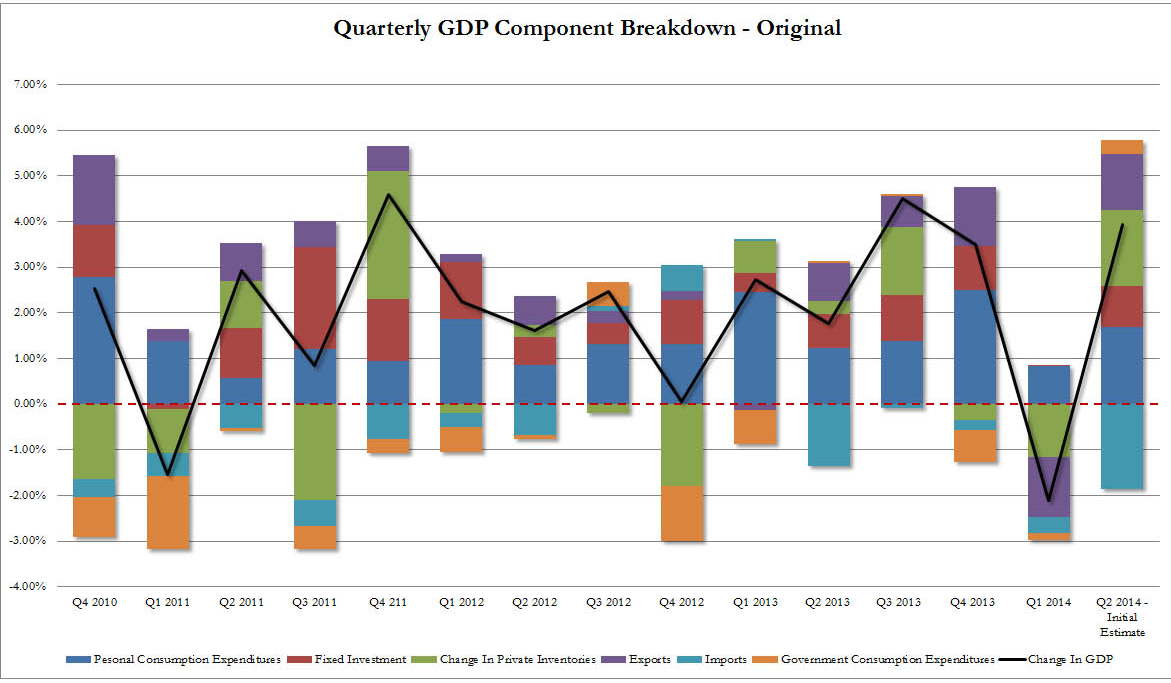
[C]heck out this chart put together by ZeroHedge. It shows quarterly GDP growth, broken down by the various components that go into adding up GDP:

GDP_components

Take a look at each of those colors, and you’ll see that the green (changes in inventory investment) is the most all-over-the-map. Red (fixed investment) tends to be positive. Darker blue (consumer spending) also tends to be positive. Government spending (orange) can be up or down, but has in recent quarters tended to be modest in size and more often than not negative.

But inventories regularly swing up, then down, then up, then down, and the size change can be big. And it’s for this reason that there’s a better way to look at GDP each quarter. The BEA releases a figure called “real final sales,” and it simply looks at GDP without those swings in inventories. By that measure, GDP only fell at an annual rate of 1 percent (not 2.1 percent) in the first quarter, and grew by 2.3 percent (not 4.0 percent) in the second. Arguably, this is a more stable measure of GDP.

Putting A Price On Your Pet’s Life

photo-20

David Grimm ponders the moral dilemmas created by recent advances in veterinary medicine:

When our dogs and cats used to get very sick, we could justify putting them to sleep because it was the only option. Now, in an age of kidney transplants for cats and chemotherapy for dogs, euthanasia has begun to seem like a cruel way out.

Yet not everyone can afford to save their pets. And some go bankrupt trying. … “It’s wonderful that people are willing to spend $10,000 or $20,000 to deal with their sick pet, but ethically it puts us in quicksand,” says Douglas Aspros, the former president of the American Veterinary Medical Association and the manager of a veterinary clinic in White Plains, New York. “If a client wants me to do a $20,000 surgery on a cat, the practicality has to go beyond, ‘There’s someone willing to pay for it.’ As a society, should we be promoting that?” Some vets, says Aspros, have started to use companies that offer credit to people with marginal incomes—just so they can afford their vet expenses—and the pet owners end up paying very high interest rates. “How much responsibility do we have for getting them into that?”

(Photo of a Dish reader and her dying dog from one of your most popular threads last year, “The Last Lesson We Learn From Our Pets“)

Race And Beauty, Head To Toe

SKOREA-HEALTH-SURGERY-ADVERTISEMENT-LIFESTYLE

Maureen O’Connor reports on the state of “ethnic plastic surgery”:

The people I interviewed differed in their aesthetics, politics, and medical preferences. But they passionately agreed on one thing: No matter what white people say, this isn’t about them. Plastic surgery doesn’t have to be a sign of deference to some master race, they told me. In fact, it could be the opposite.

According to O’Connor, those most perturbed by these procedures are the people you might least expect:

Why do white people fixate on the “Westernizing” elements of ethnic plastic surgery? While working on this article, I found that people of all races had principled reservations about and passionate critiques of these practices. But the group that most consistently believed participants were deluding themselves about not trying to look white were, well, white people. Was that a symptom of in-group narcissism—white people assuming everyone wants to look like them? Or is it an issue of salience—white people only paying attention to aesthetics they already understand? Or is white horror at ethnic plastic surgery a cover for something uglier: a xenophobic fear of nonwhites “passing” as white, dressed up as free-to-be-you-and-me political correctness?

O’Connor sees a waning centrality of whiteness in beauty ideals, as “the cult of mixed-race idealism promotes racially ambiguous stars like Jessica Alba and Kim Kardashian as avatars for post-racial beauty.” Adding further complexity to questions of race and beauty is Hadley Freeman, who examines the cultural significance of Kardashian’s butt:

Kardashian… is not black – she is half-Armenian, and therefore classified as white European, which presents an interesting opportunity for fashion magazines and pop culture. Here is a woman with the physical attributes associated with sexualised black women, but the skin colour that is preferred by magazine editors. That Kardashian first came to fame via a sex tape also seems to make her fair game to be sexualised by the media. No question, Kardashian does dress in a way that shows her backside’s shape, but I’m not really sure what else she should do, other than wear a wimple.

And on the topic of race and attraction, a reader sounds off on a recent study we posted on interracial couples:

Part of the eroticism of being part of an interracial couple is not being with someone you find exotic, but being with someone who finds YOU exotic. As an Irish-American woman who grew up in the southern suburbs of Boston, a community teeming with the freckled and lily-white descendants of Irish immigrants, my appearance was nothing special to the young men in my town.  The Middle Eastern and Hispanic men I dated in college and after were utterly enchanted by my milky skin and ice blue eyes.  Their view of me as exotic changed my perception of myself.  There is no turn-on like being unique.

(Photo: A an advertisement for a plastic surgery clinic at a subway station in Seoul on March 26, 2014. By Jung Yeon-Je /AFP/Getty Images)

The Myths Of Gaza

Peter Beinart has a relentless rebuttal to several of the talking points by defenders of Israel’s latest assault on Gaza. Since it’s paywalled – but you can get around it by clicking the link in the tweet above – here’s my brief summary.

Myth Number One: Israel left Gaza in 2005. It didn’t in any meaningful way, maintaining control over all of Gaza’s borders, identification of all citizens, and squeezing still further the small space Gazans had to live in. It evacuated a small number of settlers in order to pre-empt any serious two-state negotiation based on the then-operative Saudi and Geneva plans. That’s why the US official position is that Gaza is still under occupation – an occupation that somehow allows Israel to pummel it at will, as if it were a foreign country.

Myth Number Two: Hamas seized power. Nope, it won an election, fueled in part by widespread opposition to Fatah’s corruption and incompetence. Now think about that: the Arab world held a free and fair election … in Gaza. The US reacted by fomenting a Fatah coup against it – that led to Hamas’ seizing power in response. That’s how the US reacts to Arab democracy if the Israelis don’t like it.

None of this excuses Hamas’ war crimes, its rocket fire purposefully directed toward civilians, its extreme theocratic essence and its rabid anti-Semitism. But it sure doesn’t excuse Israel’s brutality and contempt and propaganda either.

Will The GOP Get The Nominee It Craves?

Kilgore suspects that 2014 electoral victories will make the GOP overconfident in 2016:

In both 2008 and 2012 the GOP managed to nominate presidential candidates with relatively moderate images and demonstrated swing-voter appeal. In both cases, the nominations were in no small part fortuitous following a demolition derby of more ideologically rigid rivals. The odds of the “most electable” candidates winning a third straight GOP nomination have been diminished by the relatively low popularity of Chris Christie (damaged significantly by “Bridgegate” and already controversial for supporting a Medicaid expansion in his state), Jeb Bush (headed for a direct collision with conservative activists for his championship of Common Core education standards) and Marco Rubio (more distant from conservative sentiment than ever as the prime Senate sponsor of “amnesty” legislation).

Linker welcomes this turn of events. He argues that “the best chance for genuine Republican reform will be for the party to nominate a fire-brand who gets roundly and unambiguously repudiated by voters”:

That defeat, coming after two previous ones, just might provoke genuine soul-searching, and a dawning awareness that the GOP has gone down a dead end and can only find its way out by a dramatic change of direction. Think of liberals nominating New Democrat Bill Clinton after losing with Jimmy Carter, Walter Mondale, and Michael “Card-Carrying Member of the ACLU” Dukakis. Or Tony “Third Way” Blair leading the U.K.’s Labour Party to victory after 15 years in the wilderness under the Conservative Party of Margaret Thatcher and John Major. Sometimes a political party needs to get knocked upside the head before it can come back to its collective senses.

That’s what I’ll be waiting for — and what the reformicons have no choice but to hope for.

Chart Of The Day

Medical Marijuana Teen Use

Christopher Ingraham insists that “the notion that medical marijuana leads to increased use among teenagers is flat-out wrong”:

A new study by economists Daniel Rees, Benjamin Hansen and D. Mark Anderson is the latest in a growing body of research showing no connection — none, zero, zilch — between the enactment of medical marijuana laws and underage use of the drug. The authors examined marijuana trends in states that passed medical marijuana laws. They tracked self-reported pot use by high school students in the years leading up to and following the enactment of these laws. They conclude that the effects of medical marijuana on teen use are “small, consistently negative, and never statistically distinguishable from zero.”