Why Undertipping Makes You A Real Jackass, Ctd

A reader writes:

I tip fairly generously and don’t really mind tipping when I go out. But why does the blame on low restaurant worker wages always fall to the jackass diner? Why not on the jackass restaurant owner? Is there any other industry where we put none of the blame for wages on the owner? If I had my choice, we would eliminate all tipping and just raise the prices to make up the difference. (If you get a chance, listen to the great Freakonomics podcast on tipping.)

Another also takes exception:

Excuse me? The jackasses in this situation are two:

one, the politicians who short-changed professions when writing minimum-wage laws. If they add waiters to the law, half (or more) of this problem goes away.

The other are the restaurants, who use the fact that tipping is required to falsely advertise prices. Force them to pay their waiters a proper wage and throw in requiring taxes to be included in the price, and then we’ll talk. But when a restaurant falsely claims I can eat there for, say, $20 per person, and it turns out that after taxes and, yes, tipping, it’s more like $35 … I think I’m entitled to feel cranky that I was lied to.

As to whether I’m an undertipper? Well, the target keeps moving, doesn’t it? I was used to 10%. Now it is 15% minimum. Soon, it sounds like it will be 20%, with various interest groups already calling for 25%.

Since the above jackasses won’t do their jobs, I’m the one left holding the invisible bill to pay these people? And I still get called a jackass for doing so? This is the primary reason why I have stopped going to places that have waiters, if I can help it.

Another:

Tipping is another cost-of-living expense that competes with the cost of living raise that regular workers are not getting. I tip pretty high even for bad service (which I get more often than good service, mostly because restaurants are understaffed to save even more money). So the headline should be: “restaurants are being jackasses for being like every other company and squeezing the low person on the totem pole.”

One thing to consider: if restaurants were forced to pay a higher wage, they would likely compensate by raising the price of their meals, especially since most restaurants operate on really tight margins. So the customer could be paying the same amount in the end – less tip, but a higher base price. Another reader changes tack:

Labor lawyer here. The tip credit is one of the most misunderstood areas of wage and hour law. The tip credit only covers what the employer has to pay the employee. The Fair Labor Standards Act (FLSA) still requires that the employee walk away with minimum wage for the week. So, for example, where the tip credit minimum wage is $2.13 this does not mean that employees at these joints earn just $2.13 per hour; they are required to be paid no less than full minimum wage. That means if their tips fall short of minimum wage, the employer has to make up the difference.

So an employee at a cheap diner may sometimes make more than minimum wage in tips, and sometimes less, forcing the employer to make up the difference. An employee at a high-end restaurant will often make more than minimum wage once tips are included, but the employer only has to pay them $2.13 per hour. The employer has to cover the difference to whatever the local minim wage is, so any raises to minimum wage are also raises for tipped workers (e.g. once Seattle’s minimum wage reaches $15 per hour, employers will have to make sure their tipped employees leave with $15/per hour).

As such, it really shouldn’t matter whether we ever raise the tipped minimum wage again, because the law already requires that tipped workers receive regular minimum wage at the end of the day. Instead we can focus on raising the minimum wage, or expanding the earned income tax credit, or both.

In practice, however, this is more complicated because there is a lot of labor law violations in the sectors where tipped workers work, both with employers underpaying employees and employees under-reporting tips. Raising the tipped minimum wage might ensure that tipped workers get paid a certain amount on the books. It often strikes me as a bit of a misguided to address issues of fraud and under-reporting with a new minimum wage, instead of better protections against fraud and wage theft themselves, though it seems that some of this misguided thinking comes from the fact that people believe that tipped workers are only entitled to $2.13 in minimum wage.

The Unavoidable Agony Of Defeat

2014 FIFA World Cup Brazil Final

A reader asks behavioral economist Dan Ariely, “If indeed, as suggested by loss aversion, people suffer from losing more than they enjoy winning – why would anyone become a fan of a team?” He responds:

Your description of the problem implies that people have a choice in the matter, and that they carefully consider the benefits vs the costs of becoming a fan of a particular team. Personally, I suspect that the choice of what team to root for is closer to religious convictions than to rational choice – which means that people don’t really make an active choice of what team to root for (at least not a deliberate informed one), and that they are “given” their team-affiliation by their surroundings, family and friends.

Another assumption that is implied in your question is that when people approach the choice of a team, that they consider the possible negative effects of losing relative to the emotional boost of winning. The problem with this part of your argument is that predicting our emotional reactions to losses is something we are not very good at, which means that we are not very likely to accurately take into account the full effect of loss aversion when we make choices.

Meanwhile, Argentina really could have used a World Cup win:

The national team, known here as La Selección (The Chosen), gave the country something to cheer for during a time of relentless bad news and sharp political division. Inflation in the country is running near 40 percent. Argentina’s vice president is facing corruption charges. A recent U.S. federal court judgment has ordered the government to pay back the creditors whom President Cristina Fernandez de Kirchner derides as “vultures.” Many worry their savings will be wiped out if Argentina defaults on its debts for the second time in 13 years. … The team’s World Cup run, said factory worker Diego Morales, “managed to unify the country, rich and poor,” at a time when the fraying dynasty of Fernández and her late husband, in power since 2003, has left Argentines too often feeling as though they’ve been playing on opposing teams.

(Photo: Argentinian fans in Rio de Janeiro watch as Germany defeats Argentina 1-0 in the final game of the 2014 World Cup. By Carlos Becerra/Anadolu Agency/Getty Images.)

A Breakthrough In Kabul

In a deal brokered by John Kerry, the two sides in Afghanistan’s seemingly intractable election crisis have tentatively agreed to radically transform the structure of the country’s government, moving toward a more parliamentary system with an empowered prime minister to check the authority of the presidency (NYT):

The candidate who is declared president after a complete vote audit in the coming weeks would then appoint either the loser, or that candidate’s nominee, to become a “chief executive” for the government, with powers to be agreed on later. Then, in the following two or three years, the Constitution would be amended to create a parliamentary democracy with a prime minister as head of government and a president as the head of state. That timeline puts important decisions off into a very indefinite future, and will revive a debate that deeply divided Afghan officials a decade ago, with some arguing then that a parliamentary system risked instability.

On balance, Mataconis decides this is the right call:

For the most part, Karzai fulfilled the role that he was supposed to play notwithstanding the well founded criticisms against him during his time in office. Now that he’s leaving, though, it seems clear that the government structure that was created a decade ago, seemingly with Karzai in mind as the person who would be the powerful President, is not going to work going forward.

Some of the reasons for this are obvious, of course. While Karzai may have been able to unite the nation’s various ethnic groups during his time in office, this election made clear that this isn’t going to be possible going forward. There are competing passions and interests, and a system that results in all of the power being vested in one side even if they only win by a narrow margin in a disputed election isn’t one that’s likely to last very long.

The parties have also agreed to a comprehensive audit of last month’s runoff election. This is all to the good, but Nishank Motwani warns that it’s too soon to breathe easy:

While the political crisis has been dampened momentarily, the increasing number of attacks by the Taliban on Afghan National Security Forces in recent weeks bodes ill for the country’s security transition. The Taliban, it appears, have been exploiting the political instability in the country and the drawdown of NATO’s International Security Assistance Force to instill fear and uncertainty in the population. Moreover, the Taliban stand to gain from an escalation of the political crisis because the ensuing instability would be far more destructive than what violence alone can deliver. Such a condition would play to their strengths as political opponents; tribal leaders and Afghans would look for an ally — even if the Taliban are undesirable — who could protect them from a crumbling, yet predatory, state. The intensification of Taliban attacks is also meant to demonstrate to the Afghan government and its security apparatus that they are far from a spent force.

Quote For The Day

“I ask Governor Perry: How many Americans should send their sons or daughters to die for a foreign country — a nation the Iraqis won’t defend for themselves? How many Texan mothers and fathers will Governor Perry ask to send their children to fight in Iraq? I will not hold my breath for an answer. If refusing to send Americans to die for a country that refuses to defend itself makes one an ‘isolationist,’ then perhaps its time we finally retire that pejorative,” – Rand Paul.

In Praise Of The Millennials, Ctd

Living With Parents

An older reader snarks:

I’m sure my son appreciates your approval of the Millennial generation. Now, shall I have his things shipped directly to you, or would you like to stop by the house to pick them up?

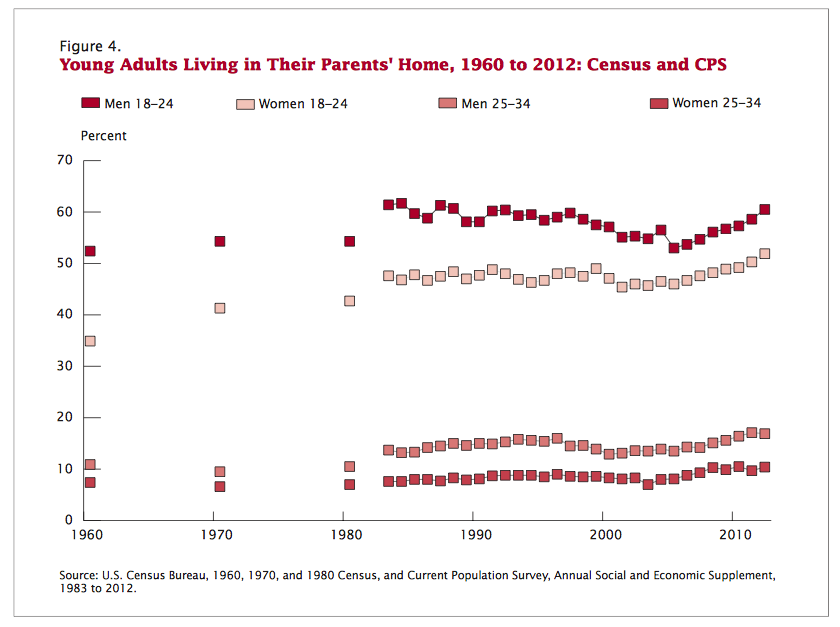
On that note, Derek Thompson recently argued that statistics about millennials living with their parents are “criminally misleading”:

Almost half of young people “living with their parents” are in college, where all campus housing counts as “living with their parents.” Scary Millennials Trends are fun and popular—young people read them to feel outraged; parents read them to gauge their own Millennial’s progress; others read them for schadenfreudeIf we’re going to freak out about young people, let’s do so for the right reasons. Unemployment is too high, entry-level jobs are depressingly salaried, and many have taken on student loans that will negatively shape their immediate future.

But David Dayen rebuts:

First of all, Thompson plays a bit with his age ranges. The statistics he pulls on the increase in college enrollment are for millennials aged 18-24. However, the trend of more young adults living at home, based on Current Population Survey statistics, extends from 18-34. You can see the upward trend for men and women aged 25-34 specifically. It’s hard to figure that this all comes from dorm living. Especially considering that college enrollment has actually fallen the past two years, yet young adults living at home continued to rise.

Put this all together, and you get the result that economist Jed Kolko of housing analysis site Trulia finds: even after you adjust for increased college enrollment, “millennials were more likely to live with parents in 2012 and 2013 than at any other time for which a consistent data series is available.” Even eliminating all full-time college students aged 18-24 from the data shows the trend.

Yglesias comes to the same conclusion. Back to the reader discussion:

While I agree that the Millennials have taken huge strides beyond our generation, it is well to remember one thing: they have the enormous advantage of being the second generation to grow up with massive change.

For example, why do they have fewer problems with gays and gay marriage? Well, consider that in my lifetime, anti-miscegenation laws were still the norm in the US. California, for example, only got rid of its laws in the middle of the last century (which means that, at the time I was born, my marriage would have been illegal). If you wonder why voters in our parents’ generation have so much trouble adapting to gay marriage, consider that they were raised in a culture where things didn’t change much – technology changed in some regards, but society much much less so.

Not to minimize how well the Millennials are doing at building a better society. But, as with all social constructions, the foundations were laid by those who went before. It’s all too easy to forget that.

Meanwhile, a pessimistic reader across the Pond writes:

I was born in 1995 and have become politically aware only during the
last couple of years, and here in England, what I see does not fill me with great confidence.

I see an electorate dominated by older generations who are terrified at the changes going on throughout the country. I would say that the political awakening that Millennials feel in this country is revulsion and cynicism. We don’t want anything to do with the obviously stitched-up system. Our only route is to get a good education and then get the hell out of this place before the older generations shut the doors to the continent and to the world through their palpable fears of everything. And our apathy and their fears have created a vicious circle, since if my generation wants nothing to do with the system and then abdicates the levers of the system to the older generations, then things will only get worse. I worry about my country.

I don’t know what can be done. I think Millennials will become more apathetic as our democracy becomes more corrupt, which will only worsen the corruption. It has become so bad that I now actually hope that Scotland will vote to leave the union in September. Maybe that can bring enough shock to the system that something can be rescued. I don’t know. I don’t hope much.

Another reader weaves in another thread:

Your reader is right that liberalising theology won’t get millennials rushing back to the pews. Partly this is because it will take time for churches to stop being associated with gay bashing, covering up child abuse and so on, it doesn’t get forgotten that instantly. And partly because it’s not enough for organised religious groups to remove some barriers to relevance; they also have to BE relevant. What does an organised church actually offer even to a millennial with faith in God that they can’t get from praying on their own or with friends or family, let alone to anyone wavering?

If nothing else, the millennial generation refuses to accept institutions and rules just because they are there or because they are venerable, and they’re getting old enough it can’t be written off as adolescent rebellion anymore. To me it is one of their most attractive features, but I imagine it aggravates people and institutions used to unquestioning obedience.

Andrew Asks Anything: Matthew Vines, Ctd

A reader connects the podcast to the ongoing thread on evangelicals and gay marriage:

A moment that jumped out at me during your podcast with Matthew Vines (partially because of my own interests and background as a former Presbyterian) was when you responded to Vines’ description of John Piper’s attempts to use the Greek to determine whether porneia was a valid excuse podcast-beaglefor divorce, and whether that divorce separated a married couple or a couple that was merely betrothed. You described this sort of hermeneutics as a sort of insanity. Matthew responded with the argument that if scripture is the word of God then we could and should take it seriously.

That exchange really intriguingly revealed the cultural distance between your Catholic upbringing and Matthew’s experience in a conservative reformed church. It was one of the few times when I thought you were both unable to achieve a mutual understanding of perspective and experience. Your faith traditions, I think, have materially different positions on what scripture is, what it’s for, how it’s interpreted, and what it should mean for our lives, going even beyond the simple Lutheran formula of sola scriputura.

In recent history, the reformed and evangelical churches responded to historical literary criticism of the texts by digging in their heels and doubling down on inerrancy and scriptural authority. But the whole exercise is a bit circular.

If you ask a good reformed Presbyterian how they know about God, they’ll say scripture. If you ask why scripture is any good, they’ll say because it’s inspired by God. If you ask them how they know that, they’ll probably cite 2 Timothy 3:16, “All scripture is God breathed and useful for rebuking correcting and training in righteousness.” See, scriptures says it’s God-breathed, so it must be true.

Which is why 1 Corinthians 7, cited by your evangelical reader as a source for Christian theology of singleness, is one of my favorite passages. Besides revealing Paul’s eschatological perspective and apparent belief that the end of the world was coming any minute, and all the juicy marital advice, Paul comes straight out and says on matters of singleness and marriage, his advice is NOT from the Lord, but only his own opinion. This passage is even used by Biblical inerrancy advocates to argue that Paul himself could tell that there were times he was writing under the inspiration of God.

But what do you do when God-Breathed scripture states explicitly that it’s not God-Breathed? Which part of that statement is inspired word of God? And what does it mean for Paul’s advice to single people? Is it a worth a hoot? Hard to tell.

My previous thoughts on the podcast are here and here.  And don’t forget to check out Matthew’s remarkable new book, God and the Gay Christian: The Biblical Case in Support of Same-Sex Relationships.

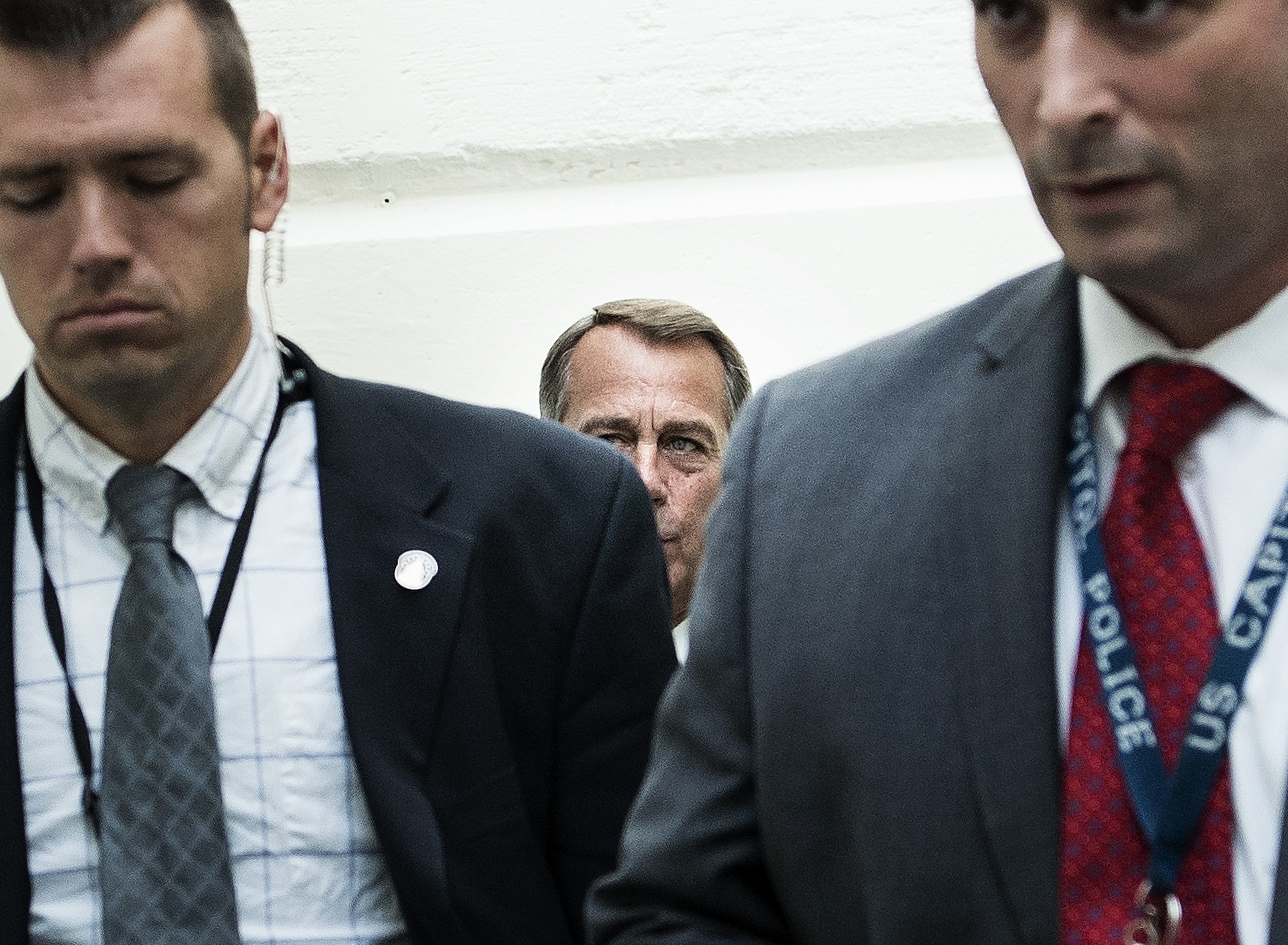
How Good A Case Does Boehner Have Against Obama?

US-POLITICS-ECONOMY-BUDGET

Damon Root believes the lawsuit has legs:

That “failure to implement” refers to the White House’s controversial unilateral action delaying implementation of Obamacare’s employer mandate, the provision of the 2010 health care law requiring firms with 50 or more employees to provide qualifying coverage. As Peter Suderman noted in July 2013, the legality of that delay has always been in doubt. In fact, even Democratic supporters of the health care law have raised questions about the propriety of Obama’s actions on that front. Sen. Tom Harkin (D-Iowa), for example, declared, “This was the law. How can they change the law?” How indeed? Perhaps we’ll find out as the House’s lawsuit moves forward.

In a roundup of legal opinions relevant to the suit, Kliff finds that the precedent benefits the president:

Congress and the courts have repeatedly recognized that the White House needs some space for discretion to make laws work. Legislation is often a broader blueprint with a particular policy goal in mind — in the case of the Affordable Care Act, for example, expanding access to insurance. The agencies that turn that blueprint into actual regulation, courts have ruled before, need some space to make decisions about the best way to handle that process.

In 1984, for example, Supreme Court’s Heckler v. Chaney decision examined whether the Food and Drug Administration had acted unlawfully when it refused to stop prisons from using lethal injection drugs that it hadn’t approved for such a purpose. This is, after all, a hugely important job for the FDA: making sure Americans are using drugs safely. But in Heckler, the Supreme Court ruled that agencies exist in a world where there are budget constraints and scarce resources and competing priorities, and sometimes they need to use their discretion in figuring out how to make the trains best run on time.

In Eric Posner’s view, the lawsuit’s entire premise, that Obama “failed to execute” the ACA employer mandate, is off-base:

Forget what you learned in seventh grade: It’s simply not the case that Congress sets policy and the president executes it. The two branches battle over policy, using all means at their disposal. The laws themselves are frequently vague and loose. In the end, the president enforces most of the laws in an even-handed way because most laws are popular—that’s why they were enacted in the first place. If you don’t believe me, consider how rare it is for presidents to use the pardon power, which is without doubt discretionary, for partisan or ideological ends. President Obama has not gone beyond public opinion—for example, by releasing prisoners from Guantánamo Bay—because he fears a political backlash, not because it’s illegal.

This conflict is baked into our system. It’s a result of the founders’ decision to give the executive and the legislature different sources of political authority. This is how our government differs from a parliamentary system, in which the prime minister operates at the pleasure of the legislature. If you want to blame someone, don’t blame Obama. Blame the Constitution.

Boehner’s choice of subject for his lawsuit is inscrutable to Arit John:

Republicans would have to prove that the president’s lawless failure to enforce the employer mandate is an attempt to derail his signature policy initiative. (Conservative pundits and media outlets have been surprisingly silent on how this might work.) If the House had gone after the president’s gun control actions or, as many suspected, his immigration orders to defer the deportations of children brought to America illegally, then the lawsuit would have at least made sense. …

Boehner could have sued the president for enacting a number of policies his base doesn’t approve of: letting “Dreamers” stay in the country, any of his 23 different gun orders, or even ending LGBT discrimination among federal contractors. Instead he’s suing him for delaying a mandate Republicans would happily delay permanently.

Nicholas Bagley highly doubts the House has standing to sue on this issue:

The memo also asserts that there is no “legislative remedy” for the delays. That’s just false. Congress could, for example, enact a statute withdrawing the President’s claimed enforcement discretion. Congress retains the power of the purse, giving it enormous leverage in negotiations with the President. And don’t forget about the impeachment power. These options may not be politically viable, but that just means Congress isn’t willing to use its power, not that it lacks the power.

On the politics of it, Yglesias sees Boehner’s lawsuit against Obama as further evidence that the speaker is, as he puts it, in zugzwang – a chess term for when a player is forced to move when his best option is to pass:

The best thing for House Republicans to do this summer and fall is nothing — Obama’s approval rating is underwater, the GOP is poised to pick up seats in the midterms, and there’s no need to rock the boat. But conservative activists won’t tolerate a pass strategy. They hate Obama and want Boehner to do something that expresses that hatred. Lawsuits are a milder move than impeachment, so given the realities of the situation the litigation is arguably a savvy move by Boehner rather than a blunder. But the impatience of the activist right is still a gift to the White House. Rather than leaving Obama to struggle impotently from the White House, it allows him to underscore the basic reality of the situation — there’s stuff he would like to do that Republicans are furiously fighting to keep from happening.

Ezra considers it a safety valve of sorts for Republican rage:

Assuming House Republicans ultimately back Boehner’s lawsuit, it will begin a lengthy legal process as the case winds its way through the courts. House Republicans will be able to go back to their districts and tell their base that they’re doing something radical and even unprecedented to bring Obama to heel. Meanwhile, Boehner can argue that attempting impeachment before the case finishes would be counterproductive: if Republicans raise impeachment as a remedy there’s no way the courts will get involved. They’ll just let Congress work it out. Boehner is letting Republicans throw as many parties as they want in the House so he can make sure they don’t drink and drive home.

I’m struck also by the speed with which the GOP establishment tried to rule out the Palin impeachment idea. They saw immediately how damaging it would be politically, and dismissed it. But if the lawsuit fails?

Previous Dish on the lawsuit here, here, and here.

(Photo: Brendan Smialowski/Getty)

There Go Those Pesky Aligned Interests Again …

Iraq isn’t the only place where America and Iran are fast becoming best frenemies. “When it comes to Afghanistan,” Michael Kugelman argues, “Tehran and Washington tend to see eye to eye on many core issues, including the Taliban”:

There’s good reason to believe that Tehran wants a stable Afghanistan. Greater instability would intensify narcotics trafficking. Additionally, it would lead to further influxes of Afghan refugees (only Pakistan has more). In recent years, these immigrants have been increasingly unwelcome in Iran, and many have been deported. Tehran also likely worries that a deteriorating Afghan security environment would embolden anti-Shia forces, including the Pakistani organization Lashkar-e-Jhangvi, whose commanders vow to march into Afghanistan when international troops depart. Though Iran publicly opposes any U.S. troops in Afghanistan, in private it would probably happily accept the presence of a residual post-2014 force.

Tehran also shares the U.S. objective of an Afghanistan that is more integrated with South and Central Asia. Iran has pursued rail, pipeline, and trade projects meant to better link Central Asian states. It is also cooperating with India on the construction of a port that would facilitate more Indian trade with Afghanistan and Central Asia (the Chabahar port would enable India to bypass longer routes through Pakistan). These efforts dovetail with Washington’s “New Silk Road” initiative, which aims to develop regional energy markets in South and Central Asia and more broadly to boost cross-border trade and transit across these regions. However, U.S. sanctions on Iran have prevented Tehran from obtaining international financing for some of its projects. Phasing out these sanctions — a possible upshot of improved bilateral relations — could bring in more financing, and allow regional integration initiatives to truly take off.

The Challenge Of Reform Conservatism, Ctd

In response to me, Douthat expounds on the nature of and audience for reform conservatism. This is well said:

The reality is that, except in truly exceptional cases, our politics is better off in the long run when views held by large proportions of the public are represented in some form by one of our two parties. Right now (to run down a partial list of divisive cultural issues), a burke_1.jpgplurality of Americans want the immigration rate decreased; about half the country opposes affirmative action; more than half supports the death penalty; about half of Americans call themselves pro-life. Support for gay marriage and marijuana legalization has skyrocketed, but in both cases about 40 percent of the country is still opposed. Even independent of my own (yes, populist and socially conservative) views, I think these people, these opinions, deserve democratic representation: Representation that leads and channels and restrains, representation that recognizes trends and trajectories and political realities, but also representation that makes them feel well-served, spoken for, and (in the case of issues where they’re probably on the losing side) respected even in defeat.

Because without that representation, populism doesn’t go away; it festers. Just ask David Cameron, Sullivan’s example of a modernizing conservative, a politician whose agenda has had a number of admirable features … but whose style and approach also helped roll out the red carpet for UKIP and Nigel Farage. In the United States, a more populist and conservative and religious country than Britain, the Farage scenario would look wilder and stranger and much, much worse for conservatism and the country. And so Republican politicians interested in outreach and coalition-building and modernization have an obligation to make sure they don’t also create a pervasive sense of populist disenfranchisement along the way.

I take Ross’s other points as well – especially about social issues like marriage equality. The GOP will probably adjust soon enough to the radically new landscape, and I may even find them more sympathetic if they try simply to protect a dissenting religious minority, rather than over-reaching. I’m in favor of religious freedom over any attempt to ram a new gay orthodoxy on the entire country. I still don’t see a powerful theme or a leader who could turn this constructive caucus into an administration. But the future is wide open. Frum joins the conversation:

The reform conservatives seem more open to the new. This is progress. If the policy agenda that follows remains cautious, remember: These conservative reformers aren’t trying to change the world. They’re trying to change a political party.

You don’t change people’s minds by telling them they are wrong, even—or especially—if they are wrong. You change their minds first by establishing an emotional connection with them. Next you ratify their existing beliefs. When it comes time to introduce a new idea, you emphasize its consistency with things they already believe. This is what the reform conservatives are doing, or have begun to do. If they seem to be moving slowly, well, take it from me: It’s no good being even 10 minutes ahead of the times.

Kilgore criticizes Frum for setting the bar so low:

As I recall, it was Michael Gerson, not David Frum, who penned George W. Bush’s memorable line that accepting bad public schools for poor and minority students reflected “the soft bigotry of low expectations.” But it’s a not a bad description for Frum’s attitude towards the GOP, and thus towards the reformicons. He clearly thinks his party is so deep in ideological sin that it can tolerate only brief and veiled exposure to the light.

Well, yes. This won’t be easy, especially if the GOP doesn’t want to chip away at its base as it now exists. Bernstein adds:

Liberals shouldn’t expect to agree with the reformers, or to find their policies appealing. But they should expect the other party to have real policy preferences, and something resembling policy proposals, and for them to abide by the basic norms of the political system. By those standards, reform conservatives deserve an incomplete grade, but one that is more positive than negative.

Drum’s take:

Are [reform conservatives] trying to build credibility with conservatives so they can later nudge them in a new direction? Or are they mostly just trying to put a friendly veneer on an essentially tea partyish agenda? We don’t know yet, because so far they haven’t been willing to take many risks. And with good reason. As a friend emailed just a few minutes ago, “The reformers are one bad suggestion away from being fully Frumanized out of the party.” I wish the reformers luck. And I don’t really blame them for their timidity so far. Still, it’s far too early to tell how serious they are. We’ll just have to wait and see.

Frumanized? I think he means Frummed.

Understanding The Permanence Of Greater Israel

Israeli air strikes on Gaza

My old sparring partner, Jeffrey Goldberg, has been busy pondering why Hamas has sent hundreds of rockets – with no fatalities – into Israel. He argues that it does this in order to kill Palestinians. It’s an arresting idea, and it helps perpetuate the notion that there are no depths to which these Islamist fanatics and war criminals will not sink.

It also helps distract from the fact that Hamas itself did not kill the three Israeli teens which was the casus belli for the latest Israeli swoop through the West Bank; that Netanyahu had called for generalized revenge in the wake of the killings, while concealing the fact that the teens had been murdered almost as soon as they had been captured; and that Israeli public hysteria, tapping into the Gilad-like trauma of captivity, then began to spawn increasingly ugly, sectarian and racist acts of revenge and brutality. It also side-steps the rather awful fact that this nihilist and futile war crime is all that Hamas has really got left.

Yes, they conceal armaments and rockets and weapons in civilian areas – and that undoubtedly increases civilian deaths. But what alternative do they have exactly, if they wish to have any military capacity at all? Should they build clearly demarcated camps and barracks and munitions stores, where the IDF could just destroy them at will? As for the argument that no democratic society could tolerate terrorist attacks without responding with this kind of disproportionate force, what about the country I grew up in, where pubs and department stores in the mainland were blown up, where the prime minister and her entire cabinet were bombed and some killed in a hotel? I don’t recall aerial bombing of Catholic areas in Belfast, do you? Or fatality numbers approaching 200 – 0? Democratic countries are marked by this kind of restraint – not by calls for revenge and bombardment of a densely populated urban area, where civilian casualties, even with the best precision targeting and warnings, are inevitable.

And there is, for all the talk of aggression on both sides, no serious equivalence in capabilities between Hamas and the IDF. The IDF has the firepower to level Gaza to the ground if it really wants to. Hamas, if it’s lucky, might get a rocket near a town or city. I suppose Israel’s reluctance just to raze Gaza for good and all is why John McCain marveled that in a war where one side has had more than 170 fatalities, 1,200 casualties, 80 percent of whom are civilians, and the other side has no fatalities and a handful of injuries, Israel has somehow practiced restraint. One wonders what no restraint would mean.

And look at the image above. Part of our skewed perspective is revealed by it. Imagine for a second that Hamas had leveled a synagogue. Can you imagine what Israel would feel justified in doing as a response? Or imagine if a Jewish extended family of 18 had been massacred by Hamas, including children? Would we not be in a major international crisis? At some point the lightness with which we treat Palestinian suffering compared with Jewish suffering needs to be addressed as an urgent moral matter. The United States is committed to human rights, not rights scaled to one’s religious heritage or race.

But this morning, as if to balance Hamas’s blame for every single death in the conflict, Goldblog feels the need to chide the Israeli prime minister for his “mistake” in having utter contempt for any two-state solution. “Mistake” is an interesting word to use.

It implies a relatively minor slip-up, a miscalculation, a foolish divergence from sanity. But it is perfectly clear to anyone not always finding excuses for the Israeli government that Netanyahu wasn’t making a mistake. He was simply reiterating his longstanding view that Israel will never, ever allow a sovereign Palestinian state to co-exist as a neighbor. And unless you understand that, nothing he has done since taking office makes any sense at all. Everything he has said and done presupposes permanent Greater Israel. And he is not some outlier. Israel’s entire political center of gravity is now firmly where Netanyahu is. The rank failure of the peace process simply underlines this fact. As do half a million Jewish settlers and religious fanatics on the West Bank. Which means that US policy is completely incoherent. Since the whole idea of a two-state solution is as dead as the infamous parrot, why on earth are Americans still pursuing it?

I think because many want Israel to be other than what it plainly is. They understand that this project of a bi-national state with Jim Crow segregation and disenfranchisement is a horrible fate. Jeffrey is as eloquent on this today as he has ever been:

If Netanyahu has convinced himself that a Palestinian state is an impossibility, then he has no choice but to accept the idea that the status quo eventually brings him to binationalism, either in its Jim Crow form—Palestinians absorbed into Israel, except without full voting rights—or its end-of-Israel-as-a-Jewish-state form, in which the two warring populations, Jewish and Arab, are combined into a single political entity, with chaos to predictably ensue.

But this is clearly the reality. The Obama administration was the last hope for some kind of agreement, and the Israelis have told the president to go fuck himself on so many occasions the very thought of accommodation is preposterous. With the acceleration of the settlements, and the ever-rising racism and religious fundamentalism in Israel itself, this is what Israel now is. And what it will always be. Anyone still assuming that a two-state solution is actually in the minds of the leaders of Israel is therefore whistling in the wind. One wonders simply how many Palestinians have to die and how much largess we must keep sending to Israel before that whistling eventually stops.

A reader adds:

This is what really put Israel’s occupation and settlement of the West Bank in perspective for me: Israel has possessed the West Bank for almost precisely the same proportion of its national existence as the United States has possessed Texas and California. About seven-tenths.  That is, Israel has occupied the West Bank for 71 percent of the time since national independence in 1948; the United States has possessed Texas and California for 69 percent of the time since national independence in 1776.

Imagine an American claiming that possession of Texas and California was not in some way fundamental to the character of the nation. Imagine if American border politics was predicated on the claim that possession of Texas and California was temporary and both would someday be returned to Mexican sovereignty. Preposterous! A United States without Texas and California would not be the United States anymore. Though it might keep its name, it would be a fundamentally different nation. Even more, the United States would first have to become an existentially different nation before it would even consider peaceably permitting California and Texas to leave the union.

Just so with Israel. Despite protestations otherwise, possession of the West Bank has become a fundamental and existential part of the character of Israeli nationhood. Possession of the West Bank is not temporary, it is not contingent, and it is not an exception to the general rule of the character of Israeli nationhood. Occupation and settlement are as central to the Israeli nation, its politics and culture, as burritos, Hollywood, and Sunbelt conservatism are to American politics, culture, and national identity.

And this was the vision of many of the Jewish state’s founders. To see what is in front of one’s nose …


For more of our ongoing coverage of this latest Israel/Gaza conflict, go here.

(Photo:  A Palestinian boy inspects the Al-Noor Mosque destroyed in air attacks staged by Israel army within the scope of “Operation Protective Edge” on July 14, 2014 in Deir Al-Balah district of Gaza City, Gaza. By Belal Khaled/Anadolu Agency/Getty Images.)