Liberating The Latin Mass

Seven years ago this month, Pope Benedict issued the document Summorum Pontificum, clarifying the legitimacy of the old Latin Mass and giving support to those who remained attached to older rite. Michael Brendan Daugherty praises him as a “brave pope” for doing so, a man who did a “great service for culture and the arts, for the whole world — even for nonbelievers”:

Why does it matter to nonbelievers? Because beauty matters to everyone. In 1971, Agatha Christie, not a Catholic, was so appalled at the disappearance of the traditional Mass and the effect this would have on English culture that she signed a petition to Pope Paul VI to keep it alive in England. It read, in part:

The rite in question, in its magnificent Latin text, has also inspired a host of priceless achievements in the arts — not only mystical works, but works by poets, philosophers, musicians, architects, painters and sculptors in all countries and epochs. Thus, it belongs to universal culture as well as to churchmen and formal Christians. [Traditio]

Because of Benedict’s intervention, my own parish in Norwalk, Conn., is treated not only to Gregorian chant, but to Renaissance-era motets, and Masses composed by Morales and Monteverdi. It is an aesthetic high crime that so much of the modern church continues to force saccharine and theologically insipid hymns like “Here I am, Lord” on its people, while leaving William Byrd’s Ave Verum Corpus in a dusty attic.

Also remarking on the anniversary of the Summorum Pontificum, Nicholas Frankovich offers an analogy for understanding what draws traditionalist Catholics to the Latin Mass:

Catholicism lacks as yet a taxonomy that would do justice to the sensibility of the Catholic whose receptors for tradition are especially keen. Contemporary Judaism, with its three main branches—Orthodox (thesis), Reform (antithesis), and Conservative (synthesis)—offers a reasonable model, although, as with any analogy, it will break down if pressed too hard. It will serve its purpose if handled gingerly.

Fifty years ago, in the eyes of many of their Conservative and Reform coreligionists, Orthodox Jews were dinosaurs, eccentric holdouts incapable of adapting to modernity; today, in New York City, the percentage of Jewish children who are Orthodox has been estimated at about 60 percent. When I consider the large young families filling out the pews at traditional Latin Masses I have attended in recent years, and when I read reports of newly ordained priests electing to say their first Masses according to the old missal, I wonder whether the Catholic Church in America may be on the same course but lagging by a few generations.

Update from a reader:

You picked the wrong hymn with which to condemn more modern worship. “Here I Am Lord” is theologically demanding, and – at least sung as I’ve heard it by a thousand hearty Methodists at our annual conference – far from saccharine. (The YouTube version you linked to is ethereal in the worst sense – here’s a much better one.) Catholics, in a poll, picked it as their favorite hymn; Methodists placed it second behind “Amazing Grace.” What’s funny about Michael Brendan Daugherty picking on it is that there are indeed a lot of vapid modern hymns; he managed to pick the meatiest and most musically powerful one to ridicule. Lovers of the Latin Mass can sometimes come off as whiny about other possibilities. Subolesco!

(Video: performance of Ave Verum Corpus by William Byrd)
It’s Beginning To Look A Lot Like Ramadan

Shahed Amanullah fears some have forgotten the true meaning of the holy month, which began on June 28th:

I feel we are inadvertently following the model of Christmas and turning the month into a “season” that is a time for socializing, indulgence and consumerism above all else. Corporate America is sensing this and is responding accordingly with Ramadan promotions and special events (latest example: the DKNY Ramadan launch this week), using a barely-modified Christmas playbook.

Our need for belonging makes us applaud any public acknowledgement of our holiday, whether it is a Best Buy ad, a politician’s Ramadan greeting or a department store Ramadan display. I regularly attend public iftars where nearly half the attendees are not Muslim, and any religious aspect is relegated to a small side room so as to not get in the way of networking and socializing. When you start seeing people like Wolf Blitzer at iftars, you just have to wonder what is happening to our most precious religious holiday.

But, in a review of DKNY’s Ramadan collection, Bina Shah argues that commercializing Islam is nothing new:

[I]sn’t it a cynical marketing gesture on the part of DKNY to use Ramadan as a way of selling clothes?  If you think that, you’ve clearly never been to Pakistan, where I live. Entire clothing lines, such as the wildly popular Junaid Jamshed men’s stores, are based on meeting Islamic guidelines and use Muslim terminology and phrases to motivate people to buy the clothes.  And it isn’t just restricted to clothes: everything is sold using religion as a motivator. There is Al-Falah (Good Works) Industries, which takes its name from the line in the Muslim call to prayer urging people to “come to good works.” There’s even a brand of household soaps and cooking oils called Sufi – after the mystical branch of Islam.

A Waking Dream, Ctd

A reader isn’t convinced that psilocybin’s effects are analogous to those of “long-term intensive meditation and prayer”:

For what it’s worth, there is one big difference between experiences on mushrooms and “unusual” experiences as a result of intensive meditation. And the difference is an underlying sense of confusion that exists in drug-altered states and the lack of that confusion in meditative states. Realization from meditation is like stubbing your toe on a rock. It’s obvious and clear. There is no “this is other than it is supposed to be” or “this is strange” feeling despite some very unusual circumstances surrounding the realization. Drug states ultimately leave you confused and doubtful eventually. At least that’s been my experience.

Another passes along the above video, from the Flaming Lips:

Except for the guy in a mushroom suit, the video doesn’t reference psychedelics explicitly. I think it’s safe to say it’s drug-addled, though. Most people hate it, and the comments on the video are mostly from people who couldn’t make it through it. I kind of like it, but I used to be a big acid head.

Here’s the thing. That video seems to get a lot closer to what psychedelics are all about than the talk about expanded consciousness and spirituality and all of that.

Yes, I have had those experiences where the borders between you and others seem to melt away and you feel the presence of the divine. But if you buy your blotter acid by the sheet, you end up at a place that’s closer to the world of this video than you do to God.

When you trip, your brain gets knocked out of its normal ruts, and the experience can be pretty unusual. Then you sober up, and you process it. You put it in a box, you decide what it meant, you create a narrative that describes what happened. “I felt a strong sense of the unity of all things. And the wood grain on this table looked like it was liquid, and moved around a bit.” Or whatever.

Those narrative boxes tend to be narrow and very much reduced from the experience itself. They’re true, as far as they go, but they aren’t really what it was like. Whenever I trip, even if it’s been years, I have a moment when I think, “Oh, I’m back in this place again.” It’s a feeling that’s completely inaccessible to me now that I’m sober, yet completely familiar when I trip. The point is that what people say about the trip afterward is actually fairly different from what it was like in the moment.

The video linked above is actually a pretty good document of that place. It’s not complete, and watching it isn’t the same as tripping. It’s reductive just like the religious narratives are, emphasizing some things, leaving others out. But the product of this reduction is really different from the stuff you usually publish. And as a guy who used to buy his blotter acid by the sheet, I think it’s closer to the mark.

Some people seem to fall into sainthood naturally, as if it’s their destiny. For most of us, though, finding God takes effort – meditation, prayer, a lot of rational thinking to try to come to terms with our ideas about theology, etc. We have to get kicked around in the world, make mistakes, digest those experiences. Mostly, we have to be with people, find sustenance in our connections, give that nurturing back, grow our compassion. It just doesn’t come in a pill.

I love acid. If I weren’t old and long out of touch with drug people, I’d probably take it frequently; as it is, I probably won’t get the chance to do it again. But I love it because I find it fun and interesting, not because it brings me closer to God.

Feminist Porn vs Regular Porn

For Aurora Snow, who used to act in adult films, the distinction is one of pleasure:

On a mainstream porn set you might hear a director shout out, “Count to five and then orgasm!” That’s happened to me before. It’s a live performance and it’s the actor’s job to deliver. That’s not to say that all mainstream orgasms are fake, but you won’t hear a countdown on a feminist set.

Feminist porn strives for an organic experience, while creating the best possible working environment. It almost sounds too good to be true, like a mainstream porn performers dream job. As [director and Feminist Porn Award winner] Madison Young advises, “Ask your performers who, where, and how they would like to have sex. Facilitate that experience and document the experience like a wild life photographer.”

Free Love Ain’t Free

Jesse Singal takes note of new research suggesting that people who believe that most women are economically self-sufficient are more accepting of female promiscuity:

In the paper, which consisted of two studies and was published in Archives of Sexual Behavior, researchers from Brunel University asked a large group of Americans to rate their level of agreement with statements like “It is wrong for women to engage in promiscuous sex” and “It is fine for a woman to have sex with a man she has just met, if they both want to.” They also had them respond to statements gauging to what extent they viewed women as economically reliant on men – “Of the women I know who are in long-term heterosexual relationships, most do not depend very heavily on money contributed by their male partner,” and so on.

Overall, the more likely a given respondent believed women were economically dependent on men, the more likely they were to view female promiscuity as immoral. These were modest to medium effects, but they were statistically significant, even controlling for factors like religiosity and political conservatism. What accounts for this connection? The researchers explain:

Results of both studies were consistent with the theory that opposition to promiscuity arises in circumstances where paternity certainty is particularly important and suggest that such opposition will more likely emerge in environments in which women are more dependent economically on a male mate.

Marcotte grumbles, “This study goes a long way toward explaining one of the more peculiar aspects of the contraception mandate debate: the stalwart conservative insistence that the mandate is some sort of employer or even government giveaway, as opposed to an earned health insurance benefit”:

Along with telling women to close their legs, the conservative complaint has been: “Why should ‘we’ have to pay for it?” This, of course, makes no sense, as the Department of Health and Human Services mandate is about women paying for their own contraception, using insurance benefits they earn by working. But right-wing media knows exactly how to push its audience’s buttons: By claiming women are getting something for “free,” conservatives are reinforcing this myth that women can’t actually be independent—they either need to rely on the government or a husband.

That’s what Jesse Watters was getting at on Fox News, talking about single female voters who want the contraceptive benefit, who he called “Beyoncé voters”: “They depend on government because they’re not depending on their husbands,” he argued, ignoring that women are actually demanding the right to the health care they are paying for.

Go Ahead, Get Uber-Drunk, You Have A Lyft Home

dui_san_fran

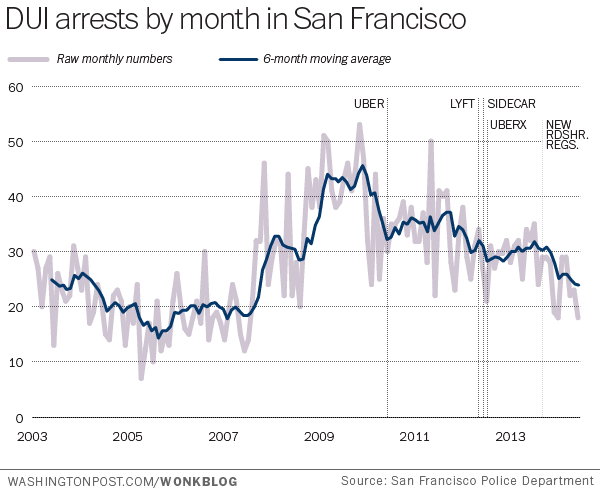
Emily Badger examines the correlation between the arrival of ride-share services and a noticeable drop in DUIs, both in Philadelphia and in San Francisco:

We’ve simply plotted arrests on a timeline here; we haven’t adjusted for changes in the city’s population, or bar scene, or the economy. Any number of other things may have changed in the city over the last few years affecting DUI arrests. … These data, though, do suggest that there’s at least more to research here. They remind me of a comment Lyft’s VP for government relations, David Estrada, made to me recently. “As a company — this might sound pollyanish — we talk about our service not being aimed at providing transportation,” he said, “but at lowering crime rates in a city like Chicago.”

DUIs are potentially one way this might happen. If these services, which run on credit cards, take cash out of transactions as well, they may also cut down on other kinds of crime like theft (this is an argument Uber has made in Chicago). Estrada was also simply talking about the idea that crime might decline because Lyft likes to think that it creates community — and jobs in communities that don’t have enough of them. That last argument merits a lot more skepticism. DUIs, though, we might actually wrap our arms around.

Learning From Mindless Pleasure

For Oliver Sacks, who turned 81 this week, getting high can be a lesson in empathy. Melissa Dahl marked Sacks’ birthday with the above video, in which the neurologist talks about what he gained from his experiences with LSD and amphetamines:

So one bonus, then, of drug experiences is that it allowed me to be more empathic, and to understand from my own experiences what various patients were going through. But also, it gave me some very direct knowledge of what physiologists would call the ‘reward systems’ of the brain. It had been found, for example, with rats in the 1960s that if they had an electrode in certain nuclei of the brain, and could get a jolt of electricity, which apparently gave them great pleasure, the rats might go back to the lever again and again. They would ignore food, they would ignore sex, and they would keep pressing the lever, till they died. …

For good and for evil, I think I experienced a similar sort of thing when taking large doses of amphetamine.

It produced intense pleasure, sometimes pleasure of an almost orgasmic degree. And this sort of pleasure is one sort of wants it to go on and on even though it doesn’t really teach one anything, and it’s maybe sort of base in a way, and it almost reduces one to the level of one of these rats pressing the reward center.

Also paying tribute, Popova quoted from Sacks’ recent book Hallucinations, in which he describes the distinction between ordinary imagination and hallucinogenic experience:

When you conjure up ordinary images— of a rectangle, or a friend’s face, or the Eiffel Tower —the images stay in your head. They are not projected into external space like a hallucination, and they lack the detailed quality of a percept or a hallucination. You actively create such voluntary images and can revise them as you please. In contrast, you are passive and helpless in the face of hallucinations: they happen to you, autonomously — they appear and disappear when they please, not when you please.

Watch his TED talk on hallucinations here. Previous Dish on Sacks here, here, and here.

Writers’ Remorse

Anna Holmes reflects on her rookie mistakes as a writer (NYT):

Mostly, what I regret is the ease with which I assumed that others’ prose styles were something not just to study and learn from but to imitate. This chameleonic impulse, a talent I developed at an early age, certainly came in handy during my stints as a writer and editor for women’s service and celebrity magazines — publications that, then and now, demand a cheerful and wholly unremarkable “female” voice — but it also did a fair amount of damage to my writerly sense of self, not to mention my ability to execute stories on issues that had nothing to do with sex tips for singletons, swingy summer dresses or the assignations of Angelina Jolie. My adoption of others’ voices made it even more difficult to find mine, and it wasn’t until I was well into my 30s that I began to realize I could honor other writing styles while also asserting my own. (This development may or may not have been influenced by my entrance into the world of blogging, an environment whose freewheeling, breezy and often very personal approach to prose has inspired any number of now-established writers.)

Leslie Jamison, meanwhile, shakes her head at her early commitment to an idea of “honesty” that translated to oversharing “the parts of myself I liked least — or the situations I most regretted”:

These were my two first mistakes about honesty: I thought it meant relentless self-flagellation, and I thought it could redeem everything. I believed there was nothing self-awareness couldn’t save. My readers taught me otherwise: They often read my self-awareness as meanness or self-indulgence or delusion. It didn’t endear me to them at all. It didn’t dissolve the flaws it confessed.

I’d always believed I was being unfair to my fictional characters if I didn’t grant them the chance to redeem themselves with desire or effort, with earnest attempts to transcend their flaws and limitations. It felt unfair to be their God and then refuse them certain saving nuances. But in my essays I was doing just this — refusing myself access to anything but my own worst tendencies. So I had to consent to making myself something more than a brat or a binger — to treat myself to the rigorous grace of complication instead.