Psyched About CBT

In their new book Thrive: The Power of Evidence-Based Psychological Therapies, Richard Layard, an economist at the London School of Economics, and David Clark, a psychologist, argue that public health policy should focus more pointedly on cognitive behavioral therapy (CBT). Bryan Appleyard unpacks the idea and nods along:

The success of CBT — and its offshoot, mindfulness — is at the heart of this book’s case for increased spending on mental health. The most succinct summary of the method is “thoughts are not facts”. People suffering, typically, from anxiety or depression are trapped in thought processes that they have come to believe are truths about themselves and the world. The therapist identifies these thoughts, then provides techniques for reducing or eliminating their impact. It doesn’t take long — typically 12 sessions — and it has much higher success rates than any other treatment — about 50%. Mindfulness, meanwhile, is a meditation technique inspired by Buddhism that helps people to see thoughts as passing phenomena rather than traps. …

If Layard and Clark are right, we seem at last to have found a gentle, non-disruptive and apparently risk-free way of dealing with the worst and most commonplace miseries of the mind. Let’s do it.

Daniel Freeman and Jason Freeman defend CBT from detractors:

CBT is sometimes criticised as an overly simplistic, once-size-fits-all strategy. Layard and Clark remind us that when done properly CBT is far more nuanced. For each problem, clinicians develop and test a specific theoretical model of symptoms and causes and on this basis generate a targeted treatment strategy. The aim is not to create a blithely complacent Stepford population, but to help people achieve meaningful and positive change in their lives. CBT isn’t merely effective, it is also relatively cheap – certainly when compared to the spiralling costs of medications such as antidepressants. …

CBT, as Layard and Clark acknowledge, doesn’t work for everyone. And it doesn’t mean that we don’t need to address the causes of mental illness, such as poverty, stress, and lack of social support. But it’s time we got serious about tackling psychological problems, ramping up research and providing people with the treatments that have been proven to work.

But Jenny Diski raises an eyebrow:

The authors are clearly compassionate people who want to abolish the misery of mental illness, and CBT, so appealing to economists with its manualised conversations, standardised questionnaires and worksheets, and in tune with contemporary culture’s desire for measurable fast outcomes, is the pragmatists’ holy grail. CBT aims to get the patient symptom-free, back to work and paying her taxes. In generations to come, if we can ward off the return of the repressed, people will be looking back at 20th-century literature and philosophy and wondering what on earth they were on about with their incomprehensible talk of the unconscious, their tales of guilt, sublimation, drives and dreamwork. Because, by then, the mysteries of the human heart will have been abolished and all the world will be transparent and symptom-free.

Writing Out Loud

Bonnie Tsui reflects (NYT) on how joining a writing collective helped her hone her craft:

I spend more time talking, which makes me a faster and better writer. This is not as weird as it sounds. My modus operandi of many years had been to work through ideas by writing. It sounds good, but what it meant in actuality was a lot of unfocused writing that went in circles. I’d struggle and spiral, elaborately, miserably, into a corner, before realizing that none of the writing was particularly good because I hadn’t thought through my ideas carefully enough. In the conversation about ideas — the clarification of an argument, the identification of a larger point to be made, the firmer realization of what I want to say before I start crafting the prose — the writing that results is inevitably clearer and smarter. Because I have opened my mouth and practiced using the words, I now set them down with more care, precision and patience.

The Misery For Child Migrants

Susan Terrio spent years interviewing children who had crossed into the US unaccompanied and were detained by US immigration. In a distillation of her research, she gives a sense of what life is like in the facilities:

Being locked up with no set endpoint creates feelings of helplessness among children who Familes and Children Held In U.S. Customs and Border Protection Processing Facilityare already suffering from trauma. Ernesto remembers his feelings of disorientation: “You don’t know what’s going to happen. I asked, ‘Why do they send me here?’ We were so afraid. Were they going to take us somewhere and kill us?’”

In 2012, the length of stay in [Office of Refugee Resettlement] facilities for unaccompanied children averaged 60 to 75 daysORR officials told me. And the longer the children stay, the more anxious they tend to feel and the more likely they are to act out. Some who qualify for protective status instead choose to self-deport in order to escape prolonged confinement. …

Based on site visits and 100 interviews with federal staff, I found that immigration custody is plagued by systemic problems. It takes an ad hoc approach that undermines consistency and fairness, lacks coordination in data collection, restricts information flows, enhances redundancy and concentrates power in the hands of senior government administrators whose decisions are difficult to review or appeal. Complaints about the abuse of children by facility staff have continued. Government officials have been slow to report abuse and have repeatedly failed to hold abusers accountable. More troubling is the lack of independent oversight to track the government’s compliance with its own detention standards—those who oversee operations are supervisors working for the ORR.

(Photo: A young boy bows his head in a holding cell where hundreds of mostly Central American immigrant children are being processed and held at the U.S. Customs and Border Protection Nogales Placement Center in Nogales, Arizona on June 18, 2014. Brownsville, Texas, and Nogales, have been central to processing the more than 47,000 unaccompanied children who have entered the country illegally since October 1. By Ross D. Franklin-Pool/Getty Images)

Colorado Is So High Right Now

Colorado

Residents are smoking a lot of pot:

Six months into marijuana legalization, the Colorado Department of Revenue has issued a new report outlining findings about the size of the newly legal market. It turns out that the demand for marijuana far exceeds earlier estimates; according to the report, statewide demand is at a whopping 121.4 tons per year. That’s 31 percent higher than a previous Department of Revenue estimate and 89 percent higher than an oft-cited study by the Colorado Futures Center. And while the vast majority of the increase is the result of resident smokers consuming more than expected, the growth of the retail market — particularly among tourists — is a promising sign for the success of legalization.

Colorado makes substantially more money from taxes on recreational marijuana than medical marijuana. So the success of recreational legalization can be measured by the state’s ability to make loads of money from pot taxes. For advocates, Colorado (so far) appears to be a first victory and may become proof of concept. If Colorado is able to rake in a substantial amount of tax revenue, legalization advocates’ pitches to legislatures in Oregon, Massachusetts and Alaska become that much easier.

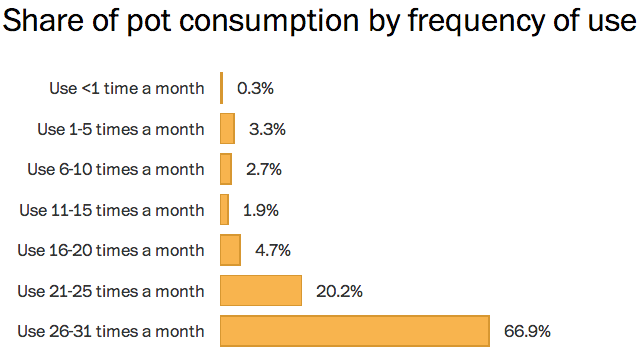
Niraj Chokshi looks at who is toking up exactly:

Adult residents either smoke pot (relatively) few times a month or nearly every day—there are few in the middle. More than half of all adult resident users consume the drug in some form fewer than six times a month. (More than 1 in 4 consume less than once a month.) At the same time, about 1 in 5 users are near or at daily consumption. While those roughly daily users account for just a fifth of the user population, they consume fully two thirds of the product.

Jon Walker highlights other details:

A particularly interesting finding is where most of the new retail consumers are coming from. Because of the low tax rate on medical marijuana and greater number of medical marijuana stores, most existing patients are not switching their buying outlets for now.

The report finds, “Using the latest retail marijuana tax statistics from the Department of Revenue, we also found that conversions from medical to retail consumption is relatively low. Instead, retail supply of marijuana is growing, while medical marijuana is relatively constant. This may indicate that medical consumers would rather pay the medical registration fees as opposed to the higher tax rates, or that there are currently relatively few retail outlets compared to medical centers. Therefore, the retail demand is derived primarily from out-of-state visitors and from consumers who previously purchased from the Colorado black and gray markets.”

For example, in Denver it is estimated that 44 percent of recreational marijuana sales are to visitors and the rate is even higher in some ski towns. Clearly, many people are coming the Colorado to enjoy the new freedom.

A Poem For Friday

2171098966_48ca65d962_b

“In my country” by Jackie Kay:

walking by the waters
down where an honest river
shakes hands with the sea,
a woman passed round me
in a slow, watchful circle,
as if I were a superstition;

or the worst dregs of her imagination,
so when she finally spoke
her words spliced into bars
of an old wheel. A segment of air.
Where do you come from?
“Here,” I said. “Here. These parts.”

(From Staying Alive: Real Poems for Unreal Times, edited by Neil Astley, Reprinted by permission of Bloodaxe Books. Photo by Andrew Rollinger)

A Milestone For The T

Laverne Cox recently became the first openly transgender woman to receive an Emmy nod. Jos Truitt applauds the news:

Cox is certainly deserving of the nomination: she brings a depth and humanity to the role that is more than what’s in the script. Sophia’s interactions with her wife and fight to get the medical care she needed were powerful moments, and it’s fantastic to see the Emmys take notice.

Cox’s celebrity has been met with some bigoted responses. So, given the occasional fool in the media, like Kevin D Williamson who still thinks that Cox’s gender should be up for debate, it’s nice to see the Emmys committee underscore that Cox is a woman nominated as an actress, full stop.

Parker Molloy considers how far the film industry has come:

In the early 1980s, Caroline Cossey tried to follow up what was at the time a successful modeling career by taking on some acting work. After appearing as an uncredited featured extra in the 1981 James Bond movie For Your Eyes Only, Cossey was outed by the tabloid News of the World when they ran a headline proclaiming “Bond Girl Was Born a Boy.” As she later recounted, the experience not only destroyed her career, but nearly drove her to suicide.

What we’re seeing now is a world in which being transgender is not necessarily the career-killer it once was. These gains – of Laverne Cox scooping an Emmy nomination, Candis Cayne appearing on shows like Elementary and Dirty, Sexy Money, and Jamie Clayton finding herself cast in a recurring role in an upcoming TV show—may be small, but they are a true sign of progress.

Meanwhile, Esther Breger wonders what the full field of nominations says about TV today:

Despite all the silliness, [yesterday] morning’s nominations – the glaring omissions and the boring deja vu – do indicate a larger cultural shift. When the Emmys overlooked The Sopranos‘ first season in 1999, awarding best drama to David E. Kelley’s campy legal procedural, The Practice, instead, the awards show was widely derided for being out of touch, unwilling to recognize cable shows that seemed unfamiliar. Fifteen years later, HBO is racking up 99 nominations, more than any other channel.

But just as shows like The Practice once crowded out innovative shows, the dominance of HBO and HBO-lite can overshadow the actually exciting TV being made today, across all channels. “Quality television is now platform-agnostic,” the TV Academy’s chief said [yesterday] morning, referring to services like Netflix. And he’s right. The defining character of this post-“Golden Age” TV era is plenty; cable, broadcast, and online streaming services all have brilliant shows and boring ones – and the great ones are as likely to look like pulpy fluff as gritty crime drama. Some of them will even have clones.

Faces Of The Day

Udall holds a news conference about a bill to override Hobby Lobby decision

Vicki Cowart, CEO of Planned Parenthood of the Rocky Mountains, listens to Colorado Senator Mark Udall talk during a news conference about a bill to override Hobby Lobby decision, July 11, 2014. The news conference was held at the Denver Place in downtown Denver. By RJ Sangosti/The Denver Post via Getty Images. Details on Udall’s effort here.

Pop-Culture Partisanship

Alyssa has grown tired of it:

As we have become more comfortable discussing the politics of culture, our discussions of art have become a lot more like our discussions of politics. We treat people whose interpretations differ from our own as if they are acting in bad faith. We focus on gaffes and supposed gaffes. And we demand that significant figures in cultural commentary have something to say about every big event so we can check their reactions against our sense of what they ought to feel to remain in good standing. …

The idea that enjoyment is tainted by argument shows up over and over again in our cultural conversations. There are fans of “Game of Thrones” who apparently cannot tolerate the idea that a show that ranges so broadly might not show the same deftness in all aspects of its production that it demonstrates when it is at its best. I regularly hear from readers of comic books who insist that the only way to judge superhero movies is to read them against their source material, which would surely change my feelings about the execution of a storyline or two. When I state an opinion – that the second paintball episode of the cult sitcom “Community” did not engage me as much as the first – that critical judgement is taken in some quarters as an error of fact.

Afghanistan Gets Worse

140709_civiliandeaths

Reid Standish relays a troubling new report from the UN that shows violence there is on the rise again:

According to newly released United Nations data, the number of civilians who were injured or killed in Afghanistan rose by 24 percent over the first half of 2014, compared to the same period in last year. In total, the United Nations Assistance Mission in Afghanistan (UNAMA) documented 1,564 civilian deaths and 3,289 injuries during the six-month span.

The U.N. data indicates that ground combat has overtaken improvised explosive devices (IEDs) as the leading cause of civilian deaths. Ground combat — which can include the use of mortars, rocket-propelled grenades, and small arms — was responsible for 39 percent of civilian deaths and injuries in 2014, accounting for 474 civilian deaths and 1,427 injuries. The number of casualties caused by ground combat rose 89 percent from the previous year.

Reading the same report, Keating highlights the particularly grave danger women and children are facing:

Child casualties more than doubled and the number of women casualties increased by 60 percent. The reason is the changing nature of the violence. For the first time, more civilians were killed by crossfire in battles between government and anti-government forces than by improvised explosive devices. Suicide attacks are also down this year. This means more violence is taking place in heavily populated areas where women and children are likely to be found. As one U.N. official put it, “the fight is increasingly taking place in communities, in public places, near playgrounds, and near the homes of ordinary Afghans.”