Will Utah Be The Big One?

Another marriage equality case is headed for the Supreme Court:

In June, the 10th Circuit Court of Appeals ruled that Utah’s ban on same-sex couples’ marriages is unconstitutional. Wednesday is the deadline for the state to ask the full appeals court to rehear that case, a process called an “en banc” rehearing, and Attorney General Sean Reyes’s office announced it will not do so. The attorney general’s office will, however, take the case directly to the Supreme Court, asking the justices to hear the appeal. The case, if taken by the justices, would present a second opportunity in recent years for the justices to declare that all state bans like the Utah one are unconstitutional, leading to nationwide marriage equality.

The court doesn’t have to take the case, of course, but Denniston explains why they might choose to:

With the case going to the Justices via such a petition, the Court will have complete discretion whether to review the Tenth Circuit ruling, or pass it up.  Utah officials are almost certain to argue that the Court should take up the issue promptly based on the argument that there is now a conflict among federal appeals courts on the constitutionality of such bans.

The Eighth Circuit upheld such a ban, but that was in 2006, seven years before the Supreme Court’s Windsor decision — a ruling that many judges have said changed the legal landscape for review of those state laws.  In the Windsor decision, which involved only a federal law, the Court indicated that it was not taking a position at that time on the validity of state laws forbidding same-sex marriages.

But there is no such conflict between courts regarding this particular case, so the justices might prefer to hold off:

While most observers expect the high court to take up the issue of marriage equality within the next few years, the Associated Press notes that the court has a history of declining to consider cases without divergent rulings from lower courts. In the Kitchen case, a federal trial judge and the 10th Circuit both ruled that the state’s ban on same-sex marriage is unconstitutional. If the Supreme Court declines Utah’s request to hear the case, those lower rulings will stand, definitively declaring Utah’s marriage law unconstitutional and striking down the voter-approved law.

Some legal experts, however, doubt the court will turn it down:

“I think the Court will take the case. Since [U.S. v.] Windsor, all of the lower courts that have ruled have struck down laws prohibiting same sex marriages,” said Erwin Chemerinsky, the Dean of the University of California, Irvine School of Law. “Perhaps without a split in the lower courts, the Supreme Court will wait. My prediction, though, is that the Court knows the issue needs to be resolved and will take it.” And if the Court does hear the case, all eyes will be on Justice Anthony Kennedy, not simply because he’s the traditional swing vote, but because he has written all three decisions in Supreme Court history that advanced gay rights. “I also predict that the five justices in the majority in Windsor will be the majority to declare unconstitutional laws that deny marriage equality to gays and lesbians,” Chemerinsky said.

Also yesterday, Alito denied without comment a county clerk’s plea to stop same-sex marriages in Pennsylvania. “That appears to remove the last potential legal barrier to Pennsylvania becoming the nineteenth state in which same-sex marriages are permitted,” Denniston adds in an update. And, in other good news, a judge struck down Colorado’s marriage equality ban yesterday, though the decision is stayed pending appeal. The speed of all this is simply staggering.
Who Killed The RomCom? Ctd

Megan Garber has her own theory about why the genre is struggling:

[T]he truth is that romantic comedies are, as works of art and pieces of culture, terrible. They are usually some ungodly, unsexy combination of: stale, trite, silly, and formulaic. They are often offensively anti-feminist. The generous reading of all this is that recent films and their creators became victims, essentially, of the innovator’s dilemma: They got too good at obeying their own, once-successful formulas – and failed to see beyond them.

The less generous reading is that film executives and creators failed to see the culture changing around them. The rom-com industrial complex – the cultural institution charged with capturing romance as a kind of ritual – failed to recognize the evolution of romance itself.

Meanwhile, a reader who writes about box-office trends offers some context, while another offers a few recommendations:

Romantic comedies aren’t weak because the male 18-24 audience dominates the box office. Indeed, the headline over the last year has been the collapse of that group among US moviegoers. Moviegoing is skewing older and a bit more female.

The need to capture a worldwide audience is one reason many genres don’t get fuller attention, but romcoms can be made relatively inexpensively, and several female-oriented films over the last few months have been considerable successes. Remember that there’s a lag of around two years between when films are greenlit and when they hit the screen. So romcoms might come back in the US. Yes, many American comedies don’t translate internationally, but a Pretty Woman would likely be just as big today as it was in 1990 (much bigger, with inflation).

Update from a reader:

I adore the movies and go as often as I can (but not to the multiplexes, which seem to be increasingly dumbed down). I prefer smaller indy films, and there are excellent indy rom coms which are neither trite nor anti-feminist. In the last month I’ve seen two excellent indy rom coms…. The Lunchbox and In a World Where…

The Lunchbox refutes the lie that romcoms cannot bridge cultures. It’s is an Indian film about a uniquely Indian system but which spoke beautifully and intelligently to longing in an unfulfilled life. I, a working American mother, related very much to the young Indian housewife at the center of the story, and her neighbor reminded me a great deal of my Puerto Rican mother-in-law. And all without innuendo about sex. The closest this film came to nudity was the heroine removing her jewelry in the evening.

In a World Where…, written, directed, starring and produced by Lake Bell, includes many romcom cliches including mistaken identity, the overlooked love interest, etc., but as a humorous side plot in this tale of a woman fighting to make it in a male-dominated industry.

If the big studios only took the time and effort to make movies that were not so dumbed down in the way they have every movie Kate Hudson and Jennifer Anniston ever starred in, maybe they could draw me back to the multiplex.

Good News For Gay Parents

A major Australian study has found that the children of same-sex couples are better off than most:

Researchers from the University of Melbourne surveyed 315 same-sex parents with a total of 500 children. About 80 percent of the children have female parents, while 18 percent have male parents. The children raised by same-sex partners scored an average of 6 percent higher than the general population on measures of general health and family cohesion. They were equivalent to those from the general population on measures of temperament and mood, behavior, mental health and self-esteem.

Researcher Simon Crouch posits that “the structure of same-sex parent families, particularly in relation to work and home duties, plays an important part in how well families get along”:

Same-sex parents, for instance, are more likely to share child care and work responsibilities more equitably than heterosexual-parent families. It is liberating for parents to take on roles that suit their skills rather than defaulting to gender stereotypes, where mum is the primary care giver and dad the primary breadwinner. Our research suggests that abandoning such gender stereotypes might be beneficial to child health.

But stigmatization remains a concern:

According to the study, about two-thirds of children with same-sex parents experienced some form of stigma because of their parents’ sexual orientation. Despite these kids’ higher marks in physical health and social well-being, the stigma associated with their family structure was linked to lower scores on a number of scales. Crouch said stigmas ranged from subtle issues such as sending letters home from school addressed to a “Mr.” and “Mrs.” to more harmful problems such as bullying at school. The greater the stigma a same-sex family faces, the greater the impact on a child’s social and emotional well-being, Crouch said.

Mark Joseph Stern argues that stigma isn’t a gay-parenting problem; it’s an anti-gay-parenting problem:

A study last year by researchers at University of Nebraska-Lincoln and University of Pretoria in South Africa took a deeper dive into the effect of stigma on gay families, finding that:

The children were not upset that their parents are gay. In fact, most of them embraced it. The negativity that children with gay parents experience is rarely the result of having gay parents. Instead, it’s the cultural stigma that causes all the problems. Any concerns they had were the result of how they would be treated in the public sphere. Research constantly shows that children with gay parents are normal, healthy, well-adjusted people. It’s the social scrutiny and stigmatization that children have to negotiate and contend with.

As that quote suggests, the study only confirmed what previous research had borne out: Gay parents don’t disadvantage their children – but conservatives’ smear campaigns against gay parents do.

German Lopez notes some caveats in the study:

The findings are based on reports from the parents who agreed to the survey, which could skew the results. The survey also focused on Australian same-sex parents, so there may be social and cultural factors at play that wouldn’t apply perfectly to America’s gay and lesbian parents. And the study doesn’t compare same-sex parents directly with opposite-sex parents; it instead compares same-sex parents and their children to the general population.

Update from a reader:

German Lopez’s caveat goes further than you may suspect. While it’s true beyond doubt that the study shows that same-sex parenting doesn’t hurt, and that’s important to get on the record, the data can’t say anything useful about whether or not it’s better. For that, you’d need to compare same-sex adoptive parents to opposite-sex adoptive parents, not same-sex parents to the general population.

It comes down to basic experiment design. You want to remove as many confounding factors as possible. Adoptive parents spend a lot of time and money on the process, have gone through a vetting process, and manifestly WANT to be parents. The general population contains a lot of willing parents, to be sure – but it also contains a lot of accidental parents, people with “buyers’ remorse”, and few of them went through any vetting process more discriminating than the mother’s choice of partner.

An interesting result, but more study is needed.

Raped Into Submission

Sarah Carr takes a disquieting look at how sexual violence has become a frequently employed tool of political repression in Egypt:

Society’s ignoring or belittling of the problem, its socially conservative attitude towards women and sex and a general atmosphere of repression all combine to allow security forces to commit sexual assaults with impunity. What better way to silence opponents in this patriarchal society, where a sex scandal is a huge social stigma, and where victim-blaming is the norm? …

Once women are detained, [psychiatrist Aida] Seif al-Dawla says that the use of sexual violence against them “is massive and systematic. The grabbing of breasts and sexual verbal abuse is routine for women.” She points out that the degree of violence is carefully calibrated, and is less brutal towards seasoned political activists who security force personnel are aware will not remain silent.

“In prison, the location, warden, officers in charge and so on are known. They would not risk this with outspoken detained women who have a say and a wide circle of supporters. They are abusing the unfortunate fact that people are okay with violations against Muslim Brotherhood members — and many still do not believe those stories when they get published,” Seif al-Dawla said.

The Amplest Avian

Pelagornis_miocaenus

The recently discovered fossils of a bird, now extinct, was large enough to rival some modern aircraft:

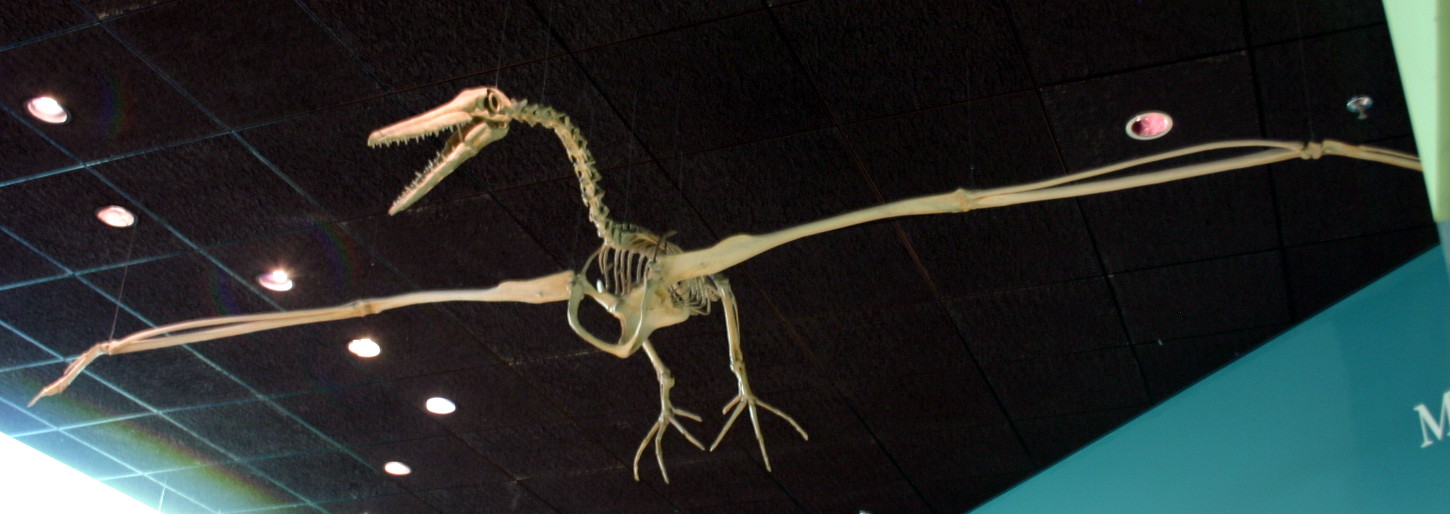
Researchers describing fossil remains of P. sandersi for the first time say the bird had a wingspan of up to 24 feet, qualifying it as the largest flying bird ever to take to Earth’s skies. Its size exceeds some estimates for the limits of powered flight, though computer models based on the well-preserved skeleton suggest the animal was an excellent glider. In a paper published [Monday] in Proceedings of the National Academy of Sciences, researchers theorize the bird flew long oceanic distances in search of prey, similar to today’s albatrosses.

But Andy Coghlan asks, “Was this the biggest bird ever to grace the skies?”

With a wingspan of about 6.4 meters, Pelagornis sandersi was nearly twice the width of a wandering albatross, the living bird with the greatest wingspan, at 3.5 meters [11.5 feet]. Its size puts it on a par with the similarly whopping Argentavis, which was estimated to have a wingspan of 7 meters [23 feet] but may have been smaller than that. Either way, they were all dwarfed by the extinct flying reptile Quetzalcoatlus northropiperhaps the largest pterosaur, with a wingspan of up to 11 meters [36 feet].

(Photo of Pelagornis sandersi fossils via Wiki)

The Denisovans’ Legacy

Tibetans are more capable than most other people of living at extreme altitudes thanks to a mutation in a gene called EPAS1, which allows them to cope with the oxygen-poor air of the 4,000-meter-high Tibetan Plateau. Now, geneticists have identified the same mutation in the Denisovans, an extinct group of humans with whom our ancestors may have interbred some 30,000-40,000 years ago:

To date, this is still “strongest instance of natural selection documented in a human A Phuwa villager stands for a portrait a few miles from thepopulation”—the EPAS1 mutation is found in 87 percent of Tibetans and just 9 percent of Han Chinese, even though the two groups have been separated for less than 3,000 years. But when the team sequenced EPAS1 in 40 more Tibetans and 40 Han Chinese, they noticed that the Tibetan version is incredibly different to those in other people. It was so different that it couldn’t have gradually arisen in the Tibetan lineage. Instead, it looked like it was inherited from a different group of people. By searching other complete genomes, the team finally found the source: the Denisovans! …

This discovery is all the more astonishing because we still have absolutely no idea what the Denisovans looked like. The only fossils that we have are a finger bone, a toe, and two teeth. Just by sequencing DNA from these fragments, scientists divined the existence of this previously unknown group of humans, deciphered their entire genome, and showed how their genes live on in modern people. Denisovan DNA makes up 5 to 7 percent of the genomes of people from the Pacific islands of Melanesia. Much tinier proportions live on in East Asians. And now, we know that some very useful Denisovan DNA lives on in Tibetans.

But Catherine Brahic deflates some of the excitement, noting that the findings are not conclusive:

The Tibetan EPAS1 probably got there by interbreeding, but more evidence is needed to confirm which archaic humans were the source, says David Reich of Harvard Medical School in Boston. “There is no proof in the paper that the origin of the [DNA] is Denisovan.” He says it could just as easily have come from Neanderthals, whose EPAS1 looks similar to the Tibetans’. That might make more sense as they were common on mainland Asia, whereas the Denisovan heartland seems to have been in South-East Asia.

It is still unclear how the modified EPAS1 gene helps Tibetans survive 4000 metres above sea level. It seems to cut the number of red blood cells, which carry oxygen, being made. That is odd: most people make more of these cells when they travel to high altitudes, to carry more oxygen. But they thicken the blood, possibly making strokes more likely. Nielsen thinks that, by thinning the blood, the Tibetan gene may help lower this risk.

Regardless, Boer Deng concludes, genetic discoveries such as these should require us to rethink our definition of “humans”:

Denisovans and Neanderthals are called extinct human “species”—a term that used to demark a clear line between two organisms incapable of interbreeding to produce fertile offspring. But the definition is no longer so clear. We know that these hominin cousins did couple with our Homo sapiens ancestors—and some of us have inherited from them valuable modern traits. How we define “humans” past and present is a subject to contemplate—as fitting for scientists as for pilgrims to think about on their journeys across Tibetan plains.

Update from a reader, who bolsters the fact that “the genetic results of the last few years demonstrate pretty clearly that Denisovans and Neanderthals are us”:

See, for example, my take (“Denisovans are us“,  “Neanderthals are us– More evidence“,  “Neanderthals are us?”), Jerry Coyne’s (“How many species of humans were there?“, and John Hawks’ (“Naming archaic human populations“, “The ‘braided stream’ at year-end“, “Is the Biological Species Concept a ‘minority view’?“) . I’m a zoologist who studies lizards, Coyne is a geneticist whose most important work has been on the nature and origin of species, and Hawks is a paleoanthropologist who studies both bones and genes, and we all came to the same conclusion.

Hawks, who studies the issue most closely, states simply, “Ancient human populations like the Neandertals and Denisovans were not separate biological species.” Here’s how I put it: “The current work tends to confirm the conclusion that archaic humans (Neanderthals and Denisovans) were part of a group of interbreeding populations in nature that included the immediate ancestors of modern humans, and thus were members of the species Homo sapiens.”

That Neanderthals and Densiovans were human can, I think, not be doubted, because they are, under any point of view, fellow members with us of the genus Homo, and thus men in the generic sense (in both the vernacular and technical senses of generic).

But are they members of the same species as us, Homo sapiens? There are, regrettably, quite a few historical instances where two peoples (both of course undoubted modern H. sapiens) met, and one people quickly disappeared, with relatively little gene flow having occurred. That Denisovans and Neanderthals contributed “only” several percent to our genomes before disappearing is no bar to their having been the same species as us moderns; it is, in fact, strong evidence of all of us (modern, Denisovan, Neanderthal) being the same species.

(Photo: A Phuwa villager stands for a portrait a few miles from the Chinese border. Hidden in the rain shadow of the Himalaya in one of the most remote corners of Nepal lies Mustang, or the former Kingdom of Lo. Hemmed in by the world’s highest mountain range to the south and an occupied and shuttered Tibet to the north, this tiny Tibetan kingdom has remained virtually unchanged since the 15th century. Today, Mustang is arguably the best-preserved example of traditional Tibetan life left in the world. By Taylor Weidman/LightRocket via Getty Images)

Syria’s Hidden Suicide Crisis

Lauren Wolfe warns that self-harm is “rapidly becoming a very real fallout of this [Syrian] war — one that is so taboo, it is rarely spoken of within families, let alone publicly”:

“Suicide is strictly forbidden in Islam,” said Haid N. Haid, a Beirut-based Syrian sociologist and Middle East program manager at the Heinrich Boll Foundation. Scholars often forbid the recitation of a funerary prayer for people who’ve committed suicide, as a way to punish the families of the dead and to deter others from taking their own lives. The cause of death is usually obscured — it is called an “accident” or “natural.” Suicide, Haid emphasized, is always “a big scandal that people will talk about for a long time.”

Despite the taboo, doctors I spoke with said they are seeing more and more cases of people with suicidal impulses – a trend confirmed by the number of reported instances in which, because of a feeling of being unable to provide for one’s family as a refugee, or because of the shame of rapepregnancy through rape, or sexual humiliation, it has been carried out. Hard data are difficult to come by. But while I was unable to find formal statistics on suicide in the Syrian war, the picture painted by doctors working in and near the country is decidedly bleak — and given how precious few mental health services are available to Syrians affected by the war, it is probably just the tip of the iceberg.

Meanwhile, a UNHCR report on female refugees from Syria illuminates the unimaginable daily struggles these women contend with:

With their husbands, fathers, and brothers dead, missing, or still in Syria — many of them denied entry to the neighboring countries — these women compose a particularly vulnerable segment of a population caught in a humanitarian catastrophe that the United Nations has described as the worst since the genocide in Rwanda. Tuesday’s report, which is based on interviews with 135 women between February and April, paints a desperate picture of their lives as refugees in Lebanon, Jordan, and Egypt. …

According to UNHCR, 40 percent of refugees in Lebanon live in substandard dwellings, which include both unfinished buildings and makeshift settlements. And female-headed refugee families — which in Jordan, Lebanon, and Egypt include on average 5.6 members — are particularly vulnerable to life in an inadequate shelter. When Suraya, a mother of seven, arrived at Jordan’s Zaatari camp, she stood guard outside her tent. “I would dress and act like a man so that my children could sleep in peace and feel safe,” she told the UNHCR. Another woman, Zaina, who also lives in Bekaa, said: “When there is no man, people are like animals.” Their children aren’t the only ones vulnerable to predators. The women must also defend themselves from sexual harassment and gender-based violence, often perpetrated by their landlords.

Tax Cuts Don’t Pay For Themselves

brownback

Andrew Prokop delivers a reality check:

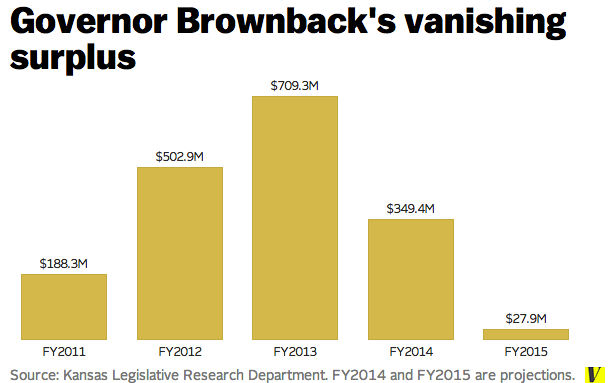
After [Sam Brownback’s tax cuts in Kansas] became law, it was undisputed that Kansas’s revenue collections would fall. But some supply-side analysts, like economist Arthur Laffer, argued that increased economic growth would deliver more revenue that would help cushion this impact. Yet it’s now clear that the revenue shortfalls are much worse than expected. “State general fund revenue is down over $700 million from last year,” Duane Goossen, a former state budget director, told me. “That’s a bigger drop than the state had in the whole three years of the recession,” he said — and it’s a huge chunk of the state’s $6 billion budget. Goossen added that the Kansas’s surplus, which had been replenished since the recession, “is now being spent at an alarming, amazing rate.” You can see that in this chart (the surplus is cumulative, not yearly)

A Plankton Of Action, Ctd

A few readers push back on this post:

As co-author of a marine science book who gives frequent public talks, I get asked about the iron sulfide engineering idea a lot. The downward flux issue is real, but there’s another major problem with the idea that’s even easier to articulate: what happens when those uber-blooms of plankton die off? Even assuming the carbon sequestration worked perfectly, you’ve now filled large swaths of the Southern Ocean with countless tons of dead plant matter. Bacteria will bloom to decompose it, creating enormous anoxic “dead zones” where pelagic fish and other organisms our species enjoys eating/admiring cannot live. Similar phenomena can be observed near major fertilizer runoff sites. The whole point of averting climate change is to prevent the ocean from turning into a sludgy toxic mess! This idea’s side effects are the very problems it means to combat.

Another is on the same page:

You ended your post about Victor Smetacek saying, “Further experiments, however, were halted due to protests from environmentalists.” But you did a disservice to them in not bothering to explain in part why they complained. As was noted in Scientific American:

A similar cruise and experiment in 2009 failed despite dumping even more iron fertilizer over an even larger area of the Southern Ocean. The eddy chosen for that experiment lacked enough silicon to prompt these particular diatoms to grow. Instead, the experiment yielded bloom of algae, which was readily and rapidly eaten by microscopic grazers. As a result, the CO2 in the algal bloom returned to the atmosphere.

In fact, these iron-seeding experiments could backfire by producing toxic algal blooms or oxygen-depleted “dead zones,” such as the one created in the over-fertilized waters at the mouth of the Mississippi River. At present, scientists have no way to ensure that the desired species of silica-shelled diatoms bloom. In short, Smetacek says, the type of bloom—and therefore the ability to sequester CO2—”cannot be controlled at this stage”.

This could be a great way to sink carbon, but we’ve gotten ourselves into problems before assuming a fix will be fine without paying attention to what might go wrong and I can’t blame people for urging caution in going forward here.

Update from a reader:

Not to pile on, but one more issue: Scaling. Thus far, we have data on ocean iron fertilization (OIF) only on a single-trial basis. We have to rely on models to extrapolate from the data at the global scale. However, here is a paper from Nature which makes several assumptions extremely favorable to OIF.

Briefly, I will highlight the favorable assumptions: It assumes a high (RCP 8.5) emissions scenario (thus relative impacts are maximized), continuous fertilization from 2020-2100, instantaneous deployment at full scale, and a full release of iron limitation from all phytoplankton south of 40° latitude.

The sum of this wildly optimistic model? A net loss of -.15°C (Table 2). Even under a low-emissions scenario (or low-sensitivity scenario favored by skeptics) OIF’s maximum potential is to buy us an extra decade at an unknown ecological price.

The Best Of The Dish Today

A couple of items. First up, I have to confess I’ve been a little obsessed with the unfolding horrors of the life of one of Britain’s biggest celebrities in the last few decades, Jimmy Savile. I only covered it on the Dish once (see “When Celebrities Rape Children And Molest the Dead“, because the context is all, and if you didn’t grow up in Britain in the 1970s and 1980s, it’s hard to get why his biography is so deeply disturbing. But for those still curious, here’s a review by David Hare of a new biography of Savile, In Plain Sight, that, apart from some throat-clearing at the start, really sets the scene. Money quote:

In normal circumstances, anyone who declared that the five days they spent alone with their mother’s coffin were the happiest of their life – “Once upon a time I had to share her with other people … But when she was dead, she was all mine” – would be subject to some public scrutiny. So would somebody whose first reaction after quadruple bypass surgery was to grope the attendant nurse’s breast. But by then Savile had pulled off the brilliant trick of seeming to make his surface weirdness part of what he called his “charismatic package”. “Nobody can be frightened of me. It would be beneath anyone’s dignity to be frightened of someone dressed like this.”

This was a pop-cultural icon who turns out to have assaulted, abused or raped hundreds – and was never caught.

Second, a response to Pascal Emanuel Gobry’s response to my post on “reform conservatism.” He says it does too have a grand and unifying theme – a populist and decentralizing politics aimed squarely at the needs of the working and middle classes, with an equally potent critique of cultural libertarianism. But my point was not that this wasn’t a coherent argument – just that it doesn’t really fit easily into an existing American conservative tradition (indeed runs counter to a great deal of it), and has as yet no political leader able to express it simply.

Gobry also argues that my cultural disaffection for cultural and social conservatism says absolutely nothing about the future of reform conservatism. A prosperous gay individualist like me is not exactly their target demographic – which is apparently “the fecund, the married and the lower-middle.” Fair enough. But there’s a class element here that seems a little off to me:

The Democratic Party already has the upper-middle class locked up, precisely because it panders very well at their cultural prejudices (which we hear very little about, as if America in 2014 was the only place in recorded history where only one side engages in demonization of the other side). A Republican Party that tried to go after its slice while dumping its base, which happens to be a plurality of voters in America, would, ipso facto, become a rump.

I prefer the kind of movement that lays out its concerns and seeks to get the widest and broadest public support for it, in all classes and all regions. But perhaps in this polarized age, that is no longer possible.

Today was a day for contraceptives and cup-cakes. We try to mix it up. We also tracked the Palin-Boehner impeachment fight; Khamenei’s depressingly public red line on the P5+1 negotiations; and the bias against black dogs. And I defended a religious exemption in ENDA, as most gay rights groups bailed on the idea, and HRC with it. And some clips from a recent podcast with Matthew Vines, the pioneering gay evangelical.

The most popular post of the day was yesterday’s Best of the Dish on Sarah Palin; followed by Monday’s The Tears of an Elephant.

Many of today’s posts were updated with your emails – read them all here.  You can always leave your unfiltered comments at our Facebook page and @sullydish. 15 more readers became subscribers today. You can join them here – and get access to all the readons and Deep Dish – for a little as $1.99 month.

See you in the morning.