Is It ADHD Or Trauma?

Rebecca Ruiz observes that “inattentive, hyperactive, and impulsive behavior may in fact mirror the effects of adversity, and many pediatricians, psychiatrists, and psychologists don’t know how – or don’t have the time – to tell the difference”:

[Dr. Nicole] Brown was completing her residency at Johns Hopkins Hospital in Baltimore, when she realized that many of her low-income patients had been diagnosed with attention deficit/hyperactivity disorder (ADHD). These children lived in households and neighborhoods where violence and relentless stress prevailed. Their parents found them hard to manage and teachers described them as disruptive or inattentive. Brown knew these behaviors as classic symptoms of ADHD, a brain disorder characterized by impulsivity, hyperactivity, and an inability to focus.

When Brown looked closely, though, she saw something else: trauma. Hyper-vigilance and dissociation, for example, could be mistaken for inattention. Impulsivity might be brought on by a stress response in overdrive. “Despite our best efforts in referring them to behavioral therapy and starting them on stimulants, it was hard to get the symptoms under control,” she said of treating her patients according to guidelines for ADHD. “I began hypothesizing that perhaps a lot of what we were seeing was more externalizing behavior as a result of family dysfunction or other traumatic experience.”

Previous Dish on ADHD here and here.

The Bias Against Black Dogs, Ctd

A reader writes:

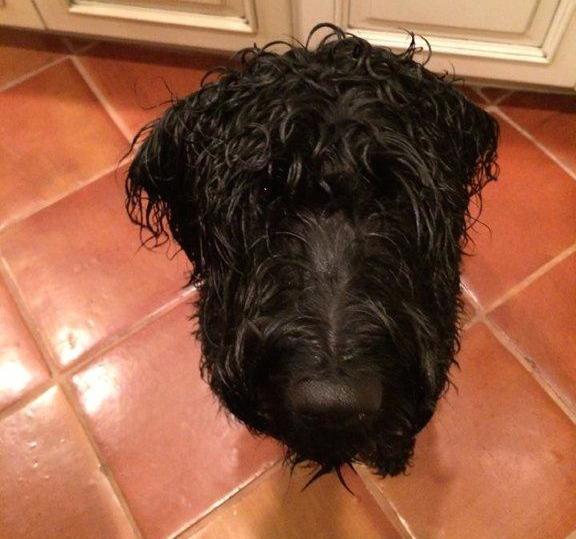
It really is true that it is more work to appreciate the features of a black dog.  For instance, in this photo of my dog, you can barely see his eyes:

10176247_10152351667344189_1085738088_n

Or his body. Or his feet.

Another can relate:

I volunteered at a shelter and noticed this problem too. I adopted a black-haired, medium-sized, young adult, mixed-breed dog who turned out to be essentially perfect. I find that with a decent camera and some experience, experimentation, and digital editing, one can make great photos of black-haired dogs. Here’s one I took of my dog, which I think proves the point:

Kitchen Portrait-2

Another reader:

We recently adopted a rather large black dog. Sonny is beautiful, but there are problems.

First, Sonny is impossible to see at night. That means he sometimes gets stuck at the back door, begging to be allowed back in the house. And sometimes, in the middle of the night, I get tripped up on my way to the bathroom.

Second, having a black dog muddies my standing as a yellow dog Democrat. In years past, when asked about my politics, I just pointed to my pooch. Can’t do that now.

Another has a suggestion for photo-taking:

As you can see, black dogs can be photographed wonderfully, and tools like Instagram help:

unnamed-insta

Another has more tips:

First, there’s the Black Dog Project if you want to see some great photographs of black dogs. The photographer, Fred Levy, photographs them against dark backgrounds to highlight the difficulties they face in being adopted.

Secondly, there’s a few things that you can do when taking photographs of black dogs to make them turn out better. This is really good for shelter workers, but also just for regular dog owners who want better photos of their pooches. Black dogs can seem scary and ominous, but if you play with the dog for a few minutes and get it into a light pant, they start to look like they are smiling, and their eyes come alive. The dog goes from scary to friendly in an instant. Washing them and giving their coat a good brush will help them shine and create really nice highlights that also make them turn out less like a dark blob in a photo.

Finally, I’d be remiss to not include a photo of my own black pup:

puptraits

Another has a different recommendation:

The best barbecue joint I have ever been to in my life is in Urbana, Illinois, home of the University of Illinois, called Black Dog Smoke and Ale House. It proudly displays several signs about this exact issue of adoption, donates to the Humane Society of Champaign (a no-kill shelter), and the owners have their own adopted black dogs. And their food is out of this world. If you ever find yourself lost in the cornfields of Illinois, worth the time.

More readers share their pup pics:

I knew about the bias against black cats in shelters, but I didn’t realize it extended to dogs. He is hard to spot in the laundry basket, though:
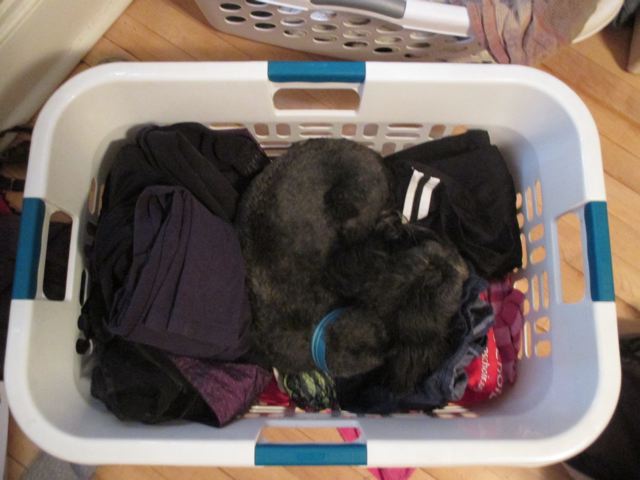
IMG_0943 (1)

Another:

It breaks my heart to think that people might be biased against dogs based simply on the color of their coats.  Makes about as much sense as being biased against people based on the color of their skin.  Not saying that the effect isn’t real, just that it’s stupid.

My evidence?  Take a look at these two adorable mutts that rule over our house: Chloe on the left and Chip on the right:

chip

Never a better pair of “pound puppies” to be found!

Another:

I couldn’t help but write you after reading your post today on the bias against black dogs; it’s an issue I think about daily.  I have two dogs, both rescues; one is a beagle/border collie mix (mainly white with charcoal markings), and the other is a black lab/doberman/german shepherd mix.  Every evening, weather permitting, I take them on a long walk throughout the neighborhood, and whenever anyone stops to talk, or pet the dogs, the white beagle mix is “the little one,” and Moxie is “the black one.”  I find it fascinating.  The only exception to this is small children; teens, adults, and the elderly all toe the invisible “little/black” line.

Both of my dogs are extremely friendly, well-Moxiebehaved on walks, and love to meet new people. I absolutely understand why strangers would be apprehensive of my larger dog, as she is about 125 pounds, but no one, not ever, in four years of walks, has called her “the big one.” My neighborhood is fairly diverse, but regardless of the ethnicity of the person we meet, she is always the Black Dog.  It makes me a little sad, not just because it happens, but because it is apparently such a widespread bias.

Interestingly, the colors/sizes split along gender lines, too.  Both of my dogs are female, but strangers always assume the mostly white dog is a girl, and the black dog is a boy (even though she sports a hot pink collar and matching leash).

Like all proud dog owners, I can’t resist talking about my dog without forcing you to look at sending at least one picture along.  Look at that face!

I can’t close without telling you how much I enjoy The Dish, and how meaningful it is to me in my daily life.  I’m a founding member, and I can say without a doubt that my membership is one of the most rewarding purchases I’ve made, and I plan on renewing into perpetuity. Thanks again!

One more:

Our black dog is Chaucer, born in Oxfordshire, who has traveled with us through 10 countries on our (USAF) military career. We are now in S. Korea for another year on assignment. He has flown over the Atlantic and Pacific and is a love. Koreans are afraid of large dogs and people have been known to run screaming when they see us on our walks. The younger folks stop and ask if they can have their picture taken with him. As you can see, he is very photogenic; please, please, PLEASE add my gorgeous boy to your black dog thread. You will make him very happy!

20080413-DSC_2091

Floral And Faunal Fragrances

Richard Conniff ponders the role of scent in the natural world:

We are by no means the only species trying to smell like something (anything) other than ourselves. The caterpillar of South Africa’s Zulu Blue butterfly, for instance, mimics the chemical scent that the ants use to recognize their own brood. So the gullible ants carry the caterpillar into their nest, and don’t seem to notice when it proceeds to devour the very ant brood it has been mimicking.

Orchids are also wicked olfactory deceivers. They need to attract wasps, bees and other insects to spread their pollen. So some orchid species have evolved the shape and coloration of specific female insects – and also release chemicals that duplicate the come-hither perfume of the females they mimic. (It’s interspecies cross-dressing – and, wait, do I hear a Broadway musical?) The duped males respond at first with clumsy groping and then quickly proceed to copulation, sometimes to the point of ejaculation. It gets more interesting: Some male wasps actually seem to prefer the scent of make-believe females. They will break away from a real female to have sex with a flower.

Drug War Fail: Afghanistan Edition

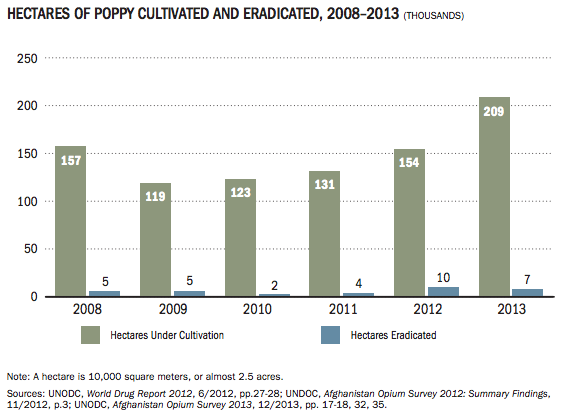
Screen_Shot_2014-07-07_at_11.06.01_AM

Beauchamp illustrates how little our opium eradication efforts have accomplished:

From 2008 to 2013, when the US anti-opium campaign hit its apex, the US only managed to eradicate 3.7 percent of the land devoted to poppy cultivation. The total amount of land devoted to poppy cultivation was a third higher in 2013 than in 2008 … Now, it’s true that the total amount of opium produced in Afghanistan has declined from its 2008 peak. But, according to the UN, that’s because of “plant diseases and bad weather” — not the war. There’s more land devoted to poppy cultivation, but it’s less productive because of natural conditions. Drug eradication doesn’t appear to have much to do with it.

Why has the campaign against opium failed so epically?

There are plenty of reasons, including widespread Afghan government corruption and the fact that 95 percent of poppy cultivation happens in the country’s insecure, Taliban-filled southwestern provinces. But the most important one is the most basic — Afghanistan runs on opium. Opium-related activities make up half of the country’s GDP; the legal economy depends on its proceeds to function. As Fabrice Pothier, the director of the Carnegie Endowment’s European branch and an expert of the Afghan drug trade, explains in an absolutely staggering passage, opium is more than 50 times as important to Afghanistan as cocaine is to Colombia[.]

Dan Murphy concurs with Zack’s takeaway:

To be fair, trying to wipe out opium production in Afghanistan would have been a Sisyphean task no matter what strategy was deployed. It’s a lucrative business, and poppies are easily cultivated, generating far more money for poor farmers and corrupt middlemen than any feasible substitution crop. During the height of the American counterinsurgency effort, winning over the general population to the side of the government and foreign forces was a big focus. The US found that tearing up crops and impoverishing farmers wasn’t very popular.

The early eradication strategy was largely abandoned in favor of going after big opium dealers and encouragng farmers to grow other crops. But that really hasn’t worked, either. The country’s opium and heroin trade is a top earner, and with the military effort winding down, the business opportunities associated with aid and foreign military spending are set to decline.

Be A Man. Take Paternity Leave.

Joe Pinsker discusses one way to put peer pressure to good use:

study released in this month’s issue of the American Economic Review suggests a social snowball effect that might counteract the stigma that’s attached to taking time off. It found that fathers who take paternity leave make their brothers 15 percent more likely to do the same. Similarly, dads who see their male coworkers take time off are 11 percent more likely to take leave themselves. …

As things stand now, the theory is that fathers tend to shy away from taking paternity leave because they think taking time off work might damage their professional lives. A 2012 article in Harvard Business Review highlighted research that suggested that “fathers with even a short work absence because of family obligations are recommended for fewer rewards and receive lower performance ratings,” and came to the conclusion that, just as women are being pressured away from prioritizing their professional lives, men are steered away from spending time with their families. Within this framework, the study’s findings make sense: armed with information of how an employer reacts to a peer’s paternity leave, a father will probably be a lot less worried about any unforeseen consequences at work.

Previous Dish on paternity leave here and here.

The Best Of The Dish Today

The former half-term governor has now declared herself in favor of impeachment of the president, and called on all good Republicans to do the same. Drudge, the original impeacher, went into full metal jacket mode – and an instant poll of his readers (close to 170,000 of them at time of posting) backed impeachment by 72 to 15 percent.

You can try and figure out the logic but this is the most coherent of the passages in her declaration of war:

The federal government is trillions of dollars in debt; many cities are on the verge of insolvency; our sarahpalin_200908_477x600_7overrun healthcare system, police forces, social services, schools, and our unsustainably generous welfare-state programs are stretched to the max. We average Americans know that. So why has this issue been allowed to be turned upside down with our “leader” creating such unsafe conditions while at the same time obstructing any economic recovery by creating more dependents than he allows producers? His friendly wealthy bipartisan elite, who want cheap foreign labor and can afford for themselves the best “border security” money can buy in their own exclusive communities, do not care that Obama tapped us out.

Look: don’t ask me. Nothing she says has ever made much sense to me.

But the obviously potent issue she is referring to is illegal immigration, the issue that took down Eric Cantor, and the issue that truly riles up the Fox Nation. And here’s the critical part with respect to the November elections:

It’s time to impeach; and on behalf of American workers and legal immigrants of all backgrounds, we should vehemently oppose any politician on the left or right who would hesitate in voting for articles of impeachment.

And so a gauntlet has been laid. A vote for the Republicans this November is a vote for the impeachment of Obama. Any Republican Senate candidate who does not back impeachment will now face growing Tea Party backlash. And every single Senator will now be asked if they support impeachment or not. That seems to me the import of Palin’s endorsement of the most radical action that can be taken against a sitting president. The November elections have just become a vote on the question of impeachment.

Are the Republicans aware of the implications of this? There are plenty of voters who might have voted Republican this fall who will hesitate if they think it means subjecting the country to the kind of spectacle we saw the last time a Democrat dared to win a second term in office. There are many African-American voters who might have sat out this election – but now will see the president beset by the same forces that tried to take down Bill Clinton and may well show up in force. There are, for that matter, many women voters who, before Hobby Lobby, might have felt apathetic this fall and may not now. What I’m suggesting is that, not for the first time, the Republican party’s most treacherous opponent … is the Republican party. And McCain’s Frankenstein leads the way!

Today, we took note of a new study of the power of psilocybin; and the role that plankton could play in reducing atmospheric carbon. I mulled over the promise and pitfalls of “reform conservatism” as well as the “revenge doctrine’ of the state of Israel. Plus: Big Pharma takes on marijuana; and the conversion of a small but growing minority of evangelicals to marriage equality.

The most popular post of the day was “The Tears Of An Elephant“, followed by “The Challenge of Reform Conservatism.”  Many of today’s posts were updated with your emails – read them all here. You can always leave your unfiltered comments at our Facebook page and @sullydish.

If you haven’t yet, but have been meaning to, please take a moment to subscribe. Without you, we have no way to keep this show on the road.

And see you in the morning.

(Photo of the former half-term governor and failed vice-presidential candidate from Runner’s World.)

Looking Back At The Great War, Ctd

John Cooper and Michael Kazin have been debating the wisdom of America entering WWI. In the latest round of argument, Kazin imagines what Germany winning might have meant:

Cooper is certainly correct about Woodrow Wilson’s motives for entering World War I. He did wager that the blood of American soldiers could make a “new world order” more likely. But if a triumphant Germanyno sure thing, even if the U.S. had stayed neutralhad been a pillar of that order, what’s the worst that would have happened? At least, it would have meant that Adolf Hitler would be remembered, if at all, as the recipient of two Iron Crosses who still failed to make it past the rank of lance corporal. It also might have given Germany’s socialist party (the SPD) – the largest in the world and one committed to democratic rule and cultural tolerance – an influential role in combatting attempts to suppress national minorities and reining in the militarist state.

But John Cooper insists that a German victory would have been disastrous:

Defeat in 1918 unquestionably poisoned the politics of the Weimar Republic, and I agree with Kazin that without it Hitler would probably never have risen from obscurity. But would either Germany or other nations have been immune to the viruses of fascism and racialist nationalism? Being on the winning side did not immunize Italy and Japan against those infections. One likely result of a German victory might have been the defeat of the Bolsheviks in Russia, but before we relish that possibility think about what a chilling effect that would have had on later anti-colonial movements. Or consider how in later decades Gandhi might have fared in a German-dominated India or Mandela in a German-reinforced Boer South Africa.

(Video: Hitch recites Wilfred Owen’s WWI poem Dulce et Decorum est.)

Who Profits From Prohibition?

Lee Fang contends that Big Pharma (and painkiller interests) are bankrolling anti-marijuana campaigns:

People in the United States, a country in which painkillers are routinely overprescribed, now consume more than 84 percent of the entire worldwide supply of oxycodone and almost 100 percent of hydrocodone opioids. In Kentucky, to take just one example, about one in fourteen people is misusing prescription painkillers, and nearly 1,000 Kentucky residents are dying every year.

So it’s more than a little odd that [the Community Anti-Drug Coalition of America (CADCA)] and the other groups leading the fight against relaxing marijuana laws, including the Partnership for Drug-Free Kids (formerly the Partnership for a Drug-Free America), derive a significant portion of their budget from opioid manufacturers and other pharmaceutical companies. According to critics, this funding has shaped the organization’s policy goals: CADCA takes a softer approach toward prescription-drug abuse, limiting its advocacy to a call for more educational programs, and has failed to join the efforts to change prescription guidelines in order to curb abuse. In contrast, CADCA and the Partnership for Drug-Free Kids have adopted a hard-line approach to marijuana, opposing even limited legalization and supporting increased police powers.

Jon Walker adds:

After reading this article it is worth drawing attention to the interesting correlation between medical marijuana states and prescriptions for opioid pain relievers. On average opioid prescription rates are noticeably lower in states that have medical marijuana laws. Of course correlation doesn’t necessarily mean causation. That said, it is also worth noting for-profit companies rarely give significant sums of money to politically active groups purely out of the goodness of their hearts.

We ran a map yesterday showing which states have the greatest dependency on prescription painkillers.

Keeping An Eye On The Ball

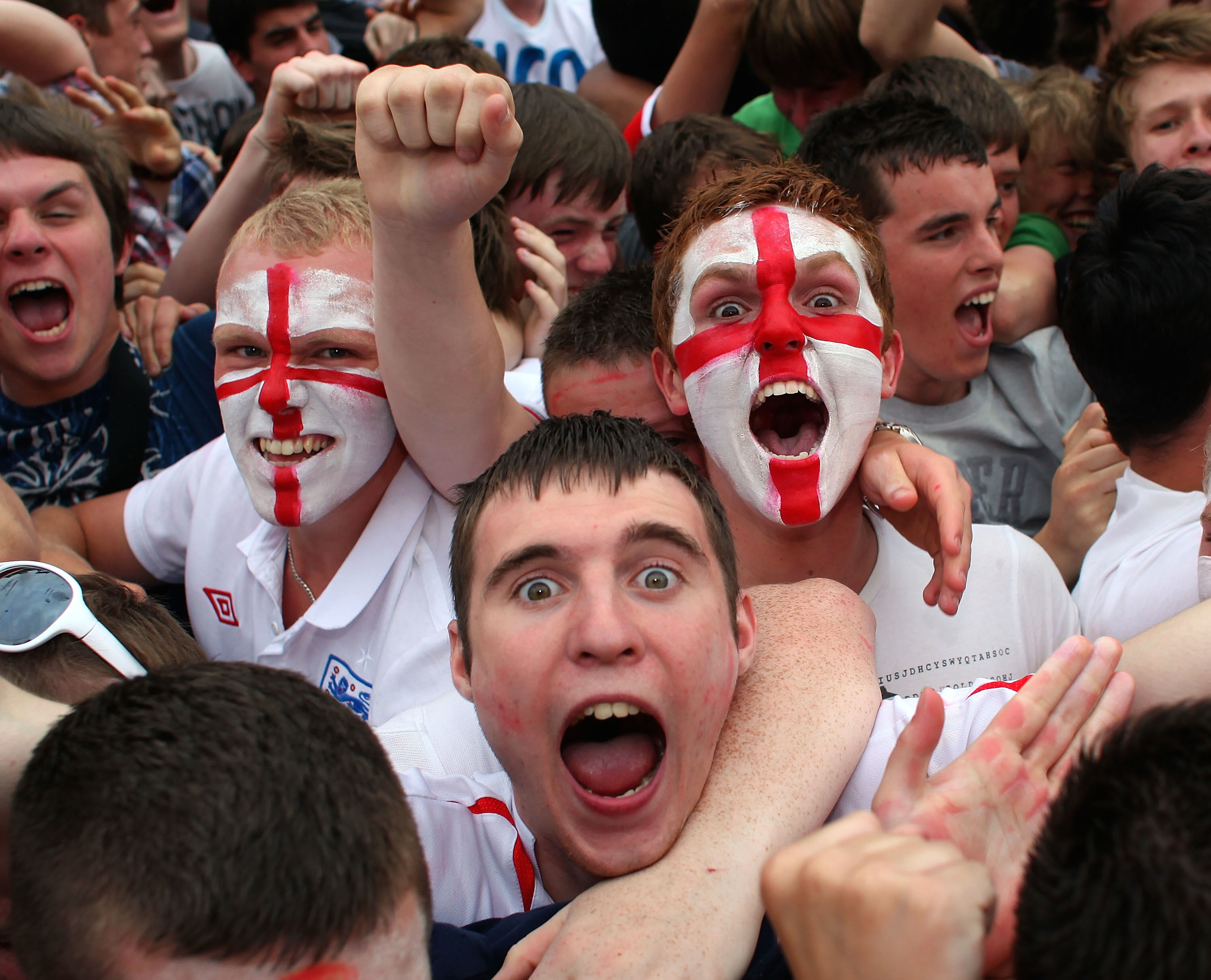
Fans Hold Their Breath For An England Victory In The World Cup

Charles Simic confesses his long-held World Cup addiction:

As hard as it is to comprehend, there are human beings on this planet who have no interest in the World Cup. Not just in the United States, where many sneer at this foreign import and find the global passion for the game incomprehensible, but also in countries where the fate of the national team in such a tournament is the sole topic of conversation for months.

I remember visiting the great Mexican poet Octavio Paz in Mexico City on the day his country was playing Italy in the 1994 World Cup. At first, we lolled around for a couple of hours, sipping wine and having a leisurely chat about literature and art. But to my surprise and distress, when the time came for the game, instead of turning on the TV, Paz and his wife took me and my Mexican translator to a French restaurant where we sat surrounded by empty tables, because everyone else in Mexico that evening was either at home watching the game or in one of the big plazas in the city seeing it on a huge screen. As we got into an argument about Heidegger, I recall cheers and gasps of collective disappointment reaching us from the vast crowd gathered outside. Desperate to find out the score, I kept going to the bathroom so I could peek into the kitchen where the cooks and the waiters were watching the game.

I have no memory of anything Octavio said that night, and I sincerely regret that, because he was the most learned and articulate man I ever encountered in my life. But I do remember the final score: Mexico one; Italy one.

(Photo: England fans celebrate after watching the England beat Slovenia 1-0 on a giant screen in Manchester, England on June 23, 2010. By Christopher Furlong/Getty Images)

Israel’s Other Terror Problem

Keating suspects Israel is regretting its failure to do anything about the epidemic of of violence and vandalism committed by West Bank settlers against their Palestinian neighbors and their property:

While the attacks have been widely condemned in Israel, the response by authorities can charitably described as sluggish. According to one report,  between 2005 and 2013, 992 investigations of complaints of Israeli violence against Palestinians were launched but only 7.8 percent of them led to indictments.

As Daniel Byman and Natan Sachs have argued, a large part of the problem is the state of legal limbo created by the occupation of the West Bank. While Israeli police have authority over criminal disputes between Israeli citizens, “the military governs most aspects of public life, from security to construction permits,” and with the overall level of violence low until the last few weeks, the Israeli Defense Forces felt little public pressure to focus on protecting Palestinians from settler violence. Despite this, the IDF has on several occasions been the target of settler attacks.

Jonathan Schanzer profiles the settler gang known as “Price Tag”, which is responsible for many such attacks:

Price Tag is more a network than a group, because its cadres — religious, teenage Jews living in the settlements and in Israel alike — operate informally, leave no electronic trail of their activities, and seem to know how to elude detection from authorities. They are so elusive, in fact, that Israel’s vaunted internal security services has made only a handful of arrests since the acts of vandalism, usually marked by graffiti bearing the words “price tag” in Hebrew, began in 2008.

Some, including Israeli Defense Minister Moshe Yaalon, have called Price Tag a terrorist movement. This is debatable, because its activities have been limited to acts of vandalism and destruction of property. But Israeli officials I spoke to this week began to speculate that if the network was responsible for the murder of Abu Khdeir, it would have graduated into the realm of terrorism. Price Tag, at least so far, has not been linked to the murder. But amid the unrest that is now spreading across East Jerusalem, the Arab areas in Israel’s northern “triangle,” and parts of the West Bank, it is clear that the network poses dangers to Israeli security.