ISIS’s “Mission Accomplished” Moment

That’s how Jennifer Keister characterizes the declaration of the so-called Islamic State. Good luck, she says, finding skilled technocrats to govern the “caliphate”:

As the BBC’s Jim Muir notes, “if the caliphate project is to take root, it will need administrators and experts in many fields, whom Abu Bakr al Baghdadi is clearly hoping will flood to heed his call.”  ISIS has demonstrated some capacity to do this in Syrian cities like Raqqa, where observers note its extensive and coercive reach into residents’ lives.  But as any administrator will tell you, competent technocrats are not necessarily easy to come by.  For ISIS, much may depend on how its declaration of the caliphate is taken among well-qualified individuals elsewhere, and the group’s willingness to engage in the compromise and politicking to build alliances.  It is possible well-qualified personnel may find ISIS’s announcement attractive (augmented by the group’s ability to pay them, at least for now).  But such individuals often bring with them their own political and religious preferences.  If ISIS refuses to compromise, it will be fishing for administrators in a doubly shallow pool of those with sufficient competence and affinity for its particular ideological brand.  Moreover, if ISIS does attract quality personnel, using them for administrative demands means the group cannot simultaneously use their skills in leading or planning attacks to expand or defend ISIS territory.

Thomas Hegghammer analyzes the Islamic State’s long-term position:

Judged by the standards of transnational jihadi groups, ISIS is doing exceptionally well. Never before has an Islamist group this radical had so much territory, so much money, and so many Western recruits. Even if ISIS was literally decimated—that is, reduced to a tenth of its current size—it would still be one of the largest jihadi groups in the world. However, by the standards of national insurgencies, ISIS is in some trouble.

Further expansion—to Baghdad, Saudi Arabia, or Jordan—is highly unlikely given the obstacles in their way. They may preserve much of their territorial gains in Iraq in the next few months, but within a year the Iraqi government should, with U.S. assistance, be able to push them back to where they were in early 2014. In the longer term, ISIS may face governance strain in its remaining areas as locals tire of strict moral policing and economic stagnation. In addition, they face a broad alliance of intelligence services that knows more and more about them. Three years from now, ISIS will probably be substantially weaker than it is today, but for reasons other than the caliphate declaration.

The jihadis’ targeting of shrines, Juan Cole adds, is threatening to undermine its popular support:

Although the so-called “Islamic State” has destroyed several Sunni, Sufi and Shiite shrines and places of worship in the past month, probably the most significant is the tomb of medieval saint Ahmad al-Rifa`i (d. 1183 AD). The Rifa`i Sufi order claims him as its founder. Sufis practice meditation and chanting and they seek mystical union with God. There are plenty of Rifa`is in Syria and the order is popular in Egypt, and still has adherents throughout the Muslim world,from Bosnia to Gujarat. IS is not making a good reputation for itself in most of the Sunni world, where there is still respect for mystics like Rifa`i. One of its allies of convenience is the Naqshbandi Sufi order in Mosul, members of which won’t be happy about all this shrine-bashing.

Face Of The Day

Mahmoud Abbas receives Mohammed Abu Khdeir's family

Fifteen-year-old American citizen Tariq Khdeir meets with Palestinian President Mahmoud Abbas in the West Bank city of Ramallah on July 7, 2014. Khdeir was beaten by Israeli policemen and arrested on Thursday during the funeral of his cousin Mohamed, who was abducted and killed by suspected Jewish settlers on Wednesday. By Issam Rimawi/Anadolu Agency/Getty Images.

Breathing Easier With ECMO

Otherwise known as Extracorporeal Membrane Oxygenation. Daniela Lamas investigates the fortunes of the medical process that “siphons blood out of the body and runs it through a machine that temporarily assumes the lung’s work—oxygen in, carbon dioxide out—and gives the injured lung time to heal,” avoiding the problems associated with respirators. The backstory:

Building on the principles of the heart-lung bypass machine used in cardiac surgeries, the first ECMO machines for lung failure came about in the nineteen-seventies. In an early, publicized case, a young man in California was dying after having injured his lung severely. His doctors put him on ECMO—the machine was the size of a car—for three days. He survived and his story was published in the New England Journal of Medicine, in 1972. The ensuing enthusiasm led to a medical trial in the seventies with the goal to test whether patients with lung failure did better with ECMO or with a respirator alone. In both groups, more than ninety per cent of patients died. The excitement about ECMO for adults with lung failure “fell back to earth,” Daniel Brodie, who directs the medical ECMO program at Columbia University Medical Center, told me.

But lately there’s been an ECMO “revival” – aided by much improved technology – and it began with a butt augmentation gone awry:

In the fall of 2008, a twenty-seven-year-old woman was admitted to the Allen Hospital after receiving silicone injections to enhance her buttocks. The silicone had leaked into her vessels and travelled to her lungs, causing massive bleeding. Even with a respirator at its highest settings forcing air into her lungs, she was, literally, drowning in her own blood. The doctor caring for the young woman called Brodie, who suggested ECMO. “By all accounts, she was surely going to die. We felt we had nothing to lose by trying, and everything to gain,” Brodie said. She survived. “When it worked, even we were a bit surprised. That one case may not have changed a lot of minds, but it certainly opened them up to the ever-so-faint possibility this wasn’t crazy.”

Then, in 2009, the H1N1 virus swept the globe and left some previously healthy people with severely injured lungs—a condition called acute-respiratory-distress syndrome. For patients whose oxygen levels still teetered despite the highest settings on the respirator, doctors started turning to ECMO. In the same year, a smaller ECMO apparatus that could get patients up and walking—older versions required patients to remain supine and sedated—won approval from the Food and Drug Administration. The coincidental timing—a new pandemic, a new machine—“opened the floodgates,” said Jose Garcia, a cardiac surgeon at Massachusetts General Hospital. “We’re redefining death, to the point that somebody we thought for sure was dead two or three years ago, well, they’re not dead anymore.”

Looking Back At The Great War

WWI

World War I began 100 years ago this month. Beinart marks the anniversary by remembering how the war spurred a major crackdown on civil liberties. He uses that history to consider how war changes the national psyche:

The problem is that the unity war breeds come at the expense of those Americans who become associated—either because of their political views or their religion, race or ethnicity—with the enemy. To avoid becoming targets of the fanatical patriotism that World War I sparked, many German Americans changed their last names. Unable to so easily conceal their ancestry, Japanese Americans during World War II were interned. For many Muslim Americans, 9/12 and the days that followed were marked not by fidelity to the “the values and principles of the greatest nation ever created” but by the government’s violation of those principles, as it surveilled and harassed vast numbers of Muslims purely because of their religion or country of origin. Since then, America’s invasion of two majority Muslim countries has fueled the paranoia that has led national politicians to warn that Sharia law is infecting the United States and local bigots to challenge the building of mosques.

As [progressive philosopher John] Dewey foresaw, wars do empower the state, a power that, in theory, could be used to redress social ills. But in the real world, argued Dewey’s protégé-turned-accuser Randolph Bourne, using war powers to achieve domestic reform is like using a firehose to fill a water glass. “War,” wrote Bourne, “is just that absolute situation … which speedily outstrips the power of intelligent and creative control.”

In another meditation on WWI, John M. Cooper insists that Wilson was right to send the US into WWI:

Wilson’s failure to educate the public about his design for peace and his permissiveness toward repression of civil liberties deservedly remain blots on his historical reputation.  But his greatest failings, particularly in shaping the peace settlement and in bringing the United States into a collective security system, stemmed from bad luck. His worst misfortune came when he suffered a massive stroke just after a belated and foreshortened speaking tour to sell the public on the League of Nations.  It left him a broken man, whose impaired judgment turned him into a major element in the spiteful stalemate that kept the America out of the League of Nations.

Would things have been different if Wilson had not decided to go to war in 1917? Yes, because Germany would almost certainly have won by the end of that year. Military disasters in Russia and Italy, grievous shipping losses inflicted by the submarines, and an untenable financial situation (the British had run out of credit in the U.S. to sustain their massive war orders), and no prospect of American troops eventually coming to their rescueall these added up to a recipe for Allied defeat. Europe dominated by a victorious Germany would almost certainly have been more benign than the Nazi-conquered continent following the Fall of France in 1940. But how much more benign? The settlement imposed on the Bolsheviks at Brest-Litovsk in 1918 leaves the question open. Likewise, what impact would such a victory have had on the long march toward the end of colonialism that began with the League of Nations mandate system?

Michael Kazin disagrees with Cooper:

The consequences of the victory won by the U.S. and its allies led, in part, to an even greater tragedy. As Wilson feared, the punitive settlement made in Paris did not last. The president may have won Senate approval for the peace treaty, if he had accepted some of the reservations which Senator Henry Cabot Lodge and his supporters demanded. But American membership in the League of Nations would likely not have stopped the rise of fascism, Nazism, or the Communist Internationalwhich, together, sowed the seeds of the Second World War. The terrible irony is that U.S. entry into World War I probably made that next and far bloodier global conflict more likely.

As the historian John Coogan has written, “It was the genius of Woodrow Wilson which recognized that a lasting peace must be ‘a peace without victory.’ It was the tragedy of Woodrow Wilson that his own unneutrality would be a major factor in bringing about the decisive Allied victory that made a healing peace impossible.”

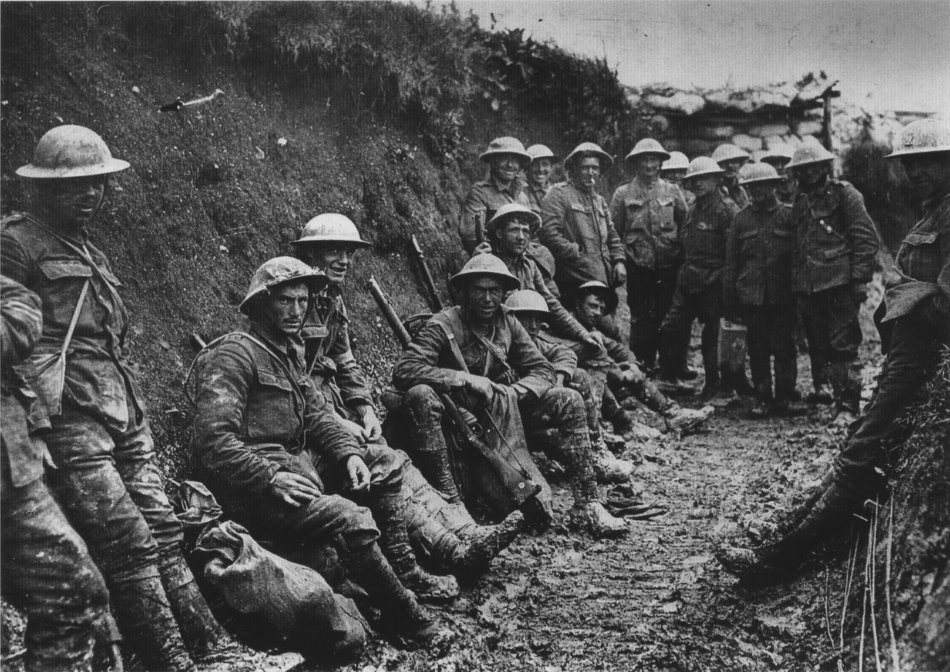
(Photo: Royal Irish Rifles in a communications trench, first day on the Somme, 1916. Via Wikipedia.)

Saddam In Shia Clothing?

In a lengthy retrospective on America’s complicated relationship with Prime Minister Maliki, Ali Khedery illustrates how that relationship began warmly, soured over time, and got us where we are today:

Maliki never appointed a permanent, parliament-confirmed interior minister, nor a defense minister, nor an intelligence chief. Instead, he took the positions for himself. He also broke nearly every promise he made to share power with his political rivals after they voted him back into office through parliament in late 2010.

He also abrogated the pledges he made to the United States. Per Iran’s instructions, he did not move forcefully at the end of 2011 to renew the Security Agreement, which would have permitted American combat troops to remain in Iraq. He did not dissolve his Office of the Commander in Chief, the entity he has used to bypass the military chain of command by making all commanders report to him. He did not relinquish control of the U.S.-trained Iraqi counterterrorism and SWAT forces, wielding them as a praetorian guard. He did not dismantle the secret intelligence organizations, prisons and torture facilities with which he has bludgeoned his rivals. He did not abide by a law imposing term limits, again calling upon kangaroo courts to issue a favorable ruling. And he still has not issued a new and comprehensive amnesty that would have helped quell unrest from previously violent Shiite and Sunni Arab factions that were gradually integrating into politics.

In short, Maliki’s one-man, one-Dawa-party Iraq looks a lot like Hussein’s one-man, one-Baath Party Iraq.

Eli Lake blames that relationship for the White House’s failure to take action when the ISIS threat emerged six months ago:

The problem for Obama was that he had no good policy option in Iraq. On the one hand, if Obama had authorized the air strikes Maliki began requesting in January, he would strengthen the hand of an Iraqi prime minister who increasingly resembled the brutal autocrat U.S. troops helped unseat in 2003. Maliki’s heavy handed policies—such as authorizing counter-terrorism raids against Sunni political leaders with no real links to terrorism—sowed the seeds of the current insurrection in Iraq.

But while Obama committed to sell Maliki’s military nearly $11 billion worth of advanced U.S. weaponry, he was unwilling to use that leverage in a meaningful way to get him to reverse his earlier reforms where he purged some of his military’s most capable leaders and replaced them with yes men. As a result of this paradox, the Iraq policy process ground to a halt at the very moment that ISIS was on the rise.

Recent Dish on Maliki’s role in precipitating the present crisis here and here.

The Central Plank Of Clinton’s Campaign?

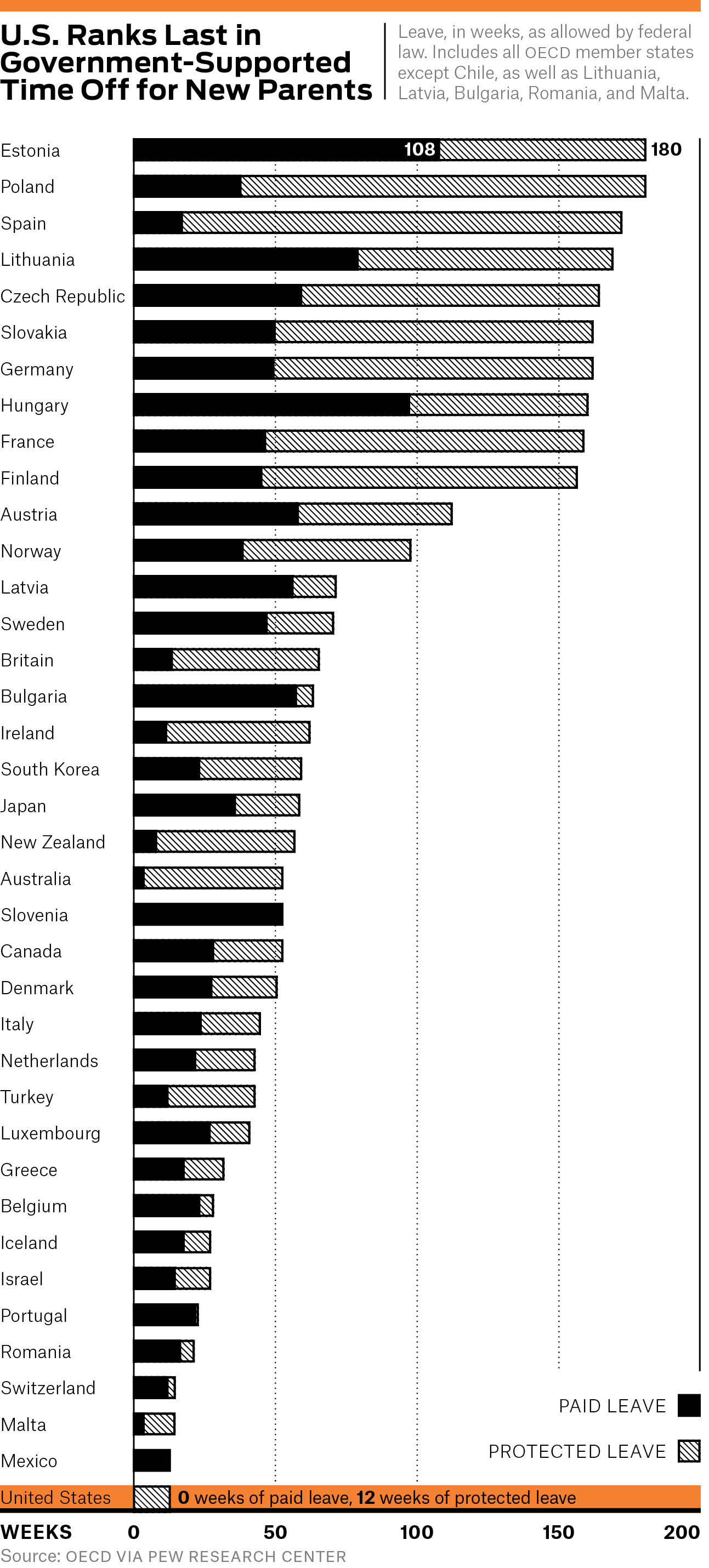
Paid Leave

Tomasky argues that it should be paid family leave:

In a nutshell, it’s popular. A survey commissioned in 2012 by a pro-leave group found that respondents supported the idea by 63 to 29 percent. Democrats were of course strongly in favor (85-10), but independents were at a still quite favorable 54-34, and even Republicans weren’t against it—they were evenly split at 47-48.

Far from being hammered by the right over such a proposal, I think Clinton could turn the tables. What percentage of women are going to be against this? In the pro-leave group’s poll, it was just 23 percent.

Of course the U.S. Chamber of Commerce and the Business Roundtable are going to go ape, but here we have facts, and the known facts suggest that in California paid leave has not been the nightmare that businesses feared. One study, by the Center for Economic and Policy Research, found that 89 percent of participating businesses reported a positive or no noticeable effect on productivity; 91 percent said the same about profitability and performance; 99 percent said the same about morale. Clinton will be able to find plenty of employers in California, and presumably New Jersey, who will sit in front of a camera for 30 seconds and testify that the law is just fine by them.

Cohn seconds Tomasky:

Of course, polling on an issue that hasn’t gotten much attention isn’t always reliable. Public sentiments could change if the Chamber of Commerce, which would spend heavily to fight such a plan, convinced Americans it would hurt the economy. And I plea totally guilty to political bias on this. I think paid leave is a great ideaan innovation that’s long overdue. But campaigns aren’t just about proposing what works politically. They’re also about laying the groundwork for a governing agenda. And while lots of people are skeptical that Clinton would take such a risk, if indeed she’s the nominee, I’m not. One reason is that she proposed such an initiative in 2007, the last time she ran for president.

A Country That Would Kill To Host The World Cup, Ctd

Even though Qatar’s 2022 World Cup arenas are being built on the backs of abused South Asian laborers (like everything else there and in other Gulf states), Justin Martin makes a counterintuitive case for letting Qatar keep the Cup:

Without its World Cup and the microscopes it attracts, Qatar would have less pressure over the next decade to improve civil liberties and basic human rights.

And what happens in Qatar doesn’t stay there. Other countries in the region pay close attention to Qatar’s domestic and diplomatic moves. The country is the wealthiest nation in the Arab Gulf and, by many metrics, the world. Doha is the Dubai of yesteryear, albeit with less hedonism, and Qatar has invested more proactively in its country’s education, healthcare, and publicly available research than other Gulf countries. Qatar’s English-language Doha News is one of the most independent and outspoken domestic news organizations in the Arab world. These positives are available for other nations in the region to see partly due to coverage of Qatar’s World Cup preparations. …

Human rights improvements in Qatar are afoot, but the country will notcannotbecome Sweden overnight. I am not saying that postponing civil liberties is ever acceptable, and yes, “justice delayed is justice denied,” but the paradox surrounding the push to relocate the Qatar World Cup is that doing so would both delay and deny the very progress critics claim to support.

Hillary, The Neo-Neocon? Ctd

Larison pooh-poohs (and rightly, I’d say) any future collaboration between a president Clinton and someone like Bob Kagan:

Clinton is as reliably hawkish as major Democratic politicians come, and I assume she wouldn’t be opposed to working with Hillary Clinton Awarded The 2013 Lantos Human Rights Prizeneoconservatives in the future on certain issues. That said, Clinton wouldn’t need to include neoconservatives in her hypothetical future administration, and they wouldn’t want to join. Her own party already has more than enough interventionists of its own, as her career and the careers of many of her allies and supporters attest. After all, why would she stir up controversy by bringing in neoconservatives when she can get very similar policy results and much better press by bringing on, say, Anne-Marie Slaughter and other liberal hawks? Supposing that a Paul nomination caused neoconservatives to endorse Clinton, that would be their ideologically-driven act of protest and not something that Clinton would feel any need to reward. Democratic partisans would spin such endorsements as “bipartisan” validation of Clinton’s foreign policy views, and they would find the display of Republican factionalism very entertaining at least until the election was over.

(Photo from Getty)

Quote For The Day II

“Before God and his people I express my sorrow for the sins and grave crimes of clerical sexual abuse committed against you. And I humbly ask forgiveness. I beg your forgiveness, too, for the sins of omission on the part of Church leaders who did not respond adequately to reports of abuse made by family members, as well as by abuse victims themselves. This led to even greater suffering on the part of those who were abused and it endangered other minors who were at risk,” – Pope Francis.