Trophy Children

swimming trophies

Teacher Molly Knefel defends giving every kid a trophy:

The disgust that so many adults feel at the idea of everyone getting a trophy has to do with creating incentives. If everyone gets a trophy then no one will try hard; if everyone gets basic food and housing to survive, then no one will work. Of course, this isn’t true. A soccer team full of 10-year-olds who all get participation trophies won’t all sit down and stop playing soccer– the kids who are good at scoring points will still want to do so. But the kid who never scored a point will, for a moment, be recognized: You played soccer too.

Instead, that kid is supposed to get the message: If you didn’t score a lot of points, no one gives a shit about you. And if that makes you sad, or if you feel that it’s not fair, get used to it. The world is a sad and unfair place. Score more goals next time. This message has always felt at odds, to me, with the equally ubiquitous platitude that children are the future. If children are the future, then why are we so gung ho about preparing them to be treated unfairly?

So they are better equipped to handle it.

(Photo by Flickr user terren in Virginia)

#Feminism

https://twitter.com/jetpack/status/476730906300784640

Rebecca Traister revisits Susan Faludi’s 1991 Backlash and analyzes the impact of the Internet on the feminist movement:

Feminism online is now so populated with younger women, just out of school. And generations who are new to feminism don’t have a comparative context so they understandably feel furious about the variety of injustices and prejudices that we are facing right now, and furious at the way media deals with women and furious at the way it deals with race and sexuality. But every once in a while, as the older person who remembers this time really clearly, I just want to say, “No, no, no, you have no idea how much better it is right now than it was in the early ’90s, you don’t remember what it was like when there was no feminist internet.” I’m grateful for this book for so thoroughly cataloguing how bad that period of backlash was, how grim it felt then.

Sarah Miller shares Traister’s ambivalence about online feminism and goes further:

I have always called myself a feminist and have no plans to quit. But while I think that the world should certainly have respect for feminism, I’d like to see feminism have a little more respect for chaos and ambiguity. Right now we are in a loop of “This is good.” “This is bad.” “This person is sexist.” The internet and its outrage machine are to blame for some of this lashing out. So is the human desire to lay blame, shouting “It is you who did this! You who thinks adults shouldn’t read teen books! You who make movies where not-so-hot guys get hot girls! You who wrote an article about a bad person and didn’t say he was as bad as I think he is!”

I think back to the Facebook comment about the Santa Barbara shooting: “If you don’t think this is about misogyny there is something wrong with you.” I suppose the thing that is wrong with me is that while I can’t escape the urge to categorize, I am aware of its potential to become pathological.

The Best Of The Dish Today

Screen Shot 2014-07-29 at 11.53.08 AM

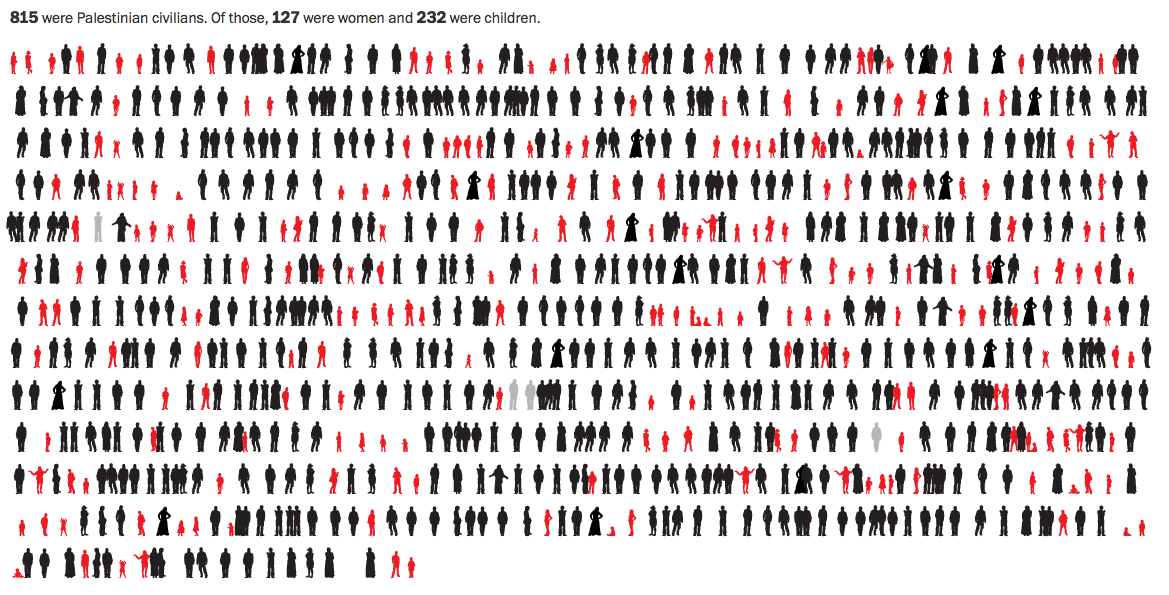
Above is an info-graphic from the Washington Post that visualizes the 815 civilian dead in Gaza (it’s updated day by day). The small red figures are children. 232 children have now died under the Israeli assault on Gaza, which originated in the outrage at the murder of three Israeli teens. I cede my time to Roger Cohen:

No argument, no Palestinian outrage or subterfuge, can gloss over what Jewish failure the killing of children in such numbers represents.

And to Jon Chait:

It is not just that the unintended deaths of Palestinians is so disproportionate to any corresponding increase in security for the Israeli targets of Hamas’s air strikes. It is not just that Netanyahu is able to identify Hamas’s strategy — to create “telegenically dead Palestinians” — yet still proceeds to give Hamas exactly what it is after. It is that Netanyahu and his coalition have no strategy of their own except endless counterinsurgency against the backdrop of a steadily deteriorating diplomatic position within the world and an inexorable demographic decline. The operation in Gaza is not Netanyahu’s strategy in excess; it is Netanyahu’s strategy in its entirety.

This does seem to be a tipping point, doesn’t it?

Today, we remembered Tony Judt’s prescience and the shifting American debate on Israel; noted a sea-change among the younger generation of Americans; and chronicled the latest bout of Israeli hating on Kerry and Obama. I tried to pre-empt George Tenet’s doomed attempt to prove he wasn’t a war criminal by authorizing torture; I parsed Montaigne’s conservative disposition – and Oakeshott’s “conservatism of joy.” And we noted the progress on the right marked by Paul Ryan’s latest plan on poverty.

The most popular post of the day was Why Am I Moving Left?, followed by The Shifting Israel Debate.

Some of today’s posts were updated with your emails – read them all here.  You can always leave your unfiltered comments at our Facebook page and @sullydish. 24 27 more readers became subscribers today. You can join them here – and get access to all the readons and Deep Dish – for a little as $1.99 month. Gift subscriptions are available here. Dish t-shirts and polos are for sale here. One reader is about to snatch one up:

I’m much taken by the new Dish logo T-shirts and wanted to thank you for producing versions that have only the beagle logo and are thus recognizable only to the cognoscenti. An order will be forthcoming. But surely someone with your experience in pun-laden headlines should not have missed the opportunity to label this approach as “dog-whistle marketing?” Oh, the opportunity lost …

See you in the morning.

Toward A Conservatism Of Joy

Noting that Michael Oakeshott’s classic essay, “On Being Conservative” (pdf) was published nearly sixty years ago, Aaron Taylor notes a few of the distinctive features of what Oakeshott described as “not a creed or a doctrine, but a disposition”:

The real foes of conservatism are not socialism and liberalism, but the reactionary and innovating mentalities. Neither the reactionary nor the innovator share the joie de vivre of the conservative mindits natural inclination to rejoice in and savor what is. They are restless and tormented if things are not in a state of perpetual flux, if “progress” is not being made either backward toward an imagined age of innocence, or forward toward an imagined age of future liberation. If nothing is changing, then nothing is happening. Reactionaries and innovators eschew what Oakeshott calls the conservative mind’s “cool and critical” attitude toward change, advocating instead a radical overhaul of society and its refashioning in the image of a golden age which is either imagined to have existed in the past or lusted after as a possible future.

I think that’s what Dan Drezner is expressing in his formulation of the “Zen Masters'” approach to foreign policy:

These people think that the long arc of history is bending in their direction — that the fundamental strengths of the United States and its key allies are more robust than any potential rivals on the global stage.  The worst thing to do, therefore, is to overreact in the short run to things that will balance out in the long run. They don’t believe in getting riled up too much, and that, in the end, the universe tends to unfold as it should.  It’s not that they’re unaware of what Russia or China or the Islamic State is doing — it’s that they believe that these actions are short-sighted, counterproductive and very likely to fail.  They believe that actors that try to forcibly revise the status quo will pay a serious price.

So, yes, Obama is a conservative. Taylor’s take on the future of this style of conservatism:

If genuine conservatism is to survive, then, it cannot succumb to the modern politics of misery that characterizes almost all political discourse today, including on the Righta discourse that proceeds by presenting a list of bitter complaints about what is wrong with the world and then offering in response to its own grievances either a selfish assertion of “my rights,” or else a vision of a social utopia that is all the more depressing because everyone knows it is pure fantasy.

This does not mean that we cannot be keenly aware of what is wrong with the world. But conservatism must rediscover a greater sense of what it is for and a sense of enjoyment for such things. It must recover the conviction articulated by the poet Gerard Manley Hopkins (who himself wrote during an age of flux and decline) that “the world is charged with the grandeur of God” and that “though the last lights off the black West went,” there still “lives the dearest freshness deep down things”little “things” that are very much worth conserving amid the ruins. Misery may be infectious, but joy is more so.

Recent Dish on Oakeshott here and here.

The Ruins Of Gaza

Gaza Damage

The Israeli army is employing what Jesse Rosenfeld calls scorched earth tactics in Gaza, practically leveling entire neighborhoods, as the UN satellite photo above illustrates:

The Israeli military, relentlessly and methodically, is driving people out of the three-kilometer (1.8 mile) buffer zone it says it needs to protect against Hamas rockets and tunnels. According to the United Nations Office for the Coordination of Humanitarian Affairs, the buffer zone eats up about 44 percent of Gaza’s territory. What that means on the ground is scenes of extraordinary devastation in places like the Al Shajaya district approaching Gaza’s eastern frontier, and Beit Hanoun in the north. These were crowded neighborhoods less than three weeks ago. Now they have been literally depopulated, the residents joining more than 160,000 internally displaced people in refuges and makeshift shelters. …

According to Hebrew University political scientist and longtime analyst of the Israeli-Palestinian conflict, Yaron Ezrahi, with or without the phrase [“scorched earth”], the idea does have a certain logic.

Ezrahi says there is a military and political calculation behind this devastation. Some in the Israeli government believe it will create enough Palestinian suffering so that Gazans will rise up against Hamas or force the leaders to come to terms with Israel when they come out of hiding. But that is an assumption that greatly underestimates the resolve of Gazans to see an end to their seven years of Israeli blockade and rid themselves of the Israeli presence that controls the strip like guards positioned around a prison yard.

Sari Bashi argues for lifting the travel restrictions on Gazans:

[I]t would be a mistake to consider the negotiations over the travel restrictions as a zero-sum game—as if lifting them were a concession to militants that must be balanced by concessions to Israel. Ending the restrictions on civilian movement into and out of Gaza would have the primary effect of benefiting Palestinian students, workers, farmers and factory owners, and many Israeli officials say doing so would improve Israeli security.

Closing off Gaza hasn’t made Israel safer. Yet that’s exactly what Israel has gradually done for the past two decades, especially since the 2007 takeover of Gaza by the Hamas movement. While Israel formally recognizes Gaza and the West Bank as a single territorial unit in international agreements, in practice it implements what it calls the “separation policy,” designed to sever Gaza from the West Bank and keep movement of people and goods to a “humanitarian minimum.” Travel to Israel and the West Bank is limited to exceptional humanitarian cases, mostly medical patients and merchants buying essential goods, and the number of Palestinians passing through the Israeli-controlled Erez Crossing is less than 1 percent of what it was in September 2000, on the eve of the Second Intifada.

Previous Dish on the humanitarian disaster in Gaza here.

(Image source: WaPo)

The Lie Behind The War, Ctd

Netanyahu has claimed that “Hamas is responsible” for the recent murder and kidnapping of three Israeli teens. Reporting suggests otherwise. Batya Ungar-Sargon attempts to undermine those reports:

It’s entirely possible that there was some “lone cell” with no more than tenuous Hamas connections—but right now all we have is [BuzzFeed’s Sheera] Frenkel’s ambiguous anonymous source and [BBC’s Jon] Donnison’s source who believes he was misquoted as our only evidence for that proposition.

Sheera Frenkel’s new dispatch provides more info on her source:

[O]ne Israeli intelligence officer who works in the West Bank and is intimately involved in investigating the case spoke to BuzzFeed on condition of anonymity and said he felt the kidnapping had been used by politicians trying to promote their own agenda.

“That announcement was premature,” the intelligence officer said. “If there was an order, from any of the senior Hamas leadership in Gaza or abroad, this would be an easier case to investigate. We would have that intelligence data. But there is no data, so we have come to conclude that these men were acting on their own.”

Meanwhile, Max Fisher, no great friend of Netanyahu, argues that it’s not fair to claim that Netanyahu used these kidnappings as a pretext for war:

In order to say that Netanyahu blamed Hamas for the Palestinians murders in order to invade Gaza, as President George W. Bush premised his Iraq invasion on Iraqi weapons of mass destruction, two things would have to be true. First, Netanyahu would have had to have planned the sequence of events from the beginning such that he would get to invade Gaza; the Middle East is rife with conspiracy theories but unless Netanyahu secretly controls Hamas, Israeli extremist gangs, and Palestinian protesters, he did not plan this. It seems much likelier that things gradually escalated out of control until both sides were sucked into war.

Second, Netanyahu would have had to have wanted to invade Gaza. You don’t devise an elaborate conspiracy to do something, after all, unless you actually want to do it. This is ultimately a question of Netanyahu’s personal internal motivation, which I will not claim to know. For whatever it’s worth, an American veteran of the Israel-Palestine peace process named Aaron David Miller wrote in the Washington Post that he believes Netanyahu did not want or seek the war. Maybe, maybe not.

If you want to get angry about something, get angry about this: Israel has for years refused to change its strategy toward Gaza and the larger Israel-Palestine conflict, even though that strategy shows zero indication of yielding sustainable peace and leads Israel to occasionally invade Gaza to weaken anti-Israel groups there.

For the record, I agree. My point is that Netanyahu’s reflexive, evidence-free, blanket condemnation of Hamas as a whole created a situation that spiraled out of control.

Medicare Gets Its Annual Check-Up

medicare_obamacare_savings

Jason Millman sums up the Medicare trustees’ report:

This year’s verdict: Medicare’s hospital insurance trust fund will be solvent through 2030, which gives the program four more years of solvency than projected in the trustees’ 2013 report. It’s also 13 years later than the prediction issued by the trustees just before passage of the Affordable Care Act in 2010.

Margot Sanger-Katz wonders how long the good news will continue:

Medicare’s trustees acknowledged that the spending slowdown driving their improved forecasts was still mysterious, and that its durability couldn’t be counted on. They are not alone in that view: There’s a healthy debate among academics and health care policy experts about why health spending has slowed recently. “No one knows” what’s causing the slowdown, said Charles Blahous III, the lone Republican among the trustees, at a news conference announcing the findings. Robert Reischauer, another public trustee, agreed that scholars were “many years away” from understanding the slowdown’s precise causes, though he was more optimistic that the slowdown could stick.

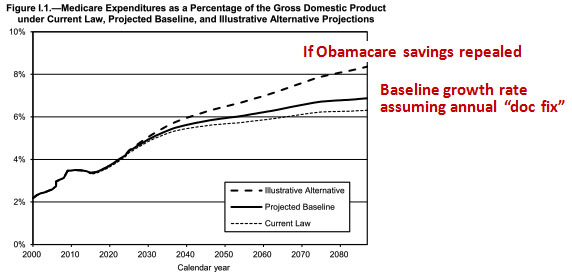
Drum posts the above chart:

Medicare actuaries take the efficiency measures in Obamacare pretty seriously. If we stick to them, they really are likely to cut the growth rate of Medicare spending. And remember: Medicare costs get reflected in overall health care costs too. If Republicans ever win their jihad against Obamacare, we lose not just the Medicare savings, but a lot of savings in private health care too. That’s a lot to give up.

Philip Klein is skeptical those savings will materialize:

“The Affordable Care Act is making important changes to the Medicare program that are designed, in part, to substantially improve its financial outlook,” [Paul Spitalnic, the chief actuary for the Centers for Medicare and Medicaid Services] wrote. “While the ACA has been successful in reducing many Medicare expenditures to date, there is a strong possibility that certain of these changes will not be viable in the long range.”

He explained that though Obamacare makes cuts to payments of medical providers, “the ability of health care providers to sustain these price reductions will be challenging, as the best available evidence indicates that most providers cannot improve their productivity to this degree for a prolonged period given the labor-intensive nature of these services.”

Kliff, meanwhile, puts the report in context:

The projected date of insolvency speaks to a world where Congress never changes anything about Medicare, the world of health financing stays static, and, if we keep spending payroll tax dollars at current rates, the fund can’t pay its bills.

In other words, the date of projected insolvency speaks to a world that doesn’t really exist. Health financing isn’t static, and Congress has lots of tools in its legislative tool box to ensure Medicare can continue paying seniors’ bills. That’s what they’ve done in the past and, given that seniors are pretty big fans of Medicare (as well as pretty big fans of voting), its a decently safe assumption that its what they would do in the future, too.

Whatever the new insolvency projection released today is, you can rest pretty sure that Medicare won’t pack up and stop paying bills that year — or any other time soon.

The Anti-Vaxx Movement Gets Worse

Amanda Marcotte explains:

It’s hard to believe it was possible, but anti-vaccination fanaticism has taken a darker turn, as Chris Mooney reports for Mother Jones: Now, it’s not just vaccines that parents are foolishly rejecting for their children, but also a simple injection of vitamin K that has been a standard part of newborn care since the 1960s. Some parents now find themselves rushing to the emergency room with babies sick with vitamin K deficiency bleeding. “This rare disorder occurs because human infants do not have enough vitamin K, a blood coagulant, in their systems,” Mooney writes. “Infants who develop VKDB can bleed in various parts of their bodies, including bleeding into the brain.” Bleeding in the brain can cause brain damage and, in some cases, death.

Mooney examines the overlap between the anti-vaccine and anti-vitamin crowds:

A quick Google search returns a number of dire warnings about vitamin K shots circulating on the Internet. One of the top results is an article at TheHealthyHomeEconomist.com, which urges readers to “Skip that Newborn Vitamin K Shot,” before going on to list an array of “dangerous ingredients in the injection cocktail.” (The site also calls vaccines “scientific fraud.”) And then there’s physician Joseph Mercola (whose popular website calls vaccinations “very neurotoxic” and suggests they are associated with a list of conditions, including autism). In another article on his site, Mercola suggests there is a “Potential Dark Side” to the vitamin K shot. “A needle stick can be a terrible assault to a baby’s suddenly overloaded sensory system, which is trying to adjust to the outside world,” it reads.

He adds, “evidence presented by the CDC suggests that refusal of vitamin K shots may be a major phenomenon to contend with”:

In Tennessee, the CDC found that at the hospital with the highest rate of missed vitamin K injections, 3.4 percent of infants were discharged without receiving one. At birthing centers in the state (a hospital alternative, often run by nurse-midwives), the number was much higher: 28 percent.

Previous Dish on anti-vaxxers here.

The Age Gap On Gaza

Gaza Blame

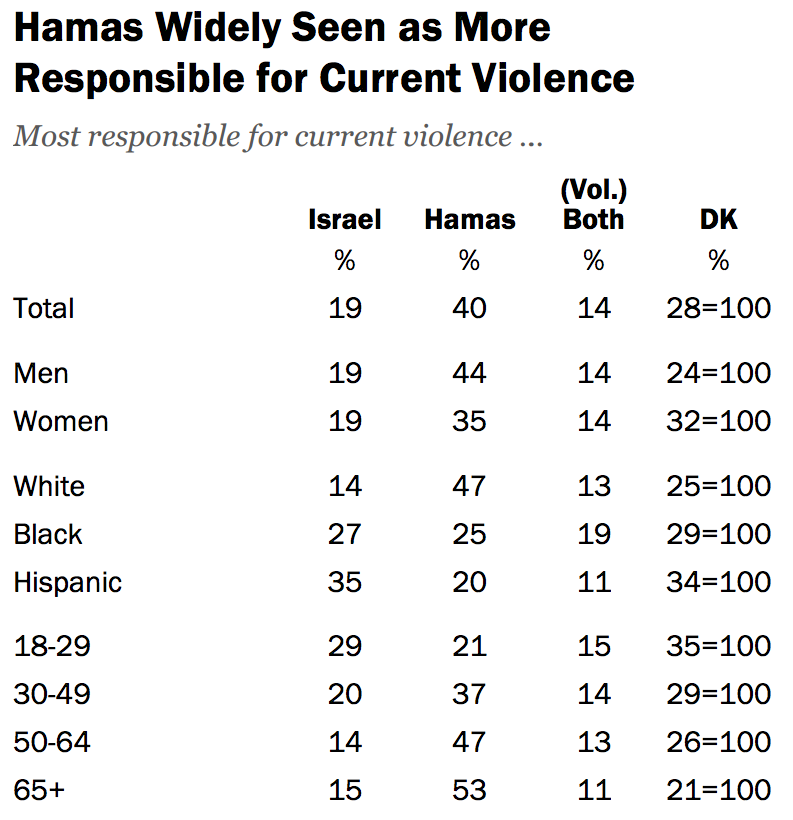
Aaron Blake parses a new Pew poll asking Americans who’s to blame for the war in Gaza:

While all age groups north of 30 years old clearly blame Hamas more than Israel for the current violence, young adults buck the trend in a big way. Among 18 to 29-year olds, 29 percent blame Israel more for the current wave of violence, while 21 percent blame Hamas. Young people are more likely to blame Israel than are Democrats, who blame Hamas more by a 29-26 margin. Even liberal Democrats are split 30-30. The only other major demographic groups who blame Israel more than Hamas are African Americans and Hispanics.

The poll echoes a Gallup survey from last week. Gallup asked Americans whether they thought Israel’s recent actions were justified. While older Americans clearly sided with Israel, 18 to 29-year olds said by a two-to-one margin (51-25) that its actions were unjustified. No other group was as strongly opposed to Israel’s actions.

Ron Fournier warns Israel of what polls like these portend:

[A] generation of global citizens is rising to power without the Israeli narrative embedded so firmly in its consciousness. The so-called Arab Spring and the United States’ diminished influence abroad has created a new set of filters through which young people will consider the Israeli-Palestinian conflict, a viewpoint that might be less inclined to favor the Jewish state. …

Again, none of this is intended to suggest that Israel should bow to Hamas’s demands. Israelis must defend themselves. Neither is this a case for or against Israel completing its current mission to shutter terrorists’ tunnels and silence the rockets. Rather, it’s a warning that Israel’s decades-old public relations and political dominance is coming to an end unless the nation’s leaders change the narrative and reset their strategic position with moderate Palestinians.

Previous Dish on American views of Israel and the Gaza conflict here and here.