A Cronenberg Creeper

The director’s new short The Nest is NSFW from the first frame:

Aisha Harris sums up the appeal of the intensely creepy film:

In the film, shot in a single long take in what looks like a very bleak storage basement, a woman (Evelyne Brochu) goes through a consultation with a doctor (voiced by Cronenberg) in hopes of having a rather unusual mastectomy.

The two discuss her reason for wanting surgery, with the camera focused upon her almost the entire time. There are no peeling, mangled, or deformed body parts here, but the woman’s vivid, visceral description of her supposed condition combined with the mundane, relaxed tone of Cronenberg’s interaction with her might creep some viewers out nearly as much as some of the goriest moments in The Fly.

Scott Beggs praises Brochu’s acting:

It’s constructed as an unflinching POV shot of the young woman, resting entirely on and proving wholly the powerful presence of Evelyne Brochu (who some will recognize from Orphan Black). Simply put, this is a dull film without her intensity and calm insanity (similar to another of Cronenberg’s modern shorts). She sells a delusion to the point that we’re left questioning whether her garage-set surgical consult is actually the right course of action for a human wasp’s nest.

Or maybe the doctor … is a mad opportunist taking advantage of mental illness. Or maybe a dozen other things. We’re left pondering a lot of possibilities, but it seems clear that no matter the reality, what’s going to happen next will be terrible.

The Shock Of Proust

Daniel Mendelsohn recalls how reading the author for the first time transformed his ideas of love and writing:

Discovering Proust was a real shock—it was the shock of recognition. I was twenty, and going through a rough patch in my love life. It gave me a shock that, I believe, is felt by every gay person reading Proust for the first time—the unsatisfied desires and the frustration I harbored had not only been felt by someone else but, even more extraordinarily, they were the subject of a great book. When I read Swann’s Way, it wasn’t the description of homosexual desire that touched me—because it’s practically absent in that volume—but something much more general, the description of unreciprocated desire, and above all, the astounding revelation that desire can’t endure its own satisfaction. We see that exemplified in Swann in Love. When Swann succeeds in physically possessing Odette, when she ceases to escape him, his desire for her vanishes. For me … that was a revelation as well as a recognition.

And then I had another kind of shock. Thanks to Proust, I found a certain consolation in thinking that all artistic creation is a substitute for frustration and disappointment—that art feeds on our failures. Back then, I remember thinking to myself, I can’t get what I want anyway, I may as well become a writer!

Scoring With Silence

Tony Zhou pieces together a primer on how Martin Scorsese, famous for his use of music in films, applies silence to equally great effect:

Back in 2008, Roger Ebert highlighted Scorsese’s use of rock music in his book on the director:

Of all directors of his generation and younger, he may make the best use of rock music in his films. His first film was scored with rock records, he was a supervising editor on Woodstock, he has done documentaries on The Band and Bob Dylan, and was working in late 2007 on a Rolling Stones concert tour. He uses period music for New York, New York or The Aviator, and he evokes a time period with Dean Martin (who he once planned to make a film about), but you sense that he edits with rock in mind; it is worth remembering that he met his longest-serving collaborator, the great editor Thelma Schoonmaker, on Who’s That Knocking, and worked on Woodstock with her. Michael Wadleigh, one of the cinematographers on Knocking, became the director of Woodstock. I remember sitting next to them on the floor of a New York loft and watching takes of that film while they were both vibrating like fans at a concert.

(Hat tip: kottke)

A Short Story For Saturday

Today’s short story, “If You Were a Dinosaur, My Love” by Rachel Swirsky, won’t take you long to read; it’s just under a thousand words. It won a 2014 Nebula Award from the Science Fiction and Fantasy Writers of America, and begins with these charming lines:

If you were a dinosaur, my love, then you would be a T-Rex. You’d be a small one, only five feet, ten inches, the same height as human-you. You’d be fragile-boned and you’d walk with as delicate and polite a gait as you could manage on massive talons. Your eyes would gaze gently from beneath your bony brow-ridge.

If you were a T-Rex, then I would become a zookeeper so that I could spend all my time with you. I’d bring you raw chickens and live goats. I’d watch the gore shining on your teeth. I’d make my bed on the floor of your cage, in the moist dirt, cushioned by leaves. When you couldn’t sleep, I’d sing you lullabies.

Read the rest here. Previous SSFSs here.

The View From Your Window Contest

VFYWC-212

You have until noon on Tuesday to guess it. City and/or state first, then country. Please put the location in the subject heading, along with any description within the email. If no one guesses the exact location, proximity counts.  Be sure to email entries to contest@andrewsullivan.com. Winner gets a free The View From Your Window book or two free gift subscriptions to the Dish. Have at it.

Happy Paralysis?

Taffy Brodesser-Akner reviews research by cosmetic dermatologist Eric Finzi, who investigates Botox as a treatment for depression:

[I]n 2003, Finzi launched a small pilot study. He treated several subjects suffering from moderate to severe depression with Botox, paralyzing the muscles in their brows that create expressions of sadness, anger, and fear. The results were astonishing. Nine out of 10 patients reported a complete remission of their depression. … [I]n May 2014, in the Journal of Psychiatric Research, Finzi published the results of a second, much larger study, this one double-blind and randomized, with the results co-authored with Dr. Norman Rosenthal, a professor of psychiatry at Georgetown Medical School. (The project was also funded by Finzi’s clinic.) The study found a 47 percent reduction in scores on the Montgomery-Åsberg Depression Rating Scale among those injected with Botox. The members of the control group, who were injected with saline, exhibited a 20.6 percent reduction.

Brodesser-Akner decided to undergo the treatment herself, with mixed results:

As the weirdness subsided, I realized I wouldn’t characterize myself as less emotional with the Botox. I had the same emotions I’d always had; I just didn’t care about them. And then I wondered what this meant.

We are our feelings, after all. The rest is just blood and tissue. I felt diminished by feeling less deeply, and that, to me, was the most compelling result. We think that the opposite of depression is elation, but that isn’t exactly correct. Happy people don’t walk around ecstatic the way depressed people walk around sad. No, the opposite of depression is the absence of depression—and I suppose, in those terms, the Botox worked. I did experience an absence of depression. But Botox also took away other feelings, the ones we need to make us whole: joy, jealousy, frustration, triumph. Feeling leap-in-the-air excited—that was gone, too.

Surveying Finzi’s research back in March, psychiatrist Richard A. Friedman considered (NYT) its broader implications:

Whether Botox will prove to be an effective and useful antidepressant is as yet unclear. If it does prove effective, however, it will raise the intriguing epidemiological question of whether in administering Botox to vast numbers of people for cosmetic reasons, we might have serendipitously treated or prevented depression in a large number of them.

Puff Gov

Former New Mexico governor Gary Johnson is dabbling in the marijuana industry, joining Cannabis Sativa Inc. as CEO and president:

Johnson said he hoped to expand Cannabis Sativa into a major marijuana business and intends to work out of New Mexico to help develop products that are legal in states like Colorado and Washington. “I generally believe this is changing the planet for the better,” said Johnson, who will be paid $1 a year and receive equity in the company. “It also is a bet on the future … We think we have the creme de la creme of marijuana products.”

Johnson, who owned a construction company that helped build Intel Corp.’s Rio Rancho, New Mexico, plant before entering politics, said the company will make marijuana-based oils aimed at helping children with epilepsy. The two-term governor also said it will make cough drop-like products for recreational use.

Emma Roller learns that “while marijuana may be his passion, Johnson has also been vocal about rekindling his presidential ambitions”:

“I hope to be able to run in 2016,” he said in a Reddit Q&A session in April. Johnson said he would run as a libertarian again, because that way he “would have the least amount of explaining to do.” While a 2016 Johnson candidacy is low-hanging fruit for pundits’ jokes, he does have a following akin to Ron Paul circa 2008. And while recreational marijuana is a long ways off from becoming a (legal) reality outside of Colorado and Washington, states are becoming more progressive with their views of medical marijuana. Even some of the most conservative states in the country have begun legalizing cannabis oil to treat children with severe epilepsy.

Paid To Sit Around?

When Aaron Gilbreath, a writer, couldn’t find a steady day job, he turned to house-sitting:

What you might call an invisible economy of house sitters exists across the country. Untold numbers roam our city streets, leaving their familiar bedrooms to stand sentinel over strangers’ homes while using them as getaways, weigh stations and de facto offices. As one 2006 AARP Magazine article describes house-sitting: “Imagine staying in some of the loveliest locations on earth—and all you have to do is feed the cats.” Websites like HouseCarers.com and Luxury House Sitting have emerged to connect homeowners with sitters, yet as Airbnb thrives and CouchSurfing.org gains millions of members worldwide, house-sitting goes relatively unnoticed as an industry. This is partly because it’s a cash economy, partly because it, depending on the client, bears such close resemblance to what you call “crashing at your friend’s place.” Don’t be fooled. The arrangement may be casually intimate, but it is business. Imagine what would happen if the house got robbed because the sitter failed to lock the back door. …

House-sitting provides a way to earn supplemental, tax-free income, as well as the additional benefit of enjoying a higher standard of living in a nicer house and neighborhood than part-timers’ income can often afford—a welcome balm to one’s imperfect work life.

Face Of The Day

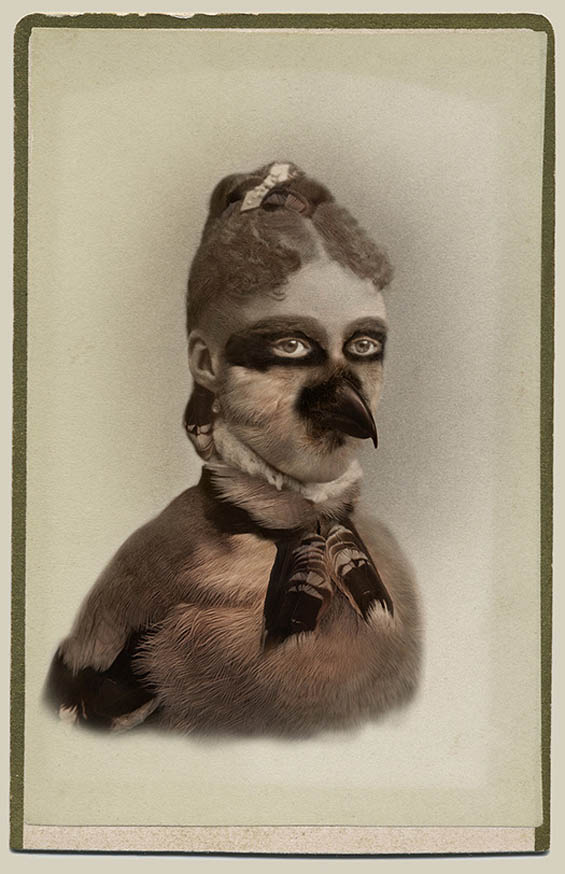
birds

Sara Barnes’s work creates “strange portraits of birds that are superimposed onto anonymous nineteenth century cartes-de-visite (small, business card sized) photographs”:

The nineteenth century was the United States’ colonial era when there was unprecedented expansion, exploration, and an interest in science and art. Family photo albums and commemorating memories were something new, as photography became increasingly common. The collection of cartes-de-visites were like trading cards, and the urge to collect didn’t stop there. People had cabinets of curiosities that included things like taxidermied birds, an interest that lead to the extinction of the passenger pigeon. Angelucci explains in a statement about the work, writing, “Made by combining photographs of endangered or extinct North American birds with anonymous nineteenth century cartes-de-visite portraits—they portray creatures about to become ghosts.”

See more of her work here.

Mammoth Losses

Satao, a fifty-year-old elephant among the largest in Africa, recently died at the hands of poachers. Elizabeth Kolbert considers the grim picture for the creatures:

Satao was an exceptional elephant; his story is not. Africa, after years of progress in protecting its wildlife, is again in crisis mode. In 2011 alone, an estimated twenty-five thousand African elephants were killed for their ivory; this comes to almost seventy a day, or nearly three an hour. Since then, an additional forty-five thousand African elephants—about ten per cent of the total population—have been slaughtered. …

[A]s disturbing as the recent carnage is, the long-term view is, if anything, worse. Elephants and rhinos are among the last survivors of a once rich bestiary of giants. Australia was home to thirteen-foot-long marsupials. North America had mammoths and mastodons, South America glyptodonts and enormous sloths, Madagascar massive elephant birds and giant lemurs. Before people arrived on the scene, these megafauna were protected by their size; afterward their size became a liability.

The giant beasts couldn’t reproduce fast enough to make up for the losses to human hunting, and so, one after another, they vanished. In this sense, what’s happening today in Africa is just the final act of a long-running tragedy.

Mike Chase, an American conservation biologist, is currently conducting an aerial census of Africa’s elephants. He started work on the project in February, when, he told the Huffington Post, he hoped to “leave people inspired and motivated with some good news.” But the opposite has happened. At a reserve in Ethiopia, where his team had expected to find three hundred elephants, they counted just thirty-six. Now, Chase said, “I feel as though the only good I’m doing is recording the extinction of one of the most magnificent animals that ever walked the earth.”

Previous Dish on poaching here, here, here, and here.