Lingua Anglica

English is a world leader in “loanwords”:

It’s a common experience for English speakers abroad: suddenly recognizing a familiar word in a newspaper, or on a billboard, or in a fragment of conversation. Since World War II, English has become by far the leading exporter of “loanwords,” as they’re known, including nearly universal terms like “OK,” “Internet,” and “hamburger.” The extent to which a language loans words is a measure of its prestige, said Martin Haspelmath, a linguist at the Max Planck Institute. English, clearly, is now on top. …

Linguistic loans can appear in a number of forms: Some float on the surface of a language, while others are more integrated. Because English and Japanese have very different sound systems, for instance, Japan often adapts words in ways that make them nearly unrecognizable to English-speakers. Über-Japanese media franchise Pokémon actually takes its name from English (“pocket monster”). Japan’s “puroresu” is another abbreviated compound, from “professional wrestling”; similarly, the extra syllables required to pronounce English consonants have given rise to “purasuchikku” (“plastic”) and “furai” (“fry”). Then there are loans where a word stays intact but the meaning shifts. A “smoking” is French for a tuxedo, and a “dressman” is a German male model. Chinese people say they want to “high” when they want to have a (non-drug-related) good time.

A Poem For Independence Day

Tattered Flag

Dish poetry editor Alice Quinn writes:

The jacket copy of the recent and brilliant edition of Frank O’Hara’s Selected Poems, edited and introduced by Mark Ford, describes O’Hara as “one of the most original and influential American poets of the twentieth century,” which is gloriously on the mark. He was also one of the most expansive and beloved personalities of his day and the spiritual anchor of what came to be known as The New York School of Poets, including in its first wave, Kenneth Koch, James Schuyler, Barbara Guest, and John Ashbery, who reigns now and has for decades as one of the most original and influential poets of our time.

Gottfried Benn (1886-1956), to whom O’Hara’s poem is addressed, was a German poet and critic, also a physician, whose early verse and poetic dramas were, according to the Columbia Encyclopedia, “strongly expressionistic and even nihilistic” and his later poems and his autobiography, Doppelleben (double life) reflective of “his ambivalent though ultimately negative reactions to the National Socialist era.”

“To Gottfried Benn” by Frank O’Hara:

Poetry is not instruments
that work at times
then walk out on you
laugh at you old
get drunk on you young
poetry’s part of your self

like the passion of a nation
at war it moves quickly
provoked to defense or aggression
unreasoning power
an instinct for self-declaration

like nations its faults are absorbed
in the heat of sides and angles
combatting the void of rounds
a solid of imperfect placement
nations get worse and worse

but not wrongly revealed
in the universal light of tragedy

(From The Collected Poems of Frank O’Hara by Frank O’Hara © 1971 by Maureen Granville-Smith, Administratrix of the Estate of Frank O’Hara. Used by permission of Alfred A. Knopf, an imprint of the Knopf Doubleday Publishing Group, a division of Random House LLC. All rights reserved. Photo by Alan Levine)

Pass On The Pyrotechnics?

Sarah Miller wonders if celebrating the sound of munitions exploding is really the best way to mark our independence:

Most Americans are very, very lucky to have escaped any homefront experience with war. So there’s perhaps something arrogant about being like, “Whoo! Let’s make lots of sounds that sound like war!” To say nothing of fireworks’ considerable expense, or the fact that they aren’t great for the air, or that they tax fire departments who need to be at the ready for other more important things, especially since wildfires are increasing and intensifying with climate change.

I’m not against fun, and I’m not always against maybe-not-environmentally-friendly fun. Meaning: I don’t blame people for loving giant trucks and speedboats and ATVs. I own a Toyota Yaris that is so light you could punt it like a football, but if money were no object and cars burned dried albizzia flowers instead of fuel, I would drive a Ford F150. But we don’t live in a world where driving a giant car means nothing, or where loud, scary, artillery-like noises mean nothing. Now I’m not saying “Fireworks are bad, ban them!” or “Let’s make the Fourth a day to weave God’s Eyes together!” (Though if someone brings beer, I’m in.) But it’s worth imagining a world without them. And if you don’t believe me, ask the nearest Irish Setter.

Meanwhile, Steven Overly stresses that fireworks injuries are on the rise:

The number of fireworks-related injuries soared to their highest level in more than a decade last year, according to a U.S. Consumer Product Safety Commission report released last week. An estimated 11,400 injuries were reported during 2013, a staggering 31 percent climb compared to 8,700 injuries reported the year before.  … As one might expect, a majority of the fireworks-related injuries last year occurred in the month surrounding Independence Day. CPSC conducted an in-depth study of the 7,400 injuries reported between June 21, 2013, and July 21, 2013. Here’s what they found:

  • Men were more likely to be injured than women, 57 percent to 43 percent.
  • Roughly half of the injured were 25 or younger. Children under 4 accounted for 14 percent of the injuries.
  • Which fireworks caused the most injuries? Sparklers accounted for 2,300 of the 7,400 injuries reported during the in-depth study. The flickering wands burn at roughly 2,000 degrees, Adler noted, and often wind up in the hands of children.
  • Hands and fingers were the body parts most likely to be burned or otherwise injured, accounting for 36 percent of injuries during the month-long study. They were followed by the head and face (22 percent), eye (16 percent) and leg (14 percent).
  • approximately 3 percent were admitted to the hospital. The remaining 2 percent of victims left the hospital without being seen, according to the report.

The First Fireworks

dish_fireworks

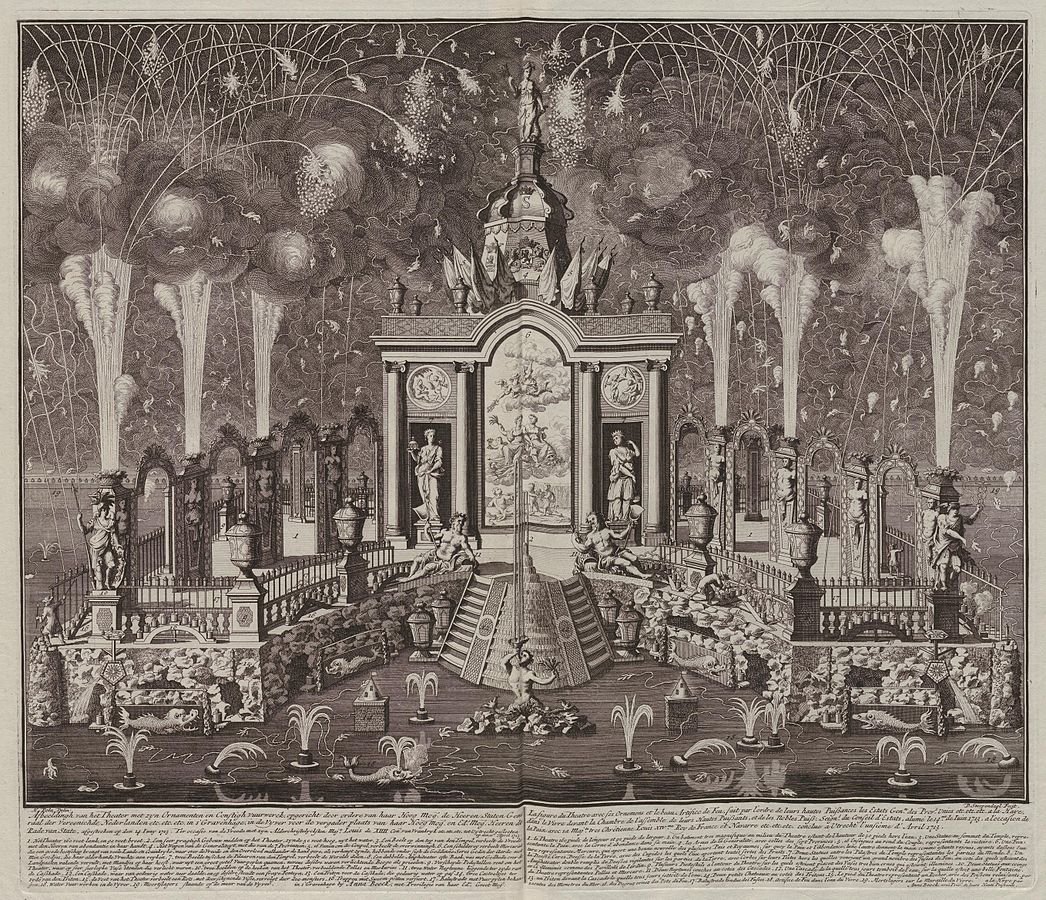
Simon Werrett looks back at the history of pyrotechnics, noting that prints like the one above were markers not so much of fun and games but of court power in 16th-18th-century Europe:

[D]isplays … typically featured symbolic or allegorical decorations and scenery which were intended to present a more specific message to audiences. The figure of a lion might represent a powerful king, or the slaying of a dragon might signal the conquest of the king’s enemies. As such, it was important to states to make sure that everyone understood the message of fireworks, and so artists were commissioned to engrave large prints of displays for distribution to relevant audiences. Fireworks prints became something of a genre in their own right, and were made by artists across Europe for several hundred years. …

Images were typically large, printed on paper, or sometimes silk, and distributed either at the display or as gifts to diplomats and other courts subsequently. Prints were not intended to capture the reality of a performance, like a photograph, but to serve as well-ordered representations of official events. Fireworks prints acted as a front-stage, sanitizing the messiness of the real event to leave only an idealized account. In fact many fireworks failed – displays often witnessed accidents, sometimes quite horrible, and there were frequently mistakes.

(Image: fireworks at The Hague, June 14, 1713 on the occasion of the “Peace of Utrecht,” via Wikimedia Commons)

The Crimes We Don’t Hear About

America would be considered a much more violent place if we took into account crimes that occur in prison:

Each year, the federal government releases two major snapshots of crime in America: The Uniform Crime Reports, written by the FBI, and the National Crime Victimization Survey, compiled by the Bureau of Justice Statistics. … According to both, America has become significantly safer over the past two decades, with today’s violent crime rate nearly half of what it was at the start of the 1990s. Neither report, however, takes into account what happens inside U.S. prisons, where countless crimes go unreported and the relatively few that are recorded end up largely ignored.

If we had a clearer sense of what happens behind bars, we’d likely see that we are reducing our violent crime rate, at least in part, with a statistical sleight of hand—by redefining what crime is and shifting where it happens. “The violence is still there,” says Lovisa Stannow, the executive director of Just Detention International, a human rights organization dedicated to ending sexual abuse and violence in prisons and jails. “It’s just been moved from our communities to our jails and prisons where it’s much more hidden.”

The Pursuit Of Heresy

Reviewing Matthew Stewart’s Nature’s God: The Heretical Origins of the American Republic, Wendy Smith unpacks his argument that the “principles that inspired the American Revolution … belong to an intellectual tradition dating to ancient Greece and reviled by every variety of Christian”:

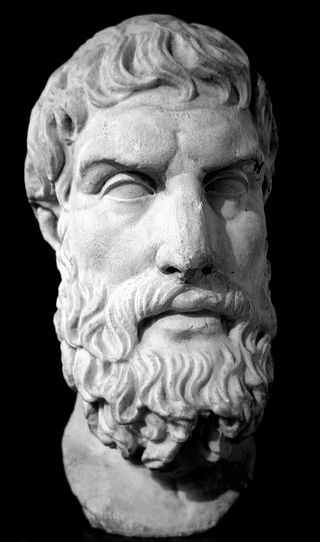
320px-Epicurus_bust2Rooted in the philosophy of Epicurus, who saw happiness as the highest good, this tradition flowered in the 17th century to produce wide-ranging inquiries into the nature of God, humanity, religion and society that got Benedict de Spinoza labeled “the atheist Jew.” Meanwhile, the more circumspect John Locke (careful to mask his iconoclasm with boilerplate declarations of conventional piety) ended up praised by historians as “the single greatest intellectual influence on America’s revolutionaries.”

Yet Spinoza the radical, no less than Locke the moderate, shaped an agnostic world view that shook America loose from Britain. Stewart pays particular attention to two fire-breathers — Ethan Allen, surprise conqueror of Ft. Ticonderoga, and Thomas Young, instigator of the Boston Tea Party — as the most outspoken proponents of a heterodox creed shared by (at minimum) Thomas Jefferson, Benjamin Franklin and George Washington. Contemporaries called them deists when not calling them infidels or atheists, and Stewart devotes considerable care to explaining that Deism, the philosophical engine of the Revolution, is not the Christianity Lite some 21st century conservatives have proclaimed it.

“America’s revolutionary deists,” Stewart writes, “saw themselves as — and they were — participants in an international movement that drew on most of the same literary sources across the civilized world.” His detailed explication of those sources ranges from Epicurus and his Roman popularizer, Lucretius, through early modern Italian freethinkers Giordano Bruno and Lucilio Vanini (both executed at the stake for their apostasy) to the diverse array of English and French intellectuals reacting to Spinoza and Locke.

In an interview, Stewart explains his use of the word “heretical” in the book’s subtitle:

Many of America’s leading revolutionaries were identified in their own time – with good reason – as “infidels.” Even more interesting is that the earlier philosophers upon whom America’s revolutionaries drew for inspiration were widely and correctly pegged as heretics, too. A surprising number were burned at the stake. I should add that they were heretics with respect to not just one but a variety of religious traditions.

Which brings up the second, more theoretical point I want to make in my subtitle. When I say “heretical” I don’t necessarily mean lacking in all religion. Heretics generally come out of religious traditions and remain committed to one form of radical religion or another. What they oppose is the common, mainstream, or orthodox religion. And what they oppose within that common religion, or so I argue, is a set of common conceptions about the nature of morality, the mind, knowledge, justice, and so forth – conceptions that, though not religious in themselves, serve to make the common religion credible. At least since the time of Socrates, the business of radical philosophy has been to challenge and oppose this common religious consciousness. Now, to get to the point: this radical, heretical philosophy was decisive in the creation of the world’s first large-scale secular republic.

(Image: A bust of Epicurus on display in the British Museum, London, via Wikimedia Commons)

What Else Was Happening in 1776?

Reviewing Claudio Saunt’s West of the Revolution: An Uncommon History of 1776, Eric Herschthal points out that, when asked about that momentous year, “few of us would think to mention the Russian fur trade with China in the Siberian town of Kyakhta; the founding of San Francisco; or the birth of the Lakota Nation in the Great Plains.” But, he says, these lesser-known developments bear “as much weight on the United States of today as what the Founders were doing in Philadelphia”:

Saunt contends that if it were not for Russia’s lucrative fur trade, the Spanish would have had little reason to colonize much of the West Coast and the Southwest. In the late eighteenth century, the Spanish became alarmed at the increasing Russian demand for sea otter and fox furs bought from natives on the Aleutian Islands, just off the coast of Alaska. To prevent their further expansion into North America, the Spanish pushed north from Mexico into California, establishing San Francisco in 1776.

Saunt’s retelling of the founding era reflects the changes in America he sees today.  We are increasingly aware of climate change, infectious diseases, and globalization, which makes us “perhaps better than ever prepared to understand and relate to the experiences of eighteenth century North America.” Disease is everywhere in Saunt’s account, and so are the nefarious effects of global trade on the environment and local populations. Skeptics might think that West of the Revolution, then, is mere politics masquerading as history. But all history writing is informed by the present, regardless of whether the historian is aware of it, admits it or not. Saunt is simply stating what most historians know implicitly.