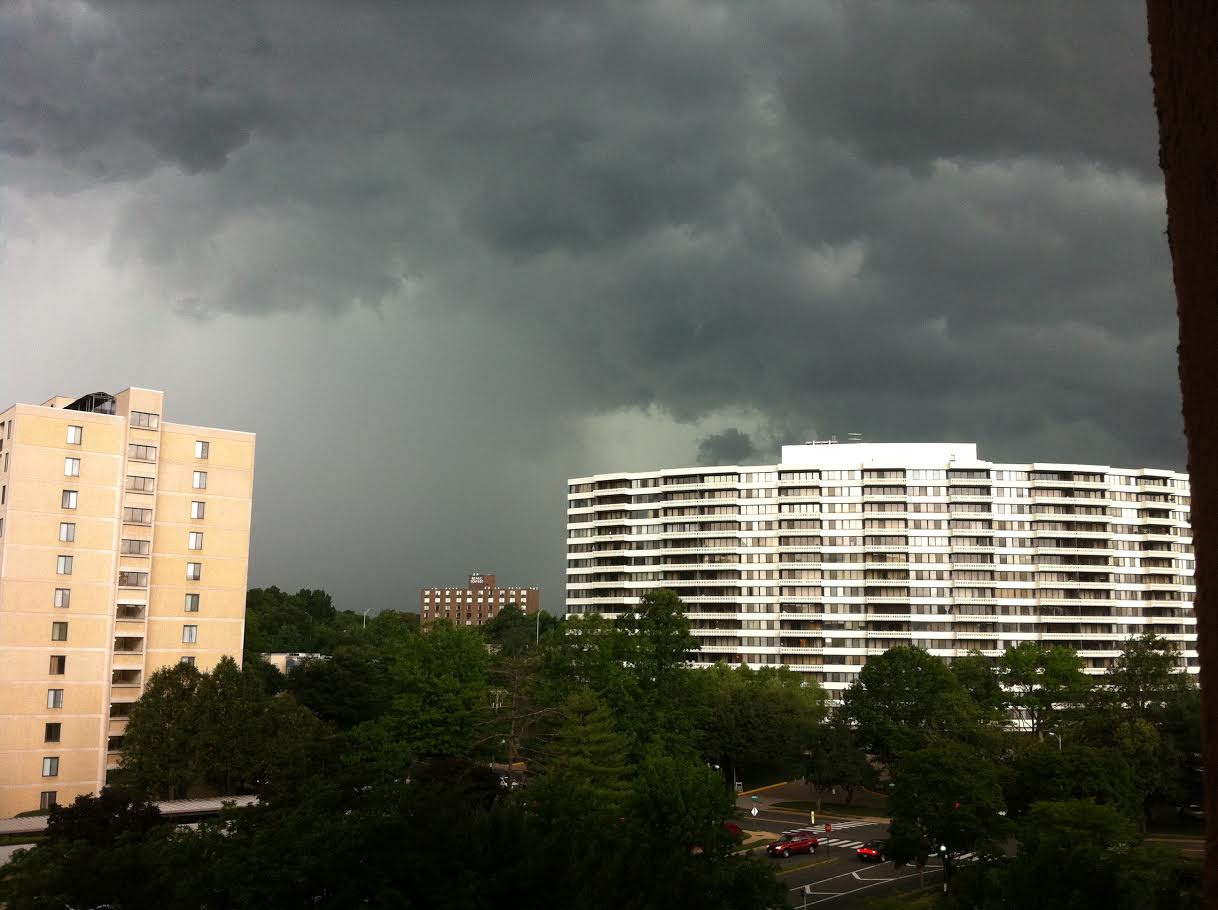
Alexandria, Virginia, 4.15 pm
Alexandria, Virginia, 4.15 pm
Today’s our national birthday, but, P.J. O’Rourke grumbles, we really should have been celebrating two days ago:
The Continental Congress declared independence from Britain on July 2nd. The 4th was simply when the Continental Congress approved the final wording of its independence declaration. If the 4th of July were the 2nd of July, it would have been on Wednesday this year. We could have taken a couple of days of family leave (which Washington prevents U.S. corporations from being required to provide) on either side of Wednesday and had a whole damn week go to parades, play backyard softball games, fire guns, ring bells, light bonfires, grill cheeseburgers, drink beer, and blow our fingers off with M-80s.
Update from a reader:
O’Rourke is right that our holiday should be a week – and there’s a historical reason. Only 12 of the 13 original colonies voted for independence on July 2. The final colony, New York, did not ratify the Declaration until July 9, a full week later. (We write about this in our book, Inside the Apple: A Streetwise History of New York City, and on our blog today.)
Why not celebrate from July 2 to July 9? Now that would be a party.
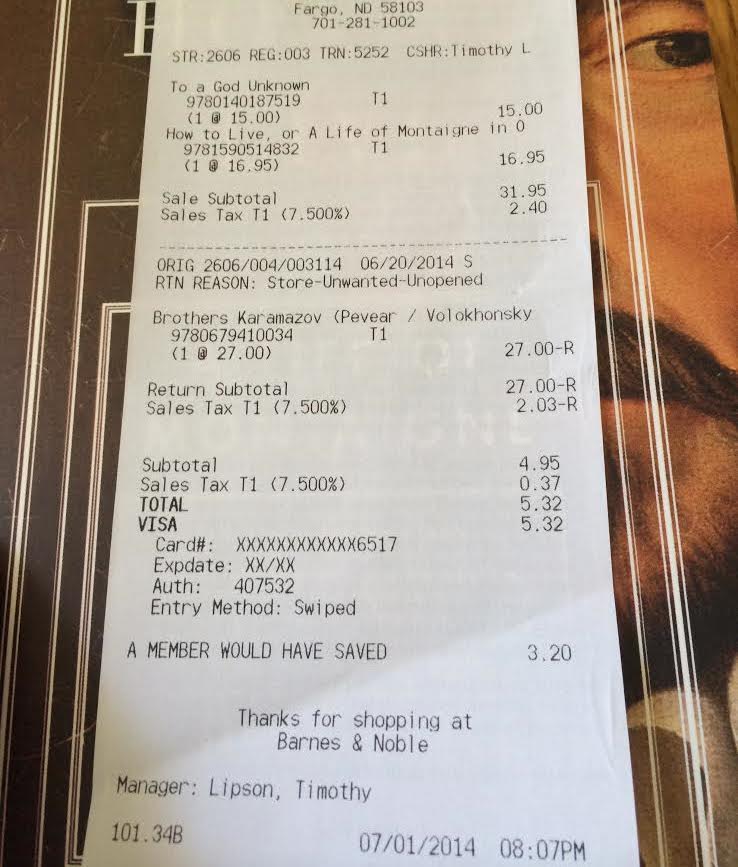
The following short email from a reader sent on Tuesday became the basis for our Book Club announcement today:
What are you picking for Book Club #3? I’m super antsy … and July is here. Tell! Tell us! Tell us all! Or just respond so I may quietly read while everyone else is blowing shit up over the weekend.
The reader followed up shortly after that post went live, sending the above photo (check the timestamp at the bottom of the receipt):
What the fuck. It’s as if I knew what you’d pick! I’m inside your brain!
Or, as Montaigne might note, maybe you guys are in mine.
Here’s my post on the book; if it appeals, join the club this month, and buy the book here. The Kindle price is just 9 bucks, about half what that reader paid for the dead-tree version. The public library link is here.
Here are the top five posts of the day in ascending order: Dissent of the Day (on Hobby Lobby); Perspective Please (ditto); KY Lubricates The Case (on the staggering success of marriage equality); An Archbishop Heightens The Contradictions (on the virulently anti-gay Archbishop Nienstadt now under investigation for sexual misconduct with adult men); and Rick Warren Wants You To Pay Him To Discriminate Against Gay People.
Many of today’s posts were updated with your emails – read them all here. You can always leave your unfiltered comments at our Facebook page and @sullydish. 15 more readers became subscribers today. You can join them here – and get access to all the readons and Deep Dish – for a little as $1.99 month.
See you in the morning.
How often can you say such a thing about a politician? I don’t mean declaring a commitment to end HIV; that plenty of politicians have done; I mean actually marshaling the means to do so, even if it might ruffle a few old feathers. This is fantastic news:
On Sunday, Gov. Andrew Cuomo announced an ambitious goal: Ending the AIDS epidemic in New York State by 2020… To that
end, he has embraced a new and controversial treatment for people at risk of contracting H.I.V.
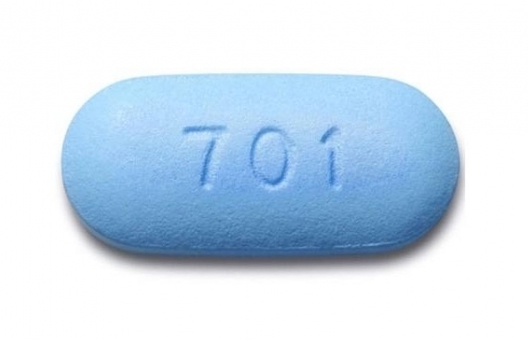
He wants to put more H.I.V.-negative people on Truvada, a drug originally developed to treat those who already have the virus, and which the F.D.A. approved in 2012 as protection against new infections.
Why fantastic? Because it’s precisely the political commitment that we need if we are to overcome the psychological baggage from the past and end HIV in the gay community in our lifetime. It truly is now a possible goal – if we combine aggressive treatment for viral suppression for the HIV-positive and block the virus’s inroads with Truvada for the HIV-negative. The Dish has made this case for a few years now – for the full argument, check out the archived thread here.
The NYT piece is also well-worth reading for a superb example of sharp reporting on this issue that would not make any gay person wince and yet make this debate accessible to all. That’s not easy – and maybe it has taken a new generation of gay journalists to bring it to a new level of sophistication and nuance. Congrats, Josh. And congrats, Cuomo. I sure can’t imagine a Clinton doing this, can you?
An independent oversight panel appointed by the White House has found that the NSA’s online data collection program is both legal and effective:
As the NSA’s troves of ostensibly foreign emails and Americans’ international communications come under heavy scrutiny, the Privacy and Civil Liberties Oversight Board dealt the NSA a victory on Tuesday night by calling the information reaped “valuable”. It pointedly rejected similar claims for the bulk collection of US call data in a January report. Under the so-called “702 program” – named after section 702 of the Fisa Amendments Act of 2008 – the NSA can harvest large amounts of ostensibly foreign digital information, including Americans’ international communications.
But the board did question the NSA’s intrusion into Americans’ data and recommended limits to the government’s ability to access large amounts of American communications data that the NSA inevitably collects and searches through without a warrant.
The Electronic Frontier Foundation is less than thrilled with the report:
The board skips over the essential privacy problem with the 702 “upstream” program: that the government has access to or is acquiring nearly all communications that travel over the Internet. The board focuses only on the government’s methods for searching and filtering out unwanted information. This ignores the fact that the government is collecting and searching through the content of millions of emails, social networking posts, and other Internet communications, steps that occur before the PCLOB analysis starts.
The foundation also slams the panel for not taking a firmer stand on whether government agencies need warrants to search Americans’ communications:
The Fourth Amendment requires a warrant for searching the content of communication. Under Section 702, the government searches through content without a warrant. Nevertheless, PCLOB’s analysis incorrectly assumes that no warrant is required. The report simply says that it “takes no position” on an exception to the warrant requirement when the government seeks foreign intelligence. The Supreme Court has never found this exception.
Although they have few qualms about the data collection itself, the Bloomberg editors favor a warrant requirement:
A lot of regulations cover the use of these data. But the NSA asserts that, once collected, it can be lawfully searched by its agents and others. The Central Intelligence Agency conducted about 1,900 queries of such information in 2013. The Federal Bureau of Investigation, alarmingly, says it doesn’t track how often it accesses the communications of Americans gathered under this program but “believes the number of queries is substantial.” In fact, the report says that the government has no idea how much data it collects on Americans, and it notes that the rules “potentially allow a great deal of private information about U.S. persons to be acquired.”
The board was split on exactly how to treat that information, an issue that gets pretty complicated. But the bottom line is this: If intelligence agencies are intentionally sifting through these data for the content of specific Americans’ communications, they should get a warrant — except in emergencies — just as the Constitution requires in all other cases.
This was the standard recommended by the president’s NSA review panel in December. And it’s the standard the House of Representatives voted to affirm last month. The Senate should do the same.
And Susan Crawford pivots from the report to make the case for stronger judicial oversight:
What’s needed now is better oversight by the FISA court. That means Congress needs to expand the court’s authority. The PCLOB report makes clear that the FISA court is being informed about the procedures that the surveillance authorities are following with respect to broad categories of foreign intelligence information. But that’s it. The court does not otherwise exercise any judicial review over the substance of these programs.
Surveillance will inevitably continue. An overly timid NSA would not serve domestic or foreign interests. But the court needs to double-check that federal agencies don’t overstep their legal limits on targeted surveillance. In this murky context, the FISA court remains at a distinct disadvantage when attempting to balance national security and privacy interests.

Adam Clark Estes explains:
The Camera in the Mirror is a project by Spanish artist Mario Santamaría that showcases moments when the indoor Google Street View camera accidentally catches itself in a mirror. The device itself appears to be a podium-sized metal case on wheels with a camera on top and a laptop on the side. In some of the photos, you can see a human operator. The images specifically come from Google’s Art Project, a pretty awesome three-year-old effort to create visual maps of museum interiors.
As the Highway Trust Fund approaches its fiscal cliff, the DOT is preparing to take drastic measures to ration funds for state infrastructure projects before the money runs out by the end of August. That is, unless Congress does something quick (ha!):
Any solution will need to pass the House of Representatives, whose own plan for funding DOT involves shuttering Saturday deliveries by the U.S. Postal Service—a plan that critics described as “unworkable” and “bad transportation policy.” The Congressional Budget Office estimates that DOT would require $8.1 billion to meet its obligations through Dec. 31. A spending solution that moved the deadline to the end of the year would push it past the November midterm elections, after which solutions like gas-tax increases might stand a chance. Senate Finance Committee Chairman Ron Wyden (D-Ore.) supports a $9 billion bill that would do exactly that: kick the ball down the road.
But the damage may be done already: Even if construction projects aren’t suspended in the middle of the summer construction season, states may be reluctant to launch big transportation infrastructure projects—especially since states depend overwhelmingly on federal funds for transportation spending. If the funding stream is shaky, the infrastructure planning will be, too.
Vinik looks over the options:
Congress is contemplating three proposals – none of them with broad support and all of them seriously flawed, for reasons I discussed last week. The White House proposal is not much better:
It’d use revenues from corporate tax reform as a short-term patch, which would mean we’ll be back in the same position four years from now. The optimal solution remains what it’s always been: Raising the gas tax by six cents in each of the next two years, then indexing it to inflation. By recouping the value lost to inflation and ensuring such erosion doesn’t happen in the future, this would make the Highway Trust Fund whole over the long-term.
It’s easy to see why the White House isn’t endorsing such a policy: It’s a political nightmare. Doing so would break the president’s promise not to increase middle class taxes. Beyond that, Republicans would never agree to it. Obama has spent enough of his presidency searching for a compromise by proposing politically risky policies. He’s not about to do it again with the gas tax. But that means it’s up to Congress to craft a sensible solution to this problem. So far, it’s not looking very good.
But Chris Edwards argues that excess spending is to blame for the shortfall, rather than a lack of tax revenue:
Tax-hike advocates say the gap is caused by insufficient gas tax revenues. It is true that the value of the federal gas tax rate has been eroded by inflation since it was last raised two decades ago. But the gas tax rate was more than quadrupled between 1982 and 1994 from 4 cents per gallon to 18.4 cents. So if you look at the whole period since 1982, gas tax revenues have risen at a robust annual average rate of 6.1 percent (see data here). In recent years, gas tax revenues have flat-lined. But the source of the HTF gap was highway and transit spending getting ahead of revenues, and then staying at elevated levels.
Previous Dish on the HTF here.
In a clip-laden essay, Oliver Farry surveys a history of cinema that turns the spotlight on itself:
Picture houses became a handy (some might say lazy) plot device for screenwriters, a place for characters to disappear into when pursued by police or the baddies. This was lampooned by Mel Brooks in Blazing Saddles where the villainous Hedley Lamarr ducks into an anachronistic cinema in the Old West and tries to get a student rate at the box office. …
Nostalgia for one’s youth forms much of the nostalgia for picture houses, which, in the movies is often elegiac.
This stands to reason – the cinema is a place for the young, for people with time and just enough money on their hands, for young lovers, student loners and groups of teenage friends. Peter Bogdanovich’s The Last Picture Show uses the closure of the local cinema in a small Texas town as a totem for the passing of an era, and of burnished youth. …
The ultimate cinema-nostalgia film is Giuseppe Tornatore’s Cinema Paradiso, in which a successful film director reminisces about his childhood helping projectionist Alfredo (Philippe Noiret) in the cinema in a Sicilian village. The film doesn’t stint on sentimentalism but it does have a pragmatic heart underneath it all. Alfredo encourages the boy, Toto, to leave the village to do something with his life, even obstructing a blossoming relationship with a local girl to do so. The cinema, palatial as it is for such a small town, exists only thanks to good fortune – after the initial one is burned down, costing Alfredo his eyesight, it is rebuilt thanks to the lottery winnings of a local, not exactly the wisest investment, it must be said. Toto’s future career is made possible by a film industry that stays alive, while the cinema, like many others in small towns, falls by the wayside.
John Vidal argues that “the outcome of the Iraq and Syrian conflicts may rest on who controls the region’s dwindling water supplies”:
“Rebel forces are targeting water installations to cut off supplies to the largely Shia south of
Iraq,” says Matthew Machowski, a Middle East security researcher at the UK houses of parliament and Queen Mary University of London. “It is already being used as an instrument of war by all sides. One could claim that controlling water resources in Iraq is even more important than controlling the oil refineries, especially in summer. Control of the water supply is fundamentally important. Cut it off and you create great sanitation and health crises,” he said[.]
Isis now controls the Samarra barrage west of Baghdad on the River Tigris and areas around the giant Mosul Dam, higher up on the same river. Because much of Kurdistan depends on the dam, it is strongly defended by Kurdish peshmerga forces and is unlikely to fall without a fierce fight, says Machowski. Last week Iraqi troops were rushed to defend the massive 8km-long Haditha Dam and its hydroelectrical works on the Euphrates to stop it falling into the hands of Isis forces. Were the dam to fall, say analysts, Isis would control much of Iraq’s electricity and the rebels might fatally tighten their grip on Baghdad.
Previous Dish on the water angle of the Iraq conflict here.
The pro-life movement is surging at the state level:
Monday’s Hobby Lobby decision is part of a deeper trend: even as Obamacare worked to expand access to contraceptives, decisions by both the courts and state governments have left American women with less access to reproductive health care than they did four years ago. Since 2010, states have moved aggressively to restrict access to abortion and taken new steps to defund family planning programs. Advocates on both sides of the issue describe the wave of changes as unprecedented.
States passed a record 205 abortion restrictions between 2011 and 2013, more than the entire 30 years prior. … In Texas, the number of abortion clinics has shrunk by half, from 40 to 20, since 2011. Arizona had 19 abortion providers in 2010; now it has seven. One clinic that shuttered posted a message on its website, directing clients go to the nearest abortion provider, in Houston, 100 miles away.
Many of those restrictions were squarely firing back at the Affordable Care Act. Twenty-five states, for example, now limit or ban abortion coverage in Obamacare’s new insurance markets. None of those laws existed before health reform.
 The Dish