Chinese Muslims of the Hui ethnic minority eat watermelon as they break fast during the holy fasting month of Ramadan at the historic Niujie Mosque in Beijing on July 3, 2014. The Hui Muslim community, which numbers more than an estimated 10 million throughout the country, is predominantly Chinese-speaking. Muslims around the world are marking Ramadan, where the devout fast from dawn until dusk, and is a time of fasting, prayer and charitable giving. By Kevin Frayer/Getty Images.
Month: July 2014
This Is A Refugee Crisis, Ctd
A reader testifies to the truth of that statement:
I am a leader in my Catholic parish’s decades-old sister parish relationship with a church in San Salvador. I have been visiting regularly since 2009. In these five years, the level of violence and insecurity has increased dramatically. Our parish supports their parish school and our families sponsor about 45 kids there. We measure this crisis in the impact on these kids, not on partisan hyperbole. Here are some of the concrete situations we’ve encountered:
• A teenager’s mom is killed in front of her, because the mom can’t pay extortion money to the gang. The teenager has dropped out of school because she needs to support the rest of her family.
• Half of the older boys in the program can no longer attend the weekend enrichment programs because they have to cross a newly shifting gang boundary due to a split in the local Calle 18 “chapter”. Before, they knew how to navigate between MS-13 and Calle 18. Now, who knows? They stay in their one-room shacks in sweltering heat as adolescence passes them by.
• Kids from Calle 18 are sent to a neighborhood controlled by MS-13 on a mission to beat up someone (doesn’t matter who really). They choose a beloved social worker who is one of the few responsible father figures in the neighborhood.
• A young nun gives presentations on human trafficking and the reality of immigration. She tells adolescents that there is a really high risk of rape. They tell her, “I’ve already been raped by (my father; the police; the gangs). What do I have to lose?” She tells them about dying of thirst in the desert. They tell her about death in their neighborhood because of lack of clean water.
The boys and girls on the border are children fleeing for their lives. They are not economic migrants.
Mental Health Break
More like Metal Health Break:
Toxic Butts, Ctd
A reader notes an unintended consequence of smoking bans:
It’s not hard to determine why there are more cigarette butts on the sidewalks than ever before. Thanks to the smoking bans in virtually all work places, restaurants and most bars, there are no more ashtrays available outside one’s home. So where else can that butt land? You certainly don’t want a smoldering cigarette butt in a garbage can. That’s a recipe for fire. And telling smokers, “Well, just don’t smoke until you get home” is simply unrealistic given the nature of nicotine addiction.
Update from a reader:
When I was in the Peace Corps my roommate smoked. One day we were standing outside and I noticed he finished a cigarette and wiggled the end of the filter between his fingers until the last bit of tobacco and rolling paper fell off. He then put the filter in his pocket. He did a lot of hiking and camping and didn’t like littering the place with stuff that would just sit there forever.
So there is one answer to your reader. Is it convenient? Probably not, but you know there are a lot of things that go along with this addiction. Compared to the inconvenience of lung cancer, emphysema, and heart disease, I don’t think storing the butts in your pocket until you can get to a trashcan is that much of a burden.
Another adds, “In the army we called this field stripping a cigarette.”
Good Luck Finding A Lesbian Bar In Portland
Alexis Clements ponders the decline of America’s “lesbian spaces”:
Two of the most stark examples are bars and feminist bookstores.
In the 1990s, there were literally 100 feminist bookstores in the U.S. Today there are 14. So in 20 years, they’ve almost disappeared. Then if you start to do any kind of research about lesbian bars, you see that they are also disappearing. Philly lost two of them. Chicago lost one. Portland doesn’t have one anymore. West Hollywood – one of the places many people consider to be one of the gayest areas in the United States – doesn’t have a lesbian bar anymore, and it had one of the oldest, the Palms. That’s gone now. …
A lot of people say, “Oh, well, there’s gay marriage now, so essentially queer people can assimilate into the larger culture; we don’t need places to go.” But for both political and romantic reasons, we still need to be able to spend time with people who we want to partner with or who we want to engage in political activities with. Those two things are in many ways core to a lot of lesbian and queer communities. Not every lesbian is a political activist, and not every political activist is queer, but the collision of politics and lesbian identity is longstanding and a very rich and important history.
Update from a reader:
I think that there are fewer lesbian bars because lesbians are much less at war, or at least high tension with straight men.
I’ve lived in Berkeley/Oakland since 1963, which has long been the lesbian’s lower profile mirror to San Francisco’s gay male community. In the ’70s through ’90s, the tough-ass-dyke-man-hater was a local fixture. At some point there was a shift, and the poster person for the lesbian community became much younger and less confrontive. Still tough, but not defined by anger towards males. This new model is also happy to show off her beauty, and less likely to buy into butch/femme sterotypes. I think that this generation doesn’t want to be beholden to a way that they are “supposed” to act.
Perhaps lesbian bars represent the “old” angry worldview. How does the saying go? “Living well is the best revenge”? From my bi-male standpoint, it looks like this generation’s largely having a great time of it, and in that sense is exacting their revenge quite well.
But I’d really like to hear from your lesbian readership. It’s a good question.
Where’s All The Plastic Going?
The ocean should be a lot more plasticky than it actually is:
For a decade or more, scientists have assumed our seas carry millions of tons of plastic, much of which should be floating in open water, forming vast midocean “gyres” – islands of man-made mess such as the Great Pacific Garbage Patch. But according to a new study, something more worrying is happening to 99 percent of the ocean’s plastic: it’s disappearing.
The study outlines the findings of scientists who trawled the waters around five large ocean gyres in 2010 and 2011. The data they obtained put them far short of the expected amount of plastic in the ocean — rather than millions of tons, the global load of ocean plastic was calculated at 40,000 tons at most.
So what happened?
Though it’s possible that sunlight is eroding it into nothingness, or that tiny pieces are washing back ashore, researchers are skeptical. What’s probably happening, scientists theorize, is that tiny fish are eating it. The most likely plastic-snackers are lanternfish and other small “mesopelagic” species, meaning those that live in the middle swath of the ocean, swimming to the surface at night to feed. These are far and away the most populous fishes in the sea. …
We don’t have a good sense of what swallowing plastic does to these fish, or even whether they’re able to excrete or throw up their plastic meals. That’s worrisome, since the toxic chemicals in plastic might permeate their tissue – bad for mesopelagic fish, but also potentially bad for humans. Pellets in the 0.5-5-millimeter range are also commonly found in the bellies of the predators who eat these smaller fish, according to the study. Those include tuna, mackerel and other sushi-menu faves.
For the larger chunks of plastic, drones could help:
[G]etting to the scale needed to map the world’s ocean garbage will require a gigantic remote-controlled swarm of nautical drones. Ultimately the idea is to deploy thousands of swarming, meter-long sailboats equipped with sensors and dragging nets behind them to scoop up the garbage.
Protei’s shape-shifting robotic hull is the project’s breakthrough technology, and the design is open source for anyone to use. The hull bends and curves like a snake in order to control the boat’s trajectory through the water. Touted as unsinkable, self-righting, and hurricane-ready, the drone uses wind power, and the latest prototype can tow a payload of under five pounds, the group claims. The vessel would use a custom plastic sensor to locate the trash; the sensor is able to measure “slices” of pollution at various depths.
Recent Dish on plasticky sedimentary rocks here.
(Photo: A bottlenose dolphin (Tursiops truncatus) swims in oil slick alongside a black plastic bag off the shore of Curacao, Netherlands Antilles. By Wild Horizons/UIG via Getty Images)
We The Profligate People
Libby Nelson considers the failings of personal finance education:
Just 17 states require personal finance courses for students, and only six test students on what they’ve learned. But those classes don’t seem to make much difference anyway: students who took a semester-long class in personal finance fared below average on the Jump$tart survey. There is no evidence that the classes actually made students worse at managing money, the group wrote in its report. But it certainly didn’t make them any better.
Academic research backs up that conclusion. A 2008 study from two Harvard Business School professors studied the relationship between education and saving and investing behavior. They found state-required financial literacy education had no effect on graduates’ saving behavior later in life. The money spent on financial literacy education, they concluded, produced little in return.
McArdle chides Americans for spending so much and saving so little:
[W]hat we have is people spending more than they have to on the big basics. The average car loan, for example, is more than $25,000, and for people with the worst credit ratings, it’s actually higher: almost $30,000. This is not because you have to spend $27,000 to get yourself from Point A to Point B. It’s because people are pouring a big fraction of their income into driving something “nice.”
By the same token, raising your kids in a modestly sized home is not physically impossible. But we’ve come to regard as deep deprivation anything less than one bathroom and one bedroom per person. Cash-strapped people mention giving up vacations as if doing so were as great a sacrifice as giving up food or heat.
Why Clinton Needs Female Challengers
Rebecca Traister makes a compelling case:
The last thing any woman in politics needs is the appearance of having won only because her would-be opponents gave her a pass. This perhaps goes double for Clinton, whose years in the spotlight have demonstrated again and again that she is at her most appealing when she is fighting and scrappy, and at her most loathed when she is self-assuredly coasting. Clinton and her party require arresting, attention-drawing competition. She needs to be duking it out, and not just with a bunch of white guys. How many people are salivating at the thought of a Martin O’Malley candidacy? 19? 20?
A predictable primary is a boring primary, and a boring primary leads to a disinterested Democratic Party—a major hindrance going into a general election.
Part of what hooked voters in the mesmerizing 2008 race was the thrum of newness, the frisson of history-making every time a woman and a black man stood on a debate stage together. And while we could reproduce that thrill in a variety of ways—there is, after all, a shameful abundance of racial, ethnic, religious, and gendered history to be made before presidential politics become remotely inclusive—one of the most realistic, ready-to-roll scenarios of 2016 is the one in which multiple women show up to debate each other.
But there’s more at stake here than the health of the party in one presidential election. Viewing women as adversaries—ideologically and also within their own parties—is an urgent next step in helping the nation adjust to the idea that female politicians are just like, you know, regular politicians. That means we have to swiftly abandon the processional model, in which one diligent woman takes her hard-earned turn, while the next waits patiently in the wings. …
When a single avatar stands in for womankind, womankind projects onto that avatar its own varied ideas and priorities and standards. Clinton suffered from this last time, metaphysically unable to satisfy a million divergent hopes. She couldn’t be progressive enough, authentic enough, strong enough, stoic enough, or well-dressed enough for everyone. That’s part of why it’s dangerous for one woman to mean so much to so many.
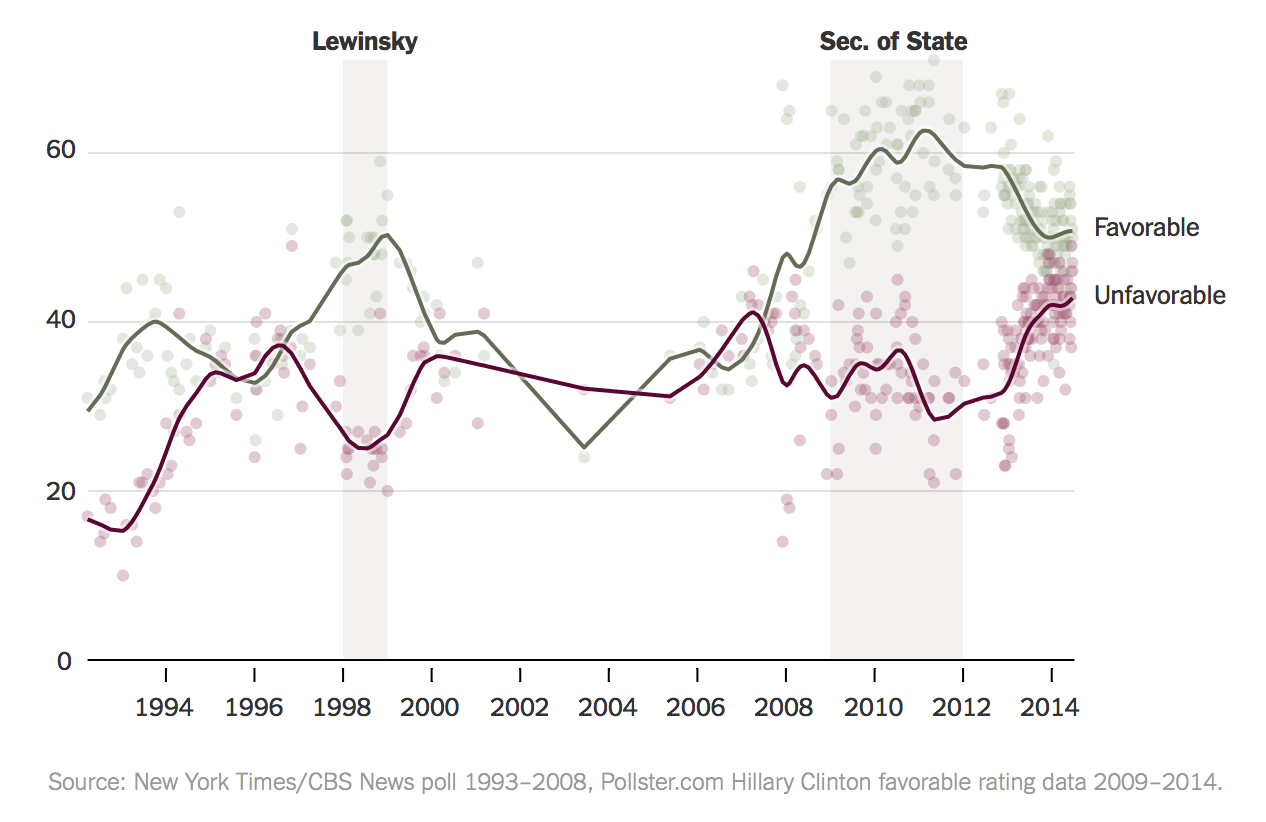
Meanwhile, Nyhan checks in on Clinton’s approval numbers:
[Her] artificially inflated poll numbers have made her seem like an especially strong presidential candidate, but the Clinton bubble is quickly coming to an end. …
[W]e tend to overrate the importance of candidate image, which is largely a function of the flow of partisan messages. When opposition elites withhold criticism during, say, a presidential honeymoon or a foreign policy crisis, politicians can seem unstoppable, but when normal politics resume, their images — and their poll numbers — quickly return to earth. The same will be true for Ms. Clinton.
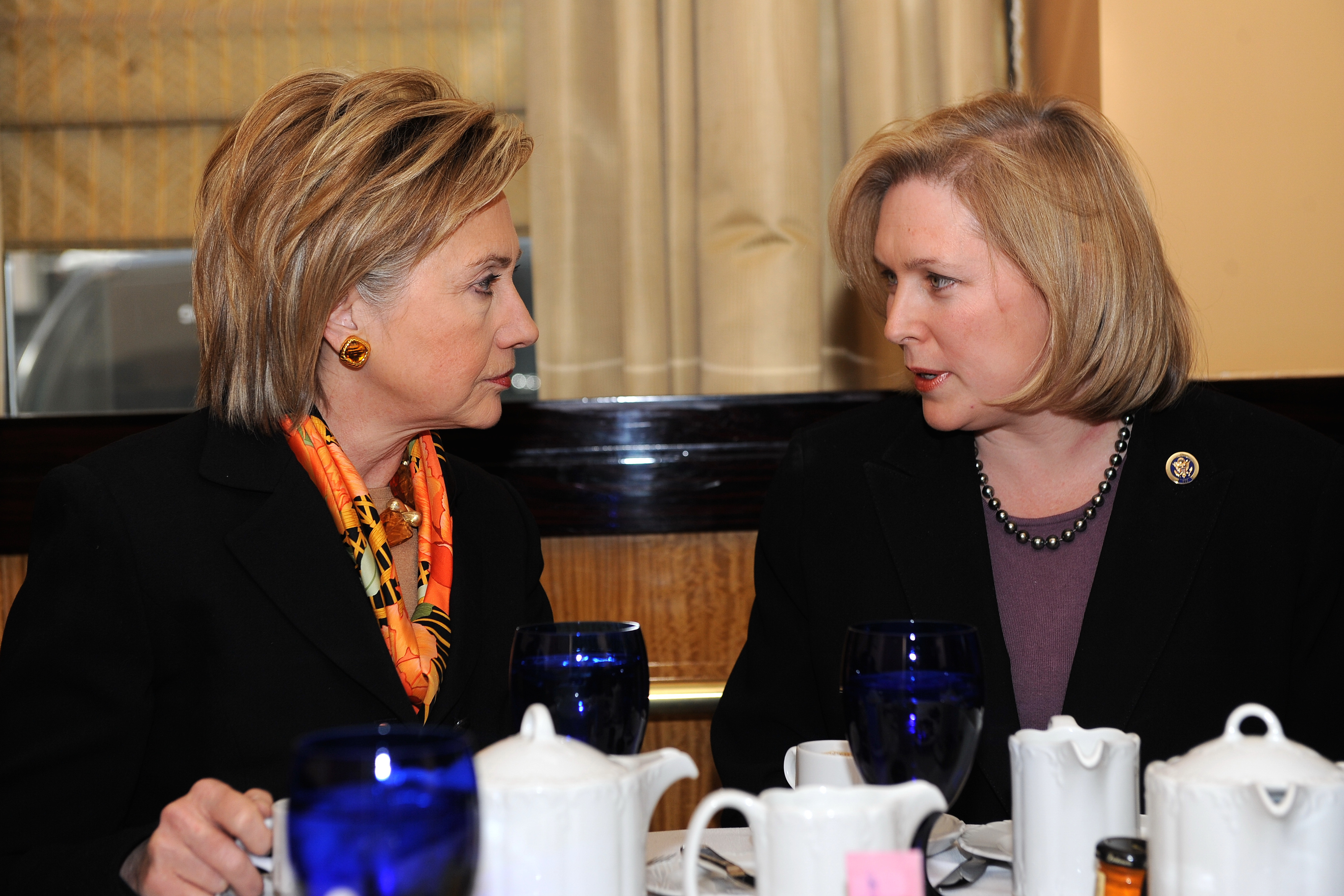
(Photo: Secretary of State Hillary Clinton has lunch with her replacement in the Senate, Kirsten Gillibrand, at Oscars Restaurant in New York City on January 25, 2009. By Enid Alvarez/NY Daily News Archive via Getty Images)
The Latest, Pathetic Pandering By Rand Paul
In the wake of Israel’s vengeful and disproportionate response to the murders of the three teenagers, Paul took the opportunity to burnish his neocon cred with an op-ed at NRO defending Israel’s actions and calling for a cutoff of aid to the Palestinian Authority. It’s a miserable, asinine piece of boilerplate designed, quite patently, to pander to the Adelson crowd. (The commenters, by the way, suggest that there is actually a robust debate on this among conservatives that is never allowed to be aired at NRO or the Weekly Standard.) Chait gets to the point:
“Israel has shown remarkable restraint,” Paul argues. “It possesses a military with clear superiority over that of its Palestinian neighbors, yet it does not respond to threat after threat, provocation after provocation, with the type of force that would decisively end their conflict.” What kind of force would “decisively end their conflict”? Killing every single Palestinian man, woman, and child?
His op-ed proceeds to demand the cutoff of aid — which is opposed by AIPAC, for the obvious reason that it would create even more dysfunction and empower terrorists. Paul’s bill does boast the support of the extreme right-wing group Zionist Organization of America. Paul’s gambit here is obviously to win over Republican hawks justifiably concerned he shares his father’s kook foreign-policy ideology. His remedy is to embrace a different kind of kookery.
And what happened to his previous call for ending foreign aid to Israel as well? Poof! Kilgore blasts Paul’s naked opportunism:
Paul, of course, has been engaged in a intensive process of overcoming his and his father’s reputation as “anti-Israeli” for favoring a cutoff of U.S. aid to Israel. So there is probably no act Israel could commit that won’t be aggressively praised by the peace-loving senator (in an impressive display of hypocrisy, he’s calling his bill for a termination of U.S. aid to the PA the “Stand With Israel Act.”) But blasting the administration for exercising actual diplomatic care over an explosive situation crosses the line from opportunism to cynical demagoguery.
Larison is disappointed that Paul’s willingness to buck GOP hawks on issues like Iraq doesn’t seem to extend to Israel:
On most things related to Israel, Sen. Paul is always too defensive, too eager to say what he thinks most Republicans want to hear, and too worried about being judged wanting in his support for the client state. Like his unnecessary security guarantee to Israel last year, this latest push to cut off funds to the Palestinian Authority is a doomed bid to beat hard-liners at their own game.
The larger problem with this is that it helps to perpetuate an undesirable status quo in U.S.-Israel relations. At present, Israel can act in whatever way it wishes without having to fear the loss of any U.S. aid or diplomatic support, and the U.S. then naturally takes some of the blame for the behavior of its client. That enables Israel to behave in harmful and ultimately self-destructive ways, and that undermines U.S. interests in the process. This is the phenomenon that Barry Posen refers to in Restraint as “reckless driving,” which the U.S. encourages by providing uncritical and effectively unconditional support to some of its allies and clients. Sen. Paul should be trying to discourage this recklessness and reduce the U.S. role in enabling it, but at the moment he is doing just the opposite.
It might even confirm to some that, in fact, there is an effective litmus test on both the GOP and Democratic primaries that demands that all potential presidents adhere to this ruinous policy for both Israel and America – or be tainted mercilessly as anti-Semitic. I want to support Paul in many ways. But this is a sign that he has no spine at all. He’s a sad, pathetic panderer on this – and libertarians and non-interventionists need to see that writing very clearly on the wall.
Lowest Unemployment Since The Market Crashed
BOOM http://t.co/rZaLqz6brv pic.twitter.com/6mZsKV1JOe
— Joseph Weisenthal (@TheStalwart) July 3, 2014
And it’s also lower than it was when Ronald Reagan won re-election on a “Morning In America” theme. But it’s a recovery from a far deeper recession, and one clearly inherited by Obama and not created by him. Vinik evaluates the new report:
For the past few years, it was like clockwork: A disappointing summer of job growth would give way to a much stronger winter. Economists would hesitantly forecast that the economy was about to kick into second gear. Then the summer would come and the disappointing data would return.
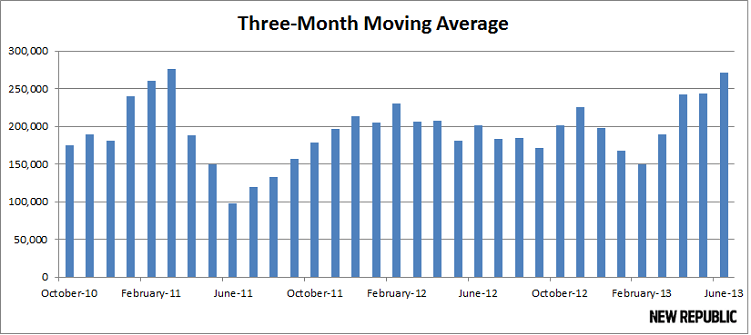
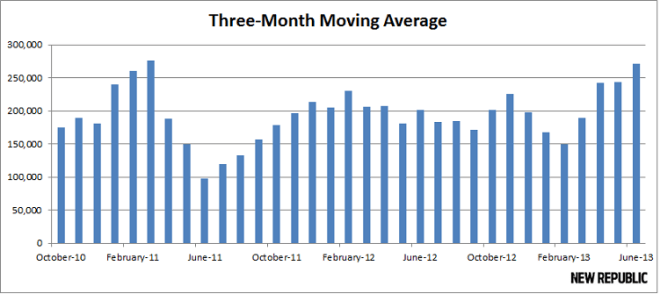
But finally, it looks like we are ready to break that trend: The economy added 288,000 jobs in June, soundly beating economists’ expectations of 211,000, and the unemployment rate fell to 6.1 percent. You can see this pattern of strong winter and weak summer—and the possible breaking of it—in the three-month moving average of job numbers:
That five-month streak “is the longest since the late 1990s and provides convincing evidence that the recovery has rebounded after unexpectedly shrinking during this year’s harsh winter.” Ylan Mui continues:
Perhaps most important, Gallup found that 45 percent of Americans were working full-time in June, one of the highest rates since the polling company began tracking the figure in four years ago. The government data released Thursday showed the size of the country’s workforce holding steady, albeit at a low level. Still, there is hope that the surprising slide in the size of the labor force may be ebbing, if not starting to turn around. “While few might agree that the economy has fully recovered from the Great Recession, there is no doubt that the job market is much stronger now than in prior years,” Gallup said in its report.
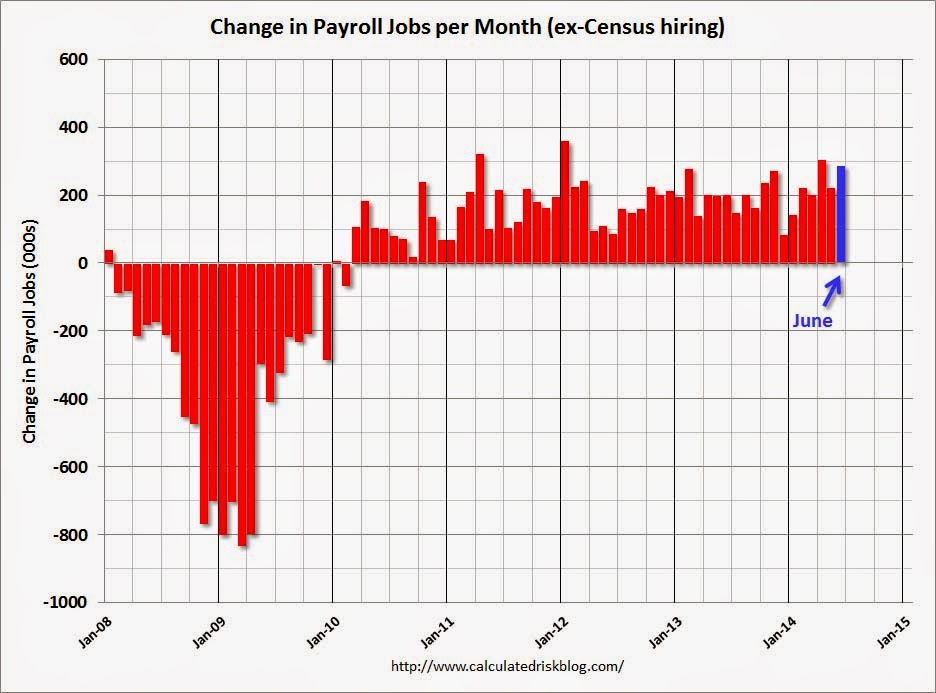
And never forget this chart:
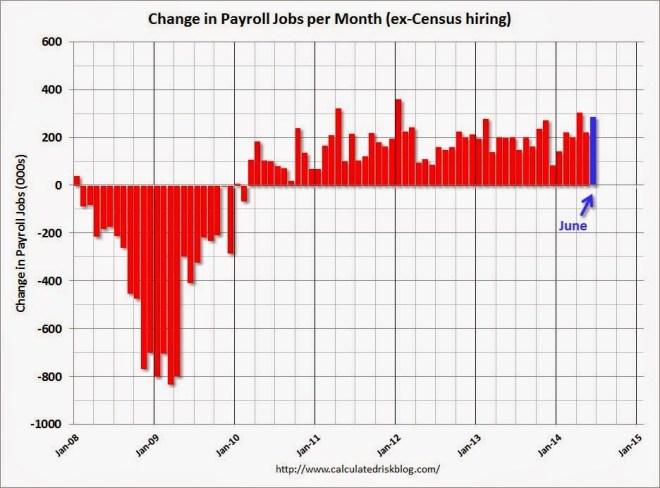
Not bad for the worst president since World War II.
Meanwhile, Danielle Kurtzleben declares that today “is the total solar eclipse of jobs days”:
— a rare day when both initial jobless claims and the monthly unemployment report come out simultaneously.
At the same time the government reported the economy added a strong 288,000 jobs in June, it also reported that the number of Americans who filed initial claims for unemployment insurance was at 315,000 for the week ending June 28.
That figure held relatively steady from the week before, when initial claims totaled 313,000. And though weekly initial claims data can be volatile, the smoother 4-week moving average also only shifted up by 500, to 315,000. That smoother moving average makes it easier to see trends than the raw numbers, and it shows improvement even in the first half of 2014. Since then, it has declined from nearly 350,000.
This level of claims is right around where claims were before the financial crisis hit. It is also a vast improvement over the middle of the recession, when claims were more than double where they are now.
Yglesias’ two cents:
One important data point from today’s release — “wages rose 2 percent over the past year.”
This is a bit of an ambiguous indicator. The number is high enough that people who’ve been itching for interest rate hikes can certainly point to it as a sign that economic slack is gone and it’s time to shift to tighter money. On the other hand, 2 percent year-on-year growth is hardly mind-blowing prosperity. It’s not even a hint of catchup from the years-long span of massive slack and no wage growth. Giving workers a chance at seeing some real gains requires the Fed to not have an itchy trigger finger on those rate hikes.
He also points to this encouraging tweet:
Labor force up by 81K. Unemployed down by 325K. –> That’s how you want the unemployment rate to drop.
— Michael R. Strain (@MichaelRStrain) July 3, 2014
But this, from economist Justin Wolfers, could be the tweet of the day:
There is simply no bad news in this jobs report. Go on, dig into the detail, and see if you can find it. I dare you.
— Justin Wolfers (@JustinWolfers) July 3, 2014
Jordan Weissman tries his best:
I think there’s some reason for optimism, especially given the fact that employers kept hiring while the economy retracted during the winter. Companies may finally feel good enough about the future to keep adding to their payrolls. On the other hand, as Neil Irwin points out at the Times, we’ve been here before. Below, I’ve graphed out a three-month rolling average of U.S. job creation. The labor market is almost back to the pace it hit in January 2012, after which employment growth took a nosedive.
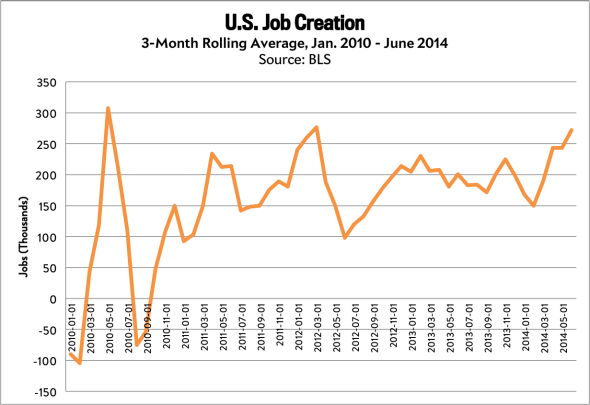
It’s also possible, Irwin points out, that schools juiced this month’s numbers a bit by staying open later into the summer to make up for days lost because of the miserable winter weather. And as Wolfers notes, there’s always a margin of error of +/- 90,000 jobs on each of these reports. For now, we have some good news—but it’s too early to tell if we’re reaching a new new normal.
And Casselman notes that “as always, there are caveats” to any good report:
June’s employment gains were mostly in part-time jobs, and the number of people working part time because they couldn’t find full-time work rose by 275,000. Much of the job growth was concentrated in low-paying sectors, such as restaurants and retail, while hiring in the better-paying construction sector continued to lag. The number of people out of work six months or more fell to a five-year low, but, at least as of May, not because the long-term unemployed were actually finding jobs.
Patrick Brennan anticipates some grousing from the right:
Skeptics — see that incorrigible pessimist Arthur Brooks — will always question why exactly we’re celebrating the labor-force-participation rate merely staying steady, at the lowest rate since the 1970s, and jobs growth at a rate at which it will take years to return to employment levels, as a share of the population, that we saw before the recession.
Two points: It’s all relative, and it is notable that we are seeing stronger growth now than we have seen in years. Second, the labor-force-participation rate isn’t just being pushed down by a bad economy — it’s in a secular demographic decline. I’d like it to rise, and to be higher than it is, but in a certain sense, it’s not ridiculous to celebrate its holding steady as a victory.