Question Of The Day

A reader asks:

What are you picking for Book Club #3?  I’m super antsy … and July is here. Tell! Tell us! Tell us all! Or just respond so I may quietly read while everyone else is blowing shit up over the weekend.

Heh. Well, yes, it is July, and a major political book did not seem like the best way for me to read on the beach this summer. So I picked a book I’ve long wanted to read but never got around to – about an author who remains among my favorite non-fiction masters of all time and blogger avant la lettre: Montaigne.

The book is How to Live: Or A Life of Montaigne in One Question and Twenty Attempts at an Answer, by Sarah Bakewell.

It’s an innovative approach to biography – it’s really a series of meditations, based on Montaigne’s life and work, on some of life’s big questions. The “answers” to How To Live? come in many Montaigne-inspired recommendations: Survive Love and Loss; Question Everything; Live Temperately; Do A Good Job, But Not Too Good A Job; Give Up Control; among many others. It has an Amazon rating of 4.4 out of 5, and won the 2010 National Book Critics Circle Award for biography.

Some reviews:

“Ms. Bakewell’s new book, How to Live, is a biography, but in the form of a delightful conversation across the centuries.” —The New York Times
513f2INPtgL
“So artful is Bakewell’s account of [Montaigne] that even skeptical readers may well come to share her admiration.” —New York Times Book Review

“Extraordinary…a miracle of complex, revelatory organization, for as Bakewell moves along she provides a brilliant demonstration of the alchemy of historical viewpoint.” —Boston Globe

“Well, How to Live is a superb book, original, engaging, thorough, ambitious, and wise.” —Nick Hornby, in the November/December 2010 issue of The Believer

“In How to Live, an affectionate introduction to the author, Bakewell argues that, far from being a dusty old philosopher, Montaigne has never been more relevant—a 16th-century blogger, as she would have it—and so must be read, quite simply, ‘in order to live’…Bakewell is a wry and intelligent guide.” —The Daily Beast

I also have an ulterior motive. For me, Montaigne’s essays – first read in college – have long been a source of enthusiasm and inspiration. His constant curiosity, his openness to new ideas, his willingness to change his mind, his capacity for growth and humor, his staggering honesty, his wit and humaneness: all helped create and nurture the emergence of the modern individual in the West. Along with Shakespeare, he saw humanity in his day in its entirety, and, like Shakespeare, was somehow able to regard it with the perspective of the ages. As literature, he also pioneered the essay as a form, and the personal voice in writing in ways not seen since Augustine. If there were one powerful influence behind my approach to blogging, it would be Montaigne.

bookclub-beagle-trSo dig in – and perhaps be inspired to go to the source material as well, as long as you get Donald Frame’s still-peerless translation. Sarah has agreed to join us in a few weeks to carry on the conversation. So let’s use this book to think about that simple question: how to live? It’s an area so ripe for reader anecdotes and stories and personal journeys that it seemed perfect for a summer discussion. Buy it here – and help give the Dish some affiliate income, and get yourself a deck-chair or a hammock.

And Happy Fourth!

Health Control

Zoe Fenson emphasizes that for many women, including herself, using birth control isn’t even about contraception:

On a regular basis, I encounter women with [Polycystic Ovary Syndrome] who rely on oral contraceptives to keep their reproductive organs in check. And even beyond our experience, there are a host of medical issues, tangentially or completely unrelated to reproduction, for which birth control serves serious medical uses. I’ve known women who take birth control to limit pain from endometriosis, to stave off migraines, to address skin-scarring cases of acne.

These issues almost never come up in discussions about access to birth control, because the conversation is so dominated by sex, and by extension, pregnancy.

Even when it does come up, the debate immediately gets redirected back. Witness Sandra Fluke’s passionate defense of contraceptives on behalf of her friend, who lost an ovary to PCOS. The loudest shouters in the public discourse immediately turned the conversation to her own sexual proclivities, accused her of agitating for consequence-free sex, and the point was completely lost. I watched that spectacle play out, raged over it, and cried quietly when my rage was spent.

Caitlin Dickson adds:

One of the birth control pills’ greatest benefits to users is a reduced risk of ovarian and endometrial cancer. Studies have found that the protective effects of oral contraception against both types of cancers increase the longer a woman takes the pill and lasts for years after she stops using it.

A reader joins the conversation:

IUDs are not just birth control devices.  They are used to prevent heavy hemorrhaging due to fibroids (growths in the uterus) in perimenopausal women.  Absent these devices, the women would have to undergo hysterectomies.

This is not just about sex.  It is about an employer making decisions, based on their religious beliefs, about the health of their employees.

Crime And Collective Punishment

The three Israeli teenagers who went missing last month were found dead on Monday, leading Israel to step up its harsh crackdown on Hamas:

In the past two weeks, Israel has launched a massive security operation in the West Bank that has led to the rounding up of over 400 Palestinians suspected of being Hamas operatives. The house-to-house searches and mass arrests brought Palestinian youth out into the streets. At least five Palestinians have died after being fatally shot by Israeli soldiers in the resulting crackdown, including 15-year-old teenager Mohammed Dudeen. … At least three Palestinians in the isolated coastal strip have died as a result [of airstrikes].

The latest volley of violence:

Palestinian rockets hit two homes in Sderot but caused no injuries. Ten people were injured by the Israeli strikes. According to The New York Times, the Israeli military said they had launched airstrikes in response to earlier rocket fire, specifically targeted training sites associated with the militant group Hamas, which controls Gaza. Israel also positioned troops along the Gaza border in what it described as a defensive measure.

Here are some young racist Israelis using the occasion to march through the streets yelling “Death to Arabs!”;

Their brazenness may well have been stirred by Netanyahu’s use of the word “revenge” to describe the Jewish state’s response to the horrifying murder of three Israeli teens. MJ Rosenberg is aghast:

Prime Minister Netanyahu’s response was perhaps the most repulsive response to an event like this that I have ever seen by any national leader of a civilized country. He vows “revenge.” Revenge? Not Even George W. Bush used that term after 9/11, pledging instead to bring the people who committed the crime to justice. FDR after Pearl Harbor? The parents after Newtown?

It’s at moment like this that you realize how tenuous Israel’s commitment to Western values have become of late. Here, for example, is a tweet showing bright young things in favor of ethnic cleansing of Arabs, the obvious end-point for Greater Israel:

Many are worried about a Third Intifada in response to all this. Beauchamp:

The million-dollar question is whether this escalates militarily, especially given that the two sides were already at a tense point. Before the [Gaza] bombing, 16 rockets had been fired into Israel out of the Gaza Strip. Israel alleges that they were the first Hamas-fired rockets since 2012. Other more recent rocket fire had been from smaller groups, which Hamas arguably attempted to repress in order to avoid risking Israeli retaliation. “Either Hamas stops it,” Netanyahu said, “or we will stop it.”

Max Fisher points out:

Collective punishment is designated as a war crime by the Geneva Conventions, which regulate warfare under international law.

It’s also deeply harmful to the Israel-Palestine peace process, polarizing Palestinian political groups and civilians against Israel. It also polarizes Israelis against Palestinians. Israeli government rhetoric and actions implicitly blaming wide swathes of Palestinians for the kidnapping have coincided with incidents of Israeli mob violence against Palestinians, including what appears to be the abduction and murder of an Arab teenager. …

In any case, the Hamas political leaders based in Gaza seem unlikely to have participated in a kidnapping in the West Bank committed by rogue Hamas militants, so it’s not clear that air strikes on Hamas political leaders in Gaza are an appropriate or justified response.

And as Eli Lake observes, Saleh al-Arouri, the Hamas commander believed by Israel to be the mastermind behind the recent wave of kidnappings in the West Bank, is not even in the country:

Senior Israeli officials confirmed for The Daily Beast that al-Arouri is the Hamas leader who has encouraged, funded and coordinated a campaign to ramp up kidnappings in the West Bank and that al-Arouri now resides in Turkey. …  [I]t could further complicate relations between Ankara and Jerusalem, two former allies that have tried recently to repair a broken relationship.

Meanwhile, Amjad Iraqi laments the “selective sympathy” on both sides when it comes to the deaths of Israeli and Palestinian children:

The apathy toward the “other child’s” suffering is painful to watch, including in this latest saga. In the two to three weeks following the abduction of the three Israeli boys, at least eight Palestinians were killed during Israel’s military responses in both Gaza and the West Bank. Among them were 10-year-old Ali al-Awour, 15-year-old Mohammad Dudeen and 22-year-old Mustafa Hosni Aslan. Ali died of wounds from an Israeli missile strike in northern Gaza; Mohammad was killed by a single live bullet in the village of Dura; Mustafa was killed by live bullets in Qalandiya refugee camp during clashes with an Israeli military raid.

I write the names of those three Palestinian boys not to belittle the horrific deaths of the three Israeli boys. I write their names because, while everyone will remember Gilad, Naftali and Eyal, no one will remember Ali, Mohammad or Mustafa.

And Susan Abulhawa decries the West’s double standard:

Palestinian children are assaulted or murdered every day and barely do their lives register in western press. While Palestinian mothers are frequently blamed when Israel kills their children, accused of sending them to die or neglecting to keep them at home away from Israeli snipers, no one questions Rachel Frankel, the mother of one of the murdered settlers. She is not asked to comment on the fact that one of the missing settlers is a soldier who likely participated in the oppression of his Palestinian neighbors. No one asks why she would move her family from the United States to live in a segregated, supremacist colony established on land confiscated from the native non-Jewish owners. Certainly no one dares accuse her of therefore putting her children in harms way.

Dissent Of The Day

A reader writes:

You continue to double down on Hobby Lobby – that it is a case of limited scope that has little bearing beyond itself; that this contraception exemption is a statutory one, and not a Constitutional issue; that liberals are seriously over-reacting. Where are the liberals’ liberal values, you ask, in regards to accommodating religious rights with respect to (the new) majoritarian rule.

I sincerely respect every person’s religious rights – every PERSON’s religious rights. Think Supreme Court Rules In Favor Of Hobby Lobby In ACA Contraception Caseabout your own personal relationship with God and what that means to you. Can you honestly then state that a corporation can have sincerely-held religious beliefs? Can it go to church or receive the sacraments? Can it be a conscientious objector? Does it have a soul? Of course not. The Court already decided in Citizens United that a corporation can have free speech rights. Now it can have religious rights. What other rights that formerly inhered only in individuals can a corporation possess? Maybe the right to keep and bear arms?
You say, “A few organizations and closely-held companies want to be exempted for religious reasons.” First, you don’t know yet that it’s just a few, now that the gates are open. Secondly, as you already know, 85–90% of corporations fit the “closely-held” description, and they don’t necessarily employ just a few workers. (Hobby Lobby has 561 stores and 23,000 employees as of 2012.) I’m sorry, but once you stipulate that that many corporations can have religious rights, that is a constitutional question. And that’s how this SCOTUS works – by building on its own wrong-headed precedent. Two decisions that confer personhood on a legal entity make the third decision a lot easier.

And if this is a narrow decision by the Court, how is it that it may already be having adverse effects? Just one day later, we find out that the decision really does include all ACA-covered contraceptives, not just the four that Hobby Lobby doesn’t “believe” in. And the next day, this: The President’s pending executive order concerning LGBT discrimination and federal contractors is coming under closer scrutiny from faith leaders. How long might it be before some of these companies will want to opt out of non-discrimination against gay people because of their sincerely-held religious beliefs.

I’m grateful for this eloquent dissent – and many others. The conversation we’ve had has changed my mind on a few things, and clarified it on a few others. So here are some thoughts in response, after mulling this over some more.

The first is on the question of religious freedom. And I agree with my reader on the core point. I do not believe that even a closely held religiously informed for-profit corporation has a soul. In fact, the desire for profit is a very strange thing for a religious organization to be involved in at all. Whatever the heretical claims of the Prosperity Gospel, there is no serious Christian defense of making money as your primary purpose – and a for-profit company is, by definition, primarily about making money. I think that automatically excludes it from the religious principle. You pick either God or Mammon. Ayn Rand, for the umpteenth time, is an enemy of Christianity, not an ally.

My own view of a religious organization is one primarily devoted to religious ritual and service. Some non-profit charities would be included, but no for-profit companies would. In other words, just to be clear, I would have voted for the minority if I were a Supreme Court Justice on those grounds alone. Norm Ornstein has a great post on this principle and I share almost all his conclusions.

Equally, I think it’s fair to say that the sincerity of the religious motives behind Hobby Lobby is a little dodgy. They provided – voluntarily – the very allegedly abortifacient contraceptives in their own health insurance coverage before the ACA came into effect. How does that square with their claim to be stricken by their conscience on the question now that Obamacare is mandating it? Hobby Lobby also has investments in companies that make contraceptives. Again, their squeamishness now reeks of opportunistic politics, not sincerely held religious conviction.

I’m also struck, as I wrote yesterday, about the very Catholic-centric view of religion this ruling implies.

One wonders, as Ginsburg wrote in her dissent, if the Justices would apply these sentiments to non-Christian religions. I noted the burqa ban in France as a distant analogy, but Steve Coll goes one further and imagines a fanatical Muslim corporation asking for the equivalent rights, as in, say, exemptions from vaccines. And here is where Alito is at his weakest. His only proactive response to this is to assume that there will not be “a flood of religious objections regarding a wide variety of medical procedures and drugs, such as vaccinations and blood transfusions.” As Coll, rather drily observes: “Why not?” The religious convictions of many Muslims go far deeper than most evangelical Protestants and devout Catholics.

But here’s where I stick with my point about perspective. In the last few years, America has crossed the Rubicon of universal health insurance. In that new law, contraception coverage was, for the first time, mandated for anyone with health insurance. That strikes me as a huge gain – not just for those women who could not afford insurance before but for those women with insurance, where contraceptive coverage could be at the whim of employers. And when government mandates something, it will get always get some petitions for exemptions. We’ll see in due course – and the Dish will keep close tabs on – how big a loophole it turns out to be. But if the administration can deploy the fix used for religious organizations proper – getting insurance companies to provide the contraception and then get re-imbursed by the government (see here for the difficulties involved), then we could easily have a win-win. Everyone gets guaranteed contraception coverage and a few religious closely-held corporations can keep their hands “clean”.

And let me suggest something else about toleration of these religiously-based companies. It will hurt them in the long run. What Hobby Lobby has now announced to the world is that women who use contraception shouldn’t work there if they don’t want to live in a hostile environment, and no one should buy goods there if they object to their policy targeting women’s healthcare – and women’s alone – for discrimination. A company that behaves this way is a company that will lose customers and potential employees. The positive way to respond to this is to stop shopping there and to seek employment elsewhere. You can even boycott if you wish. Since the vast majority of women, including overwhelming majorities of Catholic women, don’t agree with the ludicrous case against contraception, it seems to me that this kind of policy will not be in the interests of any company trying to make a profit. That’s how a free society works.

One final thing: Can I respond to the emailers who say the only reason I am not too alarmed by the Hobby Lobby ruling is because I’m a man, and not a woman? I sure hope that isn’t the case. I’ve long been a libertarian type of conservative, and have long had much higher tolerance for people doing bad things in a free society than some others. So to take the very personal question of homosexuality, I have defended the right of the Boy Scouts to discriminate against gays, I have defended the right of the Saint Patrick’s Day Parade to exclude gays, I oppose hate crime laws protecting gays, and I have even theoretically opposed anti-discrimination laws in employment for gay people (and plenty others). This does not mean that I approve of any of those things – I despise them all, in fact. But in a free society, religious fanatics and bigots have rights as well. I would not have given Hobby Lobby what SCOTUS just did, but I sympathize with the principle involved, and prefer a limited government in a free society over a powerful government in a more just one. And a free society must mean religious freedom sometimes in contravention of established norms. That’s what freedom requires. And we are a stronger country for it.

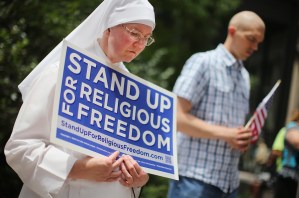
(Photo by Scott Olson/Getty Images)

Sponsored Content Watch

Screen Shot 2014-07-03 at 1.38.03 AM

A reader writes:

I noticed today that “partner” has invaded the Cheat Sheet at the Daily Beast. When youScreen Shot 2014-07-03 at 1.41.33 AM moved from the Atlantic to DB, I loved the Cheat Sheet as a quick-glance headline source for important news before I delved into more long reads and blogs. Today, they have the #8 spot as an ad for the National Geographic channel special on the 1990s, in addition to all the banner and sidebar ads for the same. It’s bastardizing something unique about their website and a remarkably stupid idea. Why would people who are wanting to read the headlines very quickly, waste their time with labeled “partner” ? We just keep scrolling. They keep missing the point.

Thank you for not seeking to monetize your ideas in such a crass way. I’m a proud subscriber to the Dish and hope that you can remain independent of advertising.

My favorite part of their disclosure? “This content was not necessarily written or created by the Daily Beast editorial team.” It reminds me of one surreal discussion I once had with the Beast’s ad department. I wondered why they couldn’t find an advertiser for the View From Your Window. After a bit, they came back and wondered if we could change the feature to “The View From Your Hotel Window”. There might be a sponsor for that.

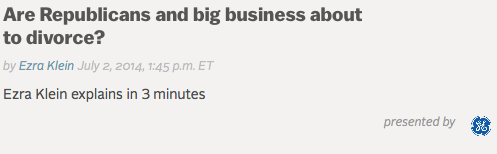
Speaking of which, how about this for irony:

Screen Shot 2014-07-03 at 10.00.44 AM

Why not just leave out the middle man and ask GE themselves?

The Workaround That’s Not Working Yet

Well this complicates things:

The Supreme Court ruled against imposing the contraceptive mandate on for profit religious companies in part because there’s a less religiously “burdensome” alternative in place for non-profits: the insurer foot the bill and the government reimburses them. The justices suggested that President Obama should just make that accommodation available to the Hobby Lobbys of the world. Unfortunately, that accommodation only works smoothly on paper.

According to Bloomberg‘s Alex Wayne, under the current system the administrator of a religious non-profit’s health plan pays for objectionable forms of birth controls, and the government reimburses them. The third-party administrators say the government doesn’t have a way to pay them back yet.

The Worst Polling Question Since WWII

Jesse Singal doesn’t take seriously the new Quinnipiac poll that’s burning up the blogosphere:

Not surprisingly, a new poll suggesting that Americans think Obama is the worst president since World War II is getting a fair amount of attention, particularly among gleeful conservatives. Thirty-three percent of the respondents, who were offered a list of the 12 U.S. presidents since the war, picked Obama. George W. Bush wasn’t far behind, at 28 percent.

Jonathan Bernstein is blunt:

[T]he questions about who are the best and worst post-WWII presidents are useless. What they mainly show is that Republicans are far more unified around a single story than are Democrats.

Aaron Blake sees a pattern:

As our own Philip Bump noted, the last time Quinnipiac asked the same question, in 2006, the American people also chose the current president, then George W. Bush. Going back even further, this question has proven similarly unkind to those who have made the poor decision to be president too close to when the poll was conducted.

[Here] are similar polls from Gallup in 1999 and 2000. Guess who just happened to place second? The guy who was in the White House! Bill Clinton even got more votes than Jimmy Carter, who to this day is basically the guy Republicans point to when they want to reference a bad Democratic president.

Weigel weighs in:

Once you process the old results, this poll looks like most polls in 2014—the president has lost independents, and voters have stopped hating George W. Bush so much. (He paints so well!) If you look at the crosstabs, the percentage of people calling Obama “honest and trustworthy” has actually stabalized and risen since 2013; the percentage calling him a strong leader, also stable.

If you ask me, the truly humiliating number for Democrats comes later, when by a 45–38 margin voters say “the nation would be better off” had Mitt Romney won the presidency. Someone at the White House is reading that, then stewing about how it was just a month ago that the job market returned to its 2008 peak, then bouncing a tennis ball against the way with with increasing force and fury.

Arit John, for his part, points to “the actual worst thing in the poll for Obama”:

“American voters say 54 – 44 percent that the Obama Administration is not competent running the government.” Politico’s Mike Allen agreed, flagging that number as of most concern to the White House this morning. This is the second recent poll to give the president or his administration a bad rating on a “competency” question: an earlier NBC/WSJ poll found that just half of Americans believe Obama is a competent leader of the federal government.

Vinik looks to the future:

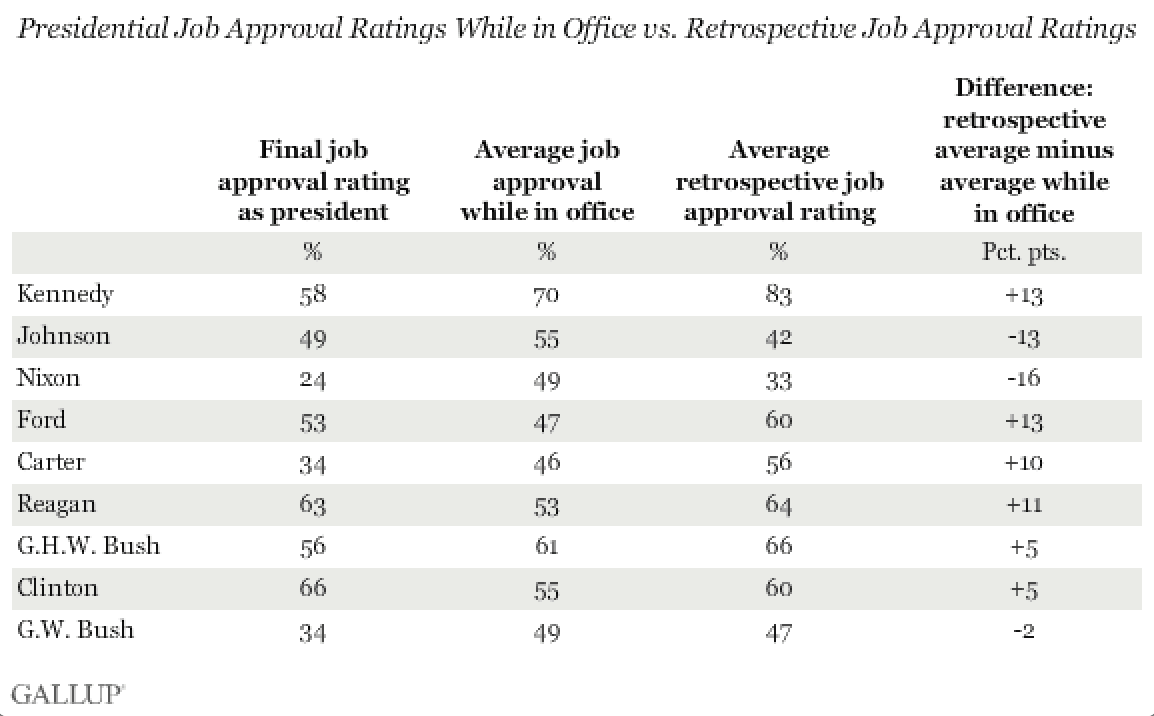
The first thing to remember is that presidential approval ratings almost always rise once they leave office. In 2013, Gallup released polling data on John F. Kennedy, Gerald Ford, Jimmy Carter, Ronald Reagan, George H.W. Bush and Bill Clinton. All saw their approval ratings increase after their presidencies. Despite the fact that millions of Americans still blame George W. Bush for the weak recovery, even he has seen his approval rating tick up in recent years.

Screen Shot 2014-07-03 at 11.41.03 AM

As the current president, Obama has not yet had the opportunity to capture this post-presidency favorability boost. Five years from now, Americans will almost certainly look back with fonder memories of his time in office.

This might help:

[A] report from the Commonwealth Fund, published Wednesday in the New England Journal of Medicine, credits President Barack Obama’s health reform law with an estimated 20 million enrollments as of May 1.

Rick Warren Wants You To Pay Him To Discriminate Against Gay People

How’s that for chutzpah? I put it that way because it reveals quite a lot about Rick Warren, and his desire to fire gay people from working for him in any capacity – and because it reveals the big difference between what he is demanding – and the usual exemptions allowed for religious groups. It’s not related to the Hobby Lobby ruling as such – but it represents a pretty shameless attempt to exploit the similarities.

Here’s why Rick Warren is, as so often, full of it. In a proposed law like the Employment Non-Discrimination Act, the government forces every employer to abide by the principles of equal opportunity. That’s why it can be appropriate for, say, a church or synagogue, to ask for an exemption from coercion. They’re asking to opt out of a system they are included in as Americans. But in federal contracts, an organization is first choosing to opt in for federal money, and then demanding special privileges of discrimination against another minority.

It is, in effect, asking two things: that it get a bunch of tax-payers’ money (thank you very much) and that it gets to discriminate against a minority in employment (fuck you very much). I see absolutely no reason to allow it. The federal government should represent all its citizens, gays, evangelicals, Mormons, and atheists. When it gives religious organizations money, it has every right to demand it not be used to persecute or stigmatize a minority. If those religious groups really feel it’s an integral part of Christianity to find out who’s gay and fire them (yes, that’s what sadly passes for Christianity these days), they can give up the money.

And there’s a simple matter of basic fairness here. Look at the current conditions set on federal contracts:

The existing federal contractor executive order bars federal contractors who do more than $10,000 worth of federal work in a year from discriminating on the basis of race, color, religion, sex, or national origin.

If the federal government prevents any group – say a secular charitable organization – from discriminating against evangelical Christians, why should it allow discrimination against gay people? Why should one group be protected and another left to the tender mercies of discriminating employers? It seems to me that if the Christian right wants to re-position itself as a minority that deserves federal protection, it should also agree that other minorities qualify. And that includes gay people.

The Arab Spring Is Still A Thing?

A woman with her child participates in a demonstration

Summing up the argument of his latest book, The New Arabs, Juan Cole hums a hopeful tune about the long-term fate of the youth-driven uprisings in the Middle East:

The generation of young Arabs who made the revolutions that led to the unrest and civil wars of the present is in fact distinctive — substantially more urban, literate, media-savvy, and wired than its parents and grandparents.  It’s also somewhat less religiously observant, though still deeply polarized between nationalists and devotees of political Islam. And keep in mind that the median age of the 370 million Arabs on this planet is only 24, about half that of graying Japan or Germany.  While India and Indonesia also have big youth bulges, Arab youth suffer disproportionately from the low rates of investment in their countries and staggeringly high unemployment rates.  They are, that is, primed for action. …

[M]any of the millennial activists who briefly turned the Arab world upside down and provoked so many changes are putting their energies into non-governmental organizations, thousands of which have flowered, barely noticed, in countries that once suffered from one-party rule.  In this way, they are learning valuable organizational skills that — count on it — will one day be applied to politics.  Others continue to coordinate with labor unions to promote the welfare of the working classes.  Their dislike of nepotism, narrow cliques, and ethnic or sectarian rule has already had a lasting impact on the politics of the Arab world.  So don’t for a second think that the Arab Spring is over, no matter the news from Libya, Egypt, Iraq, or elsewhere.

Meanwhile, in an interview, Cole notes that the Bush-era neocons may indeed have helped spread democracy in the Middle East – just in the totally opposite way they intended:

To the casual observer, the Arab Spring seemed to come from nowhere. It was an extemporaneous uprising triggered by a Tunisian street vendor who set himself on fire—the proverbial straw that broke the camel’s back. In talking to many of the activists, Cole came to see that organized protests over the invasion of Iraq and the 2008 Israel-Gaza conflict also played a major role. Just as indispensable were a decade’s worth of labor organizing over economic issues.

“In some ways, it was the invasion of Iraq that often produced the first big street demonstrations that these young people were involved in,” explains Cole. “But then the Gaza War in 2008-9—that surprised me in the sense that it seems to have been a really big rallying point for the Tunisian youth.”

(Photo: Bahrainis protest against the government and call for the release of political prisoners on June 20, 2014. By Hussain Albahrani/Pacific Press/LightRocket via Getty Images)