Ukraine Unravels Again

Anna Nemtsova checks in after President Poroshenko cancelled a short-lived ceasefire with Russian-backed separatists on Monday night. His government is now talking about sealing the entire border:

As fighting continues in the east, including within the city of Donetsk, Ukrainian authorities understand that a conventional Russia invasion remains possible, which would represent an escalation of the covert tactics now in play between the Russian army and local militants. Andiy Parubiy, the secretary of the National Security and Defense Council, said on the television show Freedom of Speech: “We understand that it can happen at any monument, on any night.” Despite Tuesday’s presidential phone call to discuss de-escalation, Ukrainian authorities prepared for a more serious military operation to re-enforce the troops fighting in Luhansk region, snug against the Russian border.

Leon Aron doesn’t see what choice Poroshenko had but to end the ceasefire, given the “cat-and-mouse game” Moscow is playing:

Pro-Russia forces attack symbolically high-value targets (e.g. an airport, or an administrative building); Kiev attempts to retake the locations; Russia condemns the efforts as the “killing of peaceful civilians” and demands that Kiev “stop attacking its own people”; Kiev declares a unilateral a ceasefire; Vladimir Putin voices support for “a peaceful resolution of the conflict that would take into account the wishes of the Russian-speaking citizens of Ukraine”; the rebels “ignore” his calls and continue to shoot down Ukrainian planes and helicopters; the ceasefire collapses.

Confronted with a horrible moral choice of ceding sovereignty over its own land or engaging in violence trying to reclaim them, Kiev has chosen the latter. It is hard to see how any government would have acted differently under the circumstances.

There are signs, however, that Putin is unwilling to escalate the situation further:

Some experts say Putin faces internal opposition from pro-war forces who think he should be more assertive in supporting east Ukraine’s beleaguered rebels. “Everybody wonders why Putin isn’t using troops [to back the rebels],” says Sergei Markov, director of the pro-Kremlin Institute of Political Studies and a frequent Kremlin adviser. “But Putin does understand how hard the war is, and wants to do what he can to preserve peace.”

Alexei Makarkin, director of the independent Center for Political Technologies, says that Putin’s recent shift toward a negotiated solution suggests that he recognizes that Ukraine has slipped out of Russia’s sphere of influence forever, and that he must try to salvage what he can of Moscow’s badly shredded relationship with the West.

The Bloomberg editors blast European leaders for not standing up to Putin:

They had set an ultimatum for Putin on Friday: Rein in Russian-backed separatists in Ukraine and agree to seal the border by Monday or face “significant restrictive measures.” The deadline arrived, Putin ignored it and … EU leaders agreed today to think about it. Some European countries, apparently, thought the situation in eastern Ukraine remained too uncertain to make a decision. If so, they’re playing right into Putin’s hands. …

Putin knows the likelihood of the EU imposing meaningful economic sanctions is low — so long as he doesn’t launch an outright invasion of Ukraine. To show Putin he’s wrong, the EU needs to follow through on its ultimatum by sanctioning Russian corporations and other well-defined economic targets, thus demonstrating its willingness to go further. So far, the EU has yet to give Putin a reason to take its threats seriously.

But James Carden argues that Ukraine’s new association agreement with the EU was a mistake that will only exacerbate tensions, and that the US is foolish to stand behind it:

Because of the specific foreign-policy and security protocols embedded within the EU-Ukraine Association Agreement, and because NATO membership usually follows on the heels of EU membership, the agreement will further exacerbate the “security dilemma” vis-a-vis Russia, Ukraine and NATO. And so we can expect Russia to respond in a number of ways, some of which we have already seen in its anticipation of the coming of the Agreement: Russia will align more closely with China; Russia will move to destabilize parts of eastern and southern Ukraine; Russia will increase military and defense spending; Russia will likely move to strengthen the Collective Security Treaty Organization (CSTO), Russia will likely attempt to add a political and security dimension to the Eurasian Union.


A Triumphant Loss

Even though Belgium’s 2-1 victory in extra time yesterday knocked USA out of the World Cup, Kornhaber celebrates our goalie Tim Howard, whose record 16 saves put an American mark on the tournament:

After watching America lose to Belgium in agonizing and thrilling fashion on Tuesday, it’s impossible to deny what I (and I suspect even Coulter) realize, deep down: If you have a problem enjoying soccer or any other popular athletic contest, that’s on you, not the sport.

Exhibits a, b, and c to that effect were Tim Howard, who nuked the notion that soccer is boring, random, and devoid of true stars (Coulter: “Do they even have MVPs in soccer?”). On the page, the fact that the U.S. keeper set a World Cup record for saves in a game (16) is just another statistic that just makes my eyes glaze over. But when I watched the process by which that statistic was achieved—really watch, beer in hand, surrounded by fans, aware of what’s riding on the outcome—the feeling was entirely different.

A compilation of Howard’s saves after the jump:

But Henry D. Fetter, prior to the game this week, tempered any excitement that soccer is finally becoming a major American sport:

Even before the World Cup got underway, soccer historian David Goldblatt told The Economist “football is taking off in America.” And even before that, writers were making predictions:

  • “U.S. soccer on the brink.”
  • “Now everyone believes in soccer’s future, a general belief that soccer has all the irresistibility of a sport whose moment has come.”
  • “Within 10 years ‘soccer will not only be the No. 1 sport in the U.S. but also the major soccer center in the world.’”
  • “Father used to take their kids to the football game. Now the kids, they take their father to the soccer game.”
  • “Soccer is on the verge of exploding.”

An impressive compilation of concurring opinions, to be sure. But, not to spoil the current celebration, those quotes are from 1968, 1975, 1977, 1980, and 1993, respectively.  And even in those years, it was hardly a novelty to be bullish about the prospects for the sport in this country. “Soccer in America is gaining in popularity … the game is established on a firm foundation and the future of the sport in the United States is assured” the New York Times recorded—in 1924.

And Kareem Abdul-Jabbar, in a less Coulterish way than Coulter, says the sport will never really catch on:

[S]occer doesn’t fully express the American ethos as powerfully as our other popular sports. We are a country of pioneers, explorers, and contrarians who only need someone to say it can’t be done to fire us up to prove otherwise. As a result, we like to see extraordinary effort rewarded. The low scoring in soccer frustrates this American impulse.

We also celebrate rugged individualism, the democratic ideal that anybody from any background can become a sports hero. We like to see heroes rise, buoyed by their teammates, but still expressing their own supreme individual skills. Certainly soccer has its celebrated stars, from Pele to Beckham, but those skills seem muted on TV where we’re often looking at small figures on a large field and therefore these feats appear less impressive than they really are.

Could Howard change that? Dunno. But he sure can grow a sweet beard.

Perspective, Please

Supreme Court Issues Rulings, Including Hobby Lobby ACA Contraception Mandate Case

Below, I reflect on the astonishing success of the marriage equality movement in the last two decades. On an issue that became a must-win for the Christianist right, the American people have delivered a resounding rebuff. Think also of other profound shifts in social policy during the Obama administration: universal health insurance, to take an epic example; the shift in drug policy away from mere law enforcement; the speed with which marijuana legalization marches forward; the rise and rise of women in the economy and the academy and politics. Then consider the broad demographic shifts – the sharp increase in the religiously unaffiliated, the super-liberal Millennial generation, the majority-minority generation being born now, and a bi-racial president possibly followed by a woman president. When I see the panic and near-hysteria among some liberals in response to the Hobby Lobby ruling, I have to wonder what America they think they’re living in.

Damon Linker notes how over the long run, the religious right is still losing big – and this is the proper context to understand a ruling like Hobby Lobby:

Where once the religious right sought to inject a unified ideology of traditionalist Judeo-Christianity into the nation’s politics, now it seeks merely to protect itself against a newly aggressive form of secular social liberalism. Sometimes that liberalism takes the relatively benign and amorphous form of an irreverent, sex-obsessed popular culture and public opinion that is unsympathetic to claims of religious truth. But at other times, it comes backed up by the coercive powers of government.

That’s how the Hobby Lobby case needs to be understood: as a defensive response to the government attempting to regulate areas of life that it never previously sought to control … From advancing an ideological project to transform America into an explicitly Catholic-Christian nation to asking that a business run by devout Christians be given a partial exemption from a government regulation that would force it to violate its beliefs — that’s what the religious right has been reduced to in just 10 years.

And this is where I part company with some of my fellow supporters of universal healthcare and marriage equality. Although I disagree with Hobby Lobby’s position on contraception (I think widespread contraception is the best bulwark in modernity against the much graver problem of abortion and that sex need not be about procreation at all), I still live in the same country that they do. And in cases where values collide, I favor some sort of accommodation. Call me a squish; but I want to live in a civil polity, not a battlefield of absolutes. (As for marriage equality, I feel the same way. I just do not believe anyone’s religious freedoms are in any way curtailed by civil marriage licenses for gay people; and that no devout person’s marriage is affected either.)

Or look at it this way: with the ACA, for the first time ever, all insurance covers a wide array of contraception options.

That’s a huge step forward for social liberalism, and it was allowed by the Roberts court. A few organizations and closely-held companies want to be exempted from that coverage for religious reasons. They just got it. The administration can still respond by crafting a compromise along the lines of that given to purely religious groups, or by other methods. Yes, there’s a precedent here that could be expanded. But, as Ross notes today, Kennedy’s concurrence suggests not by much. And overall, this battle has been decisively won by secular liberals and their allies (who include many religious people as well). What’s really being done here is negotiating the terms of surrender. And in general, I think victories are more durable if they are allied with a certain degree of magnanimity.

You can read countless screeds against this decision, for example, that nowhere even mention that for some devout people, the mandate might actually be a genuine problem of conscience. Is liberalism indifferent to the conscientious dissent of minorities? The truth is: I don’t think so. But many cannot yet see that the religious right is no longer a majority, fast becoming a small minority, unable to win at the ballot box, and needing some accommodation with respect to majoritarian rule.

That used to be a liberal value. And I hope, before too long, it will again.

(Photo: Supporters of employer-paid birth control rally in front of the Supreme Court before the decision in Burwell v. Hobby Lobby Stores was announced June 30, 2014 in Washington, DC. By Chip Somodevilla/Getty Images.)

The Intensifying Immigration Wars

Waldman analyzes the president’s Rose Garden speech from Monday, calling it “a pretty blatant thumb in the opposition’s eye”:

Obama is basically accurate in his characterization of Republican arguments, even if he portrays them in an uncomplimentary way. They do indeed argue that they won’t pass an immigration bill because they don’t trust the president to enforce it properly. Which is just an invitation for him to take executive action, making them more angry, to which he can respond, I’m only doing this because you won’t pass a bill. And since Democrats have worked just as hard to convince the public that Republicans are insanely obstructionist as Republicans have to convince the public that Obama is a tyrant, the president’s response isn’t hard to explain to people; they understand by now that Republicans are opposed to passing immigration reform. So the places where Republicans have been the most recalcitrant are those where Obama is most likely to be emboldened to move aggressively.

Vinik outlines some ways the president could tackle immigration without Congress. But rather than making an end run around the House GOP, Connor Simpson suggests Obama might actually be trying to force their hand:

Earlier Monday, the President sent a surprise request to Congress asking for roughly $2 billion to deal with the influx of children attempting to cross the border illegally from South America. While children from Mexico can be deported fairly easily, immigrants who travel from as far as Guatemala, Honduras and El Salvador are much more difficult and expensive. The move will likely cause chaos on Capitol Hill, but could potentially force the House to finally deal with immigration   reform.

It’s a catch-22 for politicians:

vote to deport a bunch of children and solve a very real problem, or vote to deport a bunch of children and look heartless in the eyes of your constituents. Hard line immigration reform opponents will love it regardless.

Chait calls the House failure to act on immigration reform “a fascinating case study of a party unable to act on its recognized political self-interest”:

The GOP’s worst problem is that Obama’s unilateral relaxation of immigration enforcement will add a newer and more potent dimension to the immigration issue. No longer will Republicans merely have to promise to oppose reform legislation. They will have to promise to undo what Obama has done. …

And so Republicans may well find themselves in the position of watching their nominee pledging to prosecute or deport immigrant families or children pardoned or left alone by Obama. The only way their friends, neighbors, or relatives who happen to be legal citizens can spare them will be to vote for Clinton. It may have seemed that the Republicans’ standing with immigrant communities had sunk to a new low in 2012, but in 2016, things could actually get worse.

Jonathan Bernstein, on the other hand, argues that the stakes are not so dire for the Republicans in 2016 – or so they seem to believe, at least:

In the long run, the electoral danger of keeping immigration reform high on the agenda is that it could keep Hispanics in the Democratic camp for generations, in part by encouraging them to use ethnicity as their primary political identification. And if that happens, Republicans will risk turning into a long-term minority party. But the electoral effects are much murkier in 2016. That makes it even more difficult for pro-reform Republicans to make the case, particularly as politicians generally aren’t known for their long-term electoral thinking.

Now, on the policy merits, Chait (and Obama) have it right: the possibility of White House action has always made a compromise the best choice for Republicans if what they care about is policy substance. But this set of House Republicans, and the party they represent, isn’t known for putting policy substance over symbolism.

But Francis Wilkinson notes that this could all blow up in Obama’s face:

Obama is in a bind, and he won’t be escaping it soon. He promised that if the House didn’t act on immigration, he would. But if he eases deportations while thousands of alien kids are entering U.S. custody, he may well inspire a ferocity from House Republicans that we haven’t seen since the days of the debt-ceiling fiasco. Only this time, Republicans will point to Obama’s tardy response to a genuine crisis, rather than their own ideological make-believe, as the proximate cause. … By setting himself up as the alternative when and if legislation failed, Obama made himself a target of immigrant desires that he is almost certainly incapable of satisfying. He now faces a backlash from foes and friends alike.

Yglesias declares immigration reform no longer a “special” issue meriting bipartisan action. Now, he believes, “like other liberal priorities it’ll happen if Democrats win a sweep election but not otherwise”:

The more interesting question is what happens to Republicans. Will they simply cede the faction of the business community that’s hungry for immigrant labor to the Democratic coalition? Or will they push harder for a new formula — something like the SKILLS Act that would allow in more highly-skilled workers in exchange for slamming the door on family reunification for less-skilled (mostly Latin American) migrants even tighter — that would try to split up the existing interest group coalition for reform.

But whatever happens, it won’t be special. We’ll see continued trench warfare through executive action and judicial decisions as long as the legislative branches are divided. And then when one party or the other gains a breakthrough, some kind of reform will pass largely on a party-line vote.

Which is a bit odd, given the growing public consensus around liberalizing immigration policy. Although a Gallup poll last week found anti-immigration sentiment on the rise, Aaron Blake examines the long-term trends to find that this increase “looks more like a blip on the screen than a significant and lasting shift.” Two data points:

1) A May poll from the New York Times showed 46 percent of Americans thought all immigrants should be welcomed to the United States. That’s up from 33 percent in 2010, 24 percent in 2007 (the last time immigration reform failed) and around 20 percent in the mid-1990s. The percentage who say there should be no immigration has also dropped to 19 percent.

2) The same poll showed the percentage of Americans who say immigrants contribute to this country has risen significantly over the past three decades. While Americans in the 1980s and 1990s said immigrants were more likely to cause problems than contribute, it’s now 66-21 in favor of contributing. And the numbers continue to rise to this day.

KY Lubricates The Case

I’ve been waiting a long time to write that headline. But seriously, folks, the ruling in Kentucky by a GHW Bush appointee is not just a victory for marriage equality; it’s the equivalent of a knock-out. It effectively says that there is no need to worry at all about the level of judicial protection applied to the gay minority – rational basis? heightened scrutiny? strict scrutiny? – because the case for banning gay marriage is so devoid of any logic it should merely be laughed out of court. Money quote:

These arguments are not those of serious people. Though it seems almost unnecessary to explain, here are the reasons why. Even assuming the state has a legitimate interest in sully-wedding-aisle-thumbpromoting procreation, the Court fails to see, and Defendant never explains, how the exclusion of same-sex couples from marriage has any effect whatsoever on procreation among heterosexual spouses.

Excluding same-sex couples from marriage does not change the number of heterosexual couples who choose to get married, the number who choose to have children, or the number of children they have … The state’s attempts to connect the exclusion of same-sex couples from marriage to its interest in economic stability and in “ensuring humanity’s continued existence” are at best illogical and even bewildering.

That, of course, was also the damning conclusion of the Prop 8 trial. If you actually put the logical arguments for banning marriage equality to a rational test, they don’t actually exist. There are no apparent costs to this reform at all:

Those opposed by and large simply believe that the state has the right to adopt a particular religious or traditional view of marriage regardless of how it may affect gay and lesbian persons. But, as this Court has respectfully explained, in America even sincere and long-held religious views do not trump the constitutional rights of those who happen to have been out-voted …

Lyle Deniston notes:

In February, in an earlier phase of the judge’s review of the Kentucky ban, he ruled in February that it was unconstitutional for the state to refuse to recognize same-sex marriages of Kentuckians that were performed in other states. That ruling is now under review by the U.S. Court of Appeals for the Sixth Circuit.

So this is not over in Kentucky. But the fact that every single marriage ban challenged since Windsor has been struck down is telling. Allahpundit continues to make the following flawed point:

We’ve gone from this issue being a fringe preoccupation of the left 20 years ago to the federal bench slam-dunking it today, thanks in large part to Kennedy and Windsor.

Marriage equality was absolutely not a “fringe preoccupation of the left” 20 years ago. It was a fringe preoccupation of the gay right and a handful of gay liberals – and largely opposed by the gay left. It was then and is today a centrist reform that any sane and reasonable conservative would support – as many have in America and around the world. Which is why it gives me particular pleasure to note that this particular judge was nominated by none other than Mitch McConnell. It is a victory for conservatism and reason – two things the current GOP has sadly a rather loose grip on.

Chart Of The Day

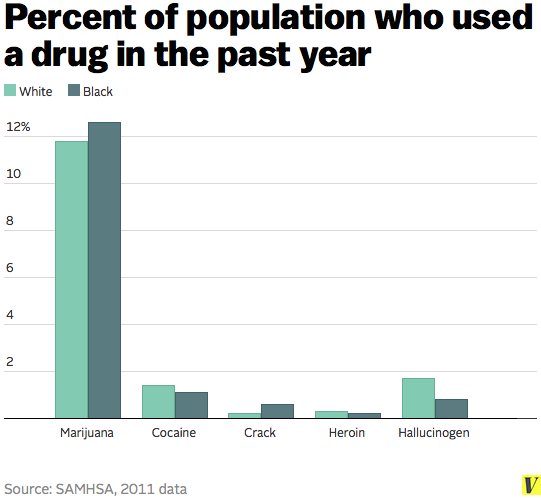
drug_use_by_race

German Lopez illustrates the racial breakdown for recreational drugs – always a helpful reminder:

White and black people report using drugs at similar rates, according to the latest data from the Substance Abuse and Mental Health Services Administration. There’s some variance from drug to drug: White people report more often using cocaine, heroin, and hallucinogens, while black people report more marijuana and crack cocaine use. These statistics underline why critics decry the war on drugs as racist. Although black people are much more likely to be sent to jail for drug possession, they’re not more likely to use drugs.

Why Not Just Provide The Pill Over The Counter?

Jonathan H. Adler considers the question:

A final step the administration could take would be to enhance access to contraception by making all forms of oral contraception available over-the-counter without a prescription (and not just “Plan B”).  While this would not make contraception “free” it would reduce the cost, and help alleviate some of the non-monetary obstacles women face.  As Adrianna McIntyre notes, cost is hardly the only (or even the largest) obstacle working women face when it comes to obtaining contraception.  Making oral contraception available OTC might not help the 3-4 percent of women who use IUDs, but it would nonetheless expand access to contraception as a practical matter, particularly for the working poor.  It also has the support of some prominent conservatives and would largely eliminate the cultural conflict engendered by the mandate.

One such conservative is Philip Klein:

Philosophically, it’s consistent with limited government principles. It removes unnecessary government regulations and increases choice. It doesn’t impose new burdens on businesses or religious institutions, nor does it require an increase in government health care spending.

And politically, it would also be beneficial to Republicans. It would make it a lot more difficult for Democrats to portray the GOP as being only interested in obstructing Democrats rather than supporting their own ideas, and harder to accuse Republicans of being broadly against access to birth control. Instead, it would allow Republicans to go on offense, and show that Democrats are the ones who want to play politics with birth control.

Ben Domenech, another conservative, runs through the counterarguments:

There are a number of objections to [OTC birth control], but I find them to largely amount to unconvincing paternalism.

The chief argument advanced is that standard oral contraceptives mess with hormones and have all sorts of side effects. This is, of course, true! But: dangerous side effects are rampant within all sorts of other over the counter drugs. Women can think for themselves and make decisions with their doctor and pharmacist about what drugs they want to take – and the evidence shows they are good at self-screening. In fact, it would actually increase the ability to mitigate and respond to unanticipated side effects, since changing tracks will no longer require a doctor’s visit and getting a new prescription. Assuming that women won’t or can’t take responsibility for themselves to consult with a doctor unless required to by arbitrary government policy is absurd.

Allahpundit spotlights one of the idea’s most vocal supporters:

Bobby Jindal, who’s wooing religious conservatives ahead of 2016, has been pushing [the OTC pill] since 2012.  … Congress could, as Jindal suggests, even adjust Health Savings Accounts so that they include OTC medicines, which would further reduce the financial burden. And politically, it would complicate the Democrats’ dopey “war on women” messaging by decoupling the contraception debate from the debate over abortion. How do you push a “Republicans don’t believe in reproductive freedom” message if GOPers like Jindal want to make the pill OTC?

But the best endorsement comes from the OCOG:

In the United States, the proposal to sell oral contraceptives over the counter has been endorsed by the premier body of relevant experts, the American Congress of Obstetricians and Gynecologists. Ultimately, though, the decision will be made by the FDA.

So why the holdup? Elizabeth Nolan Brown has a must-read:

“Doctors regularly hold women’s birth control prescriptions hostage, forcing them to come in for exams,” wrote Stephanie Mencimer in a Mother Jones piece about her own doctor doing so. Dr. [Jeffrey] Singer described as it doctors extorting pay for a “permission slip” to get the same medication over and over again. Feminist blogger Amanda Marcotte says doctors use “the pill as bait” to make sure women come in once a year. Both doctors and public health officials publicly worry that women won’t receive annual cervical cancer and sexually transmitted infection (STI) screenings without such coercion. How much of this concern is motivated by profit, how much by paternalism, is hard to say. …

It’s not just some doctors and medical groups who want to keep things status quo. Pharmaceutical companies also gain from it. OTC sales “would drive down the prices substantially,” says Singer. Drugmakers can get higher prices from insurance companies than they could in a competitive contraceptive market. … Yet the pharmaceutical industry is the only entity with standing to challenge the prescription status of current birth control pills. In order to initiate the switch from prescription to nonprescription, a drug maker must approach the FDA.

How Lame Is HRC?

I’m a broken record on this, but I have less respect for HRC, the country’s largest gay rights lobby, than I do for AIPAC. AIPAC may weaken the US, but at least it gets shit done. HRC? Not so much. Case in point – at New York’s Gay Pride Parade, they apparently couldn’t even muster a real contingent for the march, according to mischievous eye-witnesses, recruiting a bunch of 20-somethings from an ad agency – McCann:

Numbering perhaps 30, they were outdone by the delegations of many smaller community groups as well as their fellow corporate doggiehrc.jpgsponsors. Walmart’s envoys stretched a block and a half; MasterCard’s crowd was loud and proud … But it seems that HRC, the largest — and richest — LGBT-rights group in the country, could not be bothered to field a team for the largest LGBT-pride parade in the country. Nor did the earnest, well-meaning boys and girls who marched in their stead have much of an idea why they were there. Some clearly thought we and our banner were part of their group. One wasn’t sure what “HRC” stands for, though most gamely chanted “H! R! C!” — corporate cheerleaders shilling for our premier civil-rights organization right down the lavender line. And no one was sure if there were any HRC staffers among them; if there were, I couldn’t find any.

Chad Griffin couldn’t show up?

Unsafe At Any Speed?

Based on his personal experience, Alexander Zaitchhik fears that off-label use of ADHD drugs is a “public health disaster”:

Around 2009, I noticed more friends and acquaintances getting scripts. These people would never in a million years be caught facedown in a caterpillar of street meth, but here they were singing in the rain about Adderall – Kate Miller’s “medicine.” More than one of these people asked me, “Why are you paying $20 a pill?” They suggested doing what they did: take an online quiz, find a friendly [Attention Deficit Disorder Association]-approved doctor who “gets it,” and get sorted in a doctor’s office.

I never considered it. A cheap and limitless supply of pharma-grade amphetamine, signed off by a friendly medical professional, struck me as an incredibly unwise pursuit. That’s how you become a heavy or daily user. The road to tweakdom is paved with Duane Reed co-pay receipts. I’ve since been proved right, sadly, by watching speed hurt people I care about. …

For those who have never taken speed, it’s difficult to convey the seriousness of a public health disaster – and the depths of its underlying corruption – that results in healthy college students taking 90 daily milligrams of amphetamine salts under blasé doctor’s orders. At 90 milligrams a day, the question is not if the person will eventually experience some form of speed psychosis, but what grade and when.

Previous Dish on Adderall here, here, and here.

Say Goodbye To Pi?

Randyn Charles Bartholomew summarizes the case against π – and for tau, otherwise known as 2π:

The crux of the argument is that pi is a ratio comparing a circle’s circumference with its diameter, which is not a quantity mathematicians generally care about. In fact, almost every mathematical equation about circles is written in terms of r for radius. Tau is precisely the number that connects a circumference to that quantity.

But usage of pi extends far beyond the geometry of circles. Critical mathematical applications such as Fourier transforms, Riemann zeta functions, Gaussian distributions, roots of unity, integrating over polar coordinates and pretty much anything involving trigonometry employs pi. And throughout these diverse mathematical areas the constant π is preceded by the number 2 more often than not. Tauists (yes, they call themselves tauists) have compiled exhaustively long lists of equations—both common and esoteric, in both mathematics and physics—with 2π holding a central place. If 2π is the perennial theme, the almost magically recurring number across myriad branches of mathematics, shouldn’t that be the fundamental constant we name and celebrate?