Does Anyone Give A Shit About Iraq?

Not the Iraqis:

The much-anticipated session of the country’s parliament started on Tuesday with enough members in attendance to ensure the nomination of a speaker would go ahead. However, the meeting quickly descended into farce, with Sunnis and Kurds using an unscheduled recess to withdraw their legislators, ensuring the session collapsed.

And not Americans:

So far, the growing crisis in Iraq has not drawn strong interest from the American public. As Sunni militants extend their control of large swaths of Iraq, 25% say they are paying very close attention to the growing violence and political instability in Iraq.

Young Americans – the ones we could send to die for a battle between Sunnis and Shi’a – have twice as much interest in the World Cup as in Iraq. And yet the hegemon staggers onward …

A Warrior’s Heart

In a review of Jonathan Shay’s Achilles in Vietnam: Combat Trauma and the Undoing of Character, Elizabeth Schambelan contemplates notions of wartime masculinity and friendship:

The broadest political implications of Achilles in Vietnam lie in Shay’s powerful critique of MikeynBrianwhat might be called martial masculinity. The entire book enacts this critique, but it is most explicit in Shay’s discussion of the intense bonds that often form between one soldier and another.

“Combat calls forth a passion of care among men who fight beside each other that is comparable to the earliest and most deeply felt family relationships,” he observes. When Patroclus dies, Achilles no longer wants to live. To Shay, the age-old question of the pair’s relationship status is irrelevant: “Achilles’s grief . . . would not have been greater had they been a sexual couple, nor less if they had not been.” The failure to recognize “love between men that is so deeply felt” greatly amplifies the survivor’s pain. “If military practice tells soldiers that their emotions of love and grief—which are inseparable from their humanity—do not matter,” Shay writes, “then the civilian society that has sent them to fight . . . should not be shocked by their ‘inhumanity’ when they try to return to civilian life.”

In a recent interview, Kash Alvaro—an army veteran who served in Afghanistan and who has been diagnosed with both PTSD and a traumatic brain injury—alludes to the lingering, interlinked stigmas around the disorder and around masculine expressions of “love and grief.”

We’ve been through things that—that’s never going to leave your mind, and it’s always going to be there. . . . And just to come back and have someone tell you, “Oh . . . you’re just acting out. You’re just looking for sympathy,” and those people just don’t understand. Not everybody—I mean, if you have a strong heart, that’s good. That’s good. But there’s people in the world that don’t. You know, you lose somebody, and it’ll break you. . . . And if—you know, if I make it another year, two years, three years, I’m fine with that. If I make it ’til next week, I’m fine with that, too.

The irony that makes this statement all the more painful to read is that, even as Alvaro reels off a checklist of PTSD’s symptoms and triggers (intrusive memories, “acting out,” death of a close friend, parasuicidal fatalism), he seems to have internalized the notion that his post-traumatic stress could have been prevented by a “strong heart,” i.e., by the inhuman lack of feeling to which Shay refers.

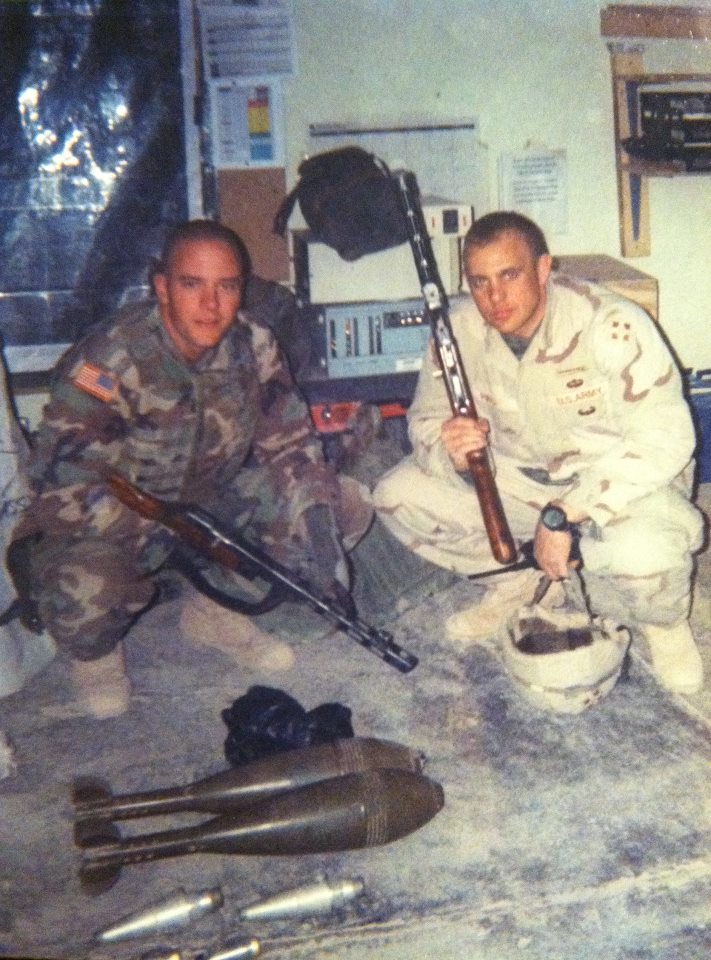
(Photo of two-time Iraq War veteran Mikey Piro and his comrade-in-arms, Brian. Mikey did a podcast with me last year about his post-war experience with PTSD. Follow his blogging at PTSD Survivor Daily. The Dish has covered much of those writings here.)

Tweets Of The Day

It appears, according to McKay Coppins, that Bobby Jindal is ready to ride the Hobby Lobby horse into the primaries, in Kilgore’s eyes, “becoming the champion of dispossessed theocrats rebranded as victims of persecution”:

Tony Perkins, president of the Family Research Council and a longtime Jindal ally, praised him as one of the few prospective 2016 candidates with an unimpeachable record on social issues, and a personal life that exemplifies conservative religious values. As an example, Perkins noted that Jindal and his wife, Supriya, were the first couple in the country to enter into a “covenant marriage,” a special sort of legal union designed by Perkins in Louisiana when he was a state lawmaker that makes divorce more difficult. “His foundation [is] really centered on his Christian faith,” Perkins said. “Talk is cheap, but the walk is where you find the worth of an individual. And he is walking.”

Sprinting, I’d say.

Update from a reader, who spells out something that casual readers might have missed:

You might want to clarify in your post on the Jindal tweets that he is dead wrong about this being a First Amendment issue.

As you have covered before, the case was explicitly decided under the Religious Freedom Restoration Act (RFRA), which was enacted precisely because the Supreme Court held in Smith that the First Amendment does not cover situations like this.  The Hobby Lobby decision is not based on the First Amendment. From the last paragraph of Justice Alito’s opinion:

The contraceptive mandate, as applied to closely held corporations, violates RFRA. Our decision on that statutory question makes it unnecessary to reach the First Amendment claim raised by Conestoga and the Hahns.

Or, as Justice Ginsburg put it in her dissent:

The Court does not pretend that the First Amendment’s Free Exercise Clause demands religion-based accommodations so extreme, for our decisions leave no doubt on that score. See infra, at 6–8. Instead, the Court holds that Congress, in the Religious Freedom Restoration Act of 1993 (RFRA), 42 U. S. C. §2000bb et seq., dictated the extraordinary religion-based exemptions today’s decision endorses.

Dr Zuckerberg Will Treat Your Moods Now, Ctd

A reader quotes Poniewozik:

Suppose The New York Times, or ABC News–or TIME magazine–had tweaked the content it displayed to hundreds of thousands of users to see if certain types of posts put readers in a certain frame of mind. The outcry would be swift and furious–brainwashing! mind control! this is how the biased media learns to manipulate us! It would be decried as not just creepy but professionally unethical. And it’s hard to imagine that the publication’s leadership could survive without promising it would never happen again.

It’s hard not to read this and immediately think of the new trend of advertorial content. I mean, isn’t this exactly what the advertorial is supposed to accomplish? To put you in a frame of mind where you’ve put your guard down because you don’t realize what you’re reading is an advertisement and not a more “objective” take from the publication? I think Poniewozik may have missed the boat on this one.

Another illustrates what your future on Facebook could portend:

Think they are trying to improve humanity? Or do you think they are trying to see how manipulating information may drive the actions of users, which in turn will help them do more targeted advertising? They know that younger people use their service more than any other media or app … the numbers are staggering. So if they can manipulate what information is provided to there subjects, and that manipulation sets the user’s frame of mind, then it potentially makes the user more pliable when it comes to targeted ads.

It is simple: create a bad mood … then insert Zoloft ad. Imagine reading all the anxiety producing news of the day and then see another article – I mean a Zoloft ad staged as an article – that gives you means of relief. Given that Zoloft can shotgun ads to people on other sites, or KNOW that the people seeing their product on Facebook will be of the proper disposition, what do you think that is worth?

The beauty of the whole thing is that Facebook EULA’s [end-user license agreement] appears to have been written by Peter Cook’s character in Bedazzled. Who needs ethics when you have profit and market share? And why would anyone think that a for-profit corporation will do the right thing and not betray your confidence when their risk analysis spits out “cha-ching!”?

If you log into your Facebook account and then have the irresistible urge to eat Taco Bell for breakfast and purchase a dildo for the office, you might want to consider getting your news elsewhere.

The View From Your Window Contest: Winner #211

VFYWC-211

A reader thinks it’s San Francisco:

The new strip mall on the other, never-photographed side of Alamo Square?

Another picks the “Smokeless Coal Capital” of America:

Looks like the roof of Tamarack arts center near Beckley, West Virginia. I just stopped there during a road trip in late April.

Another:

Hard one this week. The closest I can get is Aden in Yemen, judging by the profile of the mountains and Arabic signage.

Another correctly notes the significance of taking the contest to the Middle East this week:

So, as a Muslim (fringy as I am), I couldn’t help thinking that this week’s contest was maybe in honor of the beginning of Ramadan. If so, great! If not, thanks for not posting a picture of one of the souped-up Arab metropolises built to be viewed from the space station.

The view looks like some sort of shopping plaza, or entrance to an arcade. It’s rather desultory, certainly doesn’t call to mind the shiny new buildings and streets of one of the UAE cities. The hilly terrain bordering the city suggested Yemen or Jordan or Algeria. Given that of the three Yemen seems the most economically oppressed, I settled on Sana a. Never having been there, I have no clue as to whether or not the signage is in multiple languages. I’m pretty sure that in Jordan and Algeria they are at least also in English and French.

Of course, I could be dead wrong, again … grr. Perhaps if we were to get a glimpse of the populace, as in whether or not there is a completely or partially shrouded female population. That would certainly give me a better idea as to the sort of prevailing religious influence on the politics.

Still, I really hope I’m closer this time, and NOT because it’s Ramadan!

Another is thinking Kabul:

That dust (rumored to be a very high fecal content due to the open sewers), those mountains, the Arabic script, and somewhat decrepit window – looks a lot like the Afghan capital. Actually, it’s the wife’s guess. I’ve learned to listen to her. A few weeks back she said: that’s Chateau de Chillon! I said, no it’s not; it looks a lot like it, but the view is wrong. Stupid me. I lived in Lausanne 7 years and now feel very silly.

I can’t guess a window now, as we’re at 34,000 feet over Alaska en route to Tokyo. Normally that would give plenty of time to search, but the 9 month old in my lap is demanding attention and refuses to sleep.

Or Lebanon?

Well, I see Arabic writing in a somewhat rundown city, but no visible minarets, so perhaps a relatively secular nation. I’d guess Beirut or Amman, but Amman has lots of buildings on its hills, while Beirut has areas that look relatively sparse, so I’m going with it. I’m not one of those folks who tries to get the exact building; I’m just hoping this isn’t a shopping center in Detroit. That would be embarrassing, even for someone whose goal is “get the right city.”

Another gets the right country:
21eur9j.jpg

The only times I think I know the view it’s because I think I’ve been there. Well, it’s a big world, so the chances of that happening are miniscule.

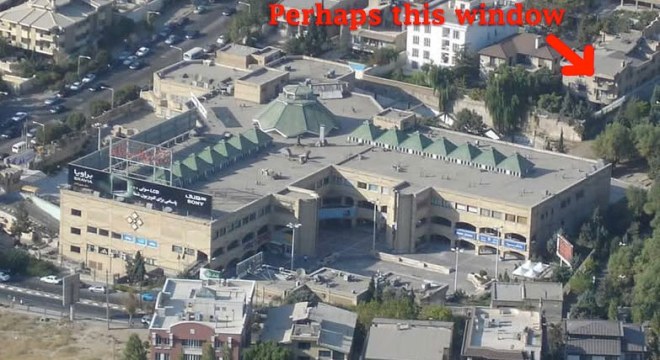
But it really does seem like these are the green pyramids on top of the Golestan Mall in Shahrak-e Gharb, Tehran, Iran. It’s where my wife would buy dubbed pirated Disney DVDs for our bilingual children (they were only allowed to watch Disney movies in Farsi) Of course it could be that every mall in Iran has green pyramids …

Another nails the right city:

By George, I’ve got it! This was taken in Isfahan, Iran (or, as most Iranians call the city, Esfahan). The turquoise roofs are unmistakably Persian, as is the script on the store signs and the somewhat less prominent signage in the middle of the photo for some sort of civic office (the part I can make out says “Information and Communications of the Mayoralty of Isfahan”). I hope the recognition of Farsi won’t be considered a case of cheating, albeit a mild one.

The beautifully intricate architecture, impressive bridges, ancient artwork, and overall grandeur of the city warrant the famous proverb “Esfahan nesf-e jahan” (Isfahan is half the world). I should know: I have fond memories of family visits to Isfahan as a child, but am reluctant to return so as not to spoil the mental imagery I have of evenings spent on the banks of Zayandeh-Rood (Zayandeh River), which, alas, has been drying up gradually in recent years.

Here’s our sparse OpenHeatMap of everyone’s entries, which totaled less than 30 this week:

This embed is invalid


Another reader was tipped off by “distinctive mountain peak in the background”. And behind that mountain is apparently some international intrigue:

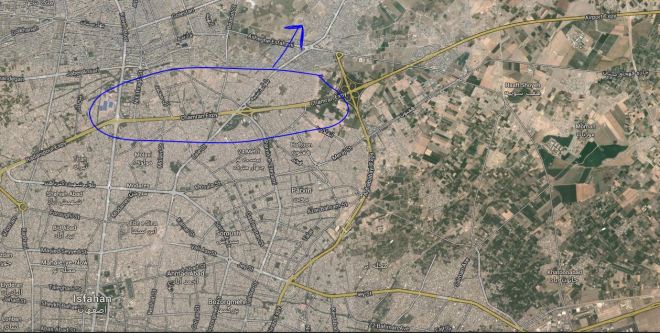
We pretty quickly narrowed this one down to Isfahan, Iran. Firstly, it’s obviously somewhere in the Middle East and secondly one of our number is an Iranian Jew whose family is from that area. Then once comparing the mountain range visible in the picture to that on the map we determined it was in the north-northeast suburbs of Isfahan looking generally to the northeast (see map):
Isfahan

But from there we were stumped. So that’s what we’ve got for this week.

It’s interesting to note that on the other side of those mountains is the Natanz nuclear uranium enrichment facility, host of 1,000 centrifuges and the very plant that was infected by the Stuxnet computer virus at the hands of Israel and the U.S. intelligence agencies in 2007.

Another gets the exact location:

This is a view from a window of the Shah Abbas Hotel in Isfahan, Iran. The hotel is currently known as the Abbasi Hotel. The view is towards the south. The building across the way is a shopping mall housing carpet dealers and other tourist shops. The hotel was created from an old Safavid caravanseri and is attached to a small bazaar and a religious school. As the Iranians say, “Isfahan is half the world”. A wonderful place with great people. I was there as a Peace Corps volunteer forty years ago and went back again five years ago. I stayed at the Abbasi, perhaps in this room. Certainly one very similar.

A fantastic entry from a former winner:

The contest view is from the southern-facing exterior of the Abbasi Hotel (entry on Amadegah Street) in Isfahan, Iran. Not surprisingly, the view is from a lesser photographed aspect of this very elaborate hotel and misses most of the hotel’s iconic views.

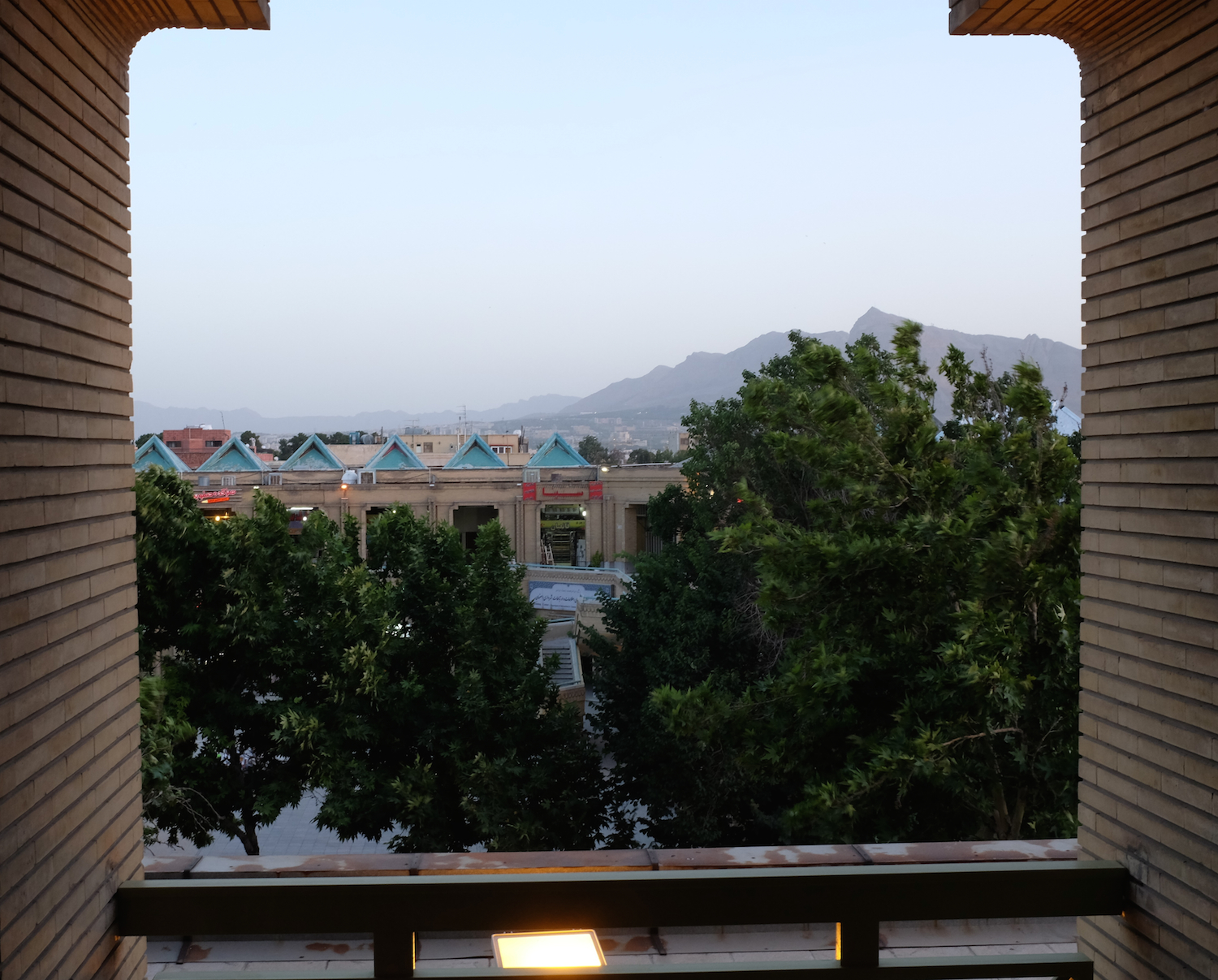
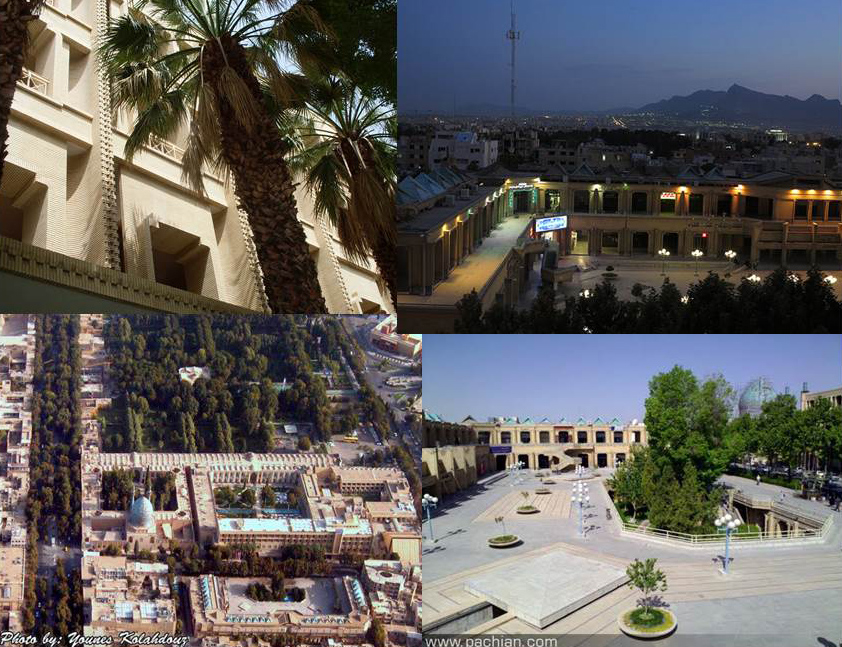
The Persian writing on the shopping complex signs suggested Iran, so I began searching hotels and general views of Tehran. A series of photographs linked to a Tehran hotel included scenes of the Khaju Bridge in Isfahan. A mountain peak in the background appeared similar to that in the contest window, so I switched the search to Isfahan. I passed through many photographs from the Abbasi Hotel before seeing one taken towards the south, which included the distinct rows of blue triangular decorative elements on the roof of the neighboring shopping complex. The brick balcony arches on the hotels southern façade also matched that of the contest window (very nicely done brickwork). The angle of the contest photograph shows only the upper portion of the baloney’s decorative railing which is characteristic of this side of the hotel (part of the railing’s cross pattern is slightly visible in the right-hand corner of the contest photograph). A collage of clues:

vfyw_Abbasi_clues_6-28-204

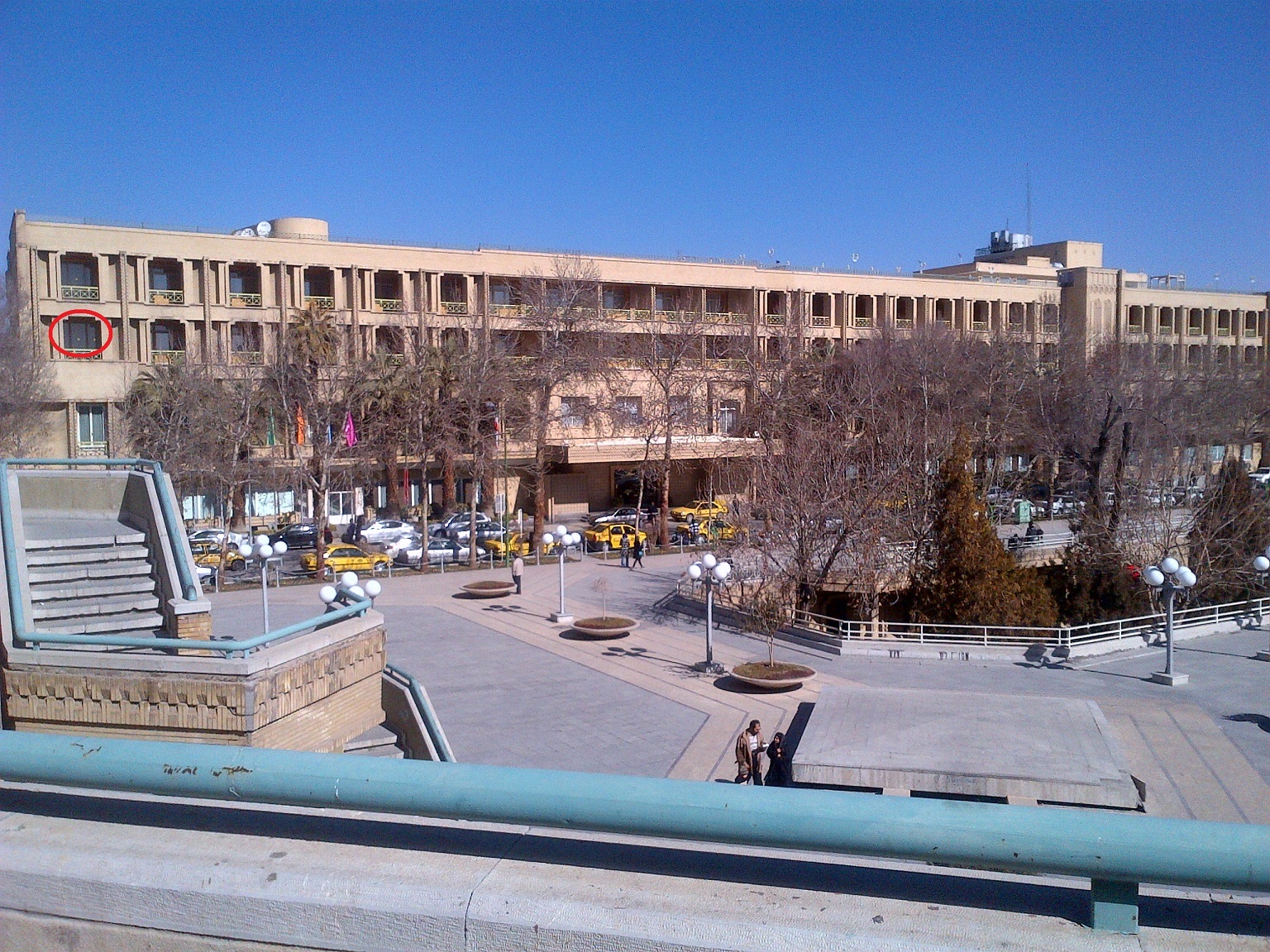
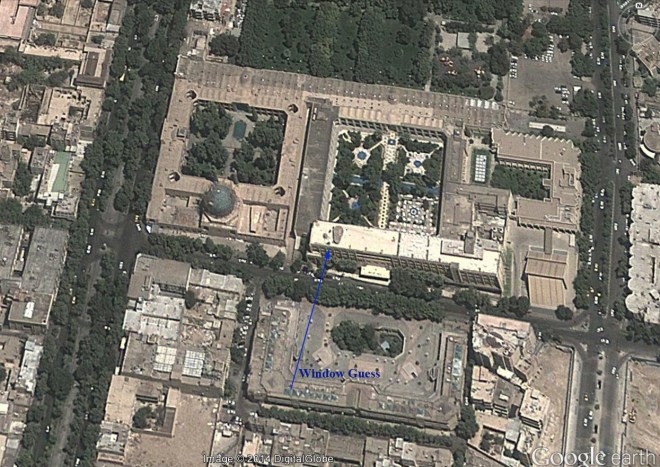
Several features of the shopping complex visible in the contest view place the window on the western side of the building’s southern façade (number and relative location of blue triangles on roof, the stairs, bend in the shopping complex roofline, roof triangles visible in right-hand side of photograph, etc.). I relied primarily on sight lines to locate the general area of the contest window and chose, with significant uncertainly, the third window in from the western side of the building’s southern face on the upper-most floor (see attached):
vfyw_Abbasi_WinGuess_6-28-2014

I selected the upper floor because the view is through the upper tree canopy and misses the tops of palm trees that line this side of the hotel. I suspect a view from a lower floor would include crowns of the palm trees. Views from the shopping complex toward the hotel suggest that the tree canopy would extend to the upper floor.

Thank you for another fine tour of a World Heritage site.

Thank your fellow readers, one of whom is a former resident:

This is a view of a shopping complex built when I lived in Isfahan, Iran in the 1970s. The highest peak in the distance is crowned with the ruins of an Assasin’s Castle. This group gave us the word assassin and is currently known as Ishmaelis. The blue tile roof echoes the colors across the street of the side of a large complex built in the 1700’s.

There is the Madrassa (religious school) Modari – Shah complete with a bulbous blue tile dome. On the other side of this is a brick covered bazaar called the Boland bazaar because of it’s high domes.  Next to the school and across the street from the pictured complex is the former Caravan Serai. Rents from this and the Bazaar helped finance the school. This is a very practical arrangement often followed in the Islamic world. A shopping complex supports the mosque. Of course this can often get out of hand.

This caravan serai was turned into a deluxe hotel with a beautiful garden in the central courtyard. By the 1900s, all of these buildings were in severe disrepair as Islamic dynasties rarely keep up buildings from a former dynasty. A sadly little known American Persian scholar and his wife, Arthur Upham Pope, convinced the last Shah’s father, Reza Shah, to fund the restoration of Iran’s architectural heritage. This involved the training of scores of craftsmen, research, etc. Much of the Islamic Architecture one sees in Iran is due to his work. Without him there probably would have been little left as. Reza Shah’s son, the last Shah, continued this funding. His wive, the Shahbanu was very active in this area. Mr. and Mrs. Pope elected to be buried in Isfahan. They said they were not just ordinary scholars, they loved their adopted country, Iran.

The Shah built them a wonderful simple brick tomb in an early Islamic style on the banks of the river that flows through the city. When Khomeini took over mobs smashed into the tomb, dug up the bones and fed them to the stray dogs. The tomb has since been repaired.

Chini, as is wont, was the only reader to guess the correct window:

I’m gonna go out on a limb and say that Persian speakers had a bit of a head start with this one. But not being able to read the signs helped to make this one of those perfect not too easy, not too hard views. More importantly, we’re not in Tehran. Lovely city, but another search through its 10,000 high rises would have just about driven me mad.
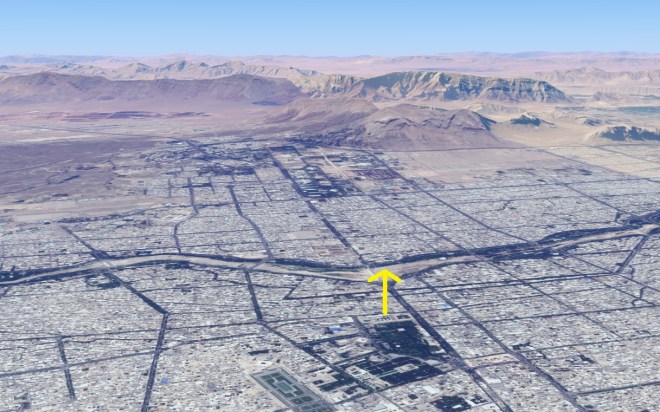
VFYW Isfahan Bird's Eye Marked - Copy

Instead, this week’s view comes from Isfahan, Iran and looks south by southwest along a heading of 191.78 degrees. The pic was likely snapped from a balcony on the third (physical) story of the Abbassi Hotel. The hotel itself is a local landmark because it was once a caravanserai, an ancient form of Persian trading inn.
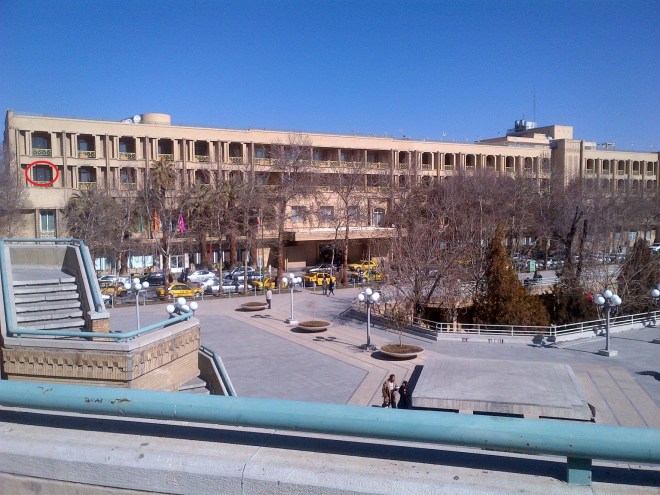
VFYW Isfahan Actual Window Marked - Copy

It’s room 301, to be exact. Our winner this week was the only reader (who hasn’t previously won a contest) to guess the correct hotel and floor:

This picture was taken from a second or third floor balcony from the Abbasi Hotel in Isfahan. It is facing south toward Amadegah Street. There is a sign in the picture for the telecom organization of the City of Isfahan. The website of this organization gave me the address which I was able to find on Google Maps.

VFYW

(Archive: Text|Gallery)

Washington And Tehran’s Eleven-Dimensional Chess Game

In an interview with Chotiner on Iran’s role in the Iraq crisis, Vali Nasr argues that Iraq now has a stake in the Iranian nuclear negotiations:

[I]t could hurt Iraq first of all if the U.S. and Iran stop talking to each other altogether and there’s no more positive momentum in the process. It’s much more difficult to say, “ok let’s forget about this gargantuan issue on which we failed, let’s focus on this other issue.” So you’re gonna make it much more difficult. The nuclear issue has now become the pivot of U.S.-Iran relations: It either creates an environment in which they can have constructive engagement more broadly, or not. Iran is going to follow its own policy, completely separate from the United States. But the irony is, unlike Syria, in Iraq, Iran’s independent policy is much more in line with the United States’, whereas in Syria they were clearly on opposite sides. …

But Nader Hashemi argues that there is “no connection whatsoever” between the nuclear and Iraq/Syria tracks when it comes to American-Iranian relations:

For 35 years, the two sides have been so distant. Getting to a nuclear deal—if we can actually get there—will be a huge accomplishment. I don’t think it necessarily means that there is going to be an agreement on any other regional issues.

Now it’s pretty clear that because of what’s happening in Iraq today there is a convergence of interests between the US position and the Iranian position. They both want to see ISIS defeated. You’re even seeing, for the first time, American senators saying, “Look, during World War II we allied ourselves with Stalin to defeat Hitler, maybe we can do the same thing in the context of Iraq.”

I don’t see anything coming of that. The United States may, at most, just look the other way while Iran’s Revolutionary Guards play a role.

That’s my hope as well. It seems blindingly obvious to me that, if the president wants ISIS to fail, the last thing on earth he should be doing is funding or training their “moderate” allies. What he should be doing is shifting toward Assad in the Syrian civil war by not arming the rebels. Assad, after all, is the main force taking on the Jihadist loons. Les Gelb is as smart as ever on this:

Instead of capitalizing on Mr. Assad’s anti-jihadi instincts, the Obama team now proposes to do what it has resisted doing for almost three years — to send hundreds of millions of dollars in arms aid for the Sunni rebels battling the Assad government. This move has American priorities backward. It will turn Mr. Assad away from the jihadis in Iraq, and back to fighting American-backed rebels in Syria.

The greatest threat to American interests in the region is ISIS, not Mr. Assad. To fight this enemy, Mr. Obama needs to call on others similarly threatened: Iran, Russia, Iraqi Shiites and Kurds, Jordan, Turkey — and above all, the political leader with the best-armed forces in the region, Mr. Assad. Part of the deal would need to be that the Syrian regime and the rebels largely leave each other alone.

Hashemi’s colleague Danny Postel adds that the nuclear talks actually hindered Washington from engaging Iran more actively on Syria:

Kenneth Roth, the Executive Director of Human Rights Watch, has argued that the United States might have been able to work with Iran and Russia to nudge the Assad regime at least on humanitarian issues—allowing food and medicine in to besieged areas, for example. But because of the nuclear negotiations, the U.S. was not willing to push either Russia or Iran on anything related to Syria, because getting that nuclear deal done is so precarious, it faces such opposition in both the US Congress and among the hardliners in Iran, and this might be the only chance, with a reformist in Tehran, and a liberal in Washington, maybe in a generation, when this could happen.

One of the senior Iranian foreign policy leaders, a former nuclear negotiator, said that had the United States bombed Assad last summer after he used sarin gas in Damascus, that Iran would have broken off the secret nuclear negotiations that were taking place in Oman.

In a wide-ranging interview the Dish linked to last week, Tom Ricks expressed doubts about US-Iran cooperation on Iraq, because Iran has already gotten pretty much everything it wants out of its neighbor:

I think Iran has played the long game very well and in 2002 and 2003, they faced the ugly prospect of having American surrogate states, American supported states, on their western border and eastern border. And they have managed, through diplomacy and through the Revolutionary Guard’s actions, to ensure that that didn’t happen. I’m told that they basically went around and threatened a lot of Iraqi politicians in recent years. “You mess with us, and you may leave with an accident.” I’m told that they paid a lot of people a lot of money to ensure that the Status of Forces Agreement would never pass the Iraqi parliament. And I think Iran has achieved its goals. It doesn’t want to control Iraq. And if it winds up with control of a Shiite rump state and all of Iraq’sor most of Iraq’snon-Kurdish oil, that’s not a bad deal for Iran.

On That Religious Freedom Question …

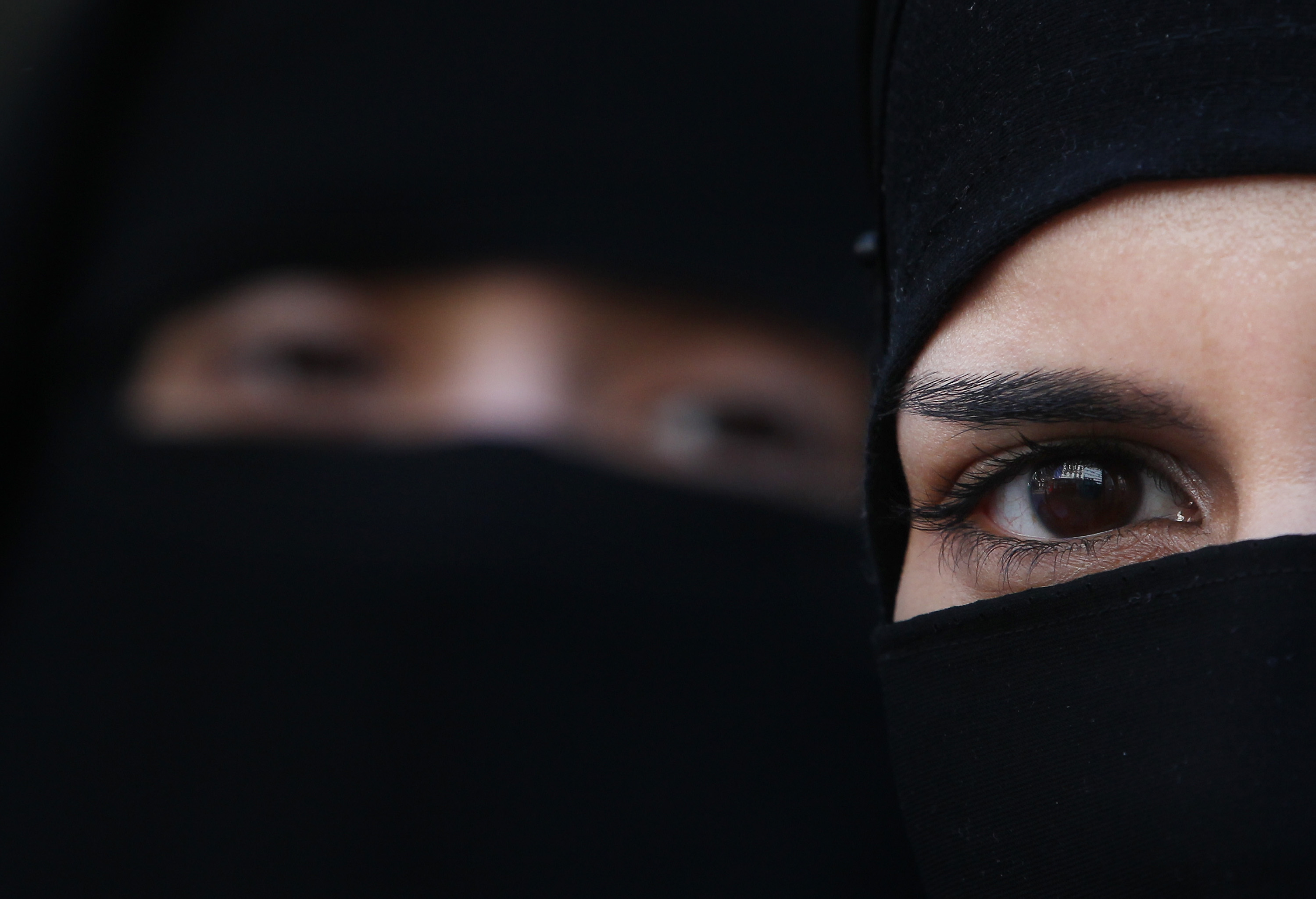
Demonstrators Protest Over The Introduction Of A Ban On Women Covering Their Faces In France

It might be worth asking various figures on the evangelical right if they are outraged by the decision today by the European Court of Human Rights to uphold the French ban on the public wearing of the full-face veil:

At the European Court of Human Rights in Strasbourg, France, judges said the ban was a legitimate attempt to preserve the norms of France’s diverse society and did not infringe on Europe’s Convention on Human Rights. The court was ruling on a case brought by an unidentified Frenchwoman who said the law, first passed in 2010 and implemented in 2011, was discriminatory and violated her freedom of conscience.

And here’s a rather strong case that the issue is one of genuine personal conscience and conviction:

In a statement summarizing the ruling on its website, the court said the woman “is a devout Muslim and in her submissions she said that she wore the burqa and niqab in accordance with her religious faith, culture and personal convictions … The applicant also emphasized that neither her husband nor any other member of her family put pressure on her to dress in this manner. She added that she wore the niqab in public and in private, but not systematically. She was thus content not to wear the niqab in certain circumstances but wished to be able to wear it when she chose to do so. Lastly, her aim was not to annoy others but to feel at inner peace with herself,” the statement said.

For the record, I oppose the ban as an infringement on religious freedom of expression – and always have. I can see how other factors could be cited in favor of the ban – notably that the full veil hurts the possibility of “open interpersonal relationships, which, by virtue of an established consensus, formed an indispensable element of community life within the society in question.” But there are broader issues involved in Hobby Lobby as well: the government’s interest in providing affordable health insurance for the population, the health of women, the reduction in abortions, etc. And the niqab question affects directly only around 2,000 women, compared with Hobby Lobby’s theoretical impact on over half of employees in America.

So let’s hear it from America’s religious right: are you consistent about religious liberty and will do all you can to protect Muslim freedom of religious expression – or admit, you’re only about asserting your own Christian identity and no one else’s.

Somehow, I suspect few of them will be put on the spot like that. But they should be, don’t you think?

The Dish has covered this issue before – read the full thread here. Update from a reader:

This book is the best one on the French ban. It allows one to understand culturally why this ban is so French.  I just wonder about all those French feminists who are trying to save their Muslim sisters from the “horror” of the veil realize that now they have just prevented these women from being able to leave their homes.

(Photo: Two women wearing Islamic niqab veils stand outside the French Embassy during a demonstration on April 11, 2011 in London, England. France has become the first country in Europe to ban the wearing of the veil. By Peter Macdiarmid/Getty Images)

Chipping Away At Public Sector Unions

The Court’s other major ruling yesterday was Harris v. Quinn, in which a slim majority ruled that public sector unions cannot collect “fair share” fees from non-union members – in this case, Illinois home-care workers who are paid by the state – even if these non-members benefit from collective bargaining by the union:

The much-awaited decision limits, but does not reverse, the court’s well-trodden ruling from 1977, known as Abood. In that case, the court found that requiring non-union-members to pay “fair share” fees did not violate workers’ First Amendment rights, so long as those fees do not go to advancing specifically “political or ideological” ends.

The decision, written by Justice Samuel Alito, marks a loss for public sector unions, which may see their coffers and power depleted in coming years, although it’s not the worst-case scenario that many labor activists feared. The ruling stopped short of finding all “fair share” dues unconstitutional. It also does not affect all full-time public employees, but only a category called “partial public employees,” which includes a growing sector of home heath care workers.

The Dish covered the case when it was argued in January. So the Harris ruling does not overturn Abood, but rather limits its reach. Noah Feldman, however, suspects four out of five of the court’s conservatives would have liked to axe it entirely:

Abood’s value was never its imperfect logic but rather its practical wisdom in solving the problem of employees’ free riding on union efforts. In the real world, a public union could hardly function if its members could opt out. The Abood doctrine put a thumb on the scale by enabling legislation to block free riding.

Today, with public unions under intense criticism and with pension reform the order of the day in many states and municipalities, the politics look different. In dissenting, the four liberals expressed “satisfaction” that Abood hadn’t been overruled. In effect, one of the conservatives, probably Kennedy or Roberts, wasn’t prepared to provide the deciding vote against labor unions — for now. But their legal future doesn’t look rosy.

Or as Kilgore puts it:

I’d say the Court is short just one Justice of a majority willing to generally ban on First Amendment grounds “fair share dues” for non-union members who benefit from collective bargaining agreements, which would be a huge blow to the labor movement. Remember that in November of 2016.

Bazelon also fears for the future of public sector unions:

Once again, the First Amendment is turning out to be a powerful ax the court’s conservatives can pick up and wield against all kinds of laws and groups they don’t like, as I wrote last week.

Kagan is right when she says that the outcome of Harris is “at least better than it might be.” Abood stands. But when she adds that “our precedent about precedent, fairly understood and applied, makes it impossible for this Court to reverse that decision,” I’m not sure she can make it so just by saying it. Once the conservatives have teachers or firefighters or police officers before them who say they don’t want to pay their union dues, won’t they use today’s opinion as the stepping stone for toppling Abood and mandatory dues? The rules for the Supreme Court won’t change, and they work like this: Five votes turns the impossible into the possible.

But Kevin Roose’s interpretation is much less dramatic:

Pro-labor progressives will likely see Harris v. Quinn as the top of a slippery slope. … But these fears are largely unfounded for now. Today, the Court decided that teachers, firefighters, and other traditional public employees will still be covered by the collective bargaining laws that have existed since the 1970s. Public employees with unusual, state-backed working arrangements, like the 20,000 personal care workers in Illinois, may not be. The Court’s narrow ruling is an annoyance for the labor movement, but hardly a cataclysm.

Andrew Grossman is pleased that Abood is on its last legs:

The Court is right that Abood is “something of an anomaly” because it sacrifices public workers’ First Amendment rights of speech and association to avoid their “free-riding” on the dues of workers who’ve chosen to join a union, the kind of thing that rarely if ever is sufficient to overcome First Amendment objections. But Abood treated that issue as already decided by prior cases, which the Harris Court recognizes it was not–a point discussed at length in Cato’s amicus briefAbood was a serious mistake, the Harris Court concludes, because public-sector union speech on “core issues such as wages, pensions, and benefits are important political issues” and cannot be distinguished from other political speech, which is due the First Amendment’s strongest protection. A ruling along those lines would spell the end of compulsory support of public-sector unions, a major source of funds and their clout.

But Moshe Marvit accuses the court of making things up:

In Harris, the majority implied that it was not the objecting employees that were the true free-riders, but rather the union. The decision focused on the fact that hourly rates were set by Illinois law and there were significant statutory restrictions over what the union could bargain over. It highlighted the fact that the union received dues for its representation, but questioned what negotiations or grievance representation the union could deliver to employees.

In effect, this analysis places unions in a bind: any reasonable observer would conclude that the union negotiated with the state to set the terms of compensation, benefits, and other terms of employment, which are then codified into law. However, because the Supreme Court has demarcated this activity to the realm of lobbying, which is beyond the strict scope of representation, it concluded that the union is in effect collecting dues for doing little. The majority has drawn an untenable distinction and then complains that the distinction is not tenable.

And Harold Pollack dissents from the perspective of home-care consumers:

Individuals with disabilities and their families have a big stake in this, too. Theywe–require a stable and motivated group of direct care workers to perform important and difficult work. The alternative is to receive services from a disgruntled, low-wage high-turnover group of workers who are unlikely to provide competent and humane care. We consumers know first-hand why these issues are important. We know our great human debt to the men and women we trust so intimately to support people we love. …

Now that this partnership has been overturned by the Supreme Court, our state, direct care workers, and individuals with disabilities face a difficult choice. Direct caregivers can simply be hired and supervised as traditional public employees. This would deprive individuals with disabilities of the ability to select, supervise, and hire their own caregivers.  We can also shift a cumbersome management burden onto people with disabilities and their families, while depriving direct care workers of the collective bargaining mechanisms they seek. Neither option seems particularly fair or practical for anyone involved.

Pride At Home And Prejudice Abroad

Reflecting on Pride Day, Reverend Gene Robinson, the recently retired IX Episcopal Bishop of New Hampshire, insists that America has a duty to help provide safe haven for oppressed gays abroad:

The LGBT people I know are horrified at what is happening to their brothers and sisters around the world, most recently in Uganda, Nigeria, the Middle East, and Russia. We are often gripped by a sense of helplessness. After all, what can I do about such oppressive policies and actions overseas? While we may not be able to stop the repressive actions of anti-LGBT regimes, we can mobilize to care for those oppressed and threatened LGBT people who make it to the United States.

Immigration Equality, a terrific group on whose board I am proud to sit, is doing just that. It has, in fact, been a fascinating few years for that organization. For two decades, we had done our best to help bi-national couples persecuted by Bill Clinton’s Defense of Marriage Act, and HIV-positive individuals targeted by Bill Clinton’s HIV Travel Ban. But in 2008, the Bush administration finally reversed the law targeting foreigners with HIV (it functionally ended under Obama) and last year, the Windsor decision destroyed DOMA, which prevented the federal government from recognizing bi-national gay marriages.

Suddenly, we were exhilaratingly adrift. Some of us thought briefly of closing the whole thing down … until something new began to happen. Immigration Equality had always provided free legal services to those seeking asylum because of homosexuality (with a 99 percent success rate). The Obama administration gave gay refugees a much more solid standing (thanks, Hillary) … and, in the wake of the wave of anti-gay initiatives across the globe, suddenly the asylum cases took off. The numbers have quadrupled in the last few years, as governments as vicious as Jamaica’s and Russia’s and Uganda’s and Nigeria’s began to target gay people for lynching, imprisonment or indescribable harrassment. These are the best of times for gay people on the planet, and the worst times as well.

In one corner of the world, Bel Trew looks at lesbian, gay, and trans Egyptians living under Sisi:

Since the military overthrew Morsi last July, rights groups have recorded the worst state crackdown on the LGBT community since the days of Hosni Mubarak.

Back in 2001, 52 gay men were arrested on a party boat on the Nile and tried for “public depravity”. Twenty-three were sentenced to hard labour in prison. In 2004, a 17-year-old student was handed a 17-year jail sentence for posting his profile on a gay dating site.

In the last 10 months, dozens have been arrested and at least 18 homosexual and transgender people have been jailed under the country’s draconian legislation criminalizing “sexual deviance,” “debauchery” and “insulting public morals.” The prison sentences have ranged from 3 to 12 years. “We are not even sure if we have documented all the cases,” said Dalia Abdel-Hamid, from Egyptian Initiative for Personal Rights (EIPR). “We know the actual number is higher.”

Josh Scheinert glances elsewhere around the globe:

When the Indian Supreme Court recriminalized consensual sex between two adult men in December 2013 (it was de-criminalized by the Delhi High Court in 2009), it contrasted gay men with straight men with the wording “as compared to normal human beings.” … In Jamaica, the LGBTQ population is denigrated and dehumanized in popular media in ways that would shock the most impartial of observers. Last year, a transgendered teenager was murdered by a mob. In Cameroon, men are imprisoned for sending text messages to one another that say, “I love you.” Last year, a leading gay rights activist was found tortured and killed in his home.

And in Uganda, which often attracts much of the attention when it comes to global LGBTQ rights, the government just declared 38 human rights organizations illegal on the grounds that they “promote homosexuality.” This is the latest development in a country where leading LGBTQ activists are outed in the media, and where one of those outed was found murdered in his home in 2011.

John Oliver devoted a sizable chunk of his latest show to Uganda’s anti-gay pogrom and American Christianist Scott Lively‘s role in it: