Annie Lowrey leafs through a new Brookings study on :
Robert A. Litan of the Brookings Institution and Ian Hathaway of Ennsyte Economics provide some scary data points in two research papers they have released in the last few months.
- The share of all companies comprised by start-ups under a year old fell by half between 1978 and 2011
- The proportion of private-sector workers employed at older firms has increased from 60 percent to 72 percent since 1992
- The proportion of workers employed at young firms has declined over the same period
- Companies under a year old are failing more often, with the “failure rate” for start-ups climbing to 27 percent from 16 percent in the early 1990s
- The “failure rate” has increased for all but the longest-established businesses
Even the vaunted high-tech sector is seeing the same trends: The share of tech companies that are 16 years old or older has risen from roughly 15 percent to 25 percent since 1992, while the proportion of the industry that works in such firms has increased, too.
Yglesias wonders if demographics are to blame:
One possibility is that the link to population aging is quite literal. A study by Vivek Wadhwa, Raj Aggarwal, Krisztina Holly, and Alex Salkever that looked specifically at “high-growth” industries found that the typical successful founder is 40. Not someone who’s at the tail-end of his career, but not someone who’s fresh out of school either. That’s in part because “professional networks were important to the success of their current business for 73 percent of the entrepreneur,” and it takes time to achieve that success. Mark Zuckerberg founded a great company when he was in college, but that kind of super-young founder is the exception not the rule — most people need some practical experience and contacts to succeed.
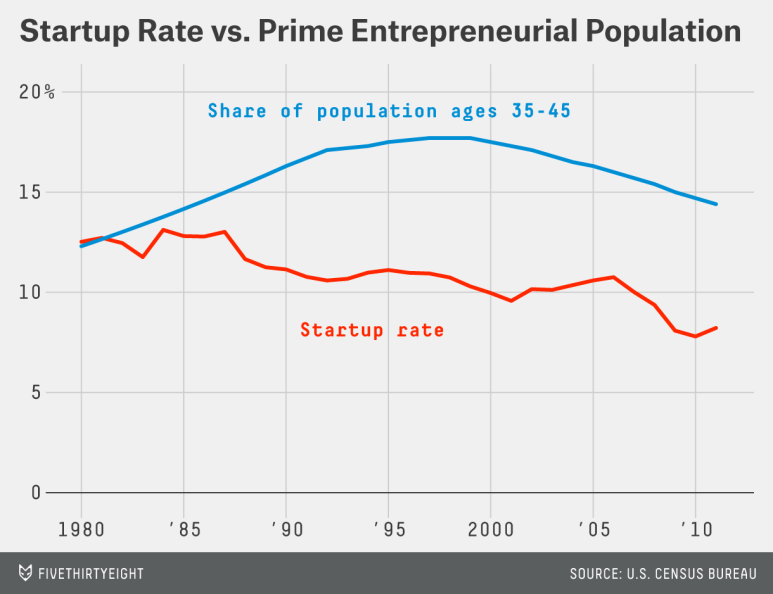
And back in the early 1990s, there were a lot of people in their late-thirties and early forties: Nowadays that cohort of people’s prime founding years are behind them. There is another large cohort of people coming up, but right now they’re too young to be peak entrepreneurs.
Casselman, who provides the above chart, thinks it’s clear the decline in the start-up rate “began long before the boomers began to age out of their prime entrepreneurial years”:
There is other evidence that America’s aging population can’t explain its aging businesses. Self-employment rates, for example, have declined for all age groups (other than teenagers) over the past 20 years. And as Hathaway and Litan showed in an earlier paper, the decline in entrepreneurship is remarkably constant across regions and industries, hitting youth-heavy tech hubs and graying industrial cities alike. Demographics may be contributing to the problem, but they aren’t the primary cause.
 The Dish