by Dish Staff
Bryan Appleyard isn’t convinced by Arthur I. Miller’s Colliding Worlds: How Cutting-Edge Science Is Redefining Contemporary Art, a book based on dozens of interviews with “science-influenced artists and musicians” that heralds “the onset of a new ‘third culture’ in which art and science will, somehow, embrace.” Why he’s skeptical of what Miller calls “art-sci”:
Perhaps the problem is that the very idea of some kind of art-science union is incoherent. Art and science are not separated by misunderstandings or ignorance, they are separated by definition. Art engages with the complexity of human experience, more precisely with that it feels like to be human; science explores the material world in a manner that necessarily ignores all such considerations. In the book the problem with this discontinuity is repeatedly made apparent by scientists who know perfectly well that art cannot impinge in any way on what they do, however enthusiastic certain artists may be. A deal between the two – Miller’s Third Culture – is, therefore, likely to be more of an annexation than a partnership.
The one exception to this might be said to be neuroscience.
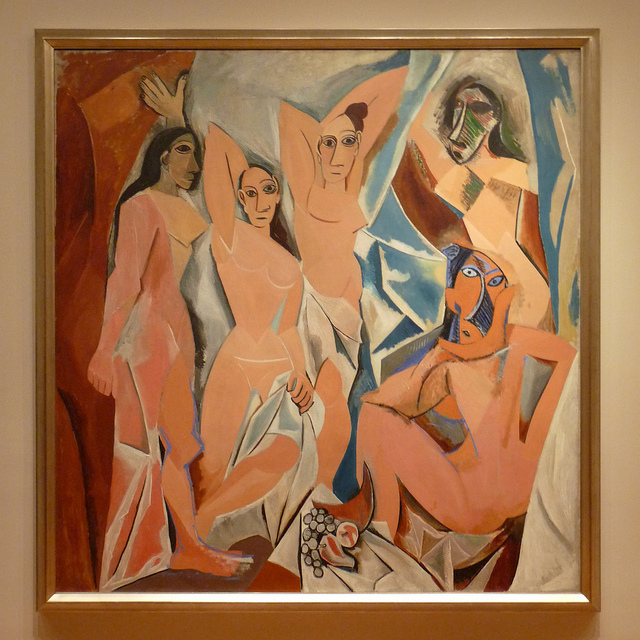
This now claims to have access to the physical substrate of our minds, feelings, impulses and so on. And, indeed, Miller does mention Semir Zeki, the genial and entertaining UCL professor who observes the reaction of our brains to works of art. Thanks to Zeki and others, neuroaesthetics is a distinct discipline. But what does any of that mean – that Titian would have been a better painter if he had been stuck in an MRI machine? Or, in biology, there are those fatuous evolutionary explanations of art as some kind of adaptive mechanism. Maybe but so what? You’re not going to get very far with Les Demoiselles d’Avignon if you persist in seeing it as nothing more than an attempt to propagate Picasso’s genes. The point about art is that it is precisely about those things that science cannot address, those things that make us more than the sum of our (no doubt) adaptive parts.
(Photo of Picasso’s Les Demoiselles d’Avignon, 1907, via Flickr user gωen)
 The Dish