by Dish Staff
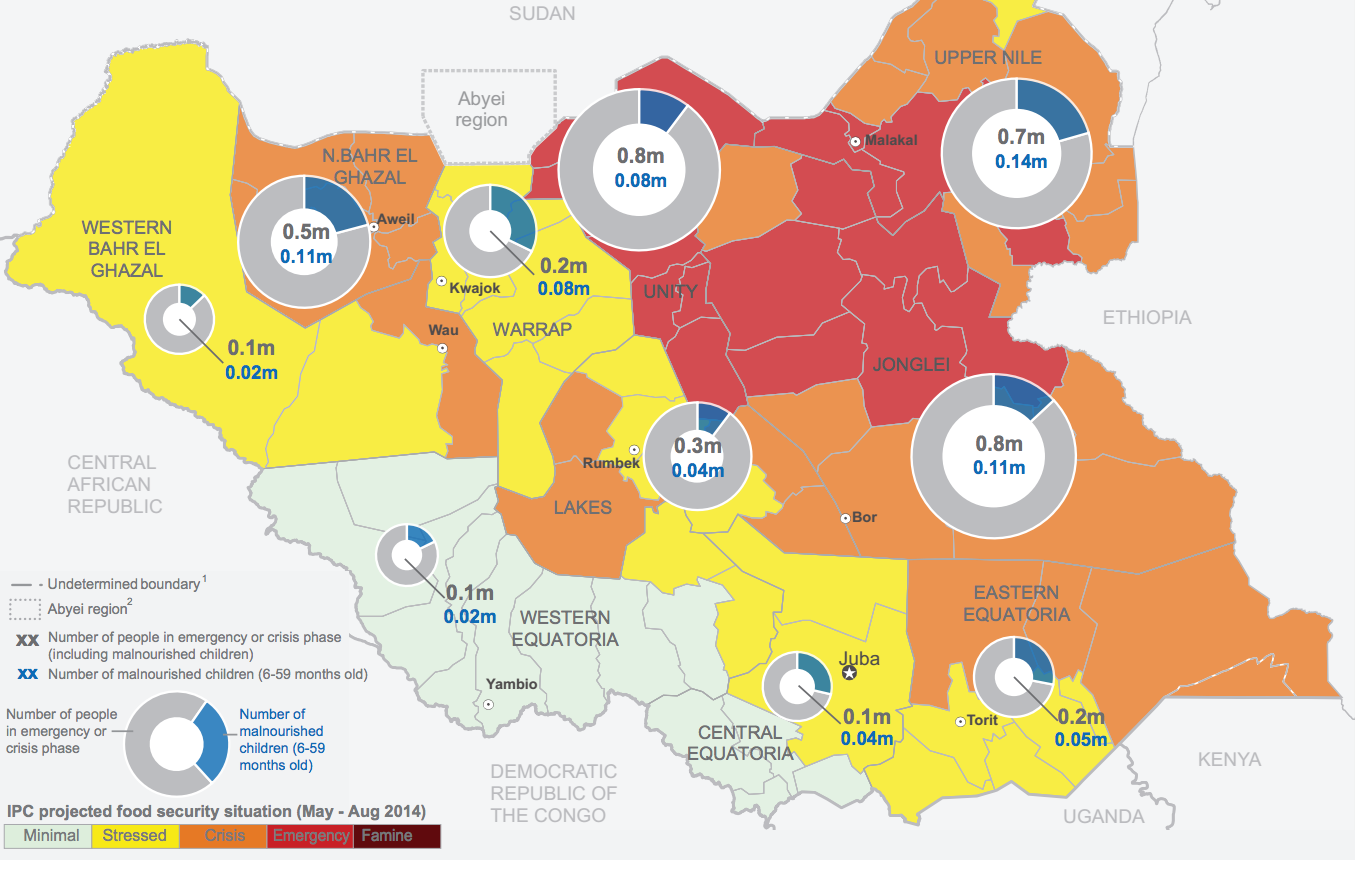
Ty McCormick warns of an impending famine in South Sudan, where over 1 million people are already in dire need of food aid:
The origins of the food-security crisis are layered. War disrupted the planting season, not just where there was active fighting, but across the northern half of the country as farmers fled their fields in anticipation of violence. But systematic underinvestment by the South Sudanese government, which has battled numerous corruption scandals since it became independent in 2011, is also part of the equation: Roughly 90 percent of South Sudanese territory is suitable for agriculture, but only about four percent of it was being cultivated, even before the current crisis. This combination of greed, violence, and lack of capacity has proven deadly. …
Experts have yet to formally declare a famine — a step that requires rigorous analysis of food supply, malnutrition, and mortality rates and can take months to complete — but the United Nations has classified South Sudan a “level-3 emergency,” a designation it shares with only three other countries: Syria, Iraq, and the Central African Republic. But aid agencies, like UNICEF, caution against relying too heavily on formal declarations or quantitative analysis. Waiting for a famine declaration before taking action, they warn, could be catastrophic. “By the time the famine was declared in Somalia in 2011,” said Veitch, “Half of the people that would die in the famine were already dead.”
Unfortunately, Rick Noack indicates, the fact that we can see it coming doesn’t necessarily mean that donor countries will step up to prevent it:
The author of [a Chatham House report on early warnings and responses to famine], Rob Bailey, told The Post that “decision-makers perceive significant downside risks from funding early action,” such as the possibility of money being diverted to hostile groups. Hence, foreign governments often wait until the last moment to provide funding – making it likely to come too late. In the early phases of a crisis, the pressure on decision-makers is low because public awareness is similarly low. Conversely, risks are high: Who wants to spend taxpayer’s money on a foreign, predicted crisis of uncertain scale?
Noack also reports that the US Government is the leading donor of aid to South Sudan, having sent another $180 million last week (out of a total $636 million this year.) But will any other countries follow suit?
(Chart: A UN map showing “South Sudan’s counties by level of food insecurity, and also indicates the number of malnourished children.”)
 The Dish